NOVA Power is Expanding Operations in Türkiye by Introducing Local Content with Maintenance and Core Production Capabilities
Defence Turkey: We had an exclusive interview with you during the IDEF '19 Fair, so can we start by summarizing what your achievements during the last 2 - 2 ½ years in Türkiye?
Süleyman BAYRAMOĞLU: Let me first state that during this two-year period we performed rather well, not only in sales performance but also in our other processes like manufacturing, testing, shipping etc. We did experience common pandemic-related and global supply chain issues but minimized the effect on our customer base.
Defence Turkey: Can you share some figures with us, for example, was there any decline in your sales?
Steve ZIFF: Within Türkiye, we did not experience any decline in sales.
Süleyman BAYRAMOĞLU: So, apart from general business performance during this two-year period, we achieved progress with several activities that we initially envisioned when we first started to operate in Türkiye, roughly ten years ago.
The first one is initiating an in-country technical support and maintenance service. About two years ago, we activated our local support and maintenance capability by launching the NOVA Technical Support Center in Ankara. With this capability we are able to provide our customers rapid responses and timely maintenance service, including on-site, or on-board support. I should also say it is rather significant for us because NOVA Technical Support Center in Türkiye constitutes our first international support center. Through our support center in Ankara, we provide service not only to our customers and partners in Türkiye, but also to those in the EMEA region.
During this two-year period, we also had a chance to realize another NOVA vision, local design efforts and production capability. It is rather in its early phase, but it is very critical in our business perspective in Türkiye. Perhaps I can give some brief information on that as well if time allows.
Steve ZIFF: We must also mention that, although not specific solely to Türkiye, we also introduced several new technologies in our product portfolio during this period.
Defence Turkey: One of the main criticisms of the COVID era was that since many people had to leave their jobs and conduct business working from home, as a kind of home office, did you experienced any delay in the delivery schedule, in the return time? You said that you are providing onsite support, but you know your products also have some electronic equipment, so if there are any problems with such equipment, they should be sent back to the United States and be repaired at the factory.
Süleyman BAYRAMOĞLU:I can definitely say that we did not suffer any substantial delays in production and delivery during the “hot” phases of the COVID period. We tolerated and adapted ourselves to new business practices quite well and managed to meet our deadlines both in manufacturing and delivery. However, I should admit that we have started to feel the adverse effects of the global supply chain issues to some extent for the last 6 months. Because of this, we have been experiencing some delays in delivery, although not very long ones. The delays are consistent with global trends.
When it comes to technical support and repair, I think this is one of our strengths. Failure rates of our solutions are very low, compared to commercial power products and other defense equipment, not requiring frequent support and maintenance.
And after we activated our local support center, we have not shipped units back to our manufacturing facility in the United States for service. All of this is now done locally in our workshop or when required, on-site or on-board the ship in a shorter amount of time and efficiently. This of course decreases the equipment downtime substantially.
Defence Turkey: It's a great achievement. So, can you elaborate about your Ankara Support Unit? How many personnel do you have there?
Süleyman BAYRAMOĞLU: This is a core capability with a limited number of engineers and technicians. As I said earlier, our products typically do not need too much maintenance after initial installation and deployment. But maintenance is just one of the technical support activities. Technical support also includes training, configuring and optimizing our products to the shipboard environment, etc. Even during the pandemic period, we mostly managed to provide this service to our customers, as pandemic limitations allowed.
Defence Turkey: Are you also providing support onboard the ships, or just onsite/in your support unit?
Süleyman BAYRAMOĞLU: Yes, in Türkiye, we provide customer/system integrator on-site, end user on-site or on-board the ship technical service. Major repair tasks are done at our technical support facility.
Steve ZIFF: We are extremely pleased to see the successful performance of the NOVA Power Technical Support Center in Türkiye, and we are getting very positive feedback from our customers. And if you look back at the interview from 2 or 3 years ago, and I recall when we were asked questions about how local content was so critical, and our plan for local production and service, the answer we always gave was the same one. We said yes, we targeted both the local technical service and production, from the minute we started doing business in Türkiye, but once we get enough volume and have enough customers and it makes sense, we'll do it. We also mentioned that a support or service center was likely to be the first step. We have used a slow and measured approach to ensure that the business unit in Türkiye is viable and sustainable. We will continue to grow the business unit in a methodical manner.
Defence Turkey: So, you have already achieved the first step…
Steve ZIFF: We achieved the first step. It's been almost two years, so probably right before the start of the pandemic, and you know, we've already been thinking about the next step. The next step is to be able to provide some of the products manufactured here, and we're now focusing on our battery modules.
I should also say, we see Türkiye as an important emerging venue for our state-of-the-art products and solutions and I am confident that our next phase of growth in Türkiye will be through providing these sorts of value-added solutions and services.
Defence Turkey: Do you plan to do this also at the Ankara Support Unit or will you establish a new facility?
Steve ZIFF: For the battery module production, mostly in the same facility with some expansion in infrastructure and space, and staff as well. We're working on getting local or regional suppliers of a lot of the components, and then we can really turn them around much quicker, and we think potentially low cost for our customers as well. For instance, we are outsourcing several of our component manufacturing to some competent firms in the industrial zones like OSTIM.
Defence Turkey: Within the scope of this local manufacturing process do you have a plan to also utilize local companies, for example you have a brochure for ASPİLSAN for lithium batteries …you said that your products have batteries… Do you have any plans to utilize existing capabilities in your products for Turkish end users?
Steve ZIFF: Yes, we have been already, and we would very much like to do so, whether it's metal fabricators or connectors, different components. Of course, we would want to try and get as much of that locally as possible. The whole purpose is to try and be able to do it in-country and to do it faster and make the products more cost effective.
Süleyman BAYRAMOĞLU: As Steve pointed out, we have been trying to find more local sources for components, and all related services associated with manufacturing like metal work, electrical work, coating, testing etc. In summary, we are trying to localize that entire production process using the locally available components and sources.
Steve ZIFF: So far, it has become very clear that Türkiye’s expanding technologies, coupled with our competence and experience in power solutions make our association in Türkiye a natural fit for NOVA. We believe that Turkish companies have the ability to integrate foreign-sourced technology into their indigenously developed solutions and systems.
Defence Turkey: Can you share any time schedule for your second step? When do you plan to start?
Steve ZIFF: We've already started.
Defence Turkey: Can you share any date information?
Süleyman BAYRAMOĞLU: We are targeting to have our first set of modules on hand during the second quarter of next year, 4 months, fully tested and verified.
Defence Turkey: So, for your local manufacturing effort, the primary target is Turkish end users… but do you also have a plan to sell to 3rd countries from Türkiye?
Steve ZIFF: The primary market, is of course, Türkiye, but we have other customers, regionally and globally, who will benefit from this as well. So, for example, we have several customers in Eastern Europe that are customers because they were foreign military sales from some U.S. integrators. Say, Company A in the U.S. sells to a North European country. That country has company A’s products with ours embedded in them. Then, it becomes the local country's responsibility to maintain it. So, when they reach a point where they need more batteries or they have repairs, or they have questions, we will direct them to the NOVA service center in Türkiye. And, yes, it will be faster, we can grow, we can hire more people, we can do it more efficiently, and it can help sustain the cost model. We can provide cost effective and most importantly, faster-localized turnaround.
Süleyman BAYRAMOĞLU: This is also valid for the support and maintenance piece, not only for the production.
Steve ZIFF: Right, we envision that this can be everything. Right now, it is the only facility we have now outside of the U.S.
Defence Turkey: So, the Ankara Support Unit is the only manufacturing facility outside of the U.S.? Since you have a range of products, did you select some products to be manufactured in Türkiye or do you plan to manufacture your entire range in Türkiye?
Steve ZIFF: Full design and production is a long-way out. Because for a battery module, there are a lot of components, but there's only a handful of different models. So, the training and understanding of how to build and support are much simpler compared to our core UPS products, where we have thousands of components. The capital expenses are high and processes more complex, including testing and validation. Around ten times as comprehensive in terms of the capability you need to be able to test them in terms of how to ensure they meet all the standards and all that. However, there's no reason to say we couldn't do it, or wouldn't do it. Again, it is a matter of cost effectivity and reliability. And, probably ten years ago, when we first started here, I wouldn't have suspected that we would be building battery modules in Türkiye and delivering them here as well.
So, if we look back, we expanded from nothing, we expanded from pure sales and business development efforts to local service and local content. Two years ago, we started with local service and support, and now it turns into some, I would say a subset, of our core products, is to be manufactured here. This is our measured, sustainable approach to building business.
Defence Turkey: You said that your Ankara Support Unit has core capability. So, prior to starting the manufacture of these products in Türkiye will you have to increase number of your personnel and make further investments?
Steve ZIFF: Yes, that's true.
Süleyman BAYRAMOĞLU: Currently we have a core capability with a couple of qualified and trained personnel, but this number will increase in time. As I noted in the beginning, although we say local, it's local to Türkiye, however we will be supporting our customers also in Europe and the surrounding region. So, in that perspective, this is our regional support entity. Similarly, the manufacturing piece is also intended not only for our customers in Türkiye but this part of the world.
But I don’t want to be misunderstood here. Although the intent here is to include local content from service to manufacturing capability in our offerings, in simple terms, selling “boxes” was not actually what we intended. Our primary objective, as we positioned NOVA in Türkiye back in 2013, is collaborating with defense system integrators and equipment manufacturers in their indigenous development projects, to provide the best of the breed, the utmost reliable power layer for their system.
So far, in the last ten years, we have provided the power layer for only locally developed indigenous systems. We didn't sell any boxes. We always took part or provided the power supply portion of locally produced systems or equipment. In that sense, we are not only unit providers, but we are taking part in some roles of local indigenous development efforts.
Our ultimate objective in collaborating with Turkish Defense Companies is to contribute to their goals of developing high quality and reliable defense systems to be marketed worldwide.
Defence Turkey: And your major customer is the Turkish Navy?
Süleyman BAYRAMOĞLU: Not directly, but our largest install base in Türkiye as the end user, is the Turkish Navy. In fact, systems or equipment having our units as sub systems are also employed by other services, of course. We mostly work directly with the system integrators and defense equipment manufacturers. So yes, in that sense, our most extensive install base is the Navy.
I can also relate that there is no ship doesn't have any NOVA products. So, each ship has at least one NOVA product embedded within their systems that are locally developed and produced.
Defence Turkey: So, it would be better if you joined the team of new ship design at the beginning phase. For example, in days or months, the TF-2000 Program will be launched by ASFAT, the Turkish MoND has authorized ASFAT for the TF-2000. Have you had any discussions in the design phase for your products?
Süleyman BAYRAMOĞLU: Our units and solutions become part of specific equipment onboard the ship. It could be new platforms like the TF-2000, LHD, or MILGEM derivatives, or existing platforms like G-Class FFGs, Preveze or AY Class subs. Simply, we collaborate and cooperate with the companies or integrators that develop or provide these kinds of systems for those platforms. I should also say our solutions are not platform specific, although we optimize or customize our solution for the platform or application it will be used in. To answer your question more directly, yes, we usually started to work with our customers during the early stages of the system/project development activities.
Defence Turkey: Since each ship has different power requirements do your products need to be customized? Would it be better to join the design process with the Power System manufacturers and, also the designers. In this way you could make a proper design at the beginning phase that means, for example, in the CDR Phase and then you would not have as many revisions to your design.
Steve ZIFF: Yes, 100% correct. On the other hand, as Süleyman pointed out we develop or provide the power layer of a specific system that will be deployed on board a ship, not the ship power system. We use the existing power and condition it, or in simple words, clean it and provide a clean and reliable power for that mission critical system to operate reliably.
For the sake of clarity, say, a satellite communications system will be developed by a system integrator or developer. In this case our customer will be that system developer and we would start to work together as early as the (Sub)System Requirements Review (SRR) phase. When they reach to Critical Design Review (CDR) phase, we also freeze our design modifications or customizations to optimally meet the power requirements set during SRR. And this collaboration continues until the completion of system acceptance or sea acceptance activities.
Defence Turkey: So, you wait for the selection of the subcontractors…so you can communicate with them…
Süleyman BAYRAMOĞLU: Basically, what we provide is the power supply modules for those systems, that could be defined as subsystems. We are not providing a system as a whole. Yes, you are right; we start to work with the system integrator or equipment manufacturer right at the beginning of the project life cycle. And we follow the same processes SRR, PDR, CDR, FAT, SIT, HAT SAT etc. We provide all the documentation needed, so we become an integrated part of the project team for the power subsystem.
Steve ZIFF: The objective here is providing the most reliable, robust and failsafe power subsystem for that, say communication system, which is a critical system on board a Navy ship or other ship. Certainly, we like to have relationships with all the layers, because if the Navy or the SSB is familiar with what expertise we have, for what other platforms, systems, and subsystems, we as NOVA have developed power subsystems, and it will be easier for them to specify the power requirements right in the beginning. So, it's much better for us from an awareness perspective so that they understand they're getting the most reliable components within their systems and subsystems.
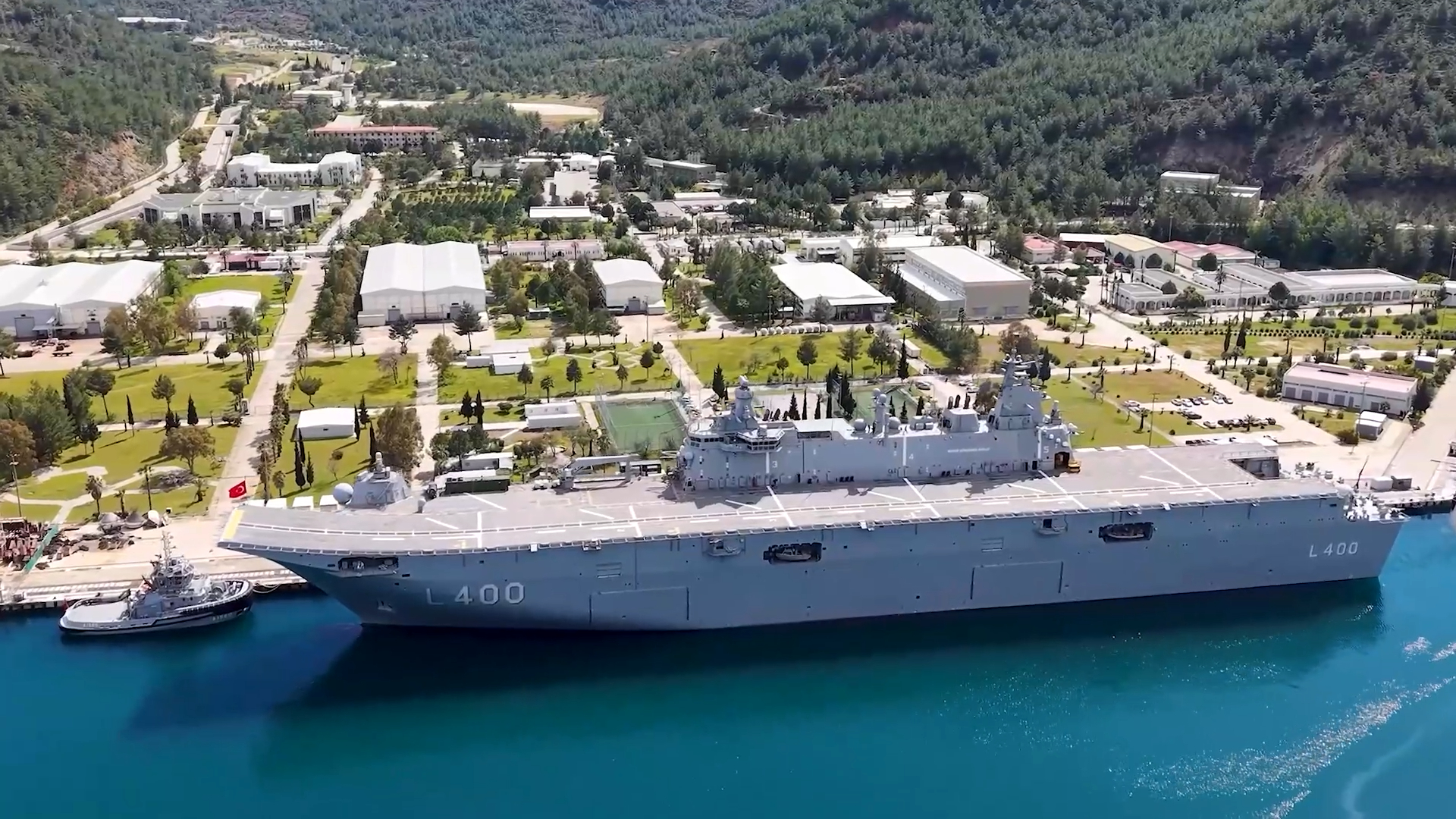
Defence Turkey: Are your products in use now on the TCG Anadolu LHD?
Steve ZIFF: Yes, we know that several systems locally and indigenously developed by Turkish Defense companies to be deployed on board ANADOLU currently use NOVA power subsystems.
Süleyman BAYRAMOĞLU: We can proudly say that, almost every class of ship, including fast patrol boats, has at least one NOVA power subsystem integrated with an indigenously developed system installed on board that ship.
Defence Turkey: Are you also delivering products for aircraft? Such as the MMU/TF-X, HURJET, or helicopter programs such as the T625 GÖKBEY?
Süleyman BAYRAMOĞLU: Currently we don’t yet have any product in our portfolio with airworthiness certification. For the moment, we are providing solutions for ground and maritime systems, including UAV ground control systems. For example, some UAV ground control systems exported by Turkish defense companies, employ power subsystems that were custom developed by NOVA.
Defence Turkey: Have you introduced any new systems so far in 2022 or do have any plans to introduce new products into the market? Are you working on any new technologies?
Steve ZIFF: Yes, we have been constantly trying hard to make our products and solutions completely fail proof, and with utmost reliability. That’s why we always say; power failure is not an option. In that sense, we do a lot of R&D efforts to exploit new technologies in the design of product architectures to increase the grade of reliability.
Süleyman BAYRAMOĞLU: This can be also a third part of the answer to your first question in the beginning of interview on what we have done during last 2 years, apart from the new support entity and local development efforts in Türkiye.
One technology we introduced during this period that is worth mentioning here is what we call Adaptive Power Factor Correction. This is a completely new paradigm in power systems and in simple terms, it increases the power quality and reliability one more level. It also improves efficiency, stability and consistency in the provisioning of electrical power, specifically for mission critical shipboard equipment where there are maybe tens of systems and hundreds of equipment running and operating concurrently. We also foresee that our products having this technology will contribute to longer on-station times and a decreasing degradation of electronic equipment. This also means a reduced maintenance cycle time and cost. This will ultimately lead to decreased unexpected equipment failure, increased operational availability of mission critical systems and overall safety.
Defence Turkey: Not only delays, but the Covid era also has had a negative effect on raw material procurement prices – have you experienced such sharp price increases? You said, "we did not transfer it to the customer", so how did you manage the price increases?
Süleyman BAYRAMOĞLU: We experienced price increases in parts and components. But we had one advantage, a very good inventory. So, we managed to mitigate it to some extent, at least so far.
Steve ZIFF: Two things. First, we did not increase prices for our customers. We probably could have, and it could have been justified because, in most cases, many of those components have increased in price. Now, the nice thing is, as Süleyman said, you know, we always keep a good amount of inventory on hand. Prices of some minor electronic components manufactured in far east doubled or even quadrupled. However, we didn't necessarily feel we needed to push that off to our customers.
But we've felt some effects and had to find other suppliers. There's a lot of price gouging going out there where people are selling things that should be selling for a dollar, they are selling for 50 dollars because there's no supply… and there are companies that have launched to do that, to take advantage of this market. They are buying up parts everywhere, and then they are holding the market hostage, and our approach has been, sorry, we're not paying that. We'll figure out another way. We'll redesign. We've had to do some redesign of some of our smaller subsystems because some parts either are not accessible or the price is unjust… or the lead time… right, something might have taken eight weeks, now it is taking 60 weeks, but those are real examples, and you have to figure out ways around it.
In summary, one of the biggest challenges we've had to deal with is the unpredictability of the supply chain. Longer lead times, much longer lead times we are expecting. So, it becomes very challenging, but that's what we must do; we must balance that.
Süleyman BAYRAMOĞLU: The truth is not only lead times for the components we procure, but our production lead times also increased. Before Covid, our general lead time for a particular product would be 6 to 10 weeks. Now optimistically, we expect to we have to increase by 60%. So instead of 10 weeks, we have to say 15 weeks, and often times more depending on the product.
Defence Turkey: One of the problems during the last 2 years between Türkiye and the U.S. is, as you know, CAATSA regulations, also the U.S. Congress has openly or secretly imposed embargoes, sanctions – did you experience any such problems with your product sales to Türkiye?
Steve ZIFF: We stayed very active in many of those discussions to ensure we understood if there was going to be an impact, we had no significant effect.
Defence Turkey: No impact whatsoever?
Süleyman BAYRAMOĞLU:I would say we have an advantage here. Our products are commercial products, and we have only minor export limitations and no end user license requirements.
Defence Turkey: Did you need any permission from U.S. Government to make investments in Türkiye?
Steve ZIFF: No. None at all.
Süleyman BAYRAMOĞLU: We are flexible in that too. This is how we position ourselves to do business in Türkiye and support local indigenous development efforts by teaming with the Turkish defense industry to provide the most reliable power subsystems. This was the first objective of our initial positioning when we started to operate in Türkiye.
And then we came to a point that we are not only providing components for local development but also providing local support and maintenance service to our customers here and to our customers in the region from Türkiye.
Defence Turkey: So, next year there will be an IDEF Exhibition. You said that you already completed your 1st step and now have started the 2nd step. What will be your 3rd step in Türkiye? Have you decided this, have you arranged any time schedule for the 3rd step?
Süleyman BAYRAMOĞLU: As I stated earlier, we initiated core local manufacturing capability as the third step. But this is just beginning of our manufacturing efforts. And another step in our plan, to work with Turkish companies in the design of some of new product families. We have started to work on this. We have already signed a framework agreement with a Turkish Company for design and prototyping. I can’t elaborate more now, but once we reach a solid phase, we will have more to say about this.
Defence Turkey: By the end of 2023? Or 24?
Steve ZIFF: I believe that next year is a massive measurement year. We will be, hopefully, post-pandemic, at least in terms of business climate, and will have allowed our local support to have another role.
Right, at first, it was just support and some service, and now we are adding a lot more. Let's ensure we can deliver on that before we start thinking about our next step.
Süleyman BAYRAMOĞLU: In connection with that…We have initiated some other efforts to utilize Turkish manufacturers for the products that are not in our product portfolio. We are getting some inquiries from our customers in the U.S. or Europe, and we are trying to offer their solutions to those customers. So, it's not only products and solutions we are delivering in Türkiye, but also, we would like to offer some products manufactured by Turkish companies to our customers in the U.S.
So, this can be considered part of our expansion activities in Türkiye: service, core manufacturing, design, validation and software development efforts by utilizing local resources.
Defence Turkey: Can you elaborate on NOVA Power Solutions' participation at SEDEC and other trade events/shows in 2022?
Steve ZIFF: I'm glad to be back in Türkiye. It's my first time here since the pandemic. It's nice to be back. It's nice to sit with and talk with people again.
Süleyman BAYRAMOĞLU: We have started to participate in several trade events and shows. For instance, in the defense sector, the Land Systems Seminar will take place in November, which we also support as one of the sponsors. Apart from of the defense domain, we also have a business line in other industries, like the transportation industry, maritime industry etc., and we also participate relevant trade shows in those domains in Türkiye.
Defence Turkey: Do you have any activities in the TOGG Project?
Süleyman BAYRAMOĞLU: No, not with the TOGG project. But especially in the transportation domain, rail or land transportation signalization systems are both mission-critical and life-critical. So, we have products for continuously powering those systems wherever they are used, also to ensure safety and reliability.
Defence Turkey: Thank you for sharing your time for our readers