Underway Replenishment Capabilities of World Navies

“An army marches on its stomach”, a quote attributed to Napoleon Bonaparte. The logistic support of a fighting force is vital to its ability to conduct warfighting. This was true then and it is true today.
The navies operating on high seas and miles and miles away from their home ports, their logistic support centers are especially in need of reliable and efficiently organized logistic support systems.
During the age of transporting food and water on board sailing ships the main consumables determined how long a ship could stay on high seas. However, with the introduction of steam engines ships had to carry the fuel for the engines on board and if the fuel was to be depleted before reaching the destination it would mean disaster.
The need for offshore bases and colonies was a necessity for imperial navies after the introduction of coal burning engines on their warships. At the height of its imperial might the British Empire was in control of many of islands that served as coal replenishment stations on all oceans.
The introduction of petrol burning internal combustion engines on ships profoundly changed the way navies supplied their warships. First, as petrol was much denser compared to coal, more fuel could be carried on board. Second, petrol was much easier and faster to transfer from one ship to another.
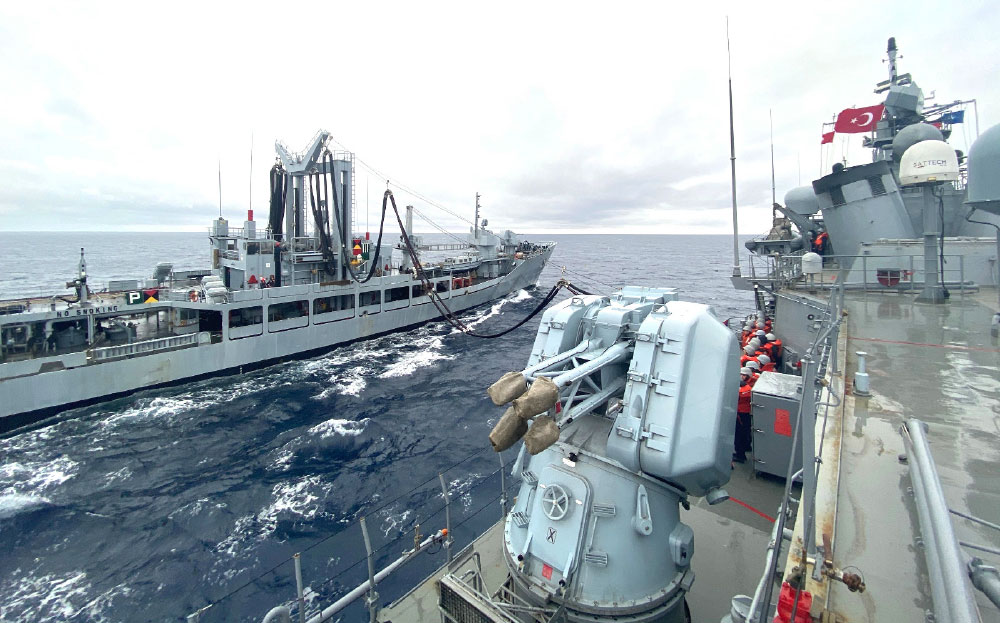
Between the two World Wars the US Navy and The Royal Navy experimented with different solutions for transferring fuel ships while underway. It was the US Navy what was able to perfect their underway replenishment techniques during World War II. "Underway replenishment was the US Navy’s World War II secret weapon" as Fleet Admiral Chester Nimitz once said. Because of the vast distances in the Pacific Theatre, ships fighting the enemy for a few days sometimes needed weeklong journeys back to logistic bases for resupply. With underway replenishment, warships were able to resume action after a short absence of a few days instead of several weeks.
Post- War the success of the US Navy keeping its task groups operational in the Pacific, other navies learned the art of keeping ships supplied underway. Modern systems designed after World War II eased both the transfer of goods and allowed for ships to stay in position during replenishment. The need for ships to carry and transfer fuel, ammunition and dry cargo increased steadily.
While earlier replenishment ships were mainly carrying only one type of supply, a warship needing fuel, ammunition and dry goods had to conduct three transfers from three different ships. Nowadays navies, if they can afford it, are combining multiple supply ships into one ship. These logistic support ships carry all the necessary items needed for the task group to be deployed and operational.
There is a trend to replace the older generation of replenishment ships among the navies. The main reason for the change is the new and strict regulation regarding environmental protection. In the commercial sector single hulled tankers have been phased out as any damage to their hull would immediately create an oil spill. As the commercial sector embraced double-hulled tankers the militaries tried to avoid following these trends as long as possible to prevent investing in new and costly replenishment ships. However, there are a number of projects in among the navies to procure new logistic supports ships.
In May 2015 Italy ordered the construction of six patrol vessels (PPA, or Multipurpose Offshore Patrol Ship), with four more in option, and for one logistic support unit (LSS or Logistic Support Ship).
According to the main contractor company Fincantieri the LSS is a vessel that provides logistics support to the fleet, endowed with hospital and healthcare capabilities thanks to the presence of a fully equipped hospital, complete with operating rooms, radiology and analysis rooms, a dentist’s office and hospital rooms capable of hosting up to 12 seriously injured patients. The ship is capable of combining capacity to transport and transfer to other transport vessels used for liquids (diesel fuel, jet fuel, fresh water) and solids (emergency spare parts, food and ammunitions) and to perform at sea repairs and maintenance work for other vessels. The defense systems are limited to the capacity of command and control in tactical scenarios, communications and dissuasive, non-lethal defense systems. The vessel is also capable of embarking more complex defense systems and becoming an intelligence and electronic war platform.
The ship was commissioned as the ITS Volcano in May 2021 in the Italian Naval Forces. In July 2022 the construction of the second unit has started.
The 193-meter-long ship has a displacement of 27,200 tons. It can carry 7,655 tons of diesel, 3,240 tons of aviation fuel, 830 tons of fresh water, 220 tons of ammunition, 40 tons of food, 15 tons of lubricant in barrels, 20 tons of solid goods and 8 ISO standard containers up to 28 tons each. The ship is equipped with five refueling stations two on each side and one aft.
In 2018 French Navy, in need for a similar new generation logistic support ship decided to adapt the basic design of the ITS Volcano for its own national FLOTLOG (Flotte Logistique) requirement for four new multirole afloat support vessels. The FLOTLOG program will replace the French Navy’s three remaining Durance-class single-hull replenishment ships, which were commissioned between 1983 and 1990.
The first ship for the French Naval Forces, Jacques Chevallier was launched in April 2022. The ship is scheduled to be commissioned in 2023.
While based on the Italian ships the French ones will be slightly longer and will have a larger displacement of 31,000 tons as they will carry more aviation fuel when escorting the French aircraft carrier.
The Spanish Naval Air Arm has small fixed-wing aircraft to support deployments. Spain constructed its own logistical support ship Cantabria, which was launched in 2010. Cantabria has a displacement of 19,500 tons and is 170.4 meters long. The ship can carry 8,200 cubic meters diesel fuel, 1,480 cubic meters/200 tons of fresh water, 270 tons of ammunition, and 470 tons of general cargo. Like in all modern tankers the fuel storage areas are double-hulled. Cantabria can replenish three ships simultaneously one on each side, plus a third via a stern refueling station.
The Spanish shipyard Navantia was able to export the Cantabria design along the two Juan Carlos 1 based Canberra class LHDs and three F-100 based Hobart class destroyers to the Royal Australian Navy.
In 2016 Royal Australian Navy announced that Navantia’s proposal based on Cantabria competing against the Aegir variant of the Tide-class tanker built by South Korea's DSME was chosen.
Navanti constructed Supply and Stalward in Spain. Both ships arrived in Australia in 2020. The first one was commissioned in April 2021 and the second ship in November 2021.
They can both carry 8,200 cubic meters of diesel fuel, 1,450 cubic meters 1200 cubic meters fresh water, respectively, 270 tons of ammunition, and 470 tons of general cargo.
The German Navy realized the need for a multi-product replenishment ship earlier than most of the other European Navies. The first Type 702 Berlin class logistical support ship was ordered in 1997 and commissioned in 2001. The second ship was commissioned in 2002 and the last one in 2013.
The ships carry 7,850 tons of fuel, 1,330 tons of fresh water, 280 tons of cargo, 220 tons of ammunition and 115 tons of lubricants. The ships have two replenishment stations one on each side.
Although, the German Navy needs to replace its older single hulled tankers, there’s no plan now for new construction of Berlin class vessels for the German Navy.
However, Germany was able to export a joint support ship concept based on Type 702 Berlin class to Canada. In June 2013, the ThyssenKrupp Marine Systems Berlin-class replenishment ship was selected as the basis for the design of the Joint Support Ship Project.
Canada is procuring two ships under the JSS project. The first ship Protecteur, is scheduled for a 2025 delivery. Preserver is expected to follow in 2027. Besides offering replenishment under way, these ships will provide basic sealift for the Canadian Army, support to forces ashore, and command facilities for a Canadian Forces joint force or naval task group. When finished the ships will carry 6,000 tons of fuel, 875 tons of aviation fuel, 400 tons of fresh water, 1,110 tons of ammunition.
In 2012 the Royal Navy ordered four large fleet tankers from the South Korean company Daewoo Shipbuilding, which was an unprecedented decision. The ships are based on the BMT Aegir design. As these ships are designed specially to support the Queen Elizabeth class carriers and their task force the ships have two replenishment stations, one on the starboard side to supply the carriers and one on the port side. The ships can carry 19,000 cubic meters of fuel and aviation fuel, 1,300 cubic meters of water and 8 20-ft ISO standard containers. The fact that these ships have limited dry good and ammunition storage indicates that they are primarily acting as tankers instead of a one stop shop for all supplies one ship needs.
Navies of the Pacific Ocean are also investing in logistical support ships as they too need to keep their task forces supplied away from their homeports. The People's Liberation Army Navy of China has been able to use the large domestic shipbuilding industry as leverage. Since 2004 the PLA Navy has commissioned 11 logistic support ships. Several ships are under construction.
The 178.5-meter-long Type 903 and Type 903/A class logistical support ships have a displacement of 23,000 tons. They can carry 10,500 tons of fuel, 250 tons of water and 680 tons of ammunition and dry goods. The ships have two replenishment stations, one on each side, one for solids and one for liquids. These ships have been deployed with the Chinese anti-piracy task forces.
The introduction of carriers into the PLA Navy necessitated commission of larger supply ships to the fleet. The first of the new generation of these ships was commissioned in 2017. With a length of 241 meters the Type 901 class ships are considerably longer than the Type 903’s. The Type 901 class have a displacement of 48,000 tons. They can carry 20,000 tons of fuel, 5,000 tons of aviation fuel, 1,000 tons of water, 3,000 tons of ammunition and 500 tons of dry goods. Two of these ships are in service with 3 more under construction.
Another Asian country investing in logistic support ships is South Korea. In 2018 the South Korean Navy commissioned the first Soyang class replenishment ship. Two more units are under construction. The 190-meter- long ship has a displacement of 22,000 tons. They can carry 10,000 tons of fuel and 1,000 tons of food and ammunition. They have three supply stations on each side, two for liquids and one for solids.
The Indian Navy has put 3 replenishment ships in service since 2000. The first one in her class, Aditya, was built according to a design of Bremer-Vulcan of Germany. The ship has 4 replenishment stations, two on each side. The ship can carry 14,200 cubic meters of fuel and aviation fuel, 2,250 cubic meters of water, 2,170 cubic meters of ammunition and dry goods.
The two supply ships constructed by Fincantieri, in Italy entered into service with the Indian Navy in 2011. The ships have a displacement of 27,500 tons. They have four replenishment stations, two on each side. Their cargo capacity is 12,000 tons of fuel, 2,300 tons of aviation fuel, 2,000 tons of water, 1,000 tons of lubricants, 200 tons of ammunition, 150 tons of food and 20 tons of dry goods.
Pakistan signed a contract with STM of Turkey in 2013 for production of one logistical support ship at Karachi Shipyard and Engineering Works. The Moawin was launched in 2014 and commissioned in 2018. The ship can carry 8,158 tons of fuel, 170 tons of aviation fuel, 1,000 tons of water and 100 tons of dry cargo. The ship is equipped with two replenishment stations one on each side. These stations can transfer both liquid and solid materials. The ship also has one stern refueling station.
Turkey ordered its logistical supply ship in 2018. The future replenishment and logistic ship Derya, is currently under construction and is scheduled to enter into service in 2024. She will be 200 meters long and will have a displacement of 22,000 tons, making her the second largest ship in the Turkish Navy inventory. The ship will have two replenishment stations on each side. The ship will be able to carry 10,000 tons of fuel, 750 tons of water, 270 cubic meters of dry goods and standard ISO containers on deck