Otokar Unveils New Platforms Ahead of IDEF`23
Celebrating its 60th anniversary, Otokar presented its defense industry capabilities at a press conference hosted at its Sakarya plant, just prior to IDEF '23 16th International Defense Industry Fair. The event featured a comprehensive overview of Otokar's ongoing activities, deliveries, test facilities, performance, and product range for the first six months of 2023. The press conference also marked the debut of the ARMA II 8x8 Vehicle, AKREP II R Diesel-Powered Reconnaissance Vehicle, and ALPAR Heavy Class Tracked Unmanned Ground Vehicle equipped with the MIZRAK-30 turret system with two OMTAS missiles installed on it, showcasing Otokar's latest innovations to the media for the first time.
Prior to the presentation of the new platform and vehicles, Serdar GÖRGÜÇ, General Manager of Otokar, shared insights on the company's activities since its establishment in 1963. " This year holds significant importance for us as we celebrate the 60th anniversary of our company's establishment. Otokar was founded in 1963 and operates with two core pillars: commercial vehicles and military vehicles. Our primary focus lies in the transportation sector, encompassing public and human transportation vehicles of all sizes. In the bus sector, we take pride in being the sole company offering the widest product range, from 6.5-meter minibuses to 21-meter buses, with comprehensive technical capabilities under a single roof. It is worth noting that Otokar's initial industrial venture began as a bus manufacturing company rather than a defense industry entity.”
Highlighting that Otokar embarked on its journey in the defense industry in 1987, GÖRGÜÇ also shared information about the military projects they have been involved in. “Otokar's entry into the defense industry commenced in 1987. The rise of terrorist incidents, particularly in the Southeast region, along with the lack of adequate transportation infrastructure and the absence of 4x4 vehicles within the Gendarmerie General Command, necessitated addressing these needs through tenders. Otokar obtained the first Land Rover license in 1987, marking the beginning of preparations for production. Actual production commenced in 1989, initially supplying vehicles through tenders from the General Command of the Gendarmerie, followed by the General Directorate of Security. In 1998, the Land Forces initiated a significant tender for the procurement of over 5,000 4x4 vehicles. In 1989, Otokar built its first military armored vehicle using a Land Rover chassis, primarily for the General Directorate of Security and the Gendarmerie Command. Prior to this, Otokar had been manufacturing armored vehicles for the transportation of money for public banks, as well as for the transportation of gold for the Central Bank. During that period, there was even a demand for armored vehicles for the transport of opium. In subsequent years, Otokar made its first exports of wheeled armored vehicles. In 2008, the company was selected as the main contractor for the Altay Project, which involved the design, development, prototype production, and qualification of the main battle tank required by the Land Forces. It was a significant and extensive project for Otokar, serving as a crucial engineering development and a prestigious venture for Türkiye. In subsequent years, we successfully implemented our indigenous 8x8 vehicle design. The first prototypes of the ALTAY were unveiled in 2012, marking a significant milestone. As the Altay Project advanced into the testing phase, our engineering team shifted its focus towards the design of tracked armored combat vehicles, leading to the successful development of the TULPAR vehicle. Subsequently, we participated in the tender for the Amphibious 8x8 armored vehicle in the United Arab Emirates with our 8x8 ARMA vehicle, alongside renowned global competitors such as the US, Russia, and Germany. The evaluation process lasted three and a half years, ultimately resulting in our victory and the commencement of production in 2018. In 2017, we successfully completed the qualification procedures for the ALTAY, delivering both prototypes and the technical data package to the Defense Industry Agency. Furthermore, in 2019, we achieved a significant engineering milestone by producing our first fully electric armored vehicle, coinciding with our entry into the electric bus export market. Finally, in February of this year, Otokar introduced both the new version of the ARMA vehicle and its domestically developed engine.”
During his speech, GÖRGÜÇ shared key information with the press regarding Otokar's performance, exports, and new investments in 2022. He highlighted that Otokar achieved remarkable results, with exports accounting for 73% of the company's turnover, amounting to USD 404 million. "Turkish defense industry is widely recognized and highly regarded in global markets for the quality and reliability of its products and vehicles. As a leading land systems manufacturer in Türkiye, Otokar plays a significant role in this success. Today, our military vehicles are in active service across more than 40 friendly and allied countries on five continents. With the collaboration of our subsidiary companies, exports constitute a significant portion, accounting for 73% of our turnover. In 2022, the defense industry turnover was predominantly driven by exports, amounting to 99%. Otokar's reputation goes beyond its product offerings, as the company is renowned worldwide for its technology transfer and domestic production capabilities.”
GÖRGÜÇ mentioned that Otokar initiated the restructuring of its commercial and military vehicle production lines in April of this year to enhance operational efficiency. He stated their objective to finalize the work on these lines by December. However, considering additional work, the completion is expected to extend to February or March in the first quarter of 2024. GÖRGÜÇ acknowledged that the improvement and restructuring processes took slightly longer than the initially planned schedule due to their implementation alongside ongoing production activities.
Otokar General Manager Serdar GÖRGÜÇ: "Our R&D Expenditure Reaches TRY 2.1 Billion Over the Past 10 Years"
Stressing the importance of continuous self-improvement and pioneering innovations, GÖRGÜÇ highlighted Otokar's commitment to research and development activities. “Otokar takes pride in implementing new technologies in land systems and assuming a pioneering role in the industry. Our comprehensive range of products, global expertise, engineering prowess, and advanced R&D and technology capabilities have solidified our position as a key player in the global defense industry. Leveraging our exceptional design, testing, and production capabilities, we can swiftly adapt to the evolving requirements and demands of our customers. We dedicate 7% of our turnover to research and development activities, resulting in an impressive R&D expenditure of TRY 2.1 billion over the past decade. Supported by a talented team of over 600 R&D Center employees, we are actively engaged in new projects and solutions, developing cutting-edge vehicles that cater to the needs of modern armies.”
During the press conference, the R&D Center was also introduced, boasting Türkiye's most cutting-edge test facilities and capabilities. Among the impressive facilities at the Otokar R&D Center are Türkiye's first and only test chamber with dynamometer and one of the few facilities in Europe; Türkiye's exclusive modern Electromagnetic Compatibility Test Center, accredited both nationally and internationally; Türkiye's highest capacity hydraulic road simulator, as well as an advanced ballistic laboratory and mine testing equipment that rank among the most advanced and modern in the world. Additionally, the R&D Center houses Türkiye's highest capacity six-degrees of freedom motion simulator and various test centers for evaluating the performance of military vehicle fire control systems and stabilization algorithms.
GÖRGÜÇ: "Negotiations Underway with Two Countries for COBRA-II MRAP with Enhanced Mine Protection Compared to COBRA-IIs"
Otokar General Manager Serdar GÖRGÜÇ highlighted the company's significant role in the defense industry, boasting a production area of 552,000 square meters and a workforce of 4,384 employees. GÖRGÜÇ emphasized Otokar's extensive capabilities, including the design and manufacture of 4x4, 6x6, and 8x8 tactical wheeled armored vehicles, as well as tracked armored vehicles weighing up to 65 tons, which include main battle tanks and turret systems. GÖRGÜÇ proudly mentioned that Otokar has exported 33,000 military vehicles to more than 40 countries across 5 continents. Specifically, he noted that the Otokar URAL 4x4 vehicle is utilized by 4-5 different countries, while the COBRA II is employed in 12 countries, with ongoing production to meet demand. “Our URAL vehicle stands as our lightest armored vehicle currently in production, specifically designed for paramilitary applications. The development of URAL commenced prior to the discontinuation of Land Rover production. Following the conclusion of Land Rover's manufacturing in the UK, we persevered for an additional three years. The 2017 Land Rover vehicle showcased at our doorway represents the final production model worldwide, crafted exclusively for the Otokar Museum. When we embarked on the URAL Project, our objective was to create a vehicle capable of surpassing the Land Rover in terms of capabilities, specifically tailored for the paramilitary class, including gendarmerie and police use. URAL encompasses various configurations, with a general structure weighing approximately 6.4 tons. Currently, URAL is not only part of our national inventory but also deployed by 4-5 countries across different regions globally. It has different variants. COBRA II, produced by Otokar, has gained significant recognition worldwide. It has been in service for four years and is currently utilized in Türkiye and in 12 other countries. There is substantial interest from numerous other countries who wish to acquire COBRA II, and we are engaged in discussions with them. We continuously produce COBRA II throughout the year to meet the demand. The vehicle has demonstrated exceptional performance in diverse geographical locations, ranging from tropical environments to desert landscapes and the steppes of Central Asia. Its success has led to its widespread adoption, and we offer various variations of COBRA II. Today, we will showcase some of these variations, including COBRA II MRAP, which provides enhanced mine protection compared to standard COBRA IIs. This special MRAP-class vehicle has been developed using COBRA-II components. We are currently in talks with two countries regarding a potential supply for this this product.
"AKREP II R" with Diesel Engine for Reconnaissance and Surveillance Mission Debuted
AKREP II R, the diesel-powered version, was unveiled for the first time during the event. Specifically designed for advanced reconnaissance and surveillance missions, this vehicle boasts a low silhouette, allowing it to easily conduct operations near the battlefield. Equipped with a battlefield management system and a satellite communication system, it can effectively gather information and transmit it to a command-and-control center. The vehicle's integrated reconnaissance and surveillance system can be concealed within the vehicle when not in use, thanks to a rising mast embedded in the hull. Additionally, it features a remote-controlled weapon system for self-protection and engaging targets in close combat situations. With a capacity of up to 3 crew members, the vehicle can be equipped with CBRN protection equipment, auxiliary power units, and other support systems, enabling extended operation on the battlefield for multiple days.
GÖRGÜÇ mentioned that the AKREP II vehicle is not currently included in the inventory of any country, and continued as follows: "We have developed AKREP II as one of our latest products—a three-seater vehicle that originated from utilizing components of our commissioned COBRA II vehicle. It is a niche product that continues to be a focus of our development efforts. We have conducted extensive testing with a full electric version and subsequently introduced a diesel variant. Currently, we are actively working on the development of a hybrid version. One notable feature of AKREP II is the side-by-side placement of the engine and transmission, as opposed to the conventional back-to-back configuration. This design choice creates an empty interior space, free from any engine or transmission protrusions. Similar to main battle tanks, the entire power pack is neatly packaged at the rear of the vehicle. We are also in the process of developing a new variant tailored for a specific mission in collaboration with a country.”
ARMA-II Ready for Use with Indigenous Engine
Developed to address the challenges posed by both contemporary asymmetric threats and traditional combat scenarios, the ARMA II 8x8 Armored Vehicle boasts an impressive maximum loaded weight of 40 tons. In addition to its enhanced carrying capacity and advanced protection features, this vehicle offers seamless integration of heavy weapon systems, supporting calibers of up to 120mm.
In addition to its foreign engine variant, the ARMA II Armored Vehicle now offers a compelling alternative—a 12.7 liter, 6-cylinder, turbo diesel domestic engine generating an impressive 720 horsepower. Following three years of rigorous development and comprehensive on-vehicle testing, the engine successfully completed system-level qualifications, marking its readiness for serial production. Otokar General Manager Serdar GÖRGÜÇ noted that the vehicle currently utilizes a foreign engine, but there is also an option for a domestic engine. “Otokar's indigenous engine for the vehicle boasts a powerful 720 horsepower, matching the capability of the foreign engine. However, as the vehicle weighs 40 tons, it does not have an amphibious feature. The ARMA I variant can be equipped with up to a 105mm cannon, while the ARMA II variant can accommodate an even more powerful 120mm cannon.”
In order to minimize foreign dependency, Otokar also uses a transfer case and suspension system designed and produced with its own resources in ARMA II. Designed as a modular platform, ARMA II is suitable for a wide range of missions, from armored personnel carriers to reconnaissance vehicles, from command-and-control vehicles to battlefield rescue missions. The expandable main hull structure of ARMA II provides valuable additional volume, enabling it to undertake tasks such as maintenance-repair and ambulance duties with ease. Over 500 Otokar ARMA vehicles are currently in use in numerous countries around the world for various missions.
Among the showcased platforms at the event, Otokar unveiled the latest version of the RABDAN vehicle. This new version of RABDAN, making its debut at IDEF '23, boasts a weight of 30 tons and possesses full amphibious capabilities. According to reports, the United Arab Emirates is soon expected to introduce the ambulance version of the RABDAN vehicle into its inventory. Furthermore, the testing phase for the second batch of RABDAN vehicles has already been successfully completed,
Anti-Tank Missile Integration to MIZRAK 30mm Turret System
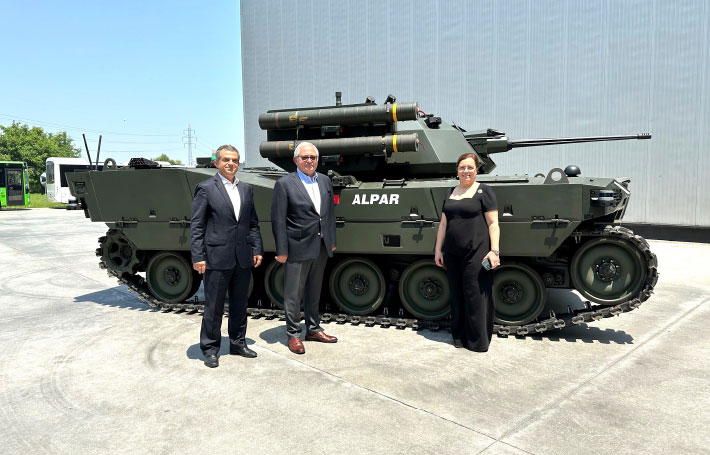
At the event, Otokar unveiled their latest turret system featuring the integration of an anti-tank missile onto the 30mm turret. This innovative development involved the integration of the Roketsan OMTAS launcher into Otokar's MIZRAK-30 turret. Notably, this marked the first time that a turret system with anti-tank missile capability was achieved in Türkiye. The MIZRAK turret offers versatility as it can be integrated onto various types of armored vehicles. With its combination of a medium-caliber cannon and anti-tank missile capability, the MIZRAK-30 turret proves to be a highly effective solution for armored infantry fighting vehicles. The turret is equipped with two ready-to-fire launchers on the right side, while two spare missiles are conveniently carried within the turret itself.
ALPAR Heavy Class Tracked Unmanned Ground Vehicle Showcased for the First Time
Otokar unveiled a remarkable surprise during the press tour—the ALPAR Heavy Class Tracked Unmanned Armored Vehicle. Developed as an unmanned platform, ALPAR can seamlessly collaborate with both manned and unmanned elements on the battlefield, catering to the growing demand for robotic and unmanned land vehicles within the Armed Forces. At IDEF '23, ALPAR will be presented in various configurations, featuring the MIZRAK-30 Weapon Turret, two ROKETSAN OMTAS missiles, and a drone system. The ALPAR Heavy Class Tracked Unmanned Armored Vehicle can be effectively controlled remotely by two individuals—the driver and the operator (gunner/commander)—from a control center or command-and-control vehicle situated up to 5 km away, depending on geographical conditions.
ALPAR, equipped with a serial hybrid electric propulsion system, excels in silent operation, and has both autonomous and remote command capabilities. It distinguishes itself with a low thermal signature, the ability to be airlifted, and a fast replaceable battery infrastructure. With hybrid propulsion, ALPAR boasts a range of 500 km, while its electric propulsion allows for a distance of 50 km. Furthermore, ALPAR can carry a Mini UGV system. ALPAR offers a range of six different configurations, including the Relay Vehicle, Logistics Service Vehicle, Anti-UAV Vehicle, Anti-Tank Vehicle, Reconnaissance and Surveillance Vehicle, and Armored Combat Vehicle. Weighing 12 tons, the vehicle has a payload capacity of three tons (maximum 15 tons), and it can achieve a maximum speed of 70 km/h.
ALPAR's electric propulsion system can be equipped with four sets of Li-Ion batteries. While the battery cells themselves are sourced externally, Otokar handles the packaging and production of these batteries. Leveraging their prior experience in battery technology used for civilian vehicles, Otokar has entered the field of battery production and packaging. Remarkably, the batteries can be replaced in under 20 minutes. Otokar has set a target to finalize the development of ALPAR by 2027
During the conclusion of the press conference, Otokar General Manager Serdar GÖRGÜÇ took the time to respond to inquiries from the press members.
The New Generation Armored Combat Vehicle Project has generated interest among the public, particularly regarding the proposal put forth by the Defense Industry Agency for Turkish armored vehicle manufacturers to collaborate on the project, similar to the partnership between Rheinmetall and Krauss-Maffei Wegmann (KMW) in Germany. Serdar GÖRGÜÇ, General Manager of Otokar, gave the following answer to our question about this proposal: “The Defense Industry Agency is currently engaged in project studies and evaluations, which is a routine and time-consuming process. They are also in discussions with the Land Forces to determine their specific requirements. It is unlikely that any meaningful conclusions will be reached in the short term. However, as demonstrated here today, Otokar has a range of wheeled and tracked vehicles that not only meet the current needs of the Land Forces but also have the potential to fulfill future requirements. Whenever we are asked technical questions or about the capabilities of our vehicles, we are ready to provide detailed answers"