Pearson Engineering Route Opening and Clearing Capability (PEROCC)
PEROCC provides a single-platform solution to the requirements of counter-improvised explosive device (C-IED) activity through the application of a suite of tools to a chassis, with the capability to detect explosive threats and proof routes at tempo while maintaining a high level of self-protection.
Pearson Engineering has long espoused the concept of a single vehicle solution for tactical C-IED requirements. The solution developed has taken a holistic view of dealing with IEDs to improve upon and advance the state of the art of existing capabilities relating to detection and pre-detonation of IEDs while mounted, reducing the need to dismount to perform any of these functions.
PEROCC is the application of a suite of tools applied to a chassis. It is designed, developed, manufactured and tested to provide an operationally relevant and technically feasible advance in capability compared to existing fielded systems.
Pearson Engineering believes that a wider range of IED defeat requirements can be met using a single platform to conduct mounted pre-detonation and detection tasks more efficiently and at higher tempo than is currently being achieved.
PEROCC Technical and Operational Approach
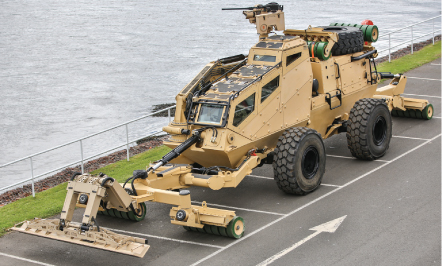
PEROCC has been specifically developed to provide clear and significant improvements over existing systems. A commercially available pivot steer wheeled loader was selected as the optimum platform to integrate improved detection and pre-detonation capabilities. The platform has been armoured against ballistic and blast threats, provided with a self-defence capability and a command and control suite.
Reliable Cost-Based Sub System
The system is inherently reliable through the use of commercially available sub systems as the basis for vehicle build. The engine, cooling pack, transmission, drive train and steering controls are all directly migrated from a commercial donor vehicle into the final assembly. This approach ensures proven reliability, with a robust, supportable, economic base for PEROCC.
Self-Protection
PEROCC is fitted for a remote weapon station (RWS) mounted on the roof of the cab. The RWS is provided with day and night cameras fitted to the slew mount. This enables the crew to control the RWS to give full 360-degree situational awareness through the RWS display and provide self-protection to the host vehicle.
Flexible and Powerful Interrogation Arm
PEROCC can be fitted with a subsurface detection suite based around Ground Penetrating Radar to give the dedicated PEROCC sensor operator an in-road buried detection capability as well as road-side and extended width (side-by-side), or spot interrogation capabilities through a repositionable arm-mounted sensor.
A powerful articulated arm provides interrogation and manipulation capabilities for the inspection of suspicious objects and areas. When stowed, the arm is protected from blast damage by the hull of the vehicle. The arm can also be used as a crane in order to carry out any necessary running repairs on the vehicle and its equipment.
The arm, based on a commercially available system, provides a flexible platform to determine the location of emplaced IEDs and IED components from a safe stand-off distance. This reduces the need for soldiers to dismount to inspect suspect areas and enables faster and more effective and safer electronic detection.
The PEROCC arm has the ability to lift 1,500 kilogrammes (3,307 lbs) at 7.5 metres (24.5 feet), and can exert a maximum dig force of 5,000 kilogrammes (11,023 lbs) at 7 metres (23 feet). This is significantly more than existing interrogation arms, and enables improved pre-detonation and detection to be achieved at greater speed and in a greater variety of ground conditions. A quick hitch capability means that the arm can be used to inspect, interrogate, neutralise and move suspect objects at a safe distance in front of the vehicle when mounted with one of the tools, including a long-reach ripper tooth, grapple, spork and bucket. Survivability of the arm is improved through the use of a specially designed ripper tool that shears at a specific point to protect the arm in the event of a blast.
Heavy Effect, Full - Width
Mine Roller
Improved pre-detonation is achieved by integrating a full-width mine roller that triggers IED devices using a higher downward pressure than is possible with existing rollers used with mine-resistant ambush protected (MRAP) class vehicles. The 4-metre (13-foot) wide full-width roller applies significantly more downward force per wheel than currently employed rollers. This improvement allows for growth potential to defeat higher pressure activated threats such as the TM62 mine or enhanced IEDs. PEROCC offers a heavy effect in a lighter-weight package because of the optimisation between platform and roller.
Interchangeable Front End Equipment
Flexibility is also provided with the use of a three-point hydraulically operated quick-hitch at the front and rear of the system, allowing the PEROCC configuration to include alternative front or rear equipment such as a dozer blade, Ground Penetrating Radar array or cyclone blower. These items would typically be fitted in place of the rollers.
Survivable, In-Stride Repair
PEROCC also offers significant improvement in the survivability of the pre-detonation capability. In the event of a blast, damaging loads are minimised to the supporting roller fabrications through frangible joints. The rollers can also be jettisoned from under armour.
The roller gangs can be quickly self- repaired using one of the three on-board replacement roller banks without the need to return to base. This capability is not available on any of the existing rollers and allows the system to self- repair using the interrogation arm, in-stride, and continue with the mission at tempo.
If the quick-hitch is used to reconfigure the system to make use of front-end equipment other than the roller, survivability of the system is maintained through the use of Blast Off Wheels (BOWs). In the event of an IED detonating under one of the vehicle wheels, the BOWs will detach, protecting the crew from life-threatening accelerations. PEROCC includes four BOWs and carries one complete assembly that can be fitted in-stride, post-blast within 30 minutes using the powerful backhoe interrogation arm.
The arm is fitted with a hydraulic quick coupler that allows rapid changing between arm tools, a feature that contributes to the proposition that pre-detonation and detection tasks can be carried out more efficiently and at higher tempo than is currently being achieved.
Further improved detection of IEDs is offered by the ability to integrate existing or emerging detection capabilities on the same platform as the full-width roller. An arm-mounted detector offering significantly improved detection capabilities than a handheld detector is integrated into the system.
PEROCC Operation And Control
PEROCC is operated by three crew: driver/arm operator, gunner and commander. The standard operating controls from the base vehicle are retained in the driving position at the front of the crew compartment. The driver controls the vehicle and operates the roller system and arm; the gunner is positioned immediately behind the driver and controls the overhead weapon station; and the commander sits in the highest position at the rear of the crew compartment in order to maximise situational awareness. Both gunner and commander can monitor GPR equipment. All crew members have excellent all- round visibility and simultaneous access to indirect vision cameras.
Development And Testing
Significant development and testing has already been undertaken to allow the manufacture of a prototype vehicle. Major milestones completed include:
Integration of a three-man armoured crew cab into a blast-protected v-hull on the front half of the vehicle
Blast tests have been carried out that assess crew protection from threats defined by STANAG 4569, level 3.
Integration of a proven blast- attenuation system for the crew
Initial integration of interrogation arm, including detector head and other tools
Integration of remote weapon station
Integration of front and rear quick hitch and roller.
An additional test mule vehicle was produced at the beginning of 2012 to represent certain features of the PEROCC concept. Specifically, the test mule vehicle was designed to represent the front and rear roller, front and rear v-hull profile, interrogation arm and the overall platform dynamics. These features were subsequently assessed through the following trials:
Preliminary roller effectiveness trials against pressure fused IEDs and anti-tank (AT) mine threats such as the TM62 series
Skip trial to assess the ability of the roller to contour undulating ground at speed
Ride and handling assessment, to quantify the effect of the vehicle dynamics on general automotive manoeuvres
Braking assessment
NATO lane change
Steady-state cornering
Soft ground mobility assessment
Longitudinal gradient assessment
Blast testing
Self-repairability assessment on the roller gang, using the vehicle- mounted interrogation arm.
Further development and testing is now being undertaken before a comprehensive test programme is carried out.
Pearson Engineering was founded on a commitment to provide world-class advanced engineering solutions to meet the challenges faced by modern armed forces. Our particular expertise is the development and supply of specialised counter-mine and combat engineer equipment for armoured fighting vehicles. As well as the recently introduced PEROCC, products include: the Mine Plough for breaching minefields; the Combat Dozer for earthmoving tasks; the Surface Clearance Device for clearing surface laid mines from routes and wide areas; the Mine Roller to explode buried pressure fused explosive devices; the Lane Marking System to mark a clear lane or area; the Magnetic Signature Duplicator to explode magnetically fused explosive devices; and the Bridge Launch Mechanism - rapid bridge laying.