PN-MILGEM Corvettes to be Armed with MBDA’s Albatros NG NBAD System!

According to the information I received, within the scope of this last-minute change on the ships’ main air defense system a number of modifications have been performed on the PN-MILGEM’s original sensors and weapon systems layout. The renewed design of the PN-MILGEM Corvette was disclosed for the first time on April 30, 2021, during the PN-MILGEM-3 Corvette’s keel laying ceremony held at Istanbul Naval Shipyard in Tuzla, Istanbul.
As we recall, on March 3, 2021, MBDA announced that it signed the first export contract with an undisclosed international customer for the Albatros NG NBAD System, which uses CAMM-ER (Extended Range) missiles. In the press release, it was stated that the Albatros NG System would become operational in 2024 within the scope of the order. With this acquisition, the Pakistan Navy became the first export customer/user of Albatros NG, and the PN-MILGEM Corvette became the first surface warship to use this new generation medium-range active radar guided air defense system. In addition, the Albatros NG NBAD System will be integrated into the GENESIS ADVENT CMS (Combat Management System) used on the ships.
Within the scope of the PN-MILGEM Project, which covers the construction of 4 corvettes based on the design of ADA Class Corvettes of the Turkish Naval Forces (TNF), two of the ships will be constructed at Istanbul Naval Shipyard Command, and the other two at Karachi Shipyard & Engineering Works (KSEW) in Pakistan. The construction of 4 corvettes is currently underway, and the first ship of the Project is planned to be launched in July 2021 and is to be delivered in Turkey in August 2023 (Pakistan will accept the vessel here, then it will be taken to Pakistan). The steel cutting ceremony of the 4th corvette was held at KSEW in Pakistan on June 15, 2021 with the participation of Chief of the Naval Staff Admiral Muhammad Amjad Khan NIAZI. The 4th PN-MILGEM Corvette is scheduled to be commissioned in February 2025. During the ceremony the renewed design of the PN-MILGEM Corvettes with a pair of 6-cell Maritime Launching System (MLS, for a total of 12 CAMM-ER missile) for the Albatros NG NBAD System was also disclosed for the first time.
PN-MILGEM Class Corvette and JINNAH Class Frigate Programs
In 2010 when the Pakistan Navy (PN) was interested in the Turkish Navy’s MILGEM Project there were 2 issues at that time; Pakistan did not have the money and the Turkish construction organizations were busier making ships for themselves, so an immediate contract for the Pakistan Navy could not be achieved at that time.
So, when Pakistan finally got through, it was originally thought that the PN would just take the exact model of the TNF’s ADA Class (MILGEM) and put it into service. It was thought that on the 4th ship, certain modifications would take place by involving Pakistani engineers and technicians who would receive on-the-job training during the construction of the first ship and the modified design to be based on the TNF’s ADA/MILGEM Class would be called PN-MILGEM. However, what actually occurred was that once the contract was awarded, the PN added a lot of weapons on to the ships. More weapons and more capabilities compared to the TNF’s ADA/MILGEM Class.
It was then realized that the original size of the TNF’s ADA/MILGEM Class would not sustain the volume of weapons on board so the size and everything had to be changed. So practically the PN-MILGEM is very much different from the TNF MILGEM, it is bigger, its heavier, the weapon systems are different, so the design teams had to conduct completely new work on it.
So, even as the name remains MILGEM the baseline design remains the ADA/MILGEM Class, but in reality, the PN’s MILGEM design is completely different from the TNF’s MILGEM Class in capability and capacity. Thus, even within the scope of the contract it was initially thought that only the 4th ship of the PN-MILGEM Project would be different, but now all 4 are different from the TNF’s MILGEM. Thus, with the PN-MILGEM Project, Pakistan gains the ability to design and build its indigenous warship with the support of Turkish engineers.
As the entire ship is new, as an offset the JINNAH Class designing came in. PN design teams, who took part in the PN-MILGEM design efforts in Istanbul, Turkey together with the Turkish ship designers have started to design a new ship, which is called the JINNAH Class. So, PN-MILGEM is different, and JINNAH is absolutely different.
All 4 ships, 2 being constructed in Istanbul and 2 being constructed in Karachi, will be different from the TNF MILGEM. And after the construction of these 4 PN-MILGEM Corvettes is completed, construction of JINNAH Class would be started. Since it is a joint design (like the JF-17 of Pakistan Air Force) both Turkey and Pakistan will have rights to sell it and market it if they want.
JINNAH is absolutely a new design. The baseline is almost similar to the PN-MILGEM, but it also very different. It is much bigger. The PN-MILGEM will come in the Corvette category whereas JINNAH will be in the Frigate category. The propulsion systems will be different, PN-MILGEMs have two 4000 Series MTU 20V4000M93L diesel engines (each generate 4,300kW/5,766hp) with a LM2500 gas turbine, whereas in the JINNAH it will be all diesel and it will not have a gas turbine. Also, in the JINNAH Class a number of systems will be indigenized. The Pakistan Navy is looking for indigenous systems. As of June 2021, the JINNAH Class is still in the Preliminary Design Phase. Once the Preliminary Design Phase is completed then there would be a cost estimation effort on how much this design will cost. Based on the concept, engineers would then make a cost estimation on how much is this ship going cost. And then they add weapons, and the cost would increase further, and then the Detailed Design Phase would be performed. Somewhere in 2022 the initial shipbuilding contract, which would allow the start of Detailed Design Phase, is expected to be awarded. Because the detailing study is can only be conducted done after the contract award. If PN Headquarters allows it, a conceptual model of the JINNAH Class will probably be on display during the IDEF ‘21 Exhibition in Istanbul.
PN-MILGEM Corvettes & Albatros NG NBAD
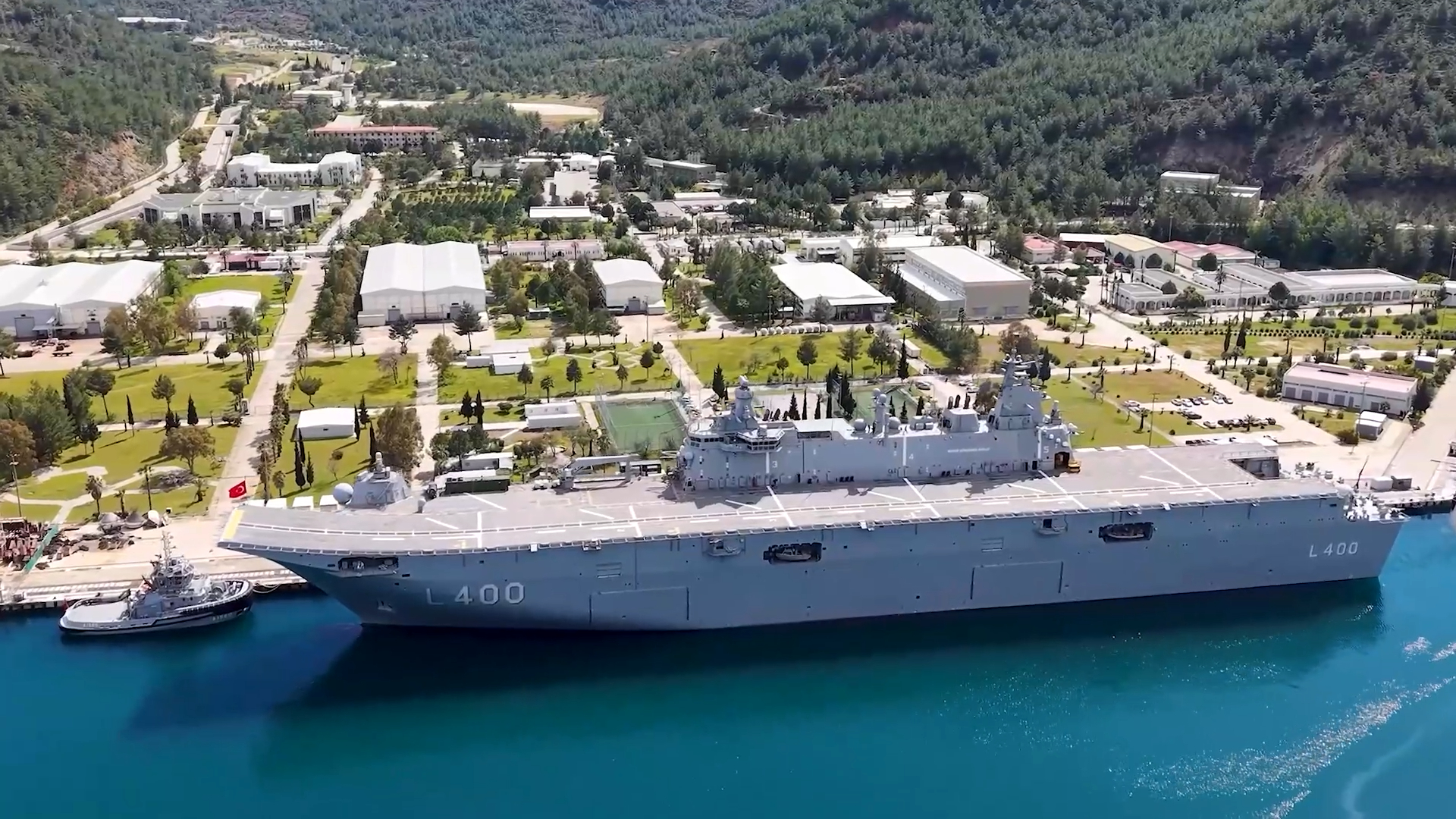
With an overall length of 108.2 m, a width of 14.8 m, a draft of 4.05 m and a displacement of 2,926 tons, PN-MILGEM Corvettes sit between the 2,400-ton ADA Class Corvettes and the 3,000-ton ISTIF Class Frigates.
When we look at the previously shared Computer-Generated Images (CGI) of the vessels, the PN-MILGEM Corvettes had a 16-cell Vertical Launching System (VLS) for the HHQ-16 Medium-Range Air Defense Missile System located just behind the Leonardo (Oto Melara) 76 mm Super Rapid main gun. The China Aerospace Science and Technology Corp (CASC)’s HHQ-16/LY-80N medium-range semi-active radar-guided air defense missile system is also used in Type 054A/P Frigates (with 32 cell VLS) currently under construction in China for the Pakistan Navy.
Measuring 5.2m in length, 340mm in diameter and weighing around 650kg, the HHQ-16 is said to have a maximum range of 42km. The HHQ-16 has a 70kg warhead and is claimed to have an interception altitude of between 15m and 18km (the extended-range version of the missile, the HHQ-16B, has a range of 70km). For target illumination requirement the PN-MILGEM Corvettes were supposed to be installed with two Type 345 Target Illumination Radars (NATO code MR-90 Front Dome), the first one would be located just in front of the mast and the other would just behind the funnel.
However, with recent improvements/modifications on the PN-MILGEM’s original sensors and weapons systems layout the 16-cell VLS for the HHQ-16 Medium-Range Air Defense Missile System is now replaced with a pair of six-cell modules of the Albatros NG Maritime Launching System (MLS, a Soft Vertical Launch/SVL system, it uses a cold gas generator to eject the missile from its canister) that is based on the compact design developed by MBDA UK for the Royal Navy’s Type 26 and Type 31 frigates and Type 345 Target Illumination Radars for the HHQ-16 Missiles were removed. The PN-MILGEM Corvettes will be also fitted with the Platform Data Link Terminal (PDLT), featuring four small arrays, of around 40cm per side, which can be mounted on the main mast to offer 360° coverage, or rearranged inside two turrets on the upper deck of the ship, each one accommodating three arrays covering 180°, as already adopted on Type 23 platforms. The PDLT will provide the two-way communication between the ship and the CAMM-ER missile; target positional updates can be uplinked from the ship to the missile in flight, while missile status information and diagnostics can be sent back to the ship.
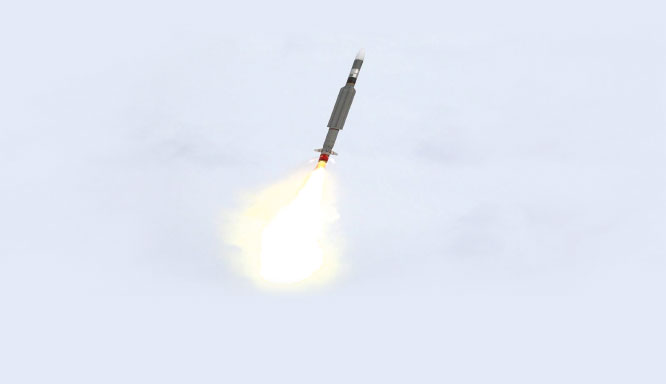
The Albatros NG is a new generation NBAD System capable of providing self and local area defense against evolving airborne threats at ranges exceeding 40km. The system uses the ER (Extended Range) variant of CAMM (Common Anti-air Modular Missile), which features advanced RF digital seeker combined with two-way RF data link (with 360° coverage) for target updates and utilizes Soft Vertical Launch technology. The CAMM-ER missile has already been selected by customers around the world for both naval and ground-based air defense. The CAMM-ER shares the same characteristics as the original CAMM except for an extended booster/sustainer rocket motor (developed specifically for the MBDA missile by Italian company Avio) in a larger calibre (190 mm) propulsion section which significantly increases the engagement range to 45+ km. The CAMM-ER is said to have an interception altitude of between 12km to 15 km. CAMM-ER weighs 160kg (350lb), is 4.2 m (14ft) in length and 190mm (7.5 in) in diameter. Each Albatros NG Firing Unit manages up to 12 missiles, requiring the installation of multiple Firing Units should a higher number of missiles be required. Thanks to the fire-and-forget capable CAMM-ER/Albatros NG NBAD System, the PN-MILGEM Corvettes will be able to engage more air targets at the same time compared to the semi-active radar-guided HHQ-16 Medium-Range Air Defense Missile System and perform missions with higher performance in the EW threat environment.
The PN-MILGEM Class Corvettes will also be equipped with a total of 6 Harbah Anti-Ship & Land Attack Cruise Missiles (ASCM/LACM with an estimated range of 450km to 750km) or another new indigenous classified missile system that is still under development (claimed to have supersonic flight capability), two ASELSAN 25 mm STOP Remote Controlled Stabilized Naval Guns (at the port and starboard deckhouses), and a ASELSAN GÖKDENİZ Close-in Weapon System (CIWS). Within the scope of recent improvements/modifications on the PN-MILGEM’s original sensors and weapons systems layout the torpedoes have been also changed.
The induction of PN-MILGEM Corvettes will significantly enhance the maritime defense and deterrence capabilities of the Pakistan Navy. Featuring state-of-the art weapons and sensors, these corvettes will become a core element of the PN's kinetic response to traditional and non-traditional challenges and to maintain balance of power in the Indian Ocean Region