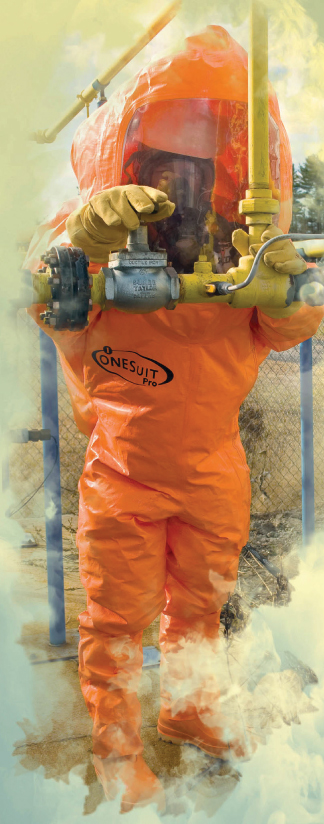
Pressure to Perform Understanding the Dynamics of Air Pressure Within Your Hazmat Suit
In the fleeting moments while donning a chemical protective hazmat suit during an emergency situation, it is natural for emergency responders to feel a sense of anxiety. A host of questions can enter the first responder’s mind while preparing to combat both known and unknown chemicals in a hazmat suit. Will I be able to manoeuvre myself effectively in this suit? How can I be sure the exhaust valves in my suit are working properly? How often does my suit need to be pressure tested?
The answers to these questions lie in understanding the engineering behind your hazmat suit. While each suit is engineered differently, a lot can be understood about the properties and performance of your suit through examining its exhaust valves. Taking the time to consider a suit’s valves will not only help emergency responders to select a hazmat suit, but ultimately provide peace of mind when in a hazardous situation.
What’s the pressure?
For the purpose of this article, we will examine Type-1a EN943-1 and 943-2 certified hazmat suits, which are built for chemical and gas protection, using a self-contained breathing apparatus (SCBA) for respiration. These suits can be engineered to slightly inflate using the air that is exhaled through the SCBA. The user’s exhalation pressurises the suit, creating a comfortable distance between the emergency responder and the material of the suit. Ultimately, this design makes the suit more comfortable by decreasing the impact of the suit’s weight on the head, shoulders, and mask, which increases user mobility. While inside a suit that is slightly inflated, emergency responders are more easily able to withdraw their hands for access to radios, gauges, and cloth for wiping a potentially fogged visor.
It is important to note that internal air pressure levels can vary by suit design and manufacturer. Of course, the best way to test your suit is by trying it on and checking that there is a comfortable space between your body and the suit’s material.
The potential for user error
To further understand the dynamics of air pressure within your suit, take time to examine your suit’s exhaust valves. There are several types of technology on the market. The most common exhaust valve systems employ a small diaphragm which fits next to a set of holes to regulate airflow and prevent leakage of air from outside of the suit. This system, while effective, requires diligent maintenance.
Maintenance entails manually dismantling and reassembling each valve to be inspected and pressure tested. The small-diaphragm technology should be used with caution, as it leaves the potential for user error during the process, posing the threat of inadvertently damaging the valve’s diaphragm during testing or reassembling it incorrectly. There is typically no way to accurately verify that the valve has been reassembled correctly and will function as intended during use. This clearly poses a risk, as the first responder’s protection against inward leakage and harmful gases could be compromised.
To mitigate this risk, it is important to look for hazmat suits with exhaust valves that cannot be disassembled and do not require maintenance. Consider suits that incorporate valves of a completely sealed design. Servicing is not required on closed construction valves, rendering them tamper proof. To be sure that your valve is tamper proof, look for a closed construction and verify with your hazmat suit manufacturer that its exhaust valves are 100% factory tested against inward leakage and outward flow.
Check out those valves
Once you have determined the construction of your valve, take time to examine the material from which the valve is constructed. Valve diaphragms can consist of silicone or more traditional rubber (e.g., butyl), which can cause a difference in shelf life and performance.
Depending on storage conditions, diaphragms made from traditional rubber can become compromised. Extreme temperature fluctuations and dry conditions increase that risk, making the valve diaphragms susceptible to cracking over time. For a more reliable alternative, consider exhaust valves that utilise silicone rubber diaphragms. Silicone is a strong, highly inert polymer, resistant to the effects of environmental exposure. It can be difficult to visually confirm your valve’s diaphragm material, so be sure to check with the suit manufacturer for specific information.
Pressure testing
Even with the highest quality exhaust valves, it is crucial to ensure that your hazmat suit is ready for use and, if the suit has been used before, that you carry out the recommended pressure testing before putting back into storage ready for the next incident. Requirements for pressure testing vary between reusable and limited life chemical suits and between manufacturers so these should be fully understood when purchasing gas tight suits. Type-1a suits certified to the European standard EN943 as reusable are typically required per the manufacturer’s guidelines to be pressure tested annually or after each time the suit is used (whichever comes first). In the case of limited life Type-1a suits certified to EN943, pressure testing guidelines also vary by manufacturer but typically they only require testing if used or fully removed from their packaging. Storing them safely in the original packaging is recommended so that they are ready for use in emergency situations.
It is important to point out that with exhaust valves requiring disassembly for pressure testing; there is a risk of damaging the valve diaphragm’s integrity through user error. To avoid this risk, look for a suit that utilises permanently sealed construction valves as these will not need to be disassembled for pressure testing.
In addition, some models of exhaust valves, often those with traditional rubber diaphragms, require that the diaphragm be replaced every two years due to manufacturer specifications. This contributes to added maintenance and logistics during the suit’s lifecycle. Be sure to check if the suit you own or are looking to purchase has such requirements.
Sealing it all in
While physically a small component of your suit, you can see how exhaust valves are a critical component to your performance, comfort, and ultimate safety while in the hazardous situations. Whether you are looking to purchase a new hazmat suit, or donning an old favourite, understanding the dynamics of your suit should provide peace of mind, which is something very important for emergency responders.
Ian Hutcheson, Market Manager Protective & Fabricated Systems Europe
As Market Manager Protective & Fabricated Systems Europe at Saint-Gobain Performance Plastics, Ian is responsible for strategy and business development across Europe, the Middle East and Africa. Ian has over 25 years experience in the field of engineered plastics and technical textiles. Previous to working at Saint-Gobain Performance Plastics, Ian worked for Chemfab Corporation specialising in sales, marketing and product development. He also held the position of Export Sales Manager at PPI Adhesive Products Ltd.
Ian has an extensive background in technical fabrics and fluoropolymers for use in personal protection and communications markets. He holds a Bachelors Degree in Economics and Business Studies as well as being fluent in French and German.
Saint-Gobain Performance Plastics (SGPPL) is a subsidiary of Saint-Gobain, one of the top 100 industrial companies. Saint-Gobain, the world leader in the habitat and construction markets, designs, manufactures and distributes building materials, providing innovative solutions to meet growing demand for energy efficiency and for environmental protection. Saint-Gobain Performance Plastics manufactures the ONESuit® line of chemical protective "hazmat" products and other high performance protective equipments such as gloves and chemical protective shelters.





