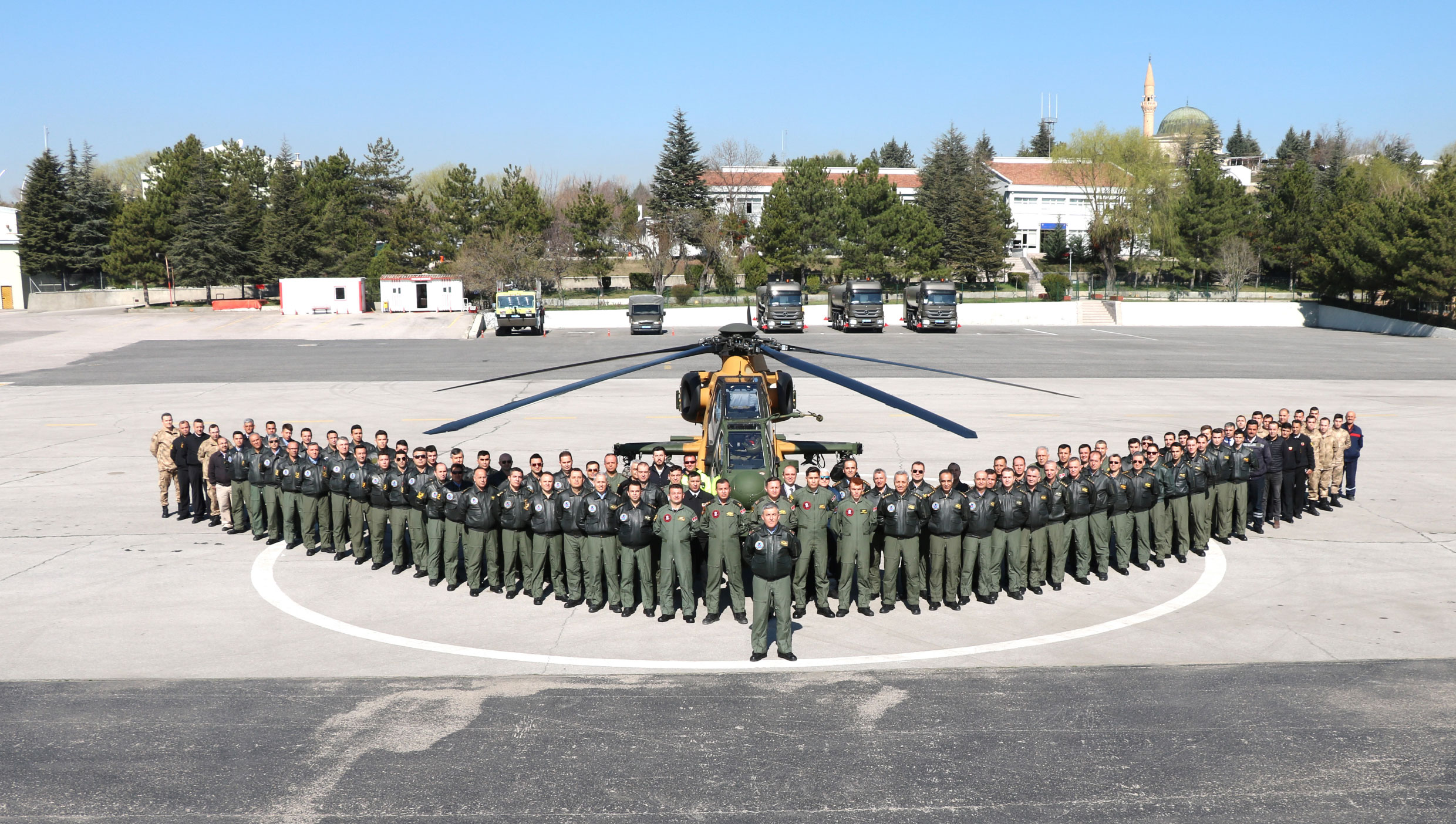
Proud of Saying ``We Didn`t Leave Anyone Behind`` Gendarmerie Aviation Department Celebrates Its 55th Anniversary
Adopting the principle of “We will not leave anyone behind” throughout its 55-year history, the Gendarmerie Aviation Department provides the Gendarmerie General Command, which serves 93% of Türkiye's land area and 30% of the population, the aviation support it needs in a timely, effective and uninterrupted manner due to the characteristics of the region of responsibility in the execution of its duties entrusted with the legal legislation.
Gendarmerie Aviation, which started with a small number of AB-206 Helicopters in Diyarbakır in 1968, started to organize throughout the country in order to meet the increasing need for air support of the Gendarmerie General Command over time and put the modern aircraft offered by technology into service, and it has reached a significant air power today comprising with over 70 fixed and rotary wing manned aircraft such as T129 ATAK Attack and Tactical Reconnaissance Helicopter, T-70, S-70i, S-70A-17/28, AB-205 (UH-1) and Mi-17-1V Utility Helicopters, AutoGyro Cavalon Gyrocopter, King Air B-350 JIKU (Gendarme Manned Reconnaissance Aircraft) and Citation C680 Sovereign Command and Control Aircraft as well as more than 20 Tactical and Operative Class Armed Unmanned Aerial Vehicles (UAV) such as BAYRAKTAR TB2 and ANKA-S. Gendarmerie Aviation Department, which has carried out more than 500,000 hours of flight with manned aircraft from August 1968 to July 2023, has performed an average of 20,000 hours of flight per year with manned aircraft, while the Gendarmerie UAV Command, whose total flight hours have reached approximately 170,000 hours from 2017 to July 2023, also performs over 35,000 hours of flight per year with Tactical and Operative Class UAVs. The total flight time realized with drones of different capabilities, the number of which exceeds 3,500, has reached 450,000 hours. In today's security environment where risks and threats are constantly changing, Gendarmerie Aviation Department, which has gained the trust and appreciation of our nation with its outstanding efforts and achievements in all tasks, aims to increase the number of aircraft in its inventory by 50% in the next 4 years, the number of pilots to 450 and the number of technicians to 512.
Based on the information and impressions I gained during the facility tour I made at the Gendarmerie Aviation Department campus located in the Martyr General Eşref BİTLİS Barracks in Güvercinlik, Ankara on both 12 and 17 July, I will first take a brief look at the history of the Gendarmerie Aviation Department, which is full of examples of heroism, sacrifice and courage in this comprehensive article, which I compiled from open sources such as the Activity Reports of the Gendarmerie General Command and the information in my news archive, then, I will mention the remarkable technological capabilities used by the Gendarmerie Aviation Units, respectively, and then I will introduce you to the simulator systems that are developed and produced with national facilities used in the training activities of the pilots and technicians with superior qualifications that form the heart of the Gendarmerie Aviation. Afterwards, I will take a look at the improvement works carried out on Mi-17-1V Utility Helicopters, some of which are still in progress, in the light of the lessons learned during the Wildfire Suppression Missions, and I will share my impressions with you of a tour of the Gendarmerie UAV Command, which has a great share in the success of Türkiye’s counter-terrorism operations. I will end my article with information on T129 ATAK Helicopter, T-70 Utility Helicopter, T625 GÖKBEY Light Utility Helicopter, AutoGyro Cavalon Gyrocopter, HÜRKUŞ-C New Generation Light Attack/Reconnaissance Aircraft and Transport and Utility Aircraft Projects which are being developed by Gendarmerie Aviation Department following the constantly changing and developing aerospace and defense technologies, procures new manned and unmanned aerial vehicles and systems within the budget possibilities, and has the aircraft in the inventory undergo revisions and modernizations in accordance with current needs.
History
The Gendarmerie General Command, which was established on 14 June 1839, is the general law enforcement agency that ensures the protection of security and public order and fulfills the duties assigned by other laws and was subordinated to the Ministry of Interior with the Decree Law No. 668 in 2016.
The Gendarmerie of the Republic of Türkiye needed a strong air support due to the characteristics of its area of responsibility and in line with this need, especially in order to provide aviation support of the Gendarmerie Units in the Eastern and Southeastern Anatolia Regions, formed the first aviation unit under the name of "Light Helicopter Company" in Diyarbakir in 1968, in the establishment of the Eastern Gendarmerie Regional Command, with the newly added AB-206 Helicopters into the inventory. The "Light Helicopter Company", which was recruited to the Diyarbakir Gendarmerie Regional Command on April 28, 1969, was moved to the 7th Corps Command's Galip Naval Barracks in 1970. To provide aviation support of Gendarmerie Units in Central and Western Anatolia Region, to be used in security-security, search-rescue, courier and liaison services; on August 25, 1970, the 1st Gendarmerie Helicopter Company was established in Güvercinlik under the Support Continental Command.
Within the scope of the agreement signed for the supply of 28 various types of helicopters from Italy within the framework of the Gendarmerie General Command Force Targets Plan, 10 AB-205 and 2 AB-206 Helicopters were included in the inventory of the 1st Gendarmerie Helicopter Company between 1974-1977, following the completion of the procurement process.
In 1974, Gendarmerie Aviation Units and Gendarmerie Commando Units participated in the Cyprus Peace Operation and as the first units to reach the island within the scope of the Operation, they took their place at the forefront of the Turkish Cypriots' struggle for independence. Gendarmerie Aviators, who went to the Turkish Republic of Northern Cyprus (TRNC) for the first time in 2022 as part of an exercise after 1974, immortalized this special moment with the photo they took in front of the TRNC Flag on the Beşparmak Mountains with the new S-70i Helicopters painted in blue, red and white colors.
Gendarmerie Aircraft and Helicopter Maintenance Supply Squadron, which was established on February 27, 1976 in order to carry out the maintenance and supply services that increased in line with the increasing number of aircraft over time, became operational in the Hangar Building built in Güvercinlik on March 7, 1977. This hangar is currently used for the maintenance and supply activities of AutoGyro Cavalon Gyrocopters and AB-205 (UH-1H) Helicopters.
In order to control the illegal poppy cultivation areas from the air, a Narcotic Air Team was established within the 1st Gendarmerie Helicopter Company with 3 single-engine aircraft given by the American Drug Enforcement Organization. Narcotic Aviation Team, which started to perform more effective operations after being reinforced within the scope of the United Nations aid project with a twin-engine Rockwell 690A Aero Commander photographic aircraft, a Cessna F182P Skylane and a Pipper PA-32 reconnaissance surveillance aircraft and 2 photo baths and analysis laboratories, was directly subordinated to the Gendarmerie General Command under the name of Gendarmerie Narcotic Air Squadron on 9 May 1978.
Meanwhile, the “Light Helicopter Company” was transformed into the Gendarmerie Air Battalion Command on March 1, 1979 and attached to the Gendarmerie General Command; in 1990, it was reorganized as the Air Group Command and was given the operational command of the Gendarmerie Public Security Command. The Gendarmerie Air Group Command was established on March 1, 1979 in Güvercinlik, by combining the aviation units under the Gendarmerie General Command, with the personnel, equipment, staff and existing ones being preserved.
The Gendarmerie Aviation Supply and Maintenance Command was attached to the Gendarmerie Logistics Command on November 1, 1985, and became a unit affiliated to the Air Group Command on February 13, 1987. The Aviation Branch Directorate, which operated under the Operations Presidency until 1987, was transformed into an independent branch after this date and was attached to the Chief of Staff. The new name of the Gendarmerie Aviation Supply and Maintenance Command, which was reorganized on 9 November 1988, became the Gendarmerie Air Maintenance Command.
In the meantime, 6 Sikorsky S-70A-17 Helicopters, which were ordered to the American Sikorsky Company with the contract worth US$40 Million signed in 1988 as part of the urgent need, were brought to İzmir Port by ship at the end of 1988. The commissioning ceremony of the first S-70A-17 Black Hawk Helicopter with a serial number of 701333 and powered by a pair of T700-701A engines each generating 1,700 shp, was held on January 1, 1989, and all helicopters entered the inventory as of January 30, 1989. With this delivery, Gendarmerie Aviation became the first S-70A Black Hawk user in our country. The last of the S-70A-28 Helicopters, powered by T700-701C engines each generating 1,900 shp, which was ordered later, entered service on 21 July 1994.
Within the scope of the efforts to expand across the country, the Aviation Branch Directorate was transformed into the Aviation Division on 1 July 1993 so that the Gendarmerie Aviation Units could serve more effectively. In 1993, the Van Gendarmerie Fleet Command was established in order to respond to the increasing terrorist incidents in a shorter time. The first batch of 6 of 19 Mi-17-1V/1VA Helicopters, two of which were in Ambulance (Mi-17-1VA) configuration, two were in Armed configuration and 15 were in Utility configuration, were delivered to Türkiye in March 1995 and the others in June 1995. Mi-17s were ordered under the US$65 Million contract signed in November 1993 with the Russian Kazan Company located in Tatarstan in return for the Eximbank loan debts of the Russian Federation. However, due to the technical problems observed in some of the helicopters flown to Türkiye, the Final Acceptance process of the helicopters was prolonged and the helicopters only started to enter the inventory as of March 13, 1996. One of the Mi-17 Helicopters, while performing courier duty, made a hard landing on the Hakkari Mountain and Commando Brigade Command Heliport on October 1, 2003, and the helicopter was completely burnt out of service as a result of the fire that broke out due to the fuel tank of the helicopter being punctured during the crash.
The Gendarmerie Aviation Command was established on May 25, 2000, in order to provide single-handed management and administration of the Gendarmerie Aviation Units. Aydın Gendarmerie Fleet Command was established in 2003 in order to meet the helicopter needs of the Gendarmerie Units in the Western Region within the scope of safety, public order, tourism and public aid activities. In order to train the pilots and helicopter technicians needed by the Gendarmerie General Command, the staff of the Gendarmerie Aviation Teaching Presidency was amended and the Gendarmerie Aviation School Command was established with the approval of the General Staff on May 31, 2013.
With the approval of the Gendarmerie General Command dated August 4, 2016, the Gendarmerie Aviation Command was abolished and the Gendarmerie Aviation Units were first gathered under the Aviation Division, and with the approval dated February 20, 2018, the Aviation Division was reorganized and the Gendarmerie Aviation Department was established. On May 3, 2021, the Gendarmerie UAV Command was established under the Aviation Department for the activities carried out with Unmanned Aerial Vehicles to neutralize targets in aerial reconnaissance, surveillance and counter-terrorism.
Indigenous Technologies Used in Gendarmerie Aviation Units
Gendarmerie Aviation Department utilizes many modern and indigenous technology product software and hardware, some of which are the product of its own R&D studies, and some of it is specially produced within the framework of the requirements it has defined for domestic companies and institutions in order to facilitate the tasks of Pilots, Mission Commanders, Technicians and Payload Operators and to increase their effectiveness in their duties.
One of these was the Mission Planning Ground Station (GPYİ, Mission Planning Ground Station/MPGS) software that I had the opportunity to see at the Gendarmerie Aviation Department Operations Center, which is kept on watch 24/7 by the Specialized Personnel. The GPYİ software, developed by ASELSAN and defined as a "legendary software" by the personnel, allows pilots to automatically make their mission planning electronically, including information such as how many minutes they will fly and which route they will follow before they take off. The computer now automatically calculates the flight route and flight time calculation, which was previously drawn on paper with a ruler. In the GPYİ, where the entire aviation database and all maps of Türkiye are loaded, even the outposts in the mission area are marked. Pilots can transfer the mission planning work they prepared in GPYİ to the helicopter they will fly with flash disk later.
Helicopter Tracking System (HeliTR), developed by TÜBİTAK BİLGEM and consisting of a satellite phone, GSM and tracking device integrated into the helicopter, allows pilots to talk to satellite and GSM via the helicopter's mission computer. HeliTR has the feature of sending location information via GSM network or satellite, depending on whether they are deployed in the required region or not. The development of the system, which will have an encryption system, and its integration into helicopters are continuing.
The UAV Image Transfer System to Mobile Devices (KUZGUN), a system developed by the Gendarmerie General Command and capable of transferring images onto defined tablets, is still actively used in the field. According to the 2022 Annual Report of the Gendarmerie General Command, KUZGUN provides instant viewing of the images obtained by UAVs in the fight against Counter-Terrorism Operations (CTO/TMH), public order incidents and natural disasters on tablets and computers, and in this way, Commando Battalion Commands can instantly monitor the images transmitted by the UAVs entering their area of responsibility.
The View of the Gendarmerie Aviation Department to Education and the Importance of Simulators
In Gendarmerie Aviation, where the culture of training an inexperienced pilot by flying together with an experienced pilot for 3-4 years, general-purpose helicopter pilots were trained to operate B-350 JIKU, and T129 ATAK Helicopter pilots to operate Sikorsky or Mi-17 Helicopters in the past when the anti-terror operations were intense in order to benefit more from the flight personnel at hand, to save personnel in some cases, and to use the ready-to-fly aircraft in its inventory more effectively.
Senior First Pilots include pilots who can operate AB-205, Sikorsky and Mi-17 Utility Helicopters and B-350 Aircraft. With the increase in the number of personnel in terms of technicians, training activities that increase the specialization according to the types have been started. The pilots were divided into Helicopter Pilot and Aircraft Pilot. Helicopter pilots are also divided into utility and ATAK Pilots. Similarly, the Gendarmerie UAV Command aims to benefit more from its pilots and to use the ready-to-fly UAVs in its inventory more effectively, giving the same training to ANKA and TB2 UAV Pilots and then passing them through Difference Training. Thus, when necessary, the pilot flying ANKA UAV can also fly TB2.
Gendarmerie Aviators, who see all missions as training opportunities, also attach great importance to crew coordination and team cohesion.
AB-205 (UH-1) Helicopters are used as Basic Training Aircraft in the Helicopter Pilot Basic Course, which is given at the Gendarmerie Aviation School and consists of 2 phases. Hand-trained personnel and a sufficient stock of spare parts play a major role in the preference of AB-205s. However, the Gendarmerie Aviation Department has started to work on the supply of a new generation training helicopter to be used in the training activities of the flying personnel who will serve in rotary wing aircraft.
The Flight Training Simulators and Personnel Candidate Selection System (PASS) are used at the Gendarmerie Aviation School, which are developed and produced with national means. During our visit to the Aviation School Command with Cem DOĞUT, we had the opportunity to see this simulator on site and even have a flight experience with some of it.
Approximately 7 km of cables were used in the UH-1 Flight Training Simulator. The cabin of the Simulator, in which different meteorological conditions can be simulated, was dismantled from a decommissioned UH-1H Helicopter used in training, while the cockpit was built by a company in Sincan Organized Industry by molding the removed cockpit of a real helicopter.
The body of the Mi-17 Flight Training Simulator, which was developed using the troops' facilities and started to be used in 2018 in order to make in-cockpit practical training more effective, efficient and cost-effective in Pilot and Navigation Officer Courses, was produced using the spare nose part which was previously purchased and put into storage under Mi-17 Helicopter Procurement Project. After being in storage for a long time, the nose of the Mi-17 was painted and used as the body of the Mi-17 Flight Training Simulator. The Projection System used in the simulator was commissioned by a local company that combines three projection images and converts them into a single image. Real conditions, including previous accident incidents, are simulated in the simulators and trainees are offered a realistic flight training. According to the Gendarmerie General Command's 2022 Annual Report, 5,270 hours of training flight have been carried out with the Mi-17 Helicopter Flight Training Simulator as of the end of 2022.
Flight safety has been increased by ensuring that emergency training, which cannot be done during the flight, is carried out in all meteorological conditions, without the risk of accident, in addition to flight training, with Flight Training Simulators. In the simulator, the actual task coordinates are entered for the trainee lieutenant who will be on duty in the future, and real scenarios are run. The trainees learn which button in the cockpit will be used under which situation and how, which is known as 'switchology' and become familiar with the buttons. Flight Training Simulators are very useful in the training of trainee Lieutenants, since the same things are applied when the person goes to the duty area.
In fact, the Personnel Candidate Selection System (PASS), which was developed as a Pilot Candidate Selection System, is used for psychomotor test of all Gendarmerie personnel and new recruits in this system by the order of the Gendermarie General Command, in other branches than the pilots upon being decided that they will be subjected to test in this system. Upon the system's success, all flight personnel of the Ministry of Interior, Security Aviation and Coast Guard Command, apart from the Gendarmerie Aviation Department, are also subjected to the PASS test. With PASS, which was put into service in 2019, more than 4,000 personnel have been tested to date. Among them, in addition to the flight personnel, there are also personnel from different branches such as UAV personnel and JÖAK personnel.
In the PASS cabinet, there are 7 separate test modules that include different tests such as visual and auditory memory, mathematical memory, psychomotor, control abilities, joystick use and measuring the reaction time to the data coming to the sense organs at the same time. The candidate taking the test must pass each of these 7 modules. It takes about 45 minutes for a candidate to pass the tests. The minimum time for the PASS test is 40 minutes and the maximum time is 60 minutes. A software program prepared with domestic facilities is running on the Personnel Candidate Selection System, which was developed after examining similar systems in use in our country and in the world, and the hardware (such as cabin and screen) designed by the Aviation Presidency used in the system was also produced in OSTİM. According to the information I have learned, while US$60-70 per trainee was paid from the Gendarmerie General Command Aviation Presidency budget for this type of test abroad, PASS paid for itself after the first 150 personnel were tested after it was put into use. Candidates can only enter the PASS System once in their lifetime. Because each candidate enters his/her own TR Identity Number while taking the test into the System, and once the number is entered, it is not possible to change it by interfering with the database or to take the exam a second time. In this way, both merit is highlighted and the objectivity of the Personnel Candidate Selection System is preserved. In the Personnel Selection process, PASS has the highest share with 30%. Academic Success has 25%, English 15% and Interview again 15%. The Gendarmerie Aviation School also plans to conduct a Postgraduate thesis on measuring the success of PASS in the selection of pilots and personnel.
WildFire Fighting Missions, Lessons Learned and Mi-17 Modernization
Gendarmerie Aviation is very satisfied with the Mi-17 Helicopters it has been using for many years. It is stated that when a Mi-17 fails, only two Sikorsky Helicopters can do what it does. The cabin interior volume is quite large, and thanks to its high cabin structure, a soldier can easily stand in it. For example, while Sikorsky's electric Ground Power Unit cannot fit in the cabin of Sikorsky Helicopter, the rear ramp of Mi-17s can be opened and loaded into the cabin easily. The blades of the T129 ATAK Helicopter can be transported with the Mi-17. At the time of the earthquake, while Sikorsky could carry 6-7 tents, it was seen that 25 tents could be carried in the Mi-17 cabin. Mi-17s served very effectively in the transfer of patients/earthquake victims between hospitals after the February 6th Kahramanmaraş Earthquakes. Although its lifting capacity is quite high (with the ability to carry an external load of up to 3 tons) since it is sensitive to tailwind and crosswind, it is necessary to be careful when landing on terrain with the Mi-17.
There is also a Helicopter Obstacle Detection and Warning System (HETS) tablet in the cockpit of the Mi-17 Helicopter. HETS is a computer-based auxiliary navigation system used to detect and warn the natural and artificial obstacles that threaten the flight crew to perform their duties safely, and to enable the pilots to take precautions in sufficient time. While HETS with software developed by Piri Reis Information Technologies is running on Land Forces helicopters, software developed by ASELSAN is running on Air Force and Gendarmerie Helicopters. Pilots are very satisfied with HETS developed by ASELSAN, it has even saved lives several times. Mi-17 helicopters are equipped with ASELSAN product National Mode 5 IFF and ASPİLSAN product batteries. Although the initial supply cost is high, ASPİLSAN product batteries have well paid back, thanks to their much higher performance compared to original batteries. Meanwhile, according to the 2022 Annual Report of the Gendarmerie General Command, the operations of 16 helicopters have been completed within the scope of the Mi-17 Helicopters Warehouse Level Maintenance Project-II, which is being carried out in coordination with the Presidency of Defense Industries (SSB), under the Prime Contractorship of THY Teknik AS. Maintenance operations are planned to be completed in 2023.
In light of the lessons learned from the raging wildfire in Marmaris in July 2021, a series of modifications and improvements are being made on Mi-17 Helicopters, primarily for Flight capability with Night Vision Goggles (NVG), using the troops' facilities. During the July 2021 Marmaris Wildfire, the Gendarmerie Aviators, who were in search of responding to the wildfires at night conditions by using the NVG, for example, flew in the region with the foreign team that made a late flight with Mi-8 MTV-1 Helicopters at that time and examined how they were doing. Realizing that the NVGs used in the helicopters are older generation than the NVGs they use in Sikorsky Helicopters, Gendarmerie Aviators came to the conclusion that if necessary improvements are made in the cockpit lighting for flight with NVG in night conditions, they can do this with their experience and modern NVGs, and thereupon, under the coordination of Major General Ali DOĞAN, Chief of Gendarmerie Aviation Department, the Project for Giving Mi-17 Helicopters Flight Capability with NVG was initiated. In this context, the original blue cockpit of the Mi-17 Helicopter is painted black to match the NVG, and the cockpit lighting is completely renewed. In addition, in the light of the experience gained during fighting wildfires, a water spray system for wipers is installed on Mi-17 Helicopters, and a caravan type mini fridge is placed in the cabin. In addition, powerful floodlights are attached to the helicopters to illuminate the water so that the pilot can detect the drift while taking water with Bambi Bucket at night conditions and Bambi Bucket can detect its contact with the water. In this regard, a study is carried out with Tekom Company with the support of the General Directorate of Military Factories. On the other hand, the number of crane-equipped Mi-17s is increased by procuring additional rescue winches for Mi-17 Helicopters.
Sikorsky Helicopters have a Bambi Bucket (fire-fighting bucket) attached to the underbody cargo hook with a 270 feet (82m) long rope. On the Mi-17 helicopter, the external load hook is directly connected to the transmission. In addition, a scale has been placed at the mooring point in the cabin so that Technician can see how many tons of water has been loaded inside the Bambi Bucket at the cabin.
The Gendarmerie Aviation Department had a distance training video prepared for the flight personnel at the Ministry of Interior Distance Education Center for fighting wildfires, and all Pilots and Technicians who are likely to fly in a fire mission first received theoretical training through this video, and after the completion of the ground lessons, they received flight training using the lakes at Ankara Gölbaşı. In this way, the first team to respond to the Marmaris fires was ready for duty in a very short time like 1 day. In addition, Mi-17 Adaptation Difference Training was given to all utility helicopter pilots and instructor pilots working in the troops for night flight and external load operations training with the NVG.
Gendarmerie Aviation actually has the ability to fly with NVG in night vision and night conditions with Black Hawk Helicopters for many years. For example, Gendarmerie Aviation Units successfully carried out the operation of landing a battalion with NVG in the Bestler Dereler Region in Şırnak, for the first time in the world, in 1998. However, the task of responding to the wildfires, which is actually an external load operation, in night conditions has a feature that conflicts with the general characteristics of the flight with the NVG. Because pilots intervene in a bright environment (due to intense burning of trees) under dense smoke with an external load (fire extinguisher bucket/Bambi Bucket) that weighs 2.5 tons, which is attached to a 270 feet (82m) long rope under the fuselage and pulls the helicopter downwards, and after unloading the external load, the helicopter suddenly becomes lighter. During the flight towards the fire area, the risk of getting that external load caught is much higher in night conditions as the obstacles cannot be seen in detail as in the daytime. There is dense smoke in the environment, which makes flight and vision difficult, as well as the brightness of the fire that blinds the eyes of the pilot wearing the NVG. NVG brings the limited light power to our eyes by increasing it through the tubes in it. In this way, we can see a limited light more clearly but in 2 tones. Normally, a person's viewing angle is 200 degrees, while in NVG it drops to 40 degrees. While we can see everything in 3D with our eyes, with NVG we have to look through glasses, from within 2 dimensions. For this reason, even routine flights at night with NVG are quite stressful, but when the fire factor is added, the situation becomes much more difficult. After the Kahramanmaraş Earthquakes, which took place for the first time on February 6, 2023, the Mi-17 Helicopters, which gained flight capability with the NVG, also carried out the evacuation of patients, injured and personnel with the mission flights performed under night conditions.
Among the problems experienced by the flight crew participating in the Forest Fire Fighting Missions during the flight are the cockpit temperature rising to 55-65 degrees Celsius, dense smoke and ash being present in the air and thus that the helicopter's engine power cannot be used completely because clean oxygen/air does not come to the engines. In addition, Technicians who dangle from the door on Mi-17s and see the clear fire and ensure that Bambi Bucket is left at the most suitable point can also be affected by the carbon dioxide caused by the dense smoke.
The Gendarmerie Aviation Department is also conducting a study to procure water tanks that can be transported under the helicopter named Helitak, developed by an Australian company, for Sikorsky Helicopters, which have higher maneuverability compared to Mi-17s, for the purpose of Fighting Wildfires. In this context, 4 mounting kits and 2 Helitak water tanks will be supplied by the General Directorate of Forestry for the Gendarmerie Aviation Department. Thus, 2 Helitaks can be exchanged between 4 Sikorsky Helicopters equipped with the necessary kit. Helitak-equipped Sikorsky Helicopters will actively operate during night flights where Mi-17s are restricted.
My Impressions in Gendarmerie UAV Command Trip
Gendarmerie Aviation, which is struggling to do something for the Mehmetçik on the ground and to increase its effectiveness and survivability in the Fight Against Terrorism, has produced nationally and locally supplied Armed UAVs and T129 ATAK Helicopters in order to provide the close air fire support needed in this context in a timely and effective manner and it has thus established its own fleet.
During our tour at the Gendarmerie Aviation Department campus, we had the opportunity to see the Image Monitoring Center (GİM) in the UAV Command building. There were simulators and Ground Control Stations for BAYRAKTAR TB2 Armed UAVs in the UAV Command. In this way, for example, a UAV that takes off from Van or another base can be taken over from here and controlled. During our visit, the installation works for the simulator room prepared for ANKA-S UAV and for YKİ were continuing in the Headquarters building. After taking off from its home base, the UAV climbs to the designated altitude and is taken over by YKI in Ankara when requested.
Gendarmerie UAVs in the air could be followed instantly at the UAV GIM and the Gendarmerie Operations Center. While some of the TB2 Armed UAVs and ANKAs could only be controlled via LoS, ANKA-Ss were also controlled via SatCom.
The Gendarmerie UAV Command can update its daily flight planning in a way that reacts instantaneously according to current flights, ie target/threat detection, on the basis of 24, unlike the Turkish Air Force (TurAF), which usually performs flights with routine planning. For example, when we were there, an image was taken in Siirt and an intelligence information came from Diyarbakır, and an order was given to land on a UAV whose flight time was about to expire, and to get up for a new UAV and go to that area. At that time, 6 UAVs were flying simultaneously in different regions, and 4 were preparing for take-off. As far as I could see, the Gendarmerie UAV operates a very different process compared to the Air and Land Forces in terms of both the concept of UAV usage and airspace control. Since the Gendarmerie General Command serves 93% of Türkiye's land area and 30% of its population, the Gendarmerie UAV Command can also perform tasks outside of Counter-Terrorism Operations (CTO/TMH). For example, the UAV that departs from Aydın can go to Muğla and provide support in the fight against migrant smuggling from the air. In order not to cause a disruption in civil air traffic during the execution of this task, it has to carry out many works in parallel, such as meeting with air traffic controllers in the region.
One of the most striking differences of the Gendarmerie UAV, which trains its own UAV Mission Commander, UAV Pilot, Technician and Payload Operator, is that the entire UAV team is from the continent, that is, it consists of personnel who have worked in the field before. For example, there are officers, non-commissioned officers and Specialist Private personnel who previously worked in the Gendarmerie Special Operations, Gendarmerie Commando Units, and served as the District Gendarmerie Command, Gendarmerie Station Command. Therefore, these personnel know both the area of duty and the personnel on the ground very well. In this way, it is sometimes possible to detect and destroy a target by taking an image from a very unrelated point. It is easy to fly with a UAV and find a target on the ground in a region that he has seen in the field before, but it is more difficult to fly and search for a target in a region that is visited for the first time. Because when you look from the camera, you get a two-dimensional image, but when you look at a Payload Operator who has walked there before, their situational awareness is higher, they know better where the threat can hide, so where to look. The staff do their duty with greater enthusiasm and care, with the motivation to find the terrorist and protect their friends on the ground.
According to the information I have received, the Gendarmerie UAV Command, which is preparing to receive the last two ANKA-S orders as New Generation ANKA UAV (with 4 external load stations under the wing), is also interested in higher-capacity Armed UAVs such as AKINCI and AKSUNGUR.
The Gendarmerie General Command's 2022 Annual Report contains the following information regarding the ongoing UAV studies:
“Within the scope of the Project of Using Images Obtained from Air Platforms for Intelligence Purposes and Establishment of UAV System, carried out in order to meet the near/far air reconnaissance and surveillance needs of the Gendarmerie units, especially CTO, while carrying out their safety and security duties; in the year 2022,
•UAV Systems, subcomponents have been supplied (Ground Control Station, Ground Data Terminal, etc.),
•Revisions were performed on the UAVs in order to increase their mission effectiveness against the effects RF jamming/blinding and deception.
•Within the scope of the works to increase the line of sight (LoS) range of Tactical UAV Systems from 150 km to 300 km, the replacement of the Ground Data Terminals (GDTs) located in the West has been completed,
•In order to increase the effectiveness and efficiency of the radio conversations between the ground troops, a contract was signed for the Integration of Mini Relays to Tactical UAVs,
•In order to increase the operational effectiveness of the troops such as teams, companies, the supply of the Mini UAV with Ammunition Release and the Mini UAV-D series UAV has been completed, and
•In order to meet the longer range (50-80 km) and medium altitude aerial reconnaissance and surveillance needs of Commando Battalions and Regiments and Provincial Gendarmerie Commands, VTOL UAV supply is planned within the scope of the Vertical Take-off Little UAV (VTOL UAV) Project contract.
Notes from New Aircraft Procurement Projects
T129 ATAK Attack Helicopter
13 T129 ATAK helicopters were received within the scope of the Gendarmerie General Command's Attack Helicopter Project, which was initiated for the supply of national and locally produced T129 ATAK helicopters in order to provide timely and effective close air fire support to the Gendarmerie General Command and are currently being used effectively in the counter-terrorism operation. It is planned to complete the deliveries of the remaining T129 Helicopters to the Gendarmerie Aviation Units, which are gaining strength, with the new domestic ATAK helicopters entering the inventory. ASELFLIR R-410D FLIR payload is expected to be used in new ATAKs.
Normally T129s have IDM-501 Data Modem with PRISM capability that allows sending messages and sharing photos. But Gendarmerie T129s do not have IDM-501 modem and HF radio. So it's a little lighter. The image transmission modem of the UAV is connected to the PRISM video channel of the IDM-501. Thus, when the UAV broadcasts, the T129 Helicopter can take the UAV image from very long distances. Gendarmerie Aviation goes one step further and is working on a software integration that will allow the flight information of the UAV to be displayed on the digital map system by getting the telemetry data, in addition to the image obtained by ANKA and BAYRAKTAR TB2 SİHA with data link, as the target coordinate marked with the laser directly falls into the target list of the T129 ATAK Helicopter pilot. Gendarmerie Aviators are also working on ASELSAN 9681 Radios to automatically display friendly unit and target coordinates.
T-70 Utility Helicopter
The Gendarmerie Aviation Department took the first T-70 Utility Helicopter (with tail number J-5001) into its inventory on December 7, 2022, within the scope of the T-70 Turkish Utility Helicopter Program (TUHP), which was signed on February 21, 2014 and carried out with Sikorsky Company under the Main Contractor of TUSAŞ. Gendarmerie Aviation, which is the biggest buyer of T-70 TUHP with a package of 33 helicopters, has added 3 T-70 utility Helicopters, all equipped with an internal additional fuel tank (which increases the helicopter's airtime by approximately 50%) and a rescue winch, to its inventory as of the end of July 2023. A total of 5 T-70s will be delivered to the Gendarmerie Aviation Department in the first package of 38 helicopters, the production license of which covers 109 T-70 Helicopters under TUHP. The first T-70 helicopter received flew for a total of 60 hours, of which 10 hours were on the first day the air aid began after the 6 February Kahramanmaraş Earthquakes (6 at night and 4 during the day). While the T-70 and S-70i helicopters in the inventory of the Gendarmerie Aviation Department have full autopilot capability, the S-70A-17 and A-28 series helicopters do not have the autopilot feature. Almost half of the T-70s will have an electrically driven rescue winch.
The T-70s, which were shifted from the General Directorate of Forestry (OGM) order to the Gendarmerie Aviation Department, have an open exhaust configuration. Helicopters with Forest (OGM) Configuration have this type of exhaust. T-70s have two basic production configurations, Forest Configuration and Common Configuration. Of the 109 T-70s to be delivered under TUHP, 89 were planned to be manufactured in Common Configuration and 20 in Forest Configuration. Thanks to its open exhaust structure, the T-70 Helicopter can stand outside the ground effect at higher altitudes and perform the rescue mission with a hover crane. Since there is no infrared suppression system and therefore no suppression in the open exhaust, there is no decrease or loss in power as the air is vented directly. Therefore, it is not planned to add equipment such as floor armor, Chaff/Flare Launcher and HEWS that will cause additional weight to the T-70s in the Forest Configuration with open exhaust.
Unlike the old-style S-70s, the T-70s have an Air Traffic Alert and Collision Avoidance System (TCAS) integrated into the Digital Map. The T-70s are also equipped with a water jet system for the wipers. A small engine is placed in the cockpit to squirt water into the wipers. While the middle one of the 4-Color Multi-Purpose Display (MFD) in the cockpit is a super-intelligent computer equipped with an internal processor, the two leading MFDs are for demonstration purposes only. While the S-70i has an 8-inch color MFD, the T-70 has a 10-inch screen. The cabin of the T-70s also includes a motorized Active Vibration Control System. Since composite blades with wide cord lines are used in the T-70s, a certain increase is achieved in the lifting capacity.
ASELFLIR R-400D FLIR payload will be used in T-70 and T625 GÖKEY Helicopters.
T625 GÖKBEY Light Utility Helicopter
Within the scope of the Turkish Light Utility Helicopter (TLUH) Procurement Project; it is planned to supply 20 T625 GÖKBEY Light Utility Helicopters for the Gendarmerie Aviation Department. It is expected that the first 3 of the T625 GÖKBEY Helicopters, whose design and production works are continuing byTUSAŞ with domestic and national resources, will enter the Gendarmerie Aviation inventory by the end of 2023. The T625 GOKBEYs will be equipped with ASELFLIR R-400D FLIR payload, will feature full autopilot capability and all will have a rescue winch.
AutoGyro Cavalon Gyrocopter
Within the scope of the Gyrocopter Procurement Project, a contract was signed between SSB and Sky Olympos A. S. on 9th August 2022 and the first 3 Gyrocopters were included in the inventory in the first quarter of 2023. As of the end of July 2023, more than 1,000 hours of flight have been carried out with autopilot equipped Gyrocopters.
The Gendarmerie Aviation Department is able to carry out tasks such as air traffic and order control, combating migrant smuggling and returning life to normal in natural disasters in a more cost-effective and practical way, thanks to the AutoGyro Cavalon Gyrokopter, a product of the German AutoGyro GmbH Company, which has recently joined its inventory. The approximate cost of the Sikorsky helicopter for a traffic flight is US$3,500 per hour, while the hourly maintenance and fuel cost of the gyrocopter is US$35.
The gyrocopter, which is a rotary wing and propeller aircraft, has an engine and propeller at the rear for forward movement, and a motorless and free rotating rotor at the top for vertical movement (transport). In order for the gyrocopter to take off, it needs to move forward for a short time. With a maximum take-off weight of 560 kg, the AutoGyro Cavalon Gyrocopter needs to move 200m forward in order to take off. Once off the ground, the Gyrocopter can climb vertically.
In the cockpit of the AutoGyro Cavalon Gyrocopter with side-by-side seating, the pilot sits on the right axle of the helicopter. A Ukrainian product camera was chosen to be used in Gyrocopters whose tail numbers consisted of 3 numbers (J-101, J-102, J-103) instead of 4 numbers, but since the image stabilization was insufficient, the cameras were sent back and were obtained from a local company, LAPIS. Also, although not in the original configuration, the Gendarmerie Aviation version has a Throttle, siren and a tablet holder. The image obtained with the camera in the nose can be transferred to this tablet via the modems located at the back and shared with the station on the ground. AutoGyro Cavalon Gyrocopter also has 2 touch screens (Garmin G3X) from Garmin in the cockpit. There was no need for air conditioning, as the ventilation from the window was sufficient. Gendarmerie Aviation Gyrocopters also use a 141 hp (104 kW) engine, different from the standard model (it has a 100 hp Rotax 912 engine). The Gendarmerie Aviation Department was the first official user of the Gyrocopter with an oil-cooled 141 hp Rotax 915iS engine, produced by the company and launched earlier this year. Likewise, the first autopilot equipped Gyrocopters are also included in the inventory of the Gendarmerie Aviation Department. It is stated that the gyrocopter, which has a fuel tank with a capacity of 100 liters, consumes 20-25 liters of fuel per hour depending on the load, speed and altitude during flight. The gyrocopter can climb to an altitude of 12,000 ft depending on air temperature and load. Gyrocopters, which are stated to be quite stable during flight, do not have a transmission on them, so they do not have a subsystem to break down. They fly constantly with a fairly high mission readiness rate. Gyrocopters cannot draw negative G in order not to leave the main rotor turned by the wind unloaded, all movements must be +G. The number of Gyrocopters, which is currently 3 in the inventory of the Gendarmerie Aviation Department, is expected to increase to 8 with an additional 5 aircraft by the end of this year, and this number is expected to reach 15 in the following period. Within the scope of the project, a vehicle used in the land transfer of the gyrocopter was supplied. For example, when a natural disaster cannot be reached by air when the weather is bad, the gyrocopter can be transported by land to a point close to that area, and can be transferred to the incident area by taking off from a short area.
HÜRKUŞ-C Close Air Support Aircraft Procurement Project
For the purposes of supporting the HÜRJET Project, which is planned to be developed locally and nationally, to have the opportunity and ability to meet the need for close air support provided by the Turkish Air Force, with its own means, further increasing its effectiveness in the Counter-Terrorism Operations (CTO), and to rapidly and effectively close air support, and meeting the need for a new air platform that will provide fire support, the Gendarmerie General Command closely follows the HÜRKUŞ-C Next Generation Light Attack/Exploration Aircraft Procurement Project together with the Turkish Air Force Command.
Gendarmerie Aviators had previously tried HÜRKUŞ for 1,5 months in Van and made extensive training flights with it. In the light of this experience, Gendarmerie Aviators wanted HÜRKUŞ-Cs to have a full autopilot, anti-icing system and an integrated sight system for the gunman, and also requested improvements in avionics equipment.
Transport and Utility Aircraft Project
In order to ensure the dispatch of large operation units with their equipment and materials in a short time, without being affected by meteorological conditions, the Gendarmerie General Command has been involved in the Liaison and Utility Aircraft Procurement Project carried out by the Defence Industry Agency (SSB) for the needs of the Land Forces Command and the General Directorate of Security. The source of the project, which aimed to supply 2+1 aircraft for the Gendarmerie Aviation Department, was planned as the national budget.
With the Transport and Utility Aircraft Project, the Gendarmerie Aviation Department aimed to be able to transfer a Battalion Gendarmerie Search and Rescue (JAK) Personnel and the Special Units of the Gendarmerie Special Public Security Command (JÖAK) quickly from one place to another with minimal impact from meteorological conditions. For such needs, CN235 Transport Aircraft allocation is requested from Turkish Air Force. With the entry of the Liaison and Utility Aircraft into the inventory, the Gendarmerie General Command will have the opportunity and capability to meet this need on its own initiative.
Conclusion
Gendarmerie Aviation, which has been carrying out its duties with great devotion for 55 years, will always continue to be at the disposal of our beloved nation with the projects it has developed and implemented with its existing facilities. Gendarmerie Aviation Units, which include Gendarmerie Pilot Officers and Aircraft/Helicopter Technician NCOs, and Mission Commander, Pilot, Technician and Payload Operator Officers, NCOs and Specialized Officers working in UAV Systems, who have the opportunity to train themselves and increase their experience within the scope of the tasks carried out in the fight against terrorists, as well as activities for search/rescue in various parts of our country, fighting wildfires, patient transport, safety, security and prevention of smuggling, are ready to do all the tasks that will be given in the future with devotion, as it has been before.