Rolls-Royce is Willing to be a Partner in the TF-2000 Program with its Wide Range of Products Including Gas Turbines & Diesel Engines
Defence Turkey: Rolls-Royce has a significant presence in a number of different sectors. Could you give us an overview of Rolls-Royce’s global business?
Görkem KİRİŞ GÜMÜŞEL: Rolls-Royce is one of the world's leading global power groups. We pioneer cutting-edge technologies that deliver clean, safe and competitive solutions to meet our planet’s vital power needs. Rolls-Royce operates in four key business segments: Civil Aerospace, Defense, Power Systems and Electrical. In our Civil Aerospace business, we are pioneering the vital power needs of civil aerospace. For nearly three decades, our family of turbofan aircraft engines have continued to push the boundaries of what is possible, as each new model sets new performance benchmarks for civil aerospace. They have earned more than 100 million flying hours. Members of the Trent engine family are now in service on the Airbus A330, A340, A350, and A380, Boeing 777 and 787 Dreamliner.
In our Defense business, our mission is to innovate efficient and sustainable power solutions to meet our customers’ operational requirements and to protect our planet, secure our world and explore the universe. We have a strong global presence with more than 16,000 military engines in service with 160 customers in 103 countries. From combat to transport, from trainers to helicopters, our engines and developing service solutions are designed to provide the Power to Protect and ensure that our customers have world-leading engine technology available, whatever the mission demands.
Our naval expertise, which is part of our Defense business, provides advanced system solutions for customers world-wide. Always at the forefront of technological developments, we offer the capability to design, build, deliver and support naval systems tailored to meet specific customer requirements. Our position and reputation for excellence is derived from our ability to focus on and respond to the needs of our customers that will meet the demands of both today and tomorrow. We understand those needs and are determined to deliver the right solutions, with through life support, providing the highest standards of service and future proof capability. Our naval portfolio includes gas turbines, diesel engines, propulsion, naval handling systems, electrical automation & control, naval support & services and distributed generation systems.
Our Power Systems business unit is focused on creating sustainable, climate neutral solutions for drive, propulsion and power generation. We are making a significant contribution to the energy transition with environmentally friendly technologies from our mtu brand.
Lastly, we have also made significant progress with our new businesses in electrical power and small modular reactors, both of which have the potential to create very significant long-term value. We are continuing to make disciplined investments to develop new and existing technologies, which will enable us to seize the significant commercial opportunity presented by the global energy transition driving the NetZero agenda with sustainable returns.
Defence Turkey: How would you summarize Rolls-Royce’s involvement in Türkiye?
Görkem KİRİŞ GÜMÜŞEL: We are active across all Rolls-Royce businesses in Türkiye. In Civil Aerospace, our partnership with Turkish Airlines started with the selection of Rolls-Royce Trent engines powering A330 in 2009. Turkish Airlines is currently operating 26 Rolls-Royce Trent 700 powered Airbus A330s and 1 Rolls-Royce Trent 500 powered A340 under the Total Care Service Agreement. Trent 700 powered Airbus A330s are being used in the operations that vary from passenger to freight. Turkey’s Presidential VIP aircraft A340 and A330 are also equipped with Rolls-Royce Trent 500 and Trent 700 engines respectively. Additionally, Rolls-Royce powered Gulfstream Business Jets are being used for VIP operations. Turkish Airlines ordered 26+5 (optional) Airbus A350 powered with Trent XWB engines, which entered into service starting from 2020. MNG Airlines operates a fleet of Rolls-Royce powered Airbus A330s.
Our Trent XWB engines are the world's most efficient large aero-engine balancing fuel efficiency and life cycle costs while delivering weight savings and improved aerodynamics. Therefore, flying further with less fuel – reducing fuel consumption by 15 percent compared to the first Trent engine. The new fleet will serve increasing demand from Istanbul’s new airport. To help and maintain Turkish Airlines’ operations, we have an Airline Support Team based at Turkish Technic facilities providing on-site support for the airline customers in Türkiye, Israel and Central Asia.
On the Defense side, Rolls-Royce has been powering approximately 400 engines of the Turkish Armed Forces fleet (C130 & C160 Transports, Bell Helicopters, T129 ATAK, T625 GÖKBEY and A400M) for over 50 years. Our vision is to make Türkiye our strategic partner in defense for Türkiye’s indigenous programs and other upcoming strategic national programs.
We have eight FFG-7 class frigates with controllable pitch propeller system shafting equipment generated by Rolls-Royce for the Turkish Navy. All those ships are former US Navy FFG 7 class frigates operated by the Turkish Navy.
Our Power Systems business with the mtu brand has had a strong footprint in the country since 1990 including production and assembly facilities and offices. 4000-Series cylinder liners are being produced at the facility in Hadımköy, Istanbul. mtu engines power a wide range of civil and defense applications for ships, heavy land, rail, defense vehicles, and oil and gas industries as well as diesel generator sets and cogeneration solutions for emergency and base/peak load applications.
Rolls-Royce is investing in Small Modular Reactor (SMR) technology and is currently in discussions with Türkiye to evaluate potential partnership opportunities. We believe that Türkiye can become a strategic partner in a regional hub construct for the supply chain, R&D, operations, services and manufacturing of SMRs. In this direction, we signed a Memorandum of Understanding (MoU) in 2019 with the Turkish Ministry of Energy/EUAS ICC. The pre-feasibility study to gain an understanding of the baseline Rolls-Royce SMR technology and engineering was completed in 2021. We are now working on the next steps of this partnership.
We are also looking for opportunities to make a positive impact in the community. In this context, we are working on a STEM (Science, Technology, Engineering and Math) Project called “Science Movement” in Türkiye in cooperation with YGA (Young Guru Academy) as part of global STEM activity. To succeed in this new information-based and highly technological society, the children need to develop their capabilities in STEM to the levels much beyond what was considered acceptable in the past. We hope that our project with YGA will help inspire children to experiment with hands-on learning and boost their curiosity in critical subjects.
“MRO facility for the LHTEC CTS800 Engine is expected to become operational before the end of this year”.
Defence Turkey: What are the aspirations of Rolls-Royce towards a long-term presence in Türkiye through cooperation?
Görkem KİRİŞ GÜMÜŞEL: Türkiye is full of opportunities for collaboration, and we are committed to doing our best to support the country to reach its full potential. It represents a strategic market for us and is a priority country, which we are developing strategies to build long-term partnership with.
We are committed to become Türkiye`s trusted mission-critical power systems solution provider and partner to increase industrial activity and develop capability in the industries we are operating in. To do that, we are closely monitoring the sectors and seeking opportunities for us to use our expertise and technologies to help local production of products and systems in high-value engineering and manufacturing. With our local partners, we are always looking for ways to accelerate our cooperation to position Türkiye as one of the global industrial powers.
To share an example; we have a well-established LHTEC CTS800 engine base in Türkiye. We are working with TUSAŞ Engine Industries (TEI) to establish an MRO (Maintenance, Repair and Overhaul) facility. This MRO facility is expected to become operational before the end of this year. The maintenance activities of CTS800 engines which are powering both T129 ATAK and TLUH-T625 GÖKBEY Platforms will be carried out in TEI`s MRO shop when it is fully operational. This establishment will have a tremendous impact for Türkiye and its future industry plans.
Türkiye has a significant position in many different strategic projects of Rolls-Royce. Positioning these projects successfully will further strengthen Rolls-Royce's presence in Türkiye and enable us to contribute to the enhancement of the industrial capability and autonomy in-country.
Defence Turkey: How would you best describe Rolls-Royce in the naval market (specifically in the field of Marine Gas Turbine) and how does it differ from its competitors? Could you please provide some key facts about the company for our readers?
Richard PARTRIDGE: Our involvement in naval propulsion spans more than half a century. We have pioneered some of the most important technical advances in marine propulsion including the use of aero-derived gas turbines for surface ship propulsion. Our marine gas turbine range is delivering the power required for next-generation platforms.
We are world-leading experts in marine gas turbine generator capability, providing key naval programs around the world with an efficient and vital source of onboard electrical power to meet the substantial power demands of high-tech warfighting and hotel systems.
We also believe in the transforming potential of technology. Therefore, our technology will play a fundamental role in enabling the transition to a low carbon global economy. Last year, we pledged to achieve net zero carbon in our operations by 2030 and we will play a crucial role in enabling the sectors in which we operate to reach net zero carbon by 2050. Accordingly, we offer the capability to provide a complete integrated power solution for our naval customers. So, in addition to military standard gas turbine packages, we also offer complete control of integration and optimization, dynamic response analysis and through-life support packages.
Combine this with our leading portfolio of military propulsion systems, adaptable and flexible naval handling systems as well as our mtu brand diesel engines and advanced electrical, automation and control systems, we are well positioned to deliver game-changing military capability for next generation naval fleets.
“More than 350 Rolls-Royce gas turbine generators are in active operation with navies including the British Royal Navy, Republic of Korea Navy, Japanese Maritime Self-Defense Force, and the U.S. Navy.”
Defence Turkey: What could you tell us about the international presence and market position of Rolls-Royce in Marine Gas Turbines? Also, what could you tell us about the current activities of Rolls-Royce in Türkiye?
Richard PARTRIDGE: In naval markets, our pedigree dates back to 1953. Today’s portfolio offers a formidable range of capabilities including gas turbines in all conceivable propulsion arrangements – full-electric, hybrid and mechanical advanced propulsion solutions.
Our marine gas turbines are on a number of key naval programs, and today more than 20 navies worldwide are operating Rolls-Royce marine gas turbines derived from aerospace technology. Currently, more than 350 Rolls-Royce gas turbine generators are in active operation with navies including the British Royal Navy, Republic of Korea Navy, Japanese Maritime Self-Defense Force, and the U.S. Navy. Over 280 of these are in operation with the U.S. Navy alone, delivering a combined electrical capacity of over 1GW which is the equivalent of 3.125 million photovoltaic panels or a typical nuclear reactor.
Within the scope of the TF-2000 Program, the Turkish Naval Forces plan to add new generation air defense warfare (ADW) destroyers. We are willing to be a partner in the TF-2000 Program with its wide range of products including gas turbines, diesel engines and other equipment.
Defence Turkey: How do you see the Marine Gas Turbine market developing in the near future? How does Rolls-Royce plan to continue its technological journey at home and in the world?
Richard PARTRIDGE: As capital warships become more electric, we will focus any future portfolio developments and investment around the need for increased installed electrical power. We see gas turbine generators as a key enabler for electric propulsion in high-performance, next generation warships due to their exceptional power density. And importantly as the Navies become leaner in terms of lower-manning operations, the gas turbine generator offers another advantage due to its low on-board maintenance requirements and high availability. The ultra-high reliability and low maintenance profile of a gas turbine also lends itself to having significant benefits and attraction for future unmanned autonomous vessels.
As our advanced aero engine portfolio emerges for next generation air vehicles, we will continue to draw on that technology and apply it to future marine gas turbine solutions. We see these solutions delivering unprecedented fuel efficiency, lower emissions, along with transformational digital capabilities we are developing that will equip our naval customers with decision superiority. In the case of MT30, it already has Engine Health Management (EHM) capability. This enables the collection of reliable data and analysis to further maximize asset availability and optimize on-board maintenance.
EHM will deliver additional long-term economic benefits supporting manpower reductions and lower maintenance costs. MT30 customers are also benefitting from our new MT30 Virtual Reality (VR) immersive training capability designed to simulate operator maintenance and service training across the complete engine within a generic compact package and its supporting ancillaries. And it is not just our customers benefitting from MT30 VR. Our own engineers will use the capability to visualize concept changes and evaluate solutions for maintainability, investigate any in-service issues and develop mitigation options, all without access to the actual hardware itself. Augmented Reality (AR) is another technology we can utilize to create a future which provides much greater data insight into customer operations with significant advances to onboard inspections and maintenance, vastly improving efficiency of operations at sea. We see the combination of Augmented and Virtual Reality technology completely transforming the way we work with physical objects in the future.
Defence Turkey: Could you please describe the MT30 Marine Gas Turbine? What are the strong points of MT30?
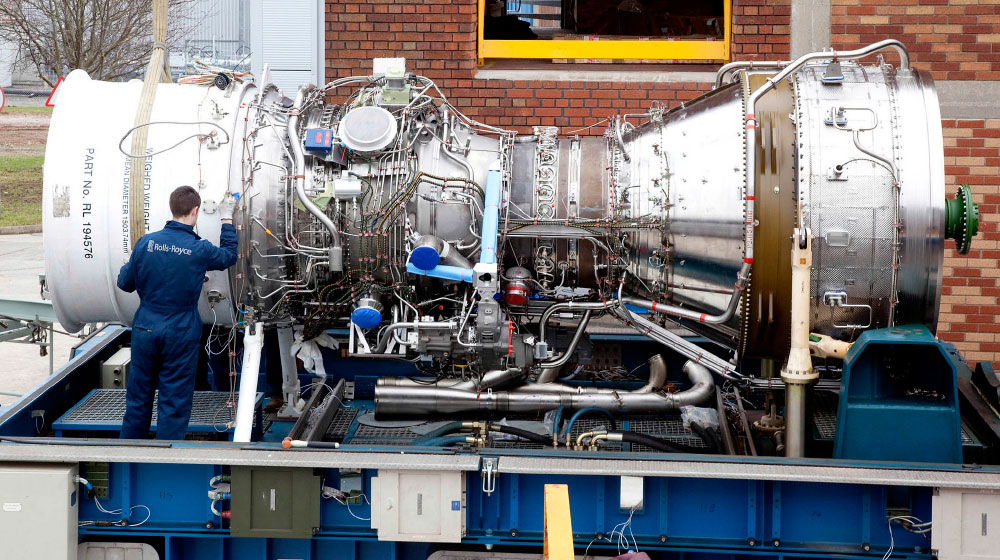
Richard PARTRIDGE: The MT30 is the world’s most power-dense marine gas turbine in service today, a key feature for naval ships where high power in minimum space, whilst meeting the operational power demands of the future, is essential.
MT30 has been specifically designed for 21st century naval ships. It surpasses its predecessors in that it packs a mighty punch of power and uniquely guarantees that power output throughout the life of the ship. This is important for the Royal Navy Queen Elizabeth Class (QEC) programmed with a 50-year service life expectancy; a guarantee that the engine will be able to deliver the power demands of tomorrow such as increasing requirements from upgrades to weapons and radar systems.
It entered service in 2008 with the U.S. Navy’s LCS Freedom-class variant. Rated at 36MW-40MW, not only is MT30 the world’s most powerful marine gas turbine in service today, but it can also deliver its full power in ambient temperatures up to 38°C (100°F), without any power degradation throughout a ship’s life – this means the ship can operate pretty much anywhere in the world without loss of power or performance.
The control system of MT30 provides fully integrated alarm, monitoring, and control functions for the packaged gas turbine, including overspeed protection. An integral backup power supply is an option. A distributed processing architecture uses modern data bus technology to provide improved reliability through simplified wiring and a reduced number of connectors, with main processors and power supplies located on the outside of the package enclosure.
Moreover, the system supports Fully Integrated Control System unmanned operation by making engine control and monitoring available over dual redundant data bus and hard-wired signals for full integration into the platform control system. It can also be set to log predetermined engine/package data for optional off-board engine health monitoring and logistical support.
MT30 has become the gas turbine of choice for many of the world’s advanced naval programs including the U.S. Navy’s Littoral Combat Ship (Freedom-class), all-electric Zumwalt-class destroyers, the Royal Navy’s (RN’s) new Queen Elizabeth Class Aircraft Carriers and Type 26 Global Combat Ship, Italian Navy’s new Landing Helicopter Dock (LHD) multi-purpose amphibious vessel, the Republic of Korea Navy’s FFX Batch II and Batch III Frigates and Japanese Maritime Self Defense Force’s 30FFM/Mogami Class Frigates. The MT30 is also on the export variant of the U.S. Navy’s Freedom-Class Littoral Combat Ship (LCS) – the Multi-Mission Surface Combatant, purchased by Royal Saudi Naval Forces. Also, the Type 26 Global Combat Ship (GCS) is an RN program, but the ship design (and therefore MT30) is also going into the (so far) two export variants of the GCS, i.e., the Royal Australian Navy Hunter Class Frigate and the Royal Canadian Navy Surface Combatant. Therefore, there are seven ship types spanning eleven programs.
“We will see further interest in the MT30 in the future and we anticipate much more success for the engine in future warship programs, hopefully including the Turkish Navy TF2000 guided-missile frigate.”
Defence Turkey: Could you elaborate on the technological competences of the MT30? What are some of the noteworthy technical breakthroughs?
Richard PARTRIDGE: We are the only manufacturer in the world that have provided naval marine gas turbine generators into front-line integrated full electric propulsion (IFEP) powered destroyers and aircraft carriers. We have extensive and proven experience in IFEP powered warships. The Royal Navy’s Type 45 destroyers are powered by Rolls-Royce’s WR-21 engines. Two MT30 main gas turbine generator sets, and two Rolls-Royce RR4500 auxiliary turbine generator sets supply 78MW of total ship power to the U.S. Navy’s Zumwalt-class destroyers. The Royal Navy’s Queen Elizabeth-class aircraft carriers combine two MT30 36MW gas turbine alternators with 4 medium-speed diesel generators delivering about 109 MW of electrical power.
Moreover, the USS Freedom class LCS propulsion system features twin MT30 engines and two diesel engines driving waterjets in a sophisticated combined diesel and gas turbine (CODAG) mechanical arrangement. MT30 has demonstrated excellent performance in service, powering the ship to speeds in excess of 40kts.
Defence Turkey: Could you elaborate on how the MT30 is giving it an edge over its competitors? How does it differ from its western world competitors?
Richard PARTRIDGE: MT30 is designed with approximately 50% fewer parts than other aero-derived gas turbines in its class, to minimize maintenance costs.
The compact and lightweight MT30 is a twin-spool, high-pressure ratio gas generator with a free power turbine, an eight-stage variable geometry intermediate pressure (IP) compressor and a six-stage corrosion protected high pressure compressor. Three stages of variable vanes and blow off valves are provided for compressor handling purposes and a continuous flow of IP delivery air is taken in for bearing sealing and cooling purposes.
Using commercially available fuels, MT30 meets all current and anticipated legislation on emissions and smoke without modification. With the gas turbine change unit (including power turbine) weighing 6,500 kg and the total module weight including enclosure and ancillary components in the order of 30,000 kg (dependent upon options) the MT30 offers a highly competitive power-to-weight ratio. To simplify installation the entire module can be installed on the base plate for a single lift, saving time and money. This is a key differentiator compared to our competitors.
We will see further interest in the MT30 in the future and we anticipate much more success for the engine in future warship programs, hopefully including the Turkish Navy TF2000 guided-missile frigate





