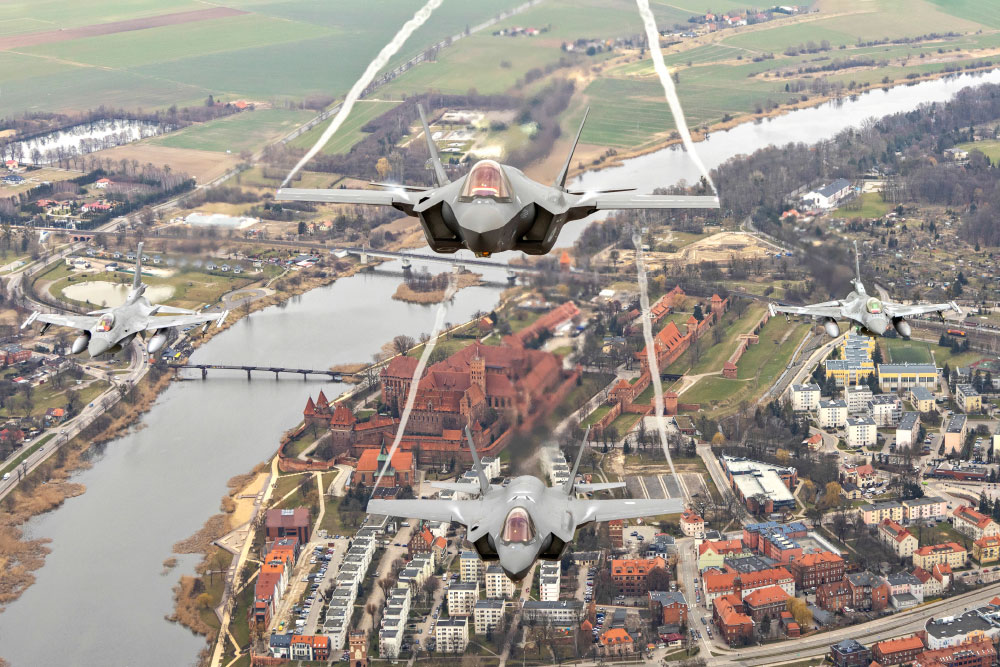
Royal Netherlands Air Force F-35s at Malbork, Poland
In the heart of Europe, on the coast of the Baltic Sea, between NATO and EU members Poland and Lithuania, there is a small piece of land of 223 km2 called Kaliningrad. This strategically important region is Russian territory. Kaliningrad Oblast, which has no land connection with Russia, is 370 km away from its homeland at the closest point. Of course, since there is no possibility of connection by land, both military and civilian transportation to this Oblast can only be provided by sea and air. As you can see, Russian jets generally do not use transponders, do not communicate with Air Traffic Control or prepare a flight plan when entering and leaving this region, which is surrounded by NATO and European airspace. This is where the demanding prevention activities that make up a large part of the Baltic Air Policing (BAP) Mission begin. In short, the most basic aim is to prevent Russian jets from flying in this region by waving their arms.
The BAP Mission is the result of agreements made to achieve a single standard of security in NATO/EU airspace for NATO member states that do not have the necessary air capabilities. Since the three Baltic states, Lithuania, Latvia and Estonia, which joined NATO on 29 March 2004, do not have the necessary air assets to contribute to NATO Air Command on their own soil, Alliance members provide protection to these countries through the Baltic Air Policing.
Russia attacked Ukraine February 24, 2022, after a build-up of military activity on the border. In 2014 it took Crimea illegally and held on to it. NATO has long been concerned about Russia's position. In recent years, joint defense and credible deterrence within the alliance have therefore received increasing attention. NATO does not want to provoke Russia, is not out for confrontation and wants to keep the conversation going. But the alliance is taking measures to adapt to the changed security environment. NATO's actions are defensive and proportionate.
As part of the BAP Mission, NATO forces are deployed at air bases in Lithuania and Estonia, ready to be managed by NATO's Combined Air Operations Center in Germany when necessary. The Lithuanian, Latvian and Estonian Air Forces contribute to the mission as host countries.
NATO Air Policing ensures the integrity of Allies’ airspace and protects Alliance nations by maintaining a continuous 24/7 Air Policing within Supreme Allied Commander Europe (SACEUR)’s area of responsibility. It is a peacetime defensive mission. As the term “policing” suggests, just like the national police forces do on the ground to respond to anything out of the ordinary e.g., protest rally, traffic accident or property offence NATO jets get airborne to monitor so-called events, i.e., unusual situations in the air. Air Policing scrambles are conducted in response to military and civilian aircraft that do not follow international flight regulations and approach Allied airspace. Often these aircraft fail to properly identify themselves, communicate with Air Traffic Control or file flight plans. These responses seek to safeguard NATO airspace and to support the safety of its users.
In February and March 2023, 8 F-35s with 170 soldiers from the Royal Netherlands Air Force will be stationed at Malbork Air Base in northern Poland. These F-35s are aircraft of the 322 Squadron based at Leeuwarden Air Base. 4 of the fighters are available for surveillance of NATO airspace over Eastern Europe. The other 4 will go through a training program with allies and can be deployed quickly. About 35 army soldiers from a team of engineers will help to set up the encampment.
The monitoring task consists of the so-called quick reaction alert. The fighter jets can take off within minutes to intercept an aircraft. This happens, for example, if an aircraft does not identify itself or approaches the airspace without permission. 2 F-35s permanently guard NATO airspace, the other two are reserves. This way commitment is guaranteed. With the 8 aircraft, the Netherlands contributes to the defense of NATO's eastern flank. It also reassures allies in the region.
Dutch F-35s are housed in tents. These aircraft shelters, plus one for vehicle maintenance, were built by a team of 34 army engineers and technicians. An already available hangar and platforms at the North Polish airbase are specially intended for international partners.
Since December 2022, French Rafales deployed to Lithuania have been performing their enhanced Air Policing mission and have trained with Sweden. Rafale fighters from the 30th Hunter Escadre are based in Mont-de-Marsa, southwestern France.
During this deployment, the French detachment has made numerous intercepts of aircraft near Allied territory providing safety and security to all air users in the area. To offer further training opportunities, the French relocated a portion of the detachment in Sweden during a cross servicing training exercise.
Polish, Netherlands and French fighter jets have all been deployed to conduct overall combat readiness and integration training across the eastern flank.
Specifically, at Malbork, Poland – NATO fighter jets are conducting combined air policing drills simulating aircraft intercepts and conducting approach, handover and escort procedures.
Specially for today, Polish MiG-29 and F-16 fighter aircraft as well as Netherlands F-35 jets took off from Malbork to fly 5th generation integration training in Polish airspace. French Rafale fighters flying out of Šiauliai Air Base, Lithuania, joined them to practice multinational formation flying with two Polish C-295 CASA transport aircraft.
“The maneuvers NATO jets conducted today are demonstrating NATO’s ability to plan, coordinate and execute combined air operations,” said Allied Air Command Deputy Chief of Staff Plans, Turkish Air Force Brigadier General Omer Nafiz GÜLMEZOGLU. “Our Joint Force Air Component at Ramstein, Germany, planned and coordinated the interaction of fighters plus transport and refueling aircraft to orchestrate this display of Allied readiness and assurance here along the eastern flank,” he added. The Royal Netherlands Air Force F-35 fighters are currently stationed at Malbork to execute enhanced Air Policing under NATO command and control until early April. Since end of January, they have flown intercept missions and combined training maneuvers with their counterparts from the Polish and other NATO allied air forces. The French Rafale fighters flew in from Šiauliai Air Base, Lithuania, to participate in the flying drills; since last December they augmented NATO’s Baltic Air Policing mission safeguarding skies above Estonia, Latvia and Lithuania.
The flying drills also served to integrate NATO Air Power capability across different aircraft generations assuring the various fighter jets can operate together. The combined display showed NATO’s enhanced Air Policing posture and demonstrated the contribution of Allies to the Deterrence and Defense of the Euro-Atlantic Area.
First A-Scramble (Alfa-Scramble Alpha Scramble is not a training Scramble, but a real Scramble) for Koninklijke Luchtmacht F-35A
In the early hours of 13 February 2023, two Koninklijke Luchtmacht (KLu, Royal Netherlands Air Force) F-35A Lightning IIs, which are temporary based at Malbork air base (Poland), intercepted three Russian Federation-Aerospace Forces (RF VKS) aircraft. The Russian aircraft, two Sukhoi Su-27 Flanker fighters and one Ilyushin Il-20M Coot-A Special Mission Communication Intelligence/Electronic Intelligence (COMINT/ELINT) aircraft approached Polish air space from the Russian controlled Kaliningrad Oblast.
About Polish Mig-29s
Poland will become the first country to deliver fighter jets to Ukraine in the next few days, marking a significant upward step in military backing for Kyiv ahead of an expected counter-offensive. The precedent, involving four Soviet-era MiG-29s as a first installment, could lead to other NATO members providing warplanes, a longstanding Ukrainian request.
The Polish president, Andrzej DUDA, made the announcement in Warsaw. He said the first planes being handed over were inherited from East Germany after the fall of the Berlin Wall. DUDA said the MiGs were coming to the end of their working lives after 30 years but were “still in working order”. The president said that more Polish MiGs were being serviced and repaired in preparation for being handed over to Ukraine. In all, Poland has 28 MiG-29s which are to be replaced over the next few years by South Korean FA-50s and US F-35s





