RUAG - Flourishing Collaboration with Turkish Industry Partners
RUAG has outstanding technological capabilities on land, in the air and in space. Today about 8,100 committed and skilled staff at production locations in Switzerland, Germany, Sweden, Finland, France, Austria, Hungary, Australia and in the USA drive forward the technologies of tomorrow.
RUAG Aviation itself is a leading supplier, support provider and integrator of systems and components for civil and military aviation worldwide. Servicing aircraft and helicopters throughout their entire life cycle, the company’s core competencies include maintenance, repair and overhaul services, upgrades, and the development, manufacturing and integration of subsystems.
RUAG is an authorized service center for OEMs of renown, such as Airbus Helicopters, Bell, Bombardier, Cirrus, Cessna, Diamond, Dassault Aviation, Embraer, Leonardo-Finmeccanica (AgustaWestland), Piaggio, Sikorsky, Pilatus, Piper, and Mooney, as well as a service center for 328 Support Services, Hawker Beechcraft, Viking und MD Helicopters. RUAG Aviation is also a partner to the Swiss Armed Forces and other international air forces. The company is also the manufacturer (OEM) of the Dornier 228, a versatile aircraft for challenging special missions and passenger and cargo operations. RUAG Aviation signed a new agreement, at the Farnborough International Airshow on 13 July 2016, for the sale of 2 new production Dornier 228 aircraft. The versatile aircraft will serve island communities in passenger and cargo operations, providing a reliable and cost-effective link to the mainland.
Airborne Sensor Solutions - Delivering Precision for Surveillance, Border Control, and ELINT capabilities on Desired Platform. RUAG Aviation Makes the Standard Package Available on Dornier 228, Pilatus PC-12 or DHC-6 Twin Otter aircraft.
Dornier 228
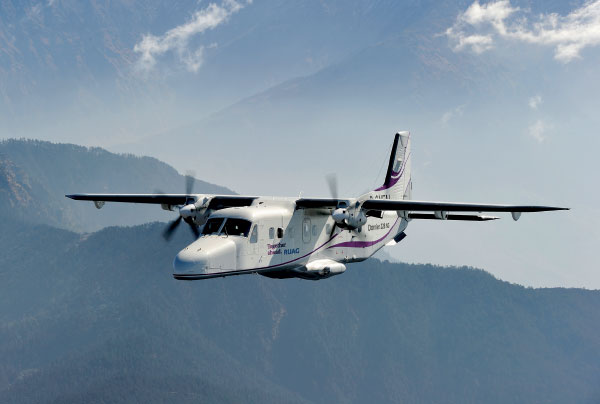
RUAG supplies the Dornier 228 as a special mission, commuter or cargo transportation aircraft configuration based on specific customer requirements. The Dornier 228 is the platform of choice for special mission operations taking place between low level and 10,000 ft. Military and government law enforcement organizations operate the Dornier 228 worldwide for maritime patrol (pollution control, search and rescue, border control, fishery patrol), research flights, surveillance and reconnaissance, and light transport operations (cargo, paratrooper, passenger, medevac).The Dornier 228 is the most versatile and most advanced high-wing aircraft in its class. It features long range, high utilization rates and high payload with state-of-the-art technology and efficiency, enabling pilots to maintain high-caliber situational awareness in the most challenging of missions. Operators of every configuration realize cost-efficient performance combined with a high level of safety. Due to its advanced aerodynamics, the Dornier 228 is able to match or exceed the short take-off and landing (STOL) performance of competitors on the same payload, exhibits excellent crosswind stability, and cruises up to 50 kts faster, while maintaining excellent endurance and up to 10 hours loitering
PC-12 Aerial Survey
Aerial surveying requires an economical and reliable platform with long-range capability and versatility. RUAG Aviation provides an innovative solution to fit the proven Pilatus PC-12 with imaging, LIDAR and photogrammetry equipment. The RUAG Aviation aerial survey solution for the Pilatus PC-12 is economical and highly effective. As owner of the Supplemental Type Certificate (STC), RUAG has designed, developed and engineered this unique modification for new and legacy PC-12 aircraft. As an aerial surveying platform, the PC-12 combines high and low speed with long range, a large pressurized cabin, fuel efficiency and low maintenance requirements. Its short take-off and landing (STOL) capabilities on unprepared surfaces enables it to be based closer to designated surveying areas, thereby maximizing productive uptime.
DHC-6 Twin Otter
With the EASA Part 145 base and line maintenance approval, RUAG Aviation fulfills customer requirements with their in-house capabilities, performing engine overhaul, avionics upgrades, interior installations, aircraft painting, component overhaul and STC design engineering.
RUAG Aviation is the OEM of the Dornier 228
RUAG Aviation is the OEM of the Dornier 228 and provides full life cycle support. RUAG is active in all aspects of Dornier 228 services, producing the aircraft, integrating avionics and all required special equipment, maintaining the aircraft engines and components, providing spare parts and customer support, facilitating training for air and ground crew, and designating Authorized Service Centers. RUAG also sources, overhauls and resells pre-owned Dornier 228 aircraft. RUAG Aviation also maintains the Do328 turboprop and is a Service Center for 328 Support Services for Central European and African clients.
In addition to the full scope of Dornier 228 OEM rights and activities, RUAG is also recognized as a first tier supplier for all major aircraft manufacturers (Airbus, Boeing, Bombardier, Embraer). And RUAG Aviation provides engineering, aerodynamic engineering and manufacturing support for the TRJet program.
Cooperation Opportunities with Turkish Authorities for the Regional Jet Aircraft Program (TRJet)
The TRJet project utilizes a modernized version of the D328, the TRJ328, as a stepping-stone toward production of the Republic of Turkey’s first domestically designed passenger aircraft. Domestic aviation companies including Turkish Aerospace Industries (TAI), Aselsan, TEI, Havelsan, Alp Aviation, Kale Aviation, Turkish Cabin Interior Inc. (TCI), and others are expected to participate in the project in coordination with SNC and SSM in manufacturing of the subsystems of the aircraft, which will be produced in Turkey. The companies are set to leverage existing capabilities with technology and knowledge sharing with Germany and the USA.
TRJet anticipates the creation of thousand jobs in Turkey. Primarily, this project is about the transfer of technology and establishing a credible aircraft Original Equipment Manufacturer (OEM) in Turkey to further projects and job creation that utilizes local subcontractors and vendors. Special incentive funds are being provided to help increase the capabilities of local companies and to engage those who are not currently operating in the aviation industry, but have capabilities applicable to the project.
Turkish aviation and aerospace industry enthusiastically strive toward the production of the first domestically produced regional jet in Turkish history. Both Aircraft will be built and certified at a new commercial facility in Ankara, owned by TRJet. Enhancements are being made to the flight deck, future-proofing the aircraft in an effort to accelerate the timeline, anticipating an inaugural flight of the TRJ328 aircraft in 2019.
RUAG Business Relations with Turkey over the Years
Current RUAG contracts with Turkish Aerospace Industries include Aerodynamic Services for vertical lift off and fixed-wing aircraft projects, collaborating with TAI for aero structures production. RUAG supplies wind tunnel mass balances to Roketsan. An ongoing knowledge exchange has flourished over the years with Turkish industry partners. RUAG participates in Turkish Industry Forums such as IDEF, ICDDA.
Mobile Optical Landing Guidance System for Unmanned Airborne Vehicles (OPATS)- Targeted for Use in the Future with TAI UAV “Anka”
RUAG Aviation developed and produces OPATS (Object Position and Tracking System). The laser-based, automatic landing system for UAVs is an automatic UAV landing system that continuously measures the dynamic positions of the object of interest. The measured positions are transmitted with a high update rate to a control system, and may be used as feedback in a speed or position control loop. The main purpose of OPATS is to provide reliable position data on the UAV during its approach and landing phase, and to send the data to the Ground Control Station (GCS). The system is cost-effective and easy to deploy, operate and maintain, while the device is run on a standard local battery and can be operated outdoors under a variety of climatic conditions.
Aerodynamic Design and Testing with Wind Tunnel for TAI’s “Hürkuş” - Trainer Aircraft and Light Multipurpose Helicopter
RUAG Aviation collaborated with TAI (Turkish Aerospace Industries Inc.) on the “Hürkuş” New Generation Basic Trainer aircraft and the Light Multipurpose helicopter projects during the development and implementation phases of the respective projects, providing their state-of-the-art aerodynamic design and testing with LWTE (Large Subsonic Wind Tunnel in Emmen). As a part of Turkey’s new generation basic trainer development program, TAI subcontracted RUAG Aviation’s Aerodynamics Department to perform tests in the LWTE. RUAG was responsible for designing, developing and instrumenting a 1:3.5-scale model, and for performing the wind tunnel tests in its facility.
RUAG Aviation’s LWTE is used extensively for the development of passenger, transport and trainer propeller aircraft, due to its highest precision and efficient measuring process as well as the company’s widespread competencies in the fields of aerodynamics, development, instrumentation and system engineering. Especially for conventional as well as for counter rotating open rotor (CROR) multi-engine airplane configurations, the challenges for powered wind tunnel testing lie in the large power density that is necessary to realistically simulate the propulsion system and the geometrical constraints e.g. for the sensors within the given scaled aerodynamic nacelle lines. The mainstay of the aerodynamics department’s services is centered on the operation of the continuously driven wind tunnels.
Land and Space Capabilities of RUAG
RUAG acts as a strategic technology partner to a large number of original equipment manufacturers, security organizations and land forces. The Defense division is a leader in maintaining and upgrading heavy weapon systems and also maintains communications systems and both virtual and live simulators. The Ammotec division is a market leader in small-caliber ammunition, pyrotechnic elements and components for the Hunting & Sports and Defense & Law Enforcement business areas as well as the construction industry.
The Space division, with over 40 years of experience in the development of cutting-edge space technologies, is a leading supplier of products for the institutional and commercial space markets in Europe and the USA. Outside these two core markets, special-purpose RUAG products also contribute to the success of almost all major space projects.
Spacecraft Launch Vehicle Payload Fairings and Payload Separation Mechanisms
Since 1974, RUAG Space has been responsible for the development and production of all Ariane launcher payload fairings. Currently, fairings are produced for the European Ariane 5 and for the United Launch Alliance Atlas V-500 launch vehicles as well as for the new small European Launcher Vega. The technology provides low-shock pyrotechnical separation and comprehensive simulation of separation dynamics. The fairings are built in composite technology based on aluminum honeycomb cores with carbon fiber reinforced plastic face sheets. This construction method allows the combination of low mass with high stiffness. To date, all payload fairings built by RUAG Space in a variety of sizes and configurations have an unrivalled 100 % mission success. RUAG Space not only designs and manufactures payload fairings but provides the customer also with the required support on the launch site. The data regarding the payload fairings’ dynamic behavior during separation is routinely measured and downlinked to the ground control station and analyzed by RUAG Space specialists.
Ariane 5
The European Ariane 5 launcher is currently the most successful Rocket for commercial satellite launches on the world market. It can carry two satellites with a total mass of up to 10 metric tons into the geostationary transfer orbit.
Atlas V-500
The Atlas V-500 rockets are constructed by United Launch Alliance (ULA), a joint venture between the U.S. companies Boeing and Lockheed Martin. These launchers are primarily used to provide reliable launch services for the U.S. government. Depending on the actual configuration the Atlas V launchers can lift up to 13 metric tons of payload into the geostationary transfer orbit.
Vega
Vega is Europe‘s dedicated launcher for small and medium-sized payloads up to 1.5 metric tons. It will make access to space easier, quicker and cheaper.