Schiebel Provides Advanced Technology for UAS
The Schiebel Group of Companies based in Vienna/Austria was founded in 1951 and focuses on the development and production of state-of-the-art mine detection equipment and high-tech VTOL Unmanned Air Systems.
The Schiebel Group of Companies’s entry to international markets occurred with development of the AN-19/2 Mine Detecting Set for the Swedish Army but the major break trough was achieved when Schiebel won the contract for the AN-19/2 Mine Detecting Set, designated AN/PSS-12, as standard equipment for the U.S. Army in 1991, the company has built an excellent international reputation for the development and production of quality products for military and counter-mine use.
Starting in 1994, Schiebel has also been engaged in the development of unmanned helicopters and, in early 2000, successfully launched the CAMCOPTER 5.1 UAV System on the market. This system has undergone a complete technical redesign in the following years and was presented to the public in 2005 as the CAMCOPTER S-100. With its integrated autonomous flight control and unique performance data, this unique VTOL platform won the first major contract for Schiebel from the United Arab Emirates. The CAMCOPTER S-100 thus gained a worldwide leading position in the rapidly expanding UAS market.
Since 2010 Schiebel expanded its technical services with the launch of its Carbon Composites Division, offering high quality custom-made composite services.
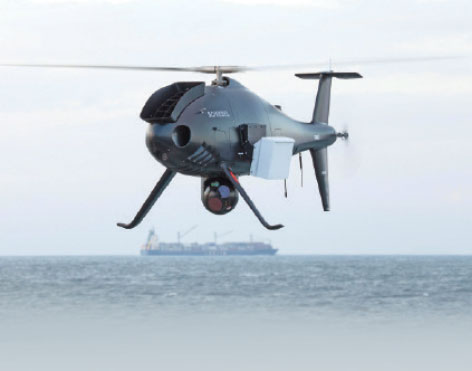
Advantage of many surveillance applications that The S-100 especially stands out for its hovering capability. Key advantage for The S-100 is; visual surveillance using day/night camera systems while maintaining a fixed perspective or ground mapping for geotechnical or agricultural assessments are civilian applications where slow or hovering flight.
The technological competence of CAMCOPTERS-100
Schiebel’s CAMCOPTER S-100 Unmanned Air System (UAS) is a proven capability for military and civilian applications. The Vertical Take-off and Landing (VTOL) UAS needs no prepared area or supporting launch or recovery equipment. It operates in day and night, under adverse weather conditions, with a beyond line-of-sight capability out to 200 km, both on land and at sea. The S-100 navigates via pre-programmed GPS waypoints or is operated with a pilot control unit. Missions are planned and controlled via a simple point-and-click graphical user interface. High definition payload imagery is transmitted to the control station in real time. Using “fly-by-wire” technology controlled by a triple-redundant flight computer, the UAV can complete its mission automatically. Its carbon fiber and titanium fuselage provides capacity for a wide range of payload/endurance combinations up to a service ceiling of 18,000 ft. In its standard configuration, the CAMCOPTER® S-100 carries a 75 lbs/34 kg payload up to 10 hours and is powered with AVGas or heavy fuel.
Schiebel’s Mine Detectors Fit Specific Requirements
Schiebel’s AN-19/2 is the standard mine detector for the United States Army as well as many other modern military organizations. Schiebel produces a variety of mine detectors to fit specific requirements. One such innovation is the MIMID Miniature Mine Detector and entered a new generation in handheld mine detection with the ATMID All Terrain Mine Detector. The ATMID is engineered specifically to detect low-metal-content mines in all types of soils and terrain conditions. To expand the capability of its demonstrated mine detection technology to a vehicle-based search-and-mark system, Schiebel introduced the VAMIDS Vehicular Array Mine Detection System. VAMIDS is a versatile, cost-effective system which can quickly locate mines on roads, tracks and open country.
Schiebel also serves aviation, telecommunications and racing markets with its composites division.
Growing Demand for VTOL in Turkey
With providing a very capable solution with the S-100, already in operation worldwide for civil and military organizations, on land and on sea, Schiebel is open for any opportunities that may arise in the future and will consider the local requirements and conditions in Turkey.