Strategic & Sub-strategic Naval Strike Missile Capabilities in Turkey

According to Defense & Aerospace Industry 2020 Performance Report that prepared by Defense Industrial Manufacturers Association (SASAD) through the evaluation of figures obtained from 85 of the 205 member companies and issued in June 2021, with 77.566 employees and advanced technologies and capabilities Turkish Defense & Aerospace industry has realized around US$8.856 Billion (it was US$10.884 Billion in 2019, so there was 18.64% decrease) turnover and US$2.266 Billion worth of exports in 2020. Turkish Weapons, Ammunition, Rocket and Missile Sector has realized US$855 Million of the total turnover (represents around 9.65% of the total turnover), around US$274 Million of the exports (represents around 12.09% of the total exports) and US$759 Million (has around 12.3% share) of the order total/backlog (US$6.175 Billion) in 2020. With these figures the Turkish Weapons, Ammunition, Rocket and Missile Sector (which also includes Small Arms) is likely the fourth strongest sector of the Turkish Defense & Aerospace Industry, coming after Military Aviation, Land Platforms and Civil Aviation Sectors. All estimates show that the Turkish Weapons, Ammunition, Rocket and Missile Sector will grow further in 2021.
The backbone of the Turkish Weapons, Ammunition, Rocket and Missile Sector is formed by state-owned Machinery and Chemical Industries Corporation (MKEK), Defense Research and Development Institute (SAGE) of the Turkish Scientific and Technological Research Council (TÜBİTAK SAGE) and ROKETSAN (55.39% of the company shares are owned by the Turkish Armed Forces Foundation (TAFF), While the MKEK is primarily focused on small arms, infantry rifles, 20mm and 35mm air defense gun systems, 107mm and 122mm unguided rockets, artillery weapons and ammunitions, TÜBİTAK SAGE, which is Turkey’s one of the most important research and development institutions, and ROKETSAN are placed in the hearth of the indigenous surface-to-surface and air-to-surface strategic and sub-strategic cruise missiles projects including SOM Air Launched Cruise Missile (ALCM) Family, ATMACA Anti-Ship Cruise Missile (ASCM) with land attack capability, AKBABA Anti-Radiation Missile, OMGF (Medium Range Anti-Ship Missile) and GEZGİN Sea & Land Based Cruise Missile, which will provide deep strike capability to the Turkish Armed Forces (TAF).
According to current project model that being implied by Turkish defense procurement authority Presidency of Defense Industries (SSB), under the Turkish Presidency, in strategic and sub-strategic cruise missile programs design, development and qualification studies/stages of the project as well as certain technological development processes are conducted by TÜBİTAK SAGE, while its industrialization and series production processes are conducted by ROKETSAN. ASELSAN, majority of the company shares are owned by Turkish armed Forces Foundation (TAFF), on the other hand is delivering important subsystems such as RF and IIR seekers for these missile systems. In SOM ALCM Family (including SOM-A, SOM-B1, SOM-B2, SOM-C1 and SOM-C2) and GEZGİN Cruise Missile Programs, TÜBİTAK SAGE serves as Prime Contractor and ROKETSAN serves as Main Sub-Contractor. Whereas in ATMACA, OMGF (Medium Range Anti-Ship Missile) an SOM-J Projects ROKETSAN serves as Prime Contractor and TÜBİTAK SAGE serves as either Subcontractor or Main Sub-contractor (in SOM-J).
Regional conflicts especially the civil war in Syria that broke out in 2011 have demonstrated the importance of deep-strike capability of cruise missiles, which are more accurate at long distances than the more risky and expensive manned combat aircraft strikes (especially when the airspace is closed to flights with Russian S-400 Triumph SAM System) and, deciding that it needs deep-strike capability to hit critical targets hundreds of kilometers from its borders, Turkey has been working hard to develop indigenous strategic and sub-strategic missiles with deep-strike capability under a phased approach since 2006. With the acquisition of deep-strike capability through indigenously developed and manufactured cruise missiles, the deterrence of the Turkish Armed Forces (TAF) in the region will also increase.
In this article we will focus on the ATMACA, ASMC with land attack capability, OMGF (Medium Range Anti-Ship Missile), SOM-J, SOM-C1 and SOM-C2 Air Launched Cruise Missiles (ALCMs) and GEZGİN Sea & Land Based National Cruise Missile Program that will bring long-range and high-precision conventional deep-strike capability to Turkey.
ATMACA ASCM to Enter Turkish Naval Forces Service By the End of 2021
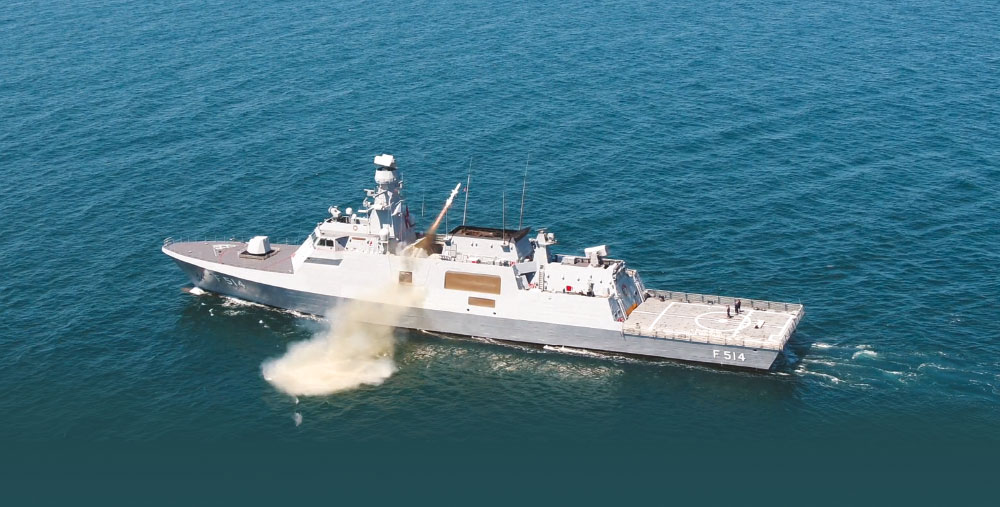
Within the scope of the ATMACA (Sparrow Hawk) Anti-Ship Cruise Missile Project, which was launched on May 8, 2009, to meet Turkish Naval Forces Command (TNFC)’s requirement for a new generation anti-ship cruise missile (ASCM) with land attack capability through national means and capabilities, final live firing test before its entry into the Turkish Naval Forces (TNF) service was performed at the Sinop Missile Test Range from TCG Kınalıada (F-514) Corvette off the coast of Sinop in the Black Sea region on June 18, 2021. This live firing was recorded as the 4th guided firing test of the ATMACA ASCM from TCG Kınalıada, in service with the TNF.
During the live firing test that conducted within the scope of ATMACA Serial Production Line Qualification Tests, contrary to previous live firing tests conducted in February 2021, rather than a ROKETSAN made stationary floating platform target, decommissioned salvage and submarine rescue ship IŞIN (A-589/ex-USS SAFEGUARD ARS-25) was used as a target ship. She was 65.07m long and had a displacement of 1.650 tons. Missile fired at this test is assumed to be one of the missiles from ATMACA ASCM serial production batch (powered by TR40 turbojet engine) that manufactured under the on-going Low-Rate Initial Production (LRIP) Phase and expected to be delivered to the TNFC in coming days. The ATMACA ASCM was launched into serial production in 2018 with the award of Serial Production Contract by SSB to Main Contractor ROKETSAN on October 29, 2018. The live firing test was observed by Turkish MoND Hulisi AKAR, Force Commanders, Head of the Digital transformation Office Ali Taha KOÇ, Vice President of Defence Industries and ROKETSAN Chairman Faruk YİĞİT, ROKETSAN General Manager Murat İKİNCİ and foreign delegations (including the ones from Azerbaijan, Indonesia and Pakistan) onboard the TCG Kınalıada Corvette.
Fired from a 4-cell launcher (similar to Mk-141) placed on the port side of the TCG Kınalıada Corvette ATMACA approaches stationary target ship IŞIN, which was deployed 70.2km away from the TCG Kınalıada corvette, in the sea-skimming mode with an altitude between 1 and 1.5 meters and performed a direct hit amidships from the starboard side. After the impact ATMACA ASCM, with live warhead (250kg class), punched through the hull and created a big hole just above the waterline. The damage inflicted on the target ship IŞIN by ATMACA ASCM clearly seen in the footage shared on June 18. Since it did not carry any fuel, ammunition or any incendiary material, which may create secondary explosions and spread the fire, IŞIN did not sink immediately after the ATMACA impact. It took some 50 minutes for her to sink. So there was enough time for some to go onboard and survey/recorded the damage from inside. In the shared footage, the heavy damage of the ATMACA’s warhead to the ship's hull on the horizontal axis was clearly visible.
The live firing test was monitored by a GÖREN ISR aircraft from the air and ULAQ AUSV from the surface. Positioned around 3.5km from the target ship IŞIN, the ULAQ Armed Unmanned Surface Vehicle (AUSV), developed by Turkish companies Meteksan Defence and ARES Shipyard, monitored and recorded the sea-skimming flight and impact moment of ATMACA on the IŞIN from a close distance. ULAQ AUSV also executed close-up damage assessment mission within the scope of this firing test. Videos/footages recorded during live ATMACA firing test and showing both the impact time and the damage the missile has created inside target ship IŞIN were shared by President Recep Tayyip ERDOĞAN, Turkish MoND and companies taking role in ATMACA Project on June 18.
Commenting on firing test ROKETSAN General Manager Murat İKİNCİ disclosed that delivery of first batch of serial production ATMACA ASCMs will commence soon and the missiles will begin to be deployed on ADA Class Corvettes by the end of this year. “With the ATMACA, Turkey gained the ability to manufacture and use its own anti-ship missiles” İKİNCİ said. Delivery of first batch of serial production ATMACA missiles to the TNFC was previously announced as 2021 Q2 by Vice President of Defense Industries and ROKETSAN Chairman Faruk YİĞİT.
Prior to this Serial Production Line Qualification Test, ATMACA missile was tested with telemetry head on February 3, 2021 and with live warhead on February 4, 2021. Both firing were conducted from TCG Kınalıada in the Black Sea, northeast of Sinop and ATMACA missiles fired from TCG Kınalıada Corvette successfully scored a direct hit on the ROKETSAN made stationary floating platform target, which imitated a surface ship. With this test firing, the effectiveness of the ATMACA missile’s warhead was also tested for the first time on the missile. Both launches from the TCG Kınalıada Corvette were monitored live by the test measurement equipment at the Sinop Missile Test Range (such as radar systems and high-speed cameras that can measure the missile's trajectory and speed) and from the air by a UAV.
The Euro80 Million valued ATMACA Surface-to-Surface Guided Missile Project contract was signed between SSB and Prime Contractor ROKETSAN on May 8, 2009 and became effective on October 14, 2009. ASELSAN (Ku-Band Active RF seeker, Fire Control System, Missile Computer and Power Distribution Unit) and Research Centre Command (ARMERKOM, Fire Control System and Operator Console Prototypes) of the TNF are also taking active role in the project as sub-contractor. According to original plan first delivery was scheduled to take place on December 31, 2016 and a total of 100 ATMACA missiles were to be procured. With indigenously designed, developed, manufactured, tested, and qualified ATMACA ASCM Turkey becomes one of elite countries in the world that can produce indigenous anti-ship cruise missile. It is claimed that the ATMACA ASCM can withstand 12+G at the terminal phase, and the missile was able to fly only 93 cm above the sea surface at the time of impact. In a statement he gave in November 2019, President of Turkish Defense Industries Prof. İsmail DEMİR pointed out that the unit cost of the ATMACA Surface-to-Surface Guided Missile was under US$500,000.
Following the completion of design and prototype manufacturing efforts and ground tests performed at laboratory environment, first test firings of the missile with Ballistic Test Missile prototypes were conducted in 2014 and 2015. Under the ATMACA Surface-to-Surface Guided Missile Project, the first controlled/guided flight tests were carried out in November 2016 (with Controlled Test Missiles). Later in parallel with the maturation of the design and the product, three different guided firing tests were conducted with the prototypes of the ATMACA ASCM (Guided Test Missiles fitted with dummy warheads, not with live warheads) in 2019 (in May, on September 18, and on November 3). While the previous firing tests were carried out toward the Black Sea from a land-based launcher at the Sinop Missile Test Range, the first Naval Launch Test was conducted with the ATMACA ASCM on the morning of November 3, 2019 from TCG Kınalıada Corvette. Within the scope of the ATMACA Surface-to-Surface Missile Project, three guided flight tests were conducted at Sinop Missile Test Range in 2020 (on July 1, September 25 and December 18). With scoring direct hits at these tests ATMACA has also completed the product qualification test process with success and received green light to enter TNF service. Under the Prototype Production Phase, I believe that around 30 ATMACA ASCMs were produced for flight/firing tests and qualification activities and at least 20 of them were used at tests. More than 20 tests have been carried out by ATMACA missile and continuous improvement has been achieved since November 2016.
Series production ATMACA ASCMs will be initially deployed at TCG Kınalıada and TCG Burgazada Corvettes thanks to their indigenous GENESIS ADVENT Combat Management System and then at İSTİF Class Frigates. BARBAROS Frigates, which will be integrated with GENESIS ADVENT CMS within the scope of on-going Mid-Life Upgrade (MLU) Project are also to be armed with ATMACA ASCMs.
ATMACA missile prototypes were powered by SAFRAN Power Units (ex-Microturbo) TR40 Turbojet Engines (generating 250-340N/2.5-3.4kN/560-750lbf) that ordered in 2013 summer. It is estimated that some 30-missile prototypes were manufactured for testing purpose. The ATMACA ASCMs being manufactured under LRIP Phase of the Project are also powered by TR40 Turbojet Engines. But since ROKETSAN has been experiencing difficulties in the supply of TR40 engines in large quantities from France due to diplomatic/politic problems between Turkey and France and there are not sufficient amount of TR40 Turbojet Engines at hand/stocks for Full Rate Production Phase the search for alternative turbojet engines was launched. However, since different foreign engine alternatives that evaluated would have required significant design changes and qualification repetition in SOM and ATMACA missiles, it has been decided to continue with indigenously developed turbojet engine KTJ-3200, which currently meets the requirements of both SOM and ATMACA missiles. Kale R&D company will deliver the first batch of serial production KTJ-3200 engines in 2021. Qualification tests of the KTJ-3200 engine were completed in the first quarter of 2021, and activities for its integration into SOM ALCM started during the first half of 2021. Acceptance tests of the KTJ-3200 engine was previously scheduled to be completed in June 2021. It is aimed to carry out the first firing test with the KTJ-3200 powered SOM ALCM (it will also feature some other domestic components) in 2022. Developed indigenously by Kale R&D company under a US$25 Million R&DE contract awarded by the SSB on February 22, 2012 the KTJ-3200 (Kale Turbojet-3200) turbojet engine will replace TR40 engines on both ATMACA and SOM Air Launched Cruise Missiles (ALCMs). The KTJ-3200 Turbojet Engine is 77cm in length, 30cm in diameter, and has a total weight of 50kg. The KTJ-3200 engine can generate 900hp/3.2kN (719.3lbf/327kgf) of thrust and is designed for a flight altitude of 5.000m and 0.95 Mach (1.095km/h) flight speed.
Developed with national means and capabilities in order to meet the operational requirements of the TNFC in surface warfare; the ATMACA subsonic ASCM has a total length of 5.2m with a solid rocket booster (operating some 6 seconds), and 4.8m without booster, body diameter of 350mm, and a launch weight of 800kg. It is able to carry 250kg high-explosive warhead with armor-piercing capability more than 200km range. It is estimated to have 350mm diameter and 1.4m wingspan. ATMACA is able to fly over and around landmasses, travel in sea skimming and super sea skimming modes (at one firing test it descended to 93cm before hitting the target), and then make random maneuvers (3D passive ranging) in the terminal phase, making it harder to stop by enemy CIWS. Thanks to indigenously developed KEMENT Tactical Data Link System ATMACA has target update, re-attack, re-target and mission abort capabilities. In addition to Active RF Seeker ATMACA also features GPS/INS Guidance System, Radar Altimeter and Barometric Altimeter. TNF has already started its efforts to procure land-based version of ATMACA ASCM. Undisclosed number of land-based ATMACA ASCM Coastal Defense Systems (on mobile land-based launch platforms) will be procured and to be deployed especially at Eastern Mediterranean for coastal defense purpose.
Launched in 2019 the ATMACA Phase II (ATMACA Block II) Project covers the development of ATMACA ASCM’s submarine-launched version. The new missile, dubbed the “ATMACA Block II” can be launched from the 533mm diameter torpedo tube of submarines through a special buoyant capsule (Encapsulated ATMACA Block II, like the Encapsulated Harpoon). The ATMACA Block II ASCM will use dual-mode seeker, the active radar (RF) seeker with ECCM capabilities and imaging infrared (IIR, with a cooled MWIR Band sensor) seeker, to search and hit the target. In time ATMACA Block I and Block II ASCMs will replace the surface launched RGM-84A (being phased out of service), RGM-84D, RGM-84G and RGM-84L Harpoon Block I and Block IIs as well as UGM-84C and UGM-84G Sub-Harpoon ASCMs in TNF service. It is estimated that there are some 200 RGM-84 series and 30 UGM-84 series Harpoon missiles in TNF inventory.
The submarine-launched cruise missiles, even with conventional warheads, are accepted as strategic weapons. By integrating ATMACA Block II SLCMs, with land attack capability, into existing submarines, TNF will gain its indigenous submarine-based sub-strategic deep-strike capability before the deployment of GEZGİN SLCMs at MİLDEN submarines some time in 2030s.
Contrary to Harpoon AShM, which climbs to an altitude of 600m after launch, ATMACA follows a low altitude profile when launched. I estimate that ATMACA ASCM climbs to 100 to 150m after launch and then (soon after the booster separates and sustained flight begins) drops to a cruise profile at below 30m. The INS/GPS guidance system, assisted with Barometric Altimeter and Radar Altimeter, controls the missile during the midcourse and active radar seeker with ECCM capability takes over for the terminal phase. Once the target is acquired by the Ku-Band Active RF Seeker ATMACA drops to 5 to 10m for its final run. More accurate inertial navigation enables late active seeker activation. During the terminal phase, evasive maneuvers (12G+) are performed to escape the ship’s hard kill defenses (CIWS). The missile shall descend to about 1m before impact or can follow a pop-up/dive-attack profile. Thanks to its over-the-horizon engagement capability where another platform, such as P-72 MPA or a S-70B SeaHawk ASW/ASUW Helicopter took of from the launching vessel, can provide the targeting data via data link (KEMENT).
OMGF First Test Firing is Expected to Take Place in 2021
The OMGF (Medium Range Anti-Ship Missile) Project was launched in 2017 for the replacement of the Penguin Mk2 Mod7 Anti-Ship Missiles in the inventory of TNF, which are about to reach the end of their service life in 2020s, with a new generation and indigenously designed anti-ship missile.
The OMGF Project was undertaken by ROKETSAN in cooperation with other Turkish companies such as ASELSAN and TEI. The OMGF, which looks very similar to the ATMACA ASCM and even a scaled model in appearance, will be propelled by a solid-fuelled booster and liquid-fuelled turbojet engine like ATMACA. The missile features foldable wing design and the air intake (NACA-type) of the turbojet engine is mounted under the rear section of the fuselage (just behind the folding wings) similar to ATMACA. As with the ATMACA, the OMGF will also feature a two-way encrypted data link, INS/GPS, a Radar Altimeter and a Barometric Altimeter. But contrary to ATMACA Blok I ASCM, the OMGF is believed to feature “dual mode” seeker. The very large seeker head mounted at the tip of the missile may contain both the IIR Seeker (SWIR Band), and active RF Seeker (ATMACA B2) or a Passive RF Seeker (AKBABA ARGM) or a Semi - Active Laser (SAL) Seeker. The OMGF will be powered by the TJ-300 Turbojet Engine developed by TEI. First ignition ceremony of TJ-300 engine was conducted at the Miniature Jet Engine Test Rig at TEI’s premises on June 19, 2020. With a power output of 1.300N (around 400hp) the TJ-300 Turbojet Engine is able to reach Mach 0.9 at 5.000ft altitude and thanks to its compact design has an outer diameter of 240mm and weighs less than 30kg. As a result of on-going development efforts TEI has managed to reduce TJ-300’s diameter from 240mm to 224mm and increase its thrust from 1.300N to 1.342N. According to TEI, the TJ-300 is the first turbojet engine able to generate a thrust of 1.342N and weight less than 30kg. TEI has been working on the TJ-300 engine since 2018 Q1. First test firing with OMGF is expected to take place before the end of 2021.
According to the information relayed during the first ignition ceremony, the OMGF is 3.2m long and weighs 300kg+. It is estimated to have a range of around 100-150km depending launch speed and altitude. The OMGF can be launched from a number of different weapons platforms including Helicopters, Maritime Patrol Aircraft and Surface Vessels (FACs).
Answering Anadolu Agency correspondent's questions after the ATMACA firing test on 18 June, ROKETSAN General Manager Murat İKİNCİ said that they have also started work on the Medium Range Anti-Ship Missile (OMGF), a scaled version of of ATMACA missile. “We think that our Medium Range Anti-Ship Missile (OMGF) will create a much more serious dynamic effect since it can be launched from helicopter platforms. With the experience and knowledge we gained in ATMACA, we will complete this project in a very short time and put it into the service of Turkish Armed Forces (TAF). The OMGF Project is currently in the Development Phase,” said İKİNCİ.
Meanwhile responding our question on whether they have any plan for adding a Anti-Ship Missile capability to the P-235 and P-72 Maritime Patrol Aircraft (MPAs) in the inventory to gain the Anti-Surface Unit Warfare (ASUW) capability and to that end, is the integration of the Medium Range Anti-Ship Missile (OMGF) developed by ROKETSAN into to the aircraft on the agenda Naval Air Commander Rear Admiral Alper YENİEL said, “In order to fully reflect the operational effectiveness and deterrent effect of MPAs to the operational field, the development of modern, lightweight air-to-surface missiles with indigenous/national facilities and enabling their integration to MPAs are quite critical. Within the scope of the on-going Air-to-Surface Guided Missile (ASM) Development and Integration Project, it is planned to provide the P-235 and P-72 D/K Aircraft in the inventory with ASM capability with a minimum range of 25 nautical miles for ASUW role.”
SOM-J 5th Generation ALCM
The SOM-J is a 5th generation, medium-to-long-range, all-weather, high-subsonic air-to-surface standoff cruise missile for sea and land targets. Stealthy and precise, the SOM-J is designed for use against heavily defended, high-value anti-surface warfare (ASUW) and land targets. These include surface-to-air missile sites, exposed aircraft, strategic assets, command and control centers and naval vessels (either stationary or moving).
Even Turkey has been expelled from the F-35 Joint Strike Fighter Program in July 2019 the SOM-J Project did not stop and efforts are still on-going to perform first test firing from an TurAF F-16 by the end of 2021. Turkey has a plan to integrate SOM-J to both F-16 and TF-X/MMU fighter jets of the TurAF as well as on Unmanned Combat Air Vehicles (UCAVs) including AKSUNGUR of TUSAŞ and AKINCI of Baykar Savunma. Integration efforts on AKINCI UCAV started during the first half of 2021. In this way, cruise missiles will be fired from UCAVs to penetrate deep into the enemy line and will be directed by pilots at the Ground Control Station to hostile targets. As one of the leading countries in the world in UAV technologies, Turkey will also open a new page with the UCAV-Cruise Missile concept.
The first release test of SOM-J, aimed to demonstrate safe separation from the launching aircraft, was successfully conducted from a F-16C aircraft of the 401st Flight Test Squadron at the Sinop Test Range in July 2018. The SOM-J that was released from an F-16C was a glide-only weapon with an active autopilot, but without a live engine and warhead. The first test firing with a SOM-J that to be fitted with live engine (an evolved version of SAFRAN Power Unit’s TR40 Turbojet Engine) but without live warhead, against a target was planned to be executed in 2020 but did not take place. According to current schedule first firing test will take place by the end of 2021. For this purpose flight tests onboard a F-16C aircraft of the 401st Flight Test Squadron have already begun as of March 2021. An F-16C Block 40 aircraft of the 401 Squadron was photographed during flight test with SOM-J KTM-2 (Controlled Test Missile-2/CTM-2 with autopilot/autonomous control capability but no IIR seeker) missile and CDART (Camera Data Acquisition Recording Telemetry) Pod (in AIM-120 missile shape) in March 2021.
The SOM-J has been designed specifically to fit in the confining weapon bays of the F-35 JSF and it is one of only two cruise missiles that will fit into the F-35’s bays. The other is Raytheon/Kongsberg’s Joint Strike Missile (JSM).
Building on existing SOM ALCM technologies already in service with the Turkish Air Force (TurAF) the SOM-J is being developed by ROKETSAN in partnership with TÜBİTAK SAGE and ASELSAN. As the subcontractor of ROKETSAN TÜBİTAK SAGE is responsible for missile design and integration. According to TUBITAK 2019 Annual Activity Report that issued in April 2020, in 2019 system level ground tests and laboratory environment verification studies of the SOM-J missile were carried out. And within the scope of Electromagnetic Interference/ Electromagnetic Compatibility (EMI/EMC) tests system level laboratory environment verification studies have been completed. According to TÜBİTAK 2020 Annual Activity Report SOM-J’s environmental conditions and ground tests were completed in October 2020.
Powered by Improved TR40 Turbojet Engine the SOM-J has a length of 4.9m, a launch weight of around 540kg and a range of 275km+. It carries a 140kg high-explosive, fragmentation, semi-armor piercing warhead and includes an IIR seeker (with MCT based cooled MWIR detector). Meanwhile, according to my sources within the scope of recently completed product improvement efforts thanks to use of composite material in the SOM-J fuselage a significant reduction (almost 50% is claimed) in weight has been achieved. While it is stated that the results of this efforts have been approved, there is no clear information about whether the Modified SOM-J design will turn into a product.
The SOM-J uses an INS/GPS, Terrain Referenced Navigation (TRN), Image Based Navigation (IBN) and Automatic Target Acquisition (ATA)-based guidance system. A two-way networking data link (Link-16) will provide Network Enabled Weapon (NEW) capability along with Target Update, Re-Targeting, Mission Abort and Bomb Hit Indication (BHI) capabilities.
SOM-C1 and C2 ALCMs with Anti-Ship Capability
On October 26, 2018, President of Defense Industries Prof. İsmail DEMİR announced via his social media account that the Contract for the Serial Production of the Precision Guided Stand-Off-Munition (SOM) Project was signed between the Presidency of Defense Industries (SSB) and Prime Contractor ROKETSAN. ROKETSAN previously secured a contract from Turkish MoND for the industrialization and series production of SOM-A and SOM-B1 ALCMs in early 2013. The contract awarded in October 2018 is believed to cover series production of SOM-B2 and development of new members of the SAM ALCM Family namely C1 and C2. It is estimated that so far, a total of 495 SOM ALCMs have been ordered under two separate contracts (80+415).
The SOM C1 and C2 ALCMs are part of combat proven SOM ALCM Family and the main features that distinguishes them from SOM-B1 and B2 are that they have a data link capability (KEMENT and National Tactical data Link/T-Link) and can engage surface targets either stationary or moving. The main difference between C1 and C2 is that the C2 version has a tandem-penetrating warhead as in the B2 version.
The development of the SOM-B2 Missile with a Dual Stage Tandem Penetrating Warhead, and its ground, flight and live firing tests were completed in 2020 and the series production started. According to TÜBİTAK 2020 Annual Activity Report second live firing test with SOM-B2 was successfully carried out on June 23, 2020. The first batch of SOM-B2 Missiles will enter TurAF service in 2021 following the completion of qualification/certification efforts. The first firing test of the SOM-B2 Air Launched Cruise Missile (ALCM) was conducted during the second half of 2019 and the target was destroyed through high precision shooting. Meanwhile, the new capabilities added to the SOM-B1 ALCM in line with operational requirements were verified with the successful test fire conducted by the TurAF in November 2019. Development activities of the SOM-C1 (with High Explosive Blast-Fragmentation Warhead) and the SOM-C2 (with Dual Stage Tandem Penetrating Warhead) that are the variants of SOM with ASUW capability and equipped with Meteksan Savunma’s KEMENT tactical data link, are still on-going. According to TÜBİTAK SAGE Director Gürcan OKUMUŞ, development activities aiming to gain KEMENT data link capability to SOM-C1 and SOM-C2 are continuing and first live firing tests with SOM-C1 and SOM-C2 will take place in 2022.
Within the scope of the SOM Project, the US$80 Million valued development contract was signed on March 31, 2006 and development activities were launched by Prime Contractor TÜBİTAK SAGE in April 2006. The SOM-A missile was unveiled for the first time at the 2nd Air Force Base located in Çiğli, İzmir in June 2011 and first firing test of SOM-A from F-4E 2020 was performed in August 2011. Following the completion of ground and flight/firing tests with success, SOM-A, Turkey’s first indigenous Air Launched Cruise Missile (ALCM), inducted into Turkish Air Force (TurAF) inventory in 2012. Development and verification tests of the SOM-B1 were also completed in 2012. Under a contract awarded in early 2013 series production of SOM-A and SOM-B1 started in July 2013 and first batch of new production SOM-As delivered during the second half of 2015. On January 4, 2018, the SSB announced via its official website that first batch of 7 series production SOM-B1 missiles were handed over to the TurAF.
The combat proven SOM is a family of new generation, air launched non-nuclear, long range, fire and forget type precision strike missiles capable of defeating both fixed non-hardened and hardened land targets as well as moving sea targets. The 1.300lb (610kg) SOM ALCM’s airframe is designed with stealth capability provided by the shape of the airframe and the materials used in its construction, to give the missile a low detection probability and allow it to penetrate enemy air defense systems. Intended targets for the SOM ALCMs are including command and control facilities, surface-to-air missile (SAM) sites, parked aircraft, hardened aircraft shelters (HAS), strategic assets and surface ships.
Powered by TR40 Turbojet Engine the SOM is an indigenously developed high-subsonic ALCM. The missile has a length of 3.85m, a launch weight of around 590kg (1.300lb) to 635kg (1.400lb, B2 and C2 versions), and a wingspan of 2.7m (during flight). It can carry 230kg high explosive unitary (SOM-A, B1 and C1) on dual stage tandem penetrator warhead (SOM-B2 and C2) out to 150nm (279km). Fitted with an IIR seeker (with MCT based cooled type 640x512 pixels MWIR detector) the missile is propelled by a liquid-fuelled turbojet engine. While the SOM-A is equipped with INS/GPS guidance system plus Terrain Referenced Navigation System (TRNS/TERCOM, provides ability to ability to follow terrain contours) coupled with radar and barometric altimeters for determining the flight altitude, other versions also employ Image Based Navigation (IBN) and Automatic Target Acquisition (ATA) systems. The IBN provides image-based midcourse navigation (IBN) by taking snapshots of waypoints and comparing them against predicted position to update the navigation system.
Thanks to its advanced guidance system SOM is able to navigate without GPS if that capability is denied or degraded. IBN and SOM ALCMs also has the ability to follow waypoints. TÜBİTAK-SAGE has also developed the Mission Planning System; a digital flight control computer on board the missile has a capacity for up to 50 waypoints. TÜBİTAK SAGE also delivers thermal battery with a service life of 25 minutes for the SOM ALCM Family. With the exception of the TR40 engine, which is to be replaced with KTJ-3200 in 2021, most of the SOM ALCM’s components are of Turkish design.
GEZGİN Sea & Land Based National Cruise Missile Program
GEZGİN (VOYAGER) will be a long-range, all-weather, high-subsonic cruise missile with metric precision deep-strike capability and expected to enter Turkish Naval Forces service during the second half of 2020s. With the deployment of GEZGİN Turkish Naval Forces will gain a true strategic deep-strike capability. First flight test/test launch with GEZGİN is expected to take place in 2021 with Ballistic Test Missile prototype.
Since it is a classified project (G-Project) there are not much confirmed information on the technical specifications of the GEZGİN missile at open sources. Nevertheless it is believed that the GEZGİN missile will have an overall length of 5.5m to 6.5m (with booster), a weight of between 1.300kg to 1.600kg (including booster), a body diameter of 50 to 53cm (should fit into torpedo tubes) and a wingspan of 2.6m to 2.8m. Expected to play a game-changer role at tactical and operational levels when become operational the missile is assumed to have a range of 600 to 800km depending flight altitude/profile. GEZGİN cruise missile is expected to share similar guidance system technology with SOM ALCM, which combines INS/GPS, Terrain Referenced Navigation System (TRNS/TERCOM), radar altimeter and barometric altimeter with Image Based Navigation (IBN) and Automatic Target Acquisition (ATA) systems via IIR seeker to achieve metric accuracies in the terminal phase. GEZGİN missile will also feature a two-way SATCOM based data link capability, which will allow it to switch targets while in flight. The two-way satellite communications (satellite data link, the L-Band National Data Link [T-Link] will feature SatCom capability thus will be able to transfer IIR seeker video at longer distances than existing HF/UHF/Link-16 LoS communication range of 300nm) will be used to perform post-launch mission changes throughout the flight and the onboard IIR seeker will provide imagery of the target to the commanders before the strike.
Resembling the US Tomahawk and French NCM cruise missiles (featuring cylindrical body of uniform diameter with pyramidal-shaped faceted dome and serrated flush air intake and a flat exhaust) GEZGİN will be fitted with a conventional warhead (250kg to 300kg) and to be powered by a solid-fuelled rocket booster during its launch phase. There after it will be powered by an oil-lubricated turbojet engine. Compared with the fuel lubrication method, even if the oil lubrication technique results in an additional volume (in order to lubricate the bearing system a separate/external oil tank should be installed) and weight on the missile, nevertheless it both increases the engine’s service life/run time and extends the range of the missile considerably.
(deliveries of the engine started in the second half of 2018 and so far some 20 engines are believed to have been supplied by foreign manufacturing company for testing phase).
Originally until the indigenous engine is ready it was planned to use an interim turbojet engine, which will be supplied from abroad and to be developed specifically for Turkey in order to meet the specific requirements of GEZGİN. In order to achieve the desired performance in GEZGİN, it was envisaged to use the oil lubricated technique instead of the fuel lubricated technique still used in TR40 and KTJ-3200 Turbojet Engines for the bearing lubrication of this new engine. Within the framework of the permission obtained from the French Defense Procurement Agency DGA, the contract with a 42-month schedule was signed with SAFRAN Power Units (ex-Microturbo) during the second half of 2017, the deliveries of the new engine were envisaged to start in the second half of 2018, and Turkish engineers had also participated in the CDR Phase. Some 20 engines were expected to be procured for the prototypes to be manufactured and tested during development and qualification phases. The new engine that dubbed G-Engine or TR40+ was claimed claimed to have better performance than the TR50 used in the SCALP Naval/MdCN Missile and developed specifically for GEZGİN missile. Featuring the oil lubrication type fueling system the configuration number of the G-Engine was set to 275-4. However, it is belived that due to diplomatic/politic problems between Turkey and France, problems have experienced in the supply of G-Engines from France thus the Ukrainian AI-35 Turbojet Engine (Preliminary Design of the engine was completed by Ivchenko-Progress at the end of 2016 and studies for the Critical Design Phase was launched in January 2017) was selected as an interim engine and in December 2019 contract was awarded. The AI-35 Turbojet Engine is believed to be customized (shall includes a series of modifications specific to GEZGİN missile requirements) version of AI-350 with oil lubrication type fueling system instead of the fuel lubricated technique. According to the Ukrainian press, the first batch of order covers the delivery of 12 AI-35/350 engines. According to my sources engines are ready and would be handed over to Turkey soon. Featuring a 5kVA built-in alternator the AI-350 turbojet engine has a dry weight of 61kg, a length of 65cm and a compressor inlet diameter of 232mm. Capable to reach Mach 0.8 speed at 5.000m altitude, the AI-350 has a specific fuel consumption rate of 1.16kg/(daN•h) at sea level and 1.50kg/(daN•h) at 5.000m altitude, has a thrust capacity of 350daN (around 787lbf) at sea level and 385daN (865lbf) at 5.000m altitude. According to Ukrainian media the AI-35 engine deliveries will take place in 2021.
The missile shall have a circular error probability of less than 10 meters. It is assumed that GEZGİN will have both land attack and anti-ship engagement capabilities and ships, submarines and land-based launchers (on a road-mobile transporter vehicle) are listed as potential launch platforms. The missile will be able to be launched horizontally both from land-based launchers and 533mm torpedo tubes of a submerged submarine and to be launched both in horizontal and vertical style from surface ships. Turkish Naval Forces is expected to gain its first ever indigenous vertical launch system capability via National Vertical Launching System (MDAS) Project, which is under development currently and planned to be deployed first at İSTİF Class Frigate TCG İstanbul (F-515), which is scheduled to start Sea Acceptance Tests in January 2023 and to enter Turkish Naval Forces (TNF) service on September 6, 2023. But the National MDAS is claimed to be not operational until 2025.
The feasibility study and capability analysis of the GEZGİN Project (G-Project) were initially carried out in the early 2000s but the Project was shelved for a while due to the lack of technical infrastructure and knowledge at that time. Thanks to the success of SOM ALCM and via technological infrastructure and knowledge obtained within the scope of SOM Project, in 2014 the G-Project was once again put into agenda and then Prime Contractor TÜBİTAK SAGE launched preliminary studies on the project. The GEZGİN National Cruise Missile, which cannot be carried on a combat aircraft in the inventory of the TurAF, due to its size and weight, is intended to be deployed at surface and underwater platforms. The ground-launched version of the missile is also expected to enter service.
In submarine launched configuration GEZGİN will be put into a special buoyant capsule like Encapsulated Harpoon. Soon after it is fired from a submarine’s torpedo tube the capsule will run to the surface. When the capsule broaches the surface, the GEZGİN missile will fly out of the capsule and begins its low-level cruise flight towards its determined target. During its autonomous flight it could communicate with launching submarine or other friendly units via SatCom.
The ability to strike strategic and military targets with exceptional precision from extended stand-off ranges has become a key operational requirement in today’s battlefield. By outfitting the surface and submerged platforms with GEZGİN cruise missile, the Turkish Naval Forces, maritime muscle of Turkey, will gain a deep-strike capability currently only owned by very few navies in the world. With the acquisition of deep-strike capability, the deterrence of the Turkish Naval Forces in the region will also increase