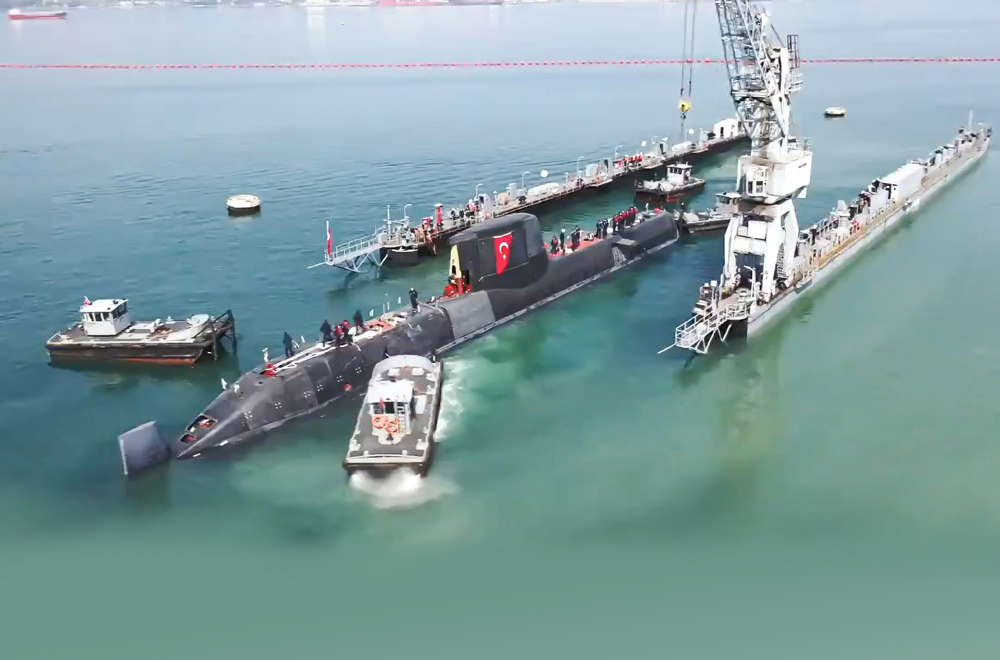
TCG PiriReis Submarine Meets the Sea
The TCG PiriReis Submarine, which is planned to reach full operational capability in 2022, will undergo Factory Acceptance (FAT), Harbour Acceptance (HAT), and Sea Acceptance (SAT) Tests, respectively, following the completion of outfitting activities. Speaking on March 24, 2021, at the İTÜ SAVTEK 2021 Conference, Head of the SSB Naval Platforms Department Alper KÖSE stated that they are working on completing the delivery of the TCG PiriReis Submarine by the end of 2021. The construction, outfit, FAT, HAT, and SAT activities of each REİS Class Submarine will last for 62 months in total. It was previously announced that HAT activities will be completed in 9 months and SAT activities in 11 months. In this case, a shortened and accelerated HAT and SAT process will take place for TCG PiriReis, which was launched on March 22, in order to reach the timeline of 2021 year end. I believe that such an action could have severe consequences for the first vessel of its Class.
While the construction activities of TCG PiriReis (S-330), the first submarine of the project, started in October 2015, the construction activities of the second submarine TCG HızırReis (S-331, expected to be delivered in 2023), started in 2016. The third submarine TCG MuratReis (S-332, expected to be delivered in 2024) laid down on February 25, 2018; the fourth submarine TCG AydınReis (S-333, expected to be delivered in 2025) laid down on November 4, 2018; and the fifth submarine TGC SeydialiReis (S-334, expected to be delivered in 2026) laid down on December 22, 2019. I do not have any information about when the construction activities started on TCG SelmanReis (S-335), which is the last submarine of the project. Havelsan had delivered the Submarine Information Distribution System, which will be used in TCG SelmanReis, to Gölcük Naval Shipyard Command for installation at the beginning of March 2021.
The Submarine Production Plant at the Gölcük Naval Shipyard, where the construction of REİS Class Submarines is carried out, consists of two large hangars, Block-A and Block-B. Block-A, which can hold three boats at one time, is used for construction and outfitting activities, while the B-Block is used for welding work on the sheets that form the submarine hull and the assembly of the blocks.
Initially, the submarines were named CERBE Class and were planned to be 66.3m long with a surface displacement of 1,845 tons. However, significant design modifications were made to meet Turkish Naval Forces Command (TNFC) requirements because of some technical problems with the design, and Turkish engineers found five major design flaws and developed solutions for them. The resulting submarine, which is longer and heavier than CERBE, was renamed REİS Class in 2014. At that time, according to the technical documents of the Turkish Naval Forces, REİS Class Submarines were 66.7m long, 13.1m high (excluding periscope masts), 6.3m wide, had a 6.0m draft, submerged displacement of 2.042 tons, and surface displacement of 1.856 tons. However, the technical specifications of the REİS Class Submarines were revised, and the total length was increased again following the modifications. Additionally, the number of Cylindrical Metal Hydride Tanks (MHT) that are used to store Liquid Hydrogen, an essential element of the Air Independent Propulsion (AIP) System, has also been increased.
While the height (13.1m/16.5m with the periscopes), width (6.3m), draft (6.8m), and the surface displacement (about 1,855 tons) of this new version, which we call REİS-II, did not change; the total length of the submarine was increased to 68.35m (0.75m longer than the first version of the REİS-Class and 2.05m longer than the CERBE Class). The submerged displacement of the submarine is around 2,050 tons.
Two BZM120 Proton-Exchange Membrane (PEM, also called Polymer Electrolyte Membrane) Fuel Cell modules (each generates 120kW power) lie at the heart of the Air Independent Propulsion (AIP) System of the Type 214 Class Submarines (the first batch of the U212A submarines and the first batch of the Type 214 boats ordered by the Republic of Korea Navy have 9 (one backup, eight active) BZM34 PEM modules that generate a total of 306kW (400hp) power). The service life of the BZ120 PEM Fuel Cell modules (each weighs 900kg, has a capacity of 500 liters, and constitutes 320 cells) is estimated between 2,000-4,000 hours. This means that after running 2,000-4,000 hours, the BZM120 PEM Fuel Cell modules will need to be replaced. The BZM120 PEM module enables the submarine to navigate at a cruising speed of 2 to 6kt (3.7 to 11.1km) and stay underwater without surfacing for about three weeks, depending on the speed. The Type 214 submarines can reach 12 knots on the surface and 22 knots while submerged. Thanks to their AIP System, the submarines can stay underwater for 18 days (approximately 1,250nm/2,315km, 14 days with AIP System and four days using batteries) at 4 knots without snorkeling to charge their batteries or travel 12,000nm (22,224km) at 4 knots with maximum fuel and snorkeling.
The Type 214 submarine uses its diesel engines while cruising at high speeds and AIP System for low-speed silent cruising. The main components of the AIP System consist of the PEM Fuel Cell module, cylindrical metal hydride tubes, liquid oxygen tank, and control unit. The submarine can operate for an extended time without surfacing by using the electrical energy generated in the fuel cell module because of the chemical reaction between the liquid oxygen and the hydrogen stored in metal hydride tanks. Since the fuel cells use pure hydrogen to generate power, the module can continuously produce electricity as long as hydrogen is supplied to the system.
The infrastructure established for REİS Class Submarines will be used in the design and construction of the first national submarine, MİLDEN, which will be designed and built with a high domestic contribution rate and national resources. Although initially thought to have similar dimensions and displacement as the REİS Class, I believe that MİLDEN boats will be slightly longer and heavier than planned. MİLDEN Class submarines that I consider to have a length of 70 to 80m, a beam of 7 to 8.5m, and a submerged displacement around 2,500-3,000 tons, will have a multi-compartment teardrop hull form, unlike REİS, AY, PREVEZE, and GÜR Class submarines with a single compartment cigar-shaped hull form considering the scale model displayed at the MİLDEN Workshop as well as MİLDEN Design Project Office, which resembles the Soryu Class submarines of the Japanese Navy. The MİLDEN model features diving planes (also known as hydroplanes, called fairwater planes on US Navy submarines) located on the sail (conning tower). Additionally, the model has "X" shaped control surfaces (stern rudders) instead of "+" cross-form rudders, unlike AY, PREVEZE, GÜR, and REİS Class submarines and fitted with a towed sonar array deployed through the horizontal 'pipe' at the stern as in the A-26 and Collins Class submarines. I think that MİLDEN will have at least six 533mm heavyweight torpedo tubes and one 650mm deployment station to allow Turkish Navy Special Forces (SAS/SAT) underwater operations. Again, considering the MİLDEN Model, I believe that the submarine will include a shaft and a shrouded screw. Although at first glance it resembles a pumpjet propulsion system, I think the subs will use a simpler shrouded screw/ducted propeller (also known as Kort Nozzle) with 6 or 7 blades. With the 'shrouded screw' propeller system, the submarine's multi-blade propeller rotates in a cylindrical casing, thereby reducing cavitation.
The official inauguration ceremony of the MİLDEN Design Project Office, which will conduct the preliminary design of the MİLDEN Submarine, was held in the summer of 2020 (August). According to the information we have received, the Office will carry out studies on the Concept Design of MİLDEN until 2023. As of the second half of 2023, it is expected that the studies on the Detail Design and Construction Phase will be started.