TEI`s New Domestic Aviation Engine Solutions: TEI-TJ90U and TEI-PG50S

Developed by TEI, the TJ90 Micro Turbojet Engine with a thrust capacity of 390N±10N (90lbf) was planned to be used on the TUSAŞ product ŞİMŞEK High-Speed Target Drone. Although TEI-produced TJ90 Turbojet Engines were tested on the ŞİMŞEK High-Speed Target Aircraft, they were not subsequently used. Currently, different versions of ŞİMŞEK Drones are operating with both foreign turbojet engines and domestic turbojet engines produced by İDEALAB Company.
The first ground test of the TJ90 Micro Turbojet Engine, with a radial compressor design, took place on June 30, 2011. The first experimental flight test occurred on June 5, 2013, and the first flight test on ŞİMŞEK was conducted on June 7, 2017. The engine was ready for serial production in 2018. Following TUSAŞ's order, TEI carried out the serial production of 11 TJ90 Engines. These engines were designed to meet the very short lifespan requirement of TUSAŞ's ŞİMŞEK High-Speed Target Drone and to withstand high G-forces when operated on the ground (since it is launched from a catapult with very high acceleration to reach flight speed within a few seconds, the engine needs to function under 30-40G forces during take-off on ŞİMŞEK). Later, TUSAŞ expressed the desire to use these engines on other platforms (supersonic UAVs) and for other purposes (kamikaze UAVs/attacking ground and surface targets using ŞİMŞEK). As a result, additional requirements emerged, such as a long lifespan and high-altitude ignition capability (for example, it needs to be started at high altitudes using the windmilling technique when launched from ANKA and AKSUNGUR UCAVS).
According to the mentioned requirements, TEI has carried out some refinement activities and made improvements to the TJ90 Engines with the Electronic Control Unit (ECU). As a result of these efforts, in January 2020, 11 TJ90 Engines were delivered. TEI continued its work to competitively meet changing customer requirements and developed a new version of the engine called TJ90U. Despite its increased length, TJ90U has reduced weight and diameter and features a Full Authority Digital Engine Control (FADEC) system.
Due to the extended duration of the improvement/development process aimed at increasing the high-altitude performance and operating time of the TJ90 engine, TUSAŞ procured Turbojet Engines from the German company JETCAT and the domestic TJ engine manufacturer İDEALAB (IL170 engines with a thrust capacity of 170N) for the versions of the ŞİMŞEK High-Speed Target Drone, which had an increased production pace. According to the product brochure, the 3.55kg Jet-Cat P400-Pro Series TJ Engine, which is similar to the TJ90, can generate a maximum thrust of 397N and has a specific fuel consumption (SFC) of 0.158kg/Nh at maximum power.
The ŞİMŞEK High-Speed Target Drone has a wingspan of 1.57m, a length of 2.33m, and a maximum take-off weight of 70kg. ŞİMŞEK can reach speeds of 350+ knots at sea level and operate at altitudes ranging from 50 to 20,000ft. It has a flight endurance of 45+ minutes and a line-of-sight range of 70+ km. In our previous interview, Ömer YILDIZ, Deputy General Manager responsible for Unmanned Aerial Vehicles at TUSAŞ, emphasized that they have increased the speed of the ŞİMŞEK High-Speed Target Drone up to 450 knots. During our interview on May 1, Ömer YILDIZ also announced that TUSAŞ had placed an order for 100 IL170 TJ engines from İDEALAB for the ŞİMŞEK family, and they have received 50 of them.
According to the product brochure, the specific fuel consumption (SFC) value of the TJ90 Turbojet Engine is 0.17kg/Nh. The engine, with a dry weight of 4.75kg and a total weight of 6.95kg (including the Engine Control System/ECS), has a diameter of 153.5mm and a length of 380mm, and it can generate a thrust of 400N (90lb) at sea level.
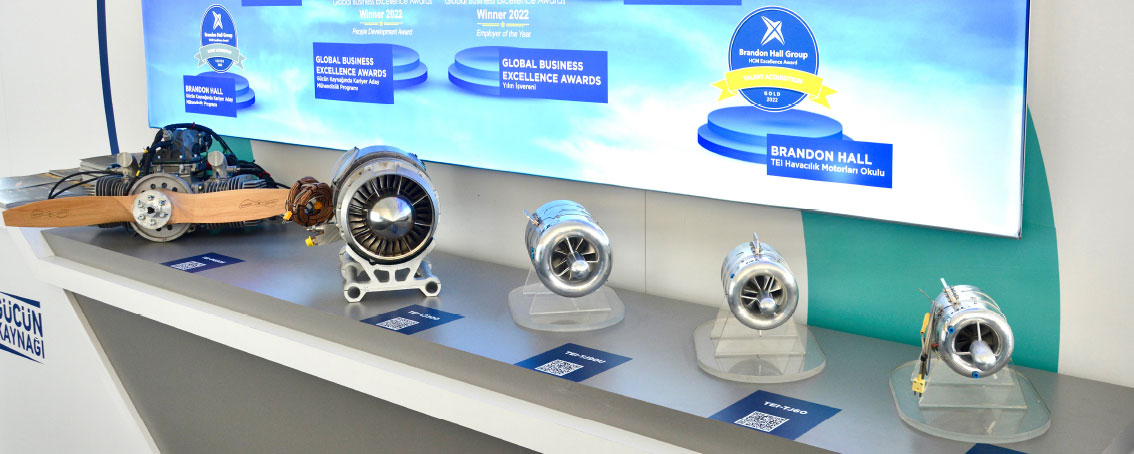
According to the product brochure, the FADEC-controlled TEI-TJ90U Micro Turbojet Engine has a thrust of 400N (90 lbf). It has a dry weight of 3.6kg and a system dry weight of 4.2kg. The engine has a length of 417mm and a diameter of 150mm. The specific fuel consumption (SFC) value stated in the product brochure for the TJ90U Engine is 0.267kg/Nh. The maximum shaft speed is 91,000 rpm, compared to 96,000 rpm for the TJ90 engine. The TEI-TJ90U Micro Turbojet Engine can use Jet A1, Diesel, Kerosene, JP8, and JP10 fuels. It utilizes a plasma-type ignition system. The engine can be started in under 10 seconds. For the TJ90 engine, which runs on JP8 fuel, both kerosene and electric starting techniques were preferred.
TEI-PG50S, which is a longer-lasting and multi-use version of the 0.5-liter TEI-PG50 (50 hp) 2-stroke boxer-type gasoline aviation engine used in the KARGI Kamikaze UAV developed by Lentatek, was also introduced to the visitors for the first time at TEI's booth at TEKNOFEST 2023.
Since the PG50 engine is specially designed for KARGI, it has a clutch system. The clutch system allows the KARGI to reach a certain speed and altitude and then operate with its own power by activating the PG50 engine after separating from the rocket motor. Since this is a critical and challenging component to manufacture, TEI has filed a patent application for the clutch system. Some countries that produce similar Kamikaze UAVs (such as Iran's Shahed 136) prefer the rocket-assisted take-off method by running the engine before launch instead of using a clutch to avoid the risk. If the clutch system does not engage on time, the aircraft may crash because the engine does not function. I had previously learned from two different sources that such incidents occurred during firing tests with KARGI. However, during the conversation I had with a TEI official, he emphasized that there was only one instance of a failure caused by the clutch system in a test, but the technical issue related to the clutch system has been resolved, and the product is now ready for serial production based on the recent firing tests. The TEI official also mentioned that they are awaiting orders for the serial production of the PG50 engine for the KARGI project until the IDEF '23 Fair.
Based on the PG50 engine, the TEI-PG50S engine is designed without a clutch system for use in domestic and foreign UAV platforms where 50 hp of thrust is sufficient. Since KARGI is a single-use "fire-and-forget" Kamikaze UAV system, there is no need for it to return to the base or perform subsequent missions. Therefore, the PG50 engine is designed as a single-use engine with a specific flight duration in mind. On the other hand, the PG50S is designed as a long-lasting engine capable of performing multiple missions on the platform. Instead of a clutch system, the PG50S has a crankshaft directly connected to the flywheel, with a propeller positioned in front of the flywheel. The PG50 engine features an alternator for electricity generation (900W continuous power). In the PG50S, which is equipped with a starter generator, an alternator with a power capacity of 1.1kW is offered as an option. This allows the PG50S to start without the need for a separate starter motor and generate electricity in the same manner. As a result, both the engine's and the platform's electrical needs can be met. As of April 2023, testing of the PG50S engine was ongoing. When examining the product brochures, both engines have nearly identical technical specifications. The only noticeable difference is that the PG50 engine has a dry weight of 19kg (±1kg), excluding accessories, while the PG50S weighs 20kg (±1kg).
Meanwhile, I have learned that TEI has proposed an adapted version of the TEI-TJ60 Micro Turbojet Engine for the KEMANKEŞ Mini Cruise Missile developed by BAYKAR TECHNOLOGY. According to the product brochure, the FADEC-controlled TEI-TJ60 Micro Turbojet Engine has a thrust of 250N (56lbf). It has a dry weight of 1.98kg and a system dry weight of 2.47kg (System Weight includes: Engine, Battery, ECS, Fuel Pump, and Clamps). The engine has a length of 334mm and a diameter of 120mm. The specific fuel consumption (SFC) value provided in the product brochure for the TJ60 Engine is 0.16kg/Nh, and its maximum shaft speed is 117,000rpm. The TEI-TJ60 Micro Turbojet Engine uses Jet A1, Diesel, Kerosene, JP8, and JP10 fuels, employing a plasma ignition system that can be started in under 8 seconds. The engine has a web-based, user-friendly motor control interface, which can be operated through a tablet.
The TEI-PD222ST engine, developed to meet the power requirements of Medium Altitude Long Endurance (MALE) unmanned aerial vehicles, can provide a maximum thrust of 225 hp for 5 minutes during take-off, and its continuous power capacity is given as 200 hp. The PD222ST is a derivative of the PD170 Turbo Diesel Aviation Engine, which is currently used on the AKSUNGUR UAV and equipped with a two-stage turbocharging system due to the altitude requirement of 45,000 ft. The PD222ST, with a dry weight of 162 kg and a lightweight aluminum block, is a single-stage turbocharged version of the PD170. Its dry weight is only 163 kg, and its fuel consumption value is 220 g/kWh (207 g/kWh for the PD170). According to the product brochure, the PD170 can provide 172 hp at 5,000 ft altitude, 170.25 hp at 20,000 ft altitude, 150 hp at 25,000 ft, 130 hp at 30,000 ft, and 70 hp at 45,000 ft. The PD222ST, on the other hand, can provide 180 hp at 20,000 ft altitude, and due to its single-stage turbocharging system, its capacity at 30,000 ft is limited to 115 hp. Both the PD170 and PD222ST Turbo Diesel Aviation Engines have a displacement of 2.1 liters and are configured with inline-four cylinders. They can operate on JP8, or Jet A-1 fuel. Both engines can generate a total of 9 kW of electrical power through their onboard alternators (2x). According to the information I obtained, integration activities of the PD222ST Turbo Diesel Aviation Engine onto the BAYRAKTAR TB3 UAV are being carried out, while test activities with the PD170 engine are still ongoing