Textron Systems is Ready to Cooperate with Turkey
Defence Turkey: Mr. Midkiff, first of all thank you for the interview. What are Textron Systems core capabilities, technologies, products focused on aerospace and defence?
You are quite welcome. It’s a pleasure to share information about Textron Systems with your readers.
In brief, we develop, deploy and sustain “find-fix-finish” system solutions for our customers.
In the most fundamental terms our customers are seeking system solutions that enhance their capabilities to “find” and identify some entity which represents a hostile threat to their interests; then “fix” that hostile threat in time and location; and ultimately take appropriate actions to mitigate that threat.
These system solutions are comprised of interoperable air, maritime, and/or land-based products which operate seamlessly. We pride ourselves in providing the services and support needed to both build and maintain effective law enforcement, security, border patrol and infrastructure protection capabilities around the globe.
Textron Systems’ solutions address customer specific defense requirements and commercial requirements, or a hybrid blending of the two. Our cross-domain products include advanced marine craft, armored vehicles, intelligence software solutions, precision weapons, intelligent battlefield and surveillance systems, test and training systems, unmanned aircraft systems, and a wide range of critical mission support services.
Defence Turkey: Could you please tell me about your Unmanned Systems such as Shadow and Aerosonde?
Our deepest experience base is in the air domain where we have developed and fielded several highly-effective system solutions for our customers; systems that often operate in harsh environments and hostile conditions.
Our Shadow 200 Tactical Unmanned Aircraft System (TUAS) is utilized by the U.S. Army and Marine Corps and the militaries of Australia, Italy and Sweden. Shadow systems have accumulated nearly one million flight hours, more than 90 percent of which have occurred during combat operations. The latest version of the system includes: a tactical common data link for higher encryption and bandwidth; extended wings for improved endurance; and an electronic fuel injection engine and fuel system improvements to further improve reliability.
The next-generation Shadow M2 TUAS builds on the success of the original Shadow 200 system with greater endurance and payload capability, as well as demonstrated satellite communications capability for beyond-line-of-sight operations. In fact, it offers much of the same mission capability as larger strategic assets. Yet the Shadow M2 is available as a block upgrade to the Shadow 200, representing an affordable and efficient path to powerful new capabilities.
Our expeditionary Aerosonde Small Unmanned Aircraft System (SUAS) offers proven performance in both military and commercial applications. It is designed for both land- and sea-based mission sets, as well as multi-payload flexibility. Featuring the Lycoming EL-005, the Aerosonde SUAS offers benchmark-setting reliability in its class. The Aerosonde system has amassed more than 100,000 flight hours for multiple U.S. Department of Defense customers in just the past two years. We are delivering high operational tempos of thousands of monthly mission hours under Textron Systems’ end-to-end, fee-for-service business model – provided by our own operators and supported by our field service specialists. The system also is being utilized in the region for oil and gas applications.
It is important to recognize the seamless connection of these airborne unmanned platforms to the manned teams they support. Our Shadow and Aerosonde platforms are the eyes of their operators; enabling them to see over the next hill, to identify an adversary with hostile intent, and then to coordinate a synchronized response to stop the adversary short of achieving their intent.
In other words, we believe the true value of these unmanned systems is best understood when recognized as a seamless extension of the manned systems they support.
With this same logic, we’ve extended our unmanned system expertise into the maritime realm through our Common Unmanned Surface Vehicle, or CUSV, which leverages our mature, interoperable command and control architecture to provide maritime domain awareness for border security and other mission sets. Textron Systems is the industry partner of choice for the U.S. Navy’s first unmanned surface vehicle program of record.
Defence Turkey: There is a political discussion in US Congress about selling unarmed and armed version of UAVs to allied nations. As Textron Systems, what is your opinion about new sale policy for U.S.-origin UAS and does it affect your platforms?
Under its recent policy updates, the U.S. State Department has clarified and expanded its approach to exporting both unmanned aircraft systems and commensurate payloads of many varieties. Their final decisions on exports will continue to be made on a case-by-case basis, and we stand ready to support approved requirements.
We certainly have received significant interest in our Shadow 200, Shadow M2 and Aerosonde systems from numerous nations, and for a variety of military and commercial mission sets.
Defence Turkey: How do you assess your international co-operation in different regions such as Caucasia, Turkey and Africa specifically concerning UAV systems?
We continue to support the U.S. government’s policies, as implemented by the State Department and Department of Defense, as they relate to building capacity and capability among partner nations around the world. We are at the ready to support allies within these regions and believe our platforms offer tremendous capability across a variety of mission sets.
Defence Turkey: Can you tell me something about your Air Cushion systems and your interest in the Turkish tender for such a system/project?
Textron Systems is now in the production phase on the new Ship-to-Shore Connector (SSC) program, a key Navy and Marine Corps program as the US military updates its amphibious landing capabilities. More than 70 of the new craft are planned.
SSC will be the premier high speed, heavy lift military grade air cushion vehicle in the world. As the successor to the Textron Systems-built Landing Craft, Air Cushion (LCAC), currently in use by the U.S. military and Japanese Defense Forces, SSC will offer a modernized means for conducting amphibious operations, including humanitarian missions, for the next 30 years. It will provide greater capability and lower operating costs with a larger payload, reduced manning requirements, and additional enhancements that improve both reliability and maintainability.
Textron Systems is in discussions with a number of international navies about the SSC air cushion vehicle. As production moves forward, we anticipate continued interest from potential customers looking to add this world-class amphibious connector system to their fleets.
Specific to Turkey, we have been in SSC related discussions in recent years with officials of your country. We also understand Turkish officials have also spoken to the US Navy about the SSC program. We expect Turkey to issue a tender for an advanced military grade air cushion vehicle in 2015 and we anticipate responding with a SSC-based offer.
Defence Turkey: Could you please inform us about your activities performed over the years in Turkey?
My personal experience with Turkey goes back a long way. I served as the Commander of the Headquarters Company to the Task Force Alpha Aviation Brigade during Provide Comfort. We were the first multi-national aviation brigade task force put into southern Turkey and northern Iraq. Our main force was in Diyarbakir, with a smaller force in Silopi and some forward elements as far south as Kirkuk.
My responsibilities included buying food from the local economy, as well as collaborating with the Turkish Air Force and many other nations, such as: The Netherlands, United Kingdom, Italy, as well as other U.S. forces including the Marine Corps, USAF Special Operations, and the USAF Civil Engineers because they build our facilities!
As the main go between with the local community, and primary customer for food stuffs, hygiene and construction material, I developed a strong local network. As the mission stabilized and we were able to let people get a day off, we organized shopping trips and day trips around the region. It was very good for morale. I still have mementos from that time – including a flag that the Turkish Red Crescent gave me, which displays most of the patches from the units and operation on it. They presented it to me for the good work we had accomplished together.
Defence Turkey: Has Textron Systems any intention to develop indigenous platforms and export them to 3rd countries jointly with Turkey? What are your views on this issue?
While I am unable to address specific plans in order to honor customer confidentiality, I can tell you Textron Systems is focused on international cooperation and that we are actively pursuing these types of projects. We are working hard to develop customized system solutions based on a firm understanding of customer requirements and mission needs.
I believe that is a fundamental difference in the Textron Systems approach. We don’t necessarily view a solution we’ve developed for the U.S. military as the one that is the best for all our customers. We have a great deal of flexibility in being able to adapt our technology and approach based on each customer’s needs, and apply our world class design teams and years of experience in building and operating customized systems for our customers and partners.
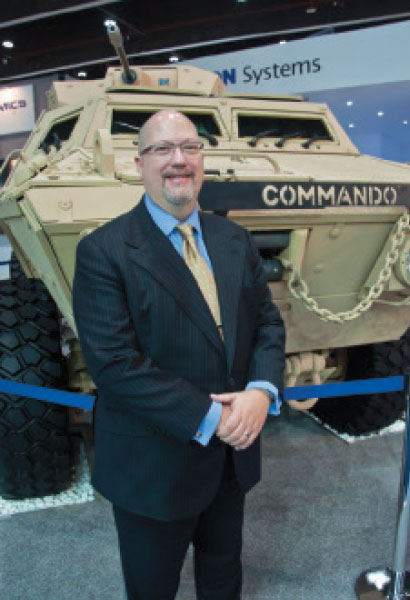
A prime example of this type of cooperative approach is our Afghanistan National Army (ANA) Mobile Strike Force Vehicle (MSFV) armoured vehicle program. These vehicles are known to us as COMMAND Select vehicles, and are not currently a vehicle in the inventory of the U.S. military. Yet it was our success with designing and producing nearly 4,000 Armoured Security Vehicles (M1117) for the U.S. Army that served as a springboard to developing and delivering a customized armored vehicle solution that is critical capability as part of the ANA’s security mission.
Defence Turkey: Could you please inform us about your R&D investment and activities?
Textron Systems maintains a commitment to independent research and development (IRAD), even in the face of challenging market conditions. We are continuing to make strategic IRAD investments when we see a capability gap in the market. There are a number of examples, but let me share a few of these with you.
For example, we have made significant investments to create a highly lean and modern production facility for making marine craft and doing so cost effectively, even at low production rates. These investments were crucial to us being selected to build the Ship-to-Shore Connector for the U.S. Navy, as was our building in commercial vendors and products to keep the costs to a minimum. We look forward to leveraging that excellence and experience with other future naval connectors.
Likewise, in the unmanned surface vessel (USV) space, we were able to leverage a significant amount of internal company investment and expertise in the unmanned area to become the U.S. technology leader with our CUSV. As I mentioned earlier, this led to our selection to build the U.S. Navy’s first unmanned surface vehicle.
We also have applied our innovative business models in support of forces fighting in Afghanistan through our ISR fee for services work using our Aerosonde SUAS. Textron Systems has made investments in new engine technology for UAS to ensure high reliability rates on the aircraft.
And our sister company, Textron AirLand, has recently developed the Scorpion ISR/Strike/Trainer Jet because we saw a need for an affordable, multi-mission tactical military jet. We did so completely on our funding, and were able to take it from design to manufacture in less than two years by using commercially available technologies and processes.
Defence Turkey: Mr. Bear Midkiff, how do you see Textron Systems’ future (for the next decade?
I am very excited about the direction Textron Systems is taking and see a bright future. I believe this next decade will be one in which we will see significant growth in unmanned systems being leveraged to seamlessly extend human capabilities in commercial as well as in military realms. Textron’s blending of commercial and military, and manned and unmanned product lines make us a well positioned corporation to address this market place.
The idea that the defense industry should apply commercial business practices and technologies to enable affordability and tap new sources of innovations will be of increasing importance, and will drive change in the international aerospace and defense industry.
Textron’s multi-industry approach also provides Textron Systems the financial depth to continue to make significant investments in technology even in the face of declining international defense budgets. As I mentioned, our Textron businesses strategically apply IRAD resources to bring to our customers innovative products and solutions, such as the previously referenced CUSV, Shadow M2 TUAS and Scorpion jet – to cite just a few examples.
Finally, our ability to leverage other parts of Textron’s commercial businesses to create partnerships, fulfill offset obligations, and attract and retain outstanding talent for our teams, is a significant advantage as we serve our current customers and grow our businesses in markets across the globe.
Defence Turkey: Do you have any message for our readers?
I have been focused on international relationships all my life. In fact, I have lived a greater number of years outside the United States than I have in the country. My experience in living abroad runs from Central America, Europe and the Middle East to Eurasia and Asia. In every place I found wonderful people who want what is best for their families, communities and their countries. I truly look forward to getting to know the countries and the people in the areas I now cover for Textron Systems.