The 55th Anniversary of Gendarmerie Aviation and Flight Training Graduation Ceremony Held in Ankara
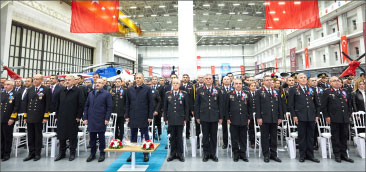
Minister of the Interior Ali YERLIKAYA, Deputy Minister of Interior Bülent TURAN, Turkish Gendarmerie General Commander General Arif ÇETIN, General Director of Police Erol AYYILDIZ, Commander of the Turkish Coast Guard Rear Admiral Ahmet KENDIR, Chief of Gendarmerie Aviation Department Major General Ali DOĞAN, families of martyr aviation personnel, and the families of graduates attended the ceremony.
Stating that they are celebrating the 55th anniversary of the Gendarmerie Aviation Department, whose foundations were first laid in Diyarbakır, Minister Ali YERLIKAYA underlined the role of the Gendarmerie in maintaining public order in various regions, as well as their continuous service in areas such as search and rescue and evacuation of patients regardless of day or night. YERLIKAYA emphasized that the Gendarmerie Aviation Department not only fights against terrorists and criminals but also takes part in disasters like earthquakes and forest fires, serving the country under all circumstances. YERLIKAYA said, "Our Gendarmerie pilots conducted 1,625 hours of flights against forest fires in just the last 2 years, and during the Kahramanmaraş earthquakes that deeply affected us all, they completed 2,300 hours of flight with 33 aircraft."
Noting that the Gendarmerie Aviation Department had completed its organization and started to provide services with manned aerial vehicles in 4 provinces and unmanned aerial vehicles in 8 provinces, YERLIKAYA highlighted the importance of technological development and diversification of aerial vehicles for more effective combat against terrorism, organized crime, and any threat to public peace and security.
"Gendarmerie Aviation Department has become a significant force multiplier."
Speaking at the ceremony, Gendarmerie General Commander General Arif ÇETIN stated that aviation units are one of the most crucial elements in ensuring public peace and security and said, "Our Gendarmerie Aviation Department has become a significant force multiplier by meticulously providing aviation support 24/7, especially in the fight against terrorists and conducting aerial transportation, command control, reconnaissance and surveillance, safety and security services, aerial supply, medical evacuation, providing humanitarian assistance during natural disasters, and search and rescue operations."
Following the speeches, Ali YERLIKAYA gave plaques to the families of martyrs and had conversed with them for a while and presented the graduating trainees with their brevet and diplomas.
The ceremony ended with a family photo and a tour of the static display area which aircrafts & helicopters in the gendarmerie's inventory were exhibited.
The Gendarmerie Aviation School Command
The Gendarmerie Aviation Command was established on May 25, 2000, in order to provide single-handed management and administration of the Gendarmerie Aviation Units. Later, in 2003, Aydın Gendarmerie Fleet Command was established to meet the helicopter needs of the Gendarmerie Units in the Western Regions of Türkiye within the scope of safety, public order, tourism, and aid activities. In order to train the pilots and helicopter technicians needed by the Gendarmerie General Command, the Gendarmerie Aviation School Command was established with the approval of the General Staff on May 31, 2013, and since then, it has consistently expanded its activities. Gendarmerie Aviation School have increased the number of Instructor Pilots from 12 to 48 during this period and simultaneously augmented the number of aircraft. Additionally, initial pilot and technician training programs, which began with just 7 trainees, has grown to accommodate 60 Pilots and 60 Technicians. The coup attempt in 2016 led to significant human resource issues across the country, which also affected Gendarmerie Aviation. In response, Aviation School rapidly took measures to increase pilot and technician sources. Consequently, Gendarmerie Aviation initiated the recruitment of university graduate Pilot and Technician candidates in 2017 without waiting for the graduation of Officer Pilot Candidates and Non-Commissioned Officer Technician Candidates from existing schools and the Gendarmerie Academy. These candidates completed a one-year training program and graduated as Second Lieutenants (2Lt) and Staff Sergeants (SSG). Subsequently, after providing them with one more year of training, Gendarmerie Aviation recruited the first outsourced Pilots and Technicians in 2018, and they joined the Gendarmerie Aviation Department. This swift response somewhat alleviated the shortage of pilots and technicians across all military branches.
Since 2017, Gendarmerie Aviation School Command has been graduating candidates for other units of the Ministry of Interior, such as the Aviation Department of the General Directorate of Security and the Aviation Department of the Coast Guard, particularly for technician requirements. With the Basic Course, which started this year, Gendarmerie Aviation School will also train pilots for the Aviation Department of the General Directorate of Security and the Coast Guard for the first time. In addition to the Basic Courses for Pilots and Technicians, Gendarmerie Aviation School offers training in 36 different branches, including UAV (Unmanned Aerial Vehicle) Pilots and Technicians. Starting this year, Gendarmerie Aviation School Command will also fulfill the entire pilot and technician needs of the UAV Command. Generally, pilots start their training with simple and small aircraft that allow them to showcase their capabilities and adapt to the helicopter.
In Gendarmerie Aviation, where the culture of training an inexperienced pilot by flying together with an experienced pilot for 3-4 years, general-purpose helicopter pilots were trained to operate B-350 JIKU, and T129 ATAK Helicopter pilots to operate Sikorsky or Mi-17 Helicopters in the past when the anti-terror operations were intense in order to benefit more from the flight personnel at hand, to save personnel in some cases, and to use the ready-to-fly aircraft in its inventory more effectively.
Senior First Pilots include pilots who can operate AB-205, Sikorsky and Mi-17 Utility Helicopters and B-350 Aircraft. With the increase in the number of personnel in terms of technicians, training activities that increase the specialization according to the types have been started. The pilots were divided into Helicopter Pilot and Aircraft Pilot. Helicopter pilots are also divided into utility and ATAK Pilots. Similarly, the Gendarmerie UAV Command aims to benefit more from its pilots and to use the ready-to-fly UAVs in its inventory more effectively, giving the same training to ANKA and TB2 UAV Pilots and then passing them through Difference Training. Thus, when necessary, the pilot flying ANKA UAV can also fly TB2.
Gendarmerie Aviators, who see all missions as training opportunities, also attach great importance to crew coordination and team cohesion. AB-205 (UH-1) Helicopters are used as Basic Training Aircraft in the Helicopter Pilot Basic Course, which is given at the Gendarmerie Aviation School and consists of 2 phases. Hand-trained personnel and a sufficient stock of spare parts play a major role in the preference of AB-205s. However, the Gendarmerie Aviation Department has started to work on the supply of a new generation training helicopter to be used in the training activities of the flying personnel who will serve in rotary wing aircraft. The Flight Training Simulators and Personnel Candidate Selection System (PASS) are used at the Gendarmerie Aviation School, which are developed and produced with national means.
The Personnel Candidate Selection System (PASS), which was developed as a Pilot Candidate Selection System, is used for psychomotor test of all Gendarmerie personnel and new recruits in this system by the order of the Gendarmerie General Command, in other branches than the pilots upon being decided that they will be subjected to test in this system. Upon the system's success, all flight personnel of the Ministry of Interior, Security Aviation and Coast Guard Command, apart from the Gendarmerie Aviation Department, are also subjected to the PASS test. With PASS, which was put into service in 2019, more than 4,000 personnel have been tested to date. Among them, in addition to the flight personnel, there are also personnel from different branches such as UAV personnel and JÖAK personnel.
Candidates can only enter the PASS System once in their lifetime. Because each candidate enters his/her own TR Identity Number while taking the test into the System, and once the number is entered, it is not possible to change it by interfering with the database or to take the exam a second time. In this way, both merit is highlighted, and the objectivity of the Personnel Candidate Selection System is preserved. In the Personnel Selection process, PASS has the highest share with 30%. Academic Success has 25%, English 15% and Interview again 15%. The Gendarmerie Aviation School also plans to conduct a Postgraduate thesis on measuring the success of PASS in the selection of pilots and personnel
At the 55th Anniversary of Gendarmerie Aviation and Flight Training Graduation Ceremony organized at the Martyr General Eşref Bitlis Barracks, a total of 134 officers and non-commissioned officers graduated, including 20 pilots, 22 UAV (Unmanned Aerial Vehicle) pilots, 51 technicians, and 41 UAV technicians who completed their courses under the Gendarmerie Aviation Department.
Minister of the Interior Ali YERLIKAYA, Deputy Minister of Interior Bülent TURAN, Turkish Gendarmerie General Commander General Arif ÇETIN, General Director of Police Erol AYYILDIZ, Commander of the Turkish Coast Guard Rear Admiral Ahmet KENDIR, Chief of Gendarmerie Aviation Department Major General Ali DOĞAN, families of martyr aviation personnel, and the families of graduates attended the ceremony.
Stating that they are celebrating the 55th anniversary of the Gendarmerie Aviation Department, whose foundations were first laid in Diyarbakır, Minister Ali YERLIKAYA underlined the role of the Gendarmerie in maintaining public order in various regions, as well as their continuous service in areas such as search and rescue and evacuation of patients regardless of day or night. YERLIKAYA emphasized that the Gendarmerie Aviation Department not only fights against terrorists and criminals but also takes part in disasters like earthquakes and forest fires, serving the country under all circumstances. YERLIKAYA said, "Our Gendarmerie pilots conducted 1,625 hours of flights against forest fires in just the last 2 years, and during the Kahramanmaraş earthquakes that deeply affected us all, they completed 2,300 hours of flight with 33 aircraft."
Noting that the Gendarmerie Aviation Department had completed its organization and started to provide services with manned aerial vehicles in 4 provinces and unmanned aerial vehicles in 8 provinces, YERLIKAYA highlighted the importance of technological development and diversification of aerial vehicles for more effective combat against terrorism, organized crime, and any threat to public peace and security.
"Gendarmerie Aviation Department has become a significant force multiplier."
Speaking at the ceremony, Gendarmerie General Commander General Arif ÇETIN stated that aviation units are one of the most crucial elements in ensuring public peace and security and said, "Our Gendarmerie Aviation Department has become a significant force multiplier by meticulously providing aviation support 24/7, especially in the fight against terrorists and conducting aerial transportation, command control, reconnaissance and surveillance, safety and security services, aerial supply, medical evacuation, providing humanitarian assistance during natural disasters, and search and rescue operations."
Following the speeches, Ali YERLIKAYA gave plaques to the families of martyrs and had conversed with them for a while and presented the graduating trainees with their brevet and diplomas.
The ceremony ended with a family photo and a tour of the static display area which aircrafts & helicopters in the gendarmerie's inventory were exhibited.
The Gendarmerie Aviation School Command
The Gendarmerie Aviation Command was established on May 25, 2000, in order to provide single-handed management and administration of the Gendarmerie Aviation Units. Later, in 2003, Aydın Gendarmerie Fleet Command was established to meet the helicopter needs of the Gendarmerie Units in the Western Regions of Türkiye within the scope of safety, public order, tourism, and aid activities. In order to train the pilots and helicopter technicians needed by the Gendarmerie General Command, the Gendarmerie Aviation School Command was established with the approval of the General Staff on May 31, 2013, and since then, it has consistently expanded its activities. Gendarmerie Aviation School have increased the number of Instructor Pilots from 12 to 48 during this period and simultaneously augmented the number of aircraft. Additionally, initial pilot and technician training programs, which began with just 7 trainees, has grown to accommodate 60 Pilots and 60 Technicians. The coup attempt in 2016 led to significant human resource issues across the country, which also affected Gendarmerie Aviation. In response, Aviation School rapidly took measures to increase pilot and technician sources. Consequently, Gendarmerie Aviation initiated the recruitment of university graduate Pilot and Technician candidates in 2017 without waiting for the graduation of Officer Pilot Candidates and Non-Commissioned Officer Technician Candidates from existing schools and the Gendarmerie Academy. These candidates completed a one-year training program and graduated as Second Lieutenants (2Lt) and Staff Sergeants (SSG). Subsequently, after providing them with one more year of training, Gendarmerie Aviation recruited the first outsourced Pilots and Technicians in 2018, and they joined the Gendarmerie Aviation Department. This swift response somewhat alleviated the shortage of pilots and technicians across all military branches.
Since 2017, Gendarmerie Aviation School Command has been graduating candidates for other units of the Ministry of Interior, such as the Aviation Department of the General Directorate of Security and the Aviation Department of the Coast Guard, particularly for technician requirements. With the Basic Course, which started this year, Gendarmerie Aviation School will also train pilots for the Aviation Department of the General Directorate of Security and the Coast Guard for the first time. In addition to the Basic Courses for Pilots and Technicians, Gendarmerie Aviation School offers training in 36 different branches, including UAV (Unmanned Aerial Vehicle) Pilots and Technicians. Starting this year, Gendarmerie Aviation School Command will also fulfill the entire pilot and technician needs of the UAV Command. Generally, pilots start their training with simple and small aircraft that allow them to showcase their capabilities and adapt to the helicopter.
In Gendarmerie Aviation, where the culture of training an inexperienced pilot by flying together with an experienced pilot for 3-4 years, general-purpose helicopter pilots were trained to operate B-350 JIKU, and T129 ATAK Helicopter pilots to operate Sikorsky or Mi-17 Helicopters in the past when the anti-terror operations were intense in order to benefit more from the flight personnel at hand, to save personnel in some cases, and to use the ready-to-fly aircraft in its inventory more effectively.
Senior First Pilots include pilots who can operate AB-205, Sikorsky and Mi-17 Utility Helicopters and B-350 Aircraft. With the increase in the number of personnel in terms of technicians, training activities that increase the specialization according to the types have been started. The pilots were divided into Helicopter Pilot and Aircraft Pilot. Helicopter pilots are also divided into utility and ATAK Pilots. Similarly, the Gendarmerie UAV Command aims to benefit more from its pilots and to use the ready-to-fly UAVs in its inventory more effectively, giving the same training to ANKA and TB2 UAV Pilots and then passing them through Difference Training. Thus, when necessary, the pilot flying ANKA UAV can also fly TB2.
Gendarmerie Aviators, who see all missions as training opportunities, also attach great importance to crew coordination and team cohesion. AB-205 (UH-1) Helicopters are used as Basic Training Aircraft in the Helicopter Pilot Basic Course, which is given at the Gendarmerie Aviation School and consists of 2 phases. Hand-trained personnel and a sufficient stock of spare parts play a major role in the preference of AB-205s. However, the Gendarmerie Aviation Department has started to work on the supply of a new generation training helicopter to be used in the training activities of the flying personnel who will serve in rotary wing aircraft. The Flight Training Simulators and Personnel Candidate Selection System (PASS) are used at the Gendarmerie Aviation School, which are developed and produced with national means.
The Personnel Candidate Selection System (PASS), which was developed as a Pilot Candidate Selection System, is used for psychomotor test of all Gendarmerie personnel and new recruits in this system by the order of the Gendarmerie General Command, in other branches than the pilots upon being decided that they will be subjected to test in this system. Upon the system's success, all flight personnel of the Ministry of Interior, Security Aviation and Coast Guard Command, apart from the Gendarmerie Aviation Department, are also subjected to the PASS test. With PASS, which was put into service in 2019, more than 4,000 personnel have been tested to date. Among them, in addition to the flight personnel, there are also personnel from different branches such as UAV personnel and JÖAK personnel.
Candidates can only enter the PASS System once in their lifetime. Because each candidate enters his/her own TR Identity Number while taking the test into the System, and once the number is entered, it is not possible to change it by interfering with the database or to take the exam a second time. In this way, both merit is highlighted, and the objectivity of the Personnel Candidate Selection System is preserved. In the Personnel Selection process, PASS has the highest share with 30%. Academic Success has 25%, English 15% and Interview again 15%. The Gendarmerie Aviation School also plans to conduct a Postgraduate thesis on measuring the success of PASS in the selection of pilots and personnel