The 5th Land Systems Seminar Held in Ankara
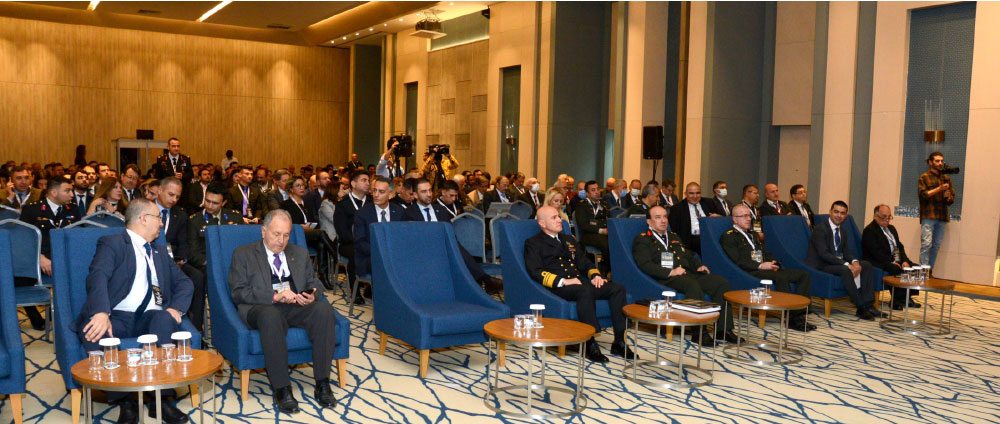
The 5th Land Systems Seminar was held on November 24-25, 2022, at The Ankara Hotel with the support of the Defense and Aerospace Industry Manufacturers Association (SaSaD).
Organized since 2012, the 5th seminar was held in Ankara this year with the support of the Ministry of National Defense (MoND), Presidency of Defense Industry Agency (SSB), and Defense and the Aerospace Industry Manufacturers Association (SaSaD). The opening speeches of the seminar were delivered by AFCEA (Armed Forces Communications & Electronics Association) Türkiye Board Member & Vice President Navy Capt. (Ret.) A. Zafer BETONER (Turkish Navy-MSEE), Vice Chairman of the Board of SaSaD and CEO of BİTES Uğur ÇOŞKUN, and Lt. Col. (Ret.) Kerim Serkan SİMAİŞ (SSB, Department of Land Vehicles). Following the opening speeches, guest speakers Serhan ÖZSOY, ASELSAN Land and Weapon Systems Program Director, and METEKSAN Defense Vice President Brig. Gen. (Ret.) Erdal TORUN took the floor.
Projects for land vehicles developed to meet Türkiye's defense demands and the necessity for qualified manpower in this field were discussed during the event. Employees from the defense industry, SMEs, universities, and researchers all gathered at the event to share knowledge that will help shape the sector's future.
During the two-day event, presentations were made on various topics by Türkiye's leading defense industry organizations, universities, researchers, manufacturers, and suppliers. Presentations made on day 1: Emre AYAZOĞLU, ASELSAN, "Model-Based Reference Architecture Definition Methodology - Tank and Armored Vehicles Application Example"; Harun SOLMAZ, METEKSAN, "New Generation Communication Electronic Attack Applications"; Kurt WORDEN, NOVA POWER, "A Unique Business Model and Contributive Partnership Paradigm in Local and National Defense System Development"; Hakan KABALAR, ROKETSAN, "ROKETSAN Land Systems"; Prof. Bilgin KAFTANOĞLU, ATILIM UNIVERSITY Metal Forming Center of Excellence, "Examples of the Contributions of Universities to the Defense Industry, and Evaluation of the Potential"; Çiğdem ŞEN ÖZER, ASELSAN, "Unmanned Ground Vehicle Systems."
The presentations made on day 2: Hamdi Görkem KAPLAN and Musa Talha İZGİ, SSB Department of Land Vehicles, "The Role of Tanks in Today's Combat Conditions and Tank Projects Conducted by the SSB"; Yunus Erkan YILBAT, SSB Department of Engine and Powertrain Systems, "Land Vehicles Power Group Road Map"; Ali Samet DAVARCIOĞLU, ASELSAN, "ASELSAN Land Electro Optic Systems"; Onur ÇİÇEK, BMC POWER, "BMC POWER Activities in Land Vehicles Engine and Powertrain Systems, Current Technology, and Future Outlook"; Tolga ÇELİK, METEKSAN, "Radar-Based Integrated Ground Systems Solutions Against Land-Based and Small-class UAV threats."
The opening speech of the 5th Land Systems Seminar was delivered by AFCEA (Armed Forces Communications & Electronics Association) Türkiye Board Member & Vice President Navy Capt. (Ret.) A. Zafer BETONER (Turkish Navy-MSEE). In his speech, Zafer BETONER highlighted the significance of branding and strategy in the defense industry. "Consuming without producing leads to disaster, as we often say. Since our first seminar, including the 16th one we are now doing, I have been telling this consistently. What we mean by producing is not only producing the product but also producing brands, patents, solutions, and strategies. According to the information we have received, our domestic and national tank's field testing is going well. Our new generation tank will hopefully be put into service as soon as feasible. We will keep working toward our aim of closely monitoring developments in the land, naval, and air defense sectors through our seminars. We work hard to strengthen our defense capabilities and create added value for the national economy."
SaSaD Vice Chairman of the Board Uğur COŞKUN: "We are developing a three-year strategic plan to address a variety of demands in the defense sector."
Taking the floor after the opening speech, SaSaD Vice Chairman of the Board Uğur COŞKUN expressed that a three-year strategic plan is being developed to address a variety of domestic and international demands in the defense and aerospace sector. "As SaSaD, we are very pleased with the numerous advancements occurring in the defense industry and the benefits that new systems provide to our country. With our total number of members reaching 260 as of 2022, we continue to support our industry stakeholders with a more inclusive approach and strive to broaden the influence of SaSaD. We are getting ready to implement our three-year strategic plan with our carefully crafted action plans in order to satisfy a variety of demands, address issues, and strengthen representation in the defense and aerospace sector on a national and international level."
ASELSAN Land and Weapon Systems Program Director Serhan ÖZSOY provided information on the company's recent activities in the field of land systems during his presentation at the event. Emphasizing that they have made significant progress in the Armored Combat Vehicle modernization project in the inventory of the Turkish Armed Forces, ÖZSOY stated that with the experience they have gained in armored combat vehicle and tank modernization projects, they have successfully completed the modernization of Renault VAB vehicles in the inventory of the Qatari Armed Forces. "We have achieved significant progress in the ACV Modernization Project. Since the start of the 1990s, armored combat vehicles have been included in the country's inventory; nevertheless, as combat circumstances changed, technology advanced, and new demands arose, modernization of these vehicles became necessary. Accordingly, we conducted our activities as part of the contract we signed with the SSB. Here, Armored Combat Vehicles were completely stripped, overhauled, and equipped with systems with superior technological capabilities. The modernization of Renault VAB vehicles in the inventory of the Qatar Armed Forces is an activity we carried out abroad. One of the challenging aspects of this project for us was that the period between the signing of the contract and the completion of user training and delivery to the customer was only four months. 50 vehicles have been modernized and delivered. Naturally, we were able to achieve this thanks to the experience we gained in the modernization activities of our ACVs and tanks. Another condition stipulated by the customer was the delivery of 50 vehicles by the start of the Qatar World Cup 2022. Fortunately, we had modernized and delivered 50 vehicles to the user by the time the opening match of the World Cup started."
Providing information on the upgrades to the M60T tanks in the Land Forces Command's inventory as part of the FIRAT Project, ÖZSOY stated that the qualification of the VOLKAN-M fire control system would be completed soon. "One of the most significant projects we have completed recently is the FIRAT M60T Project. In the project, which surfaced from the need to take measures against close-mid range, anti-tank missiles, and for lifetime extension, we modernized the M60T tanks on-site in a project-specific model and added them to our Armed Forces. We are currently continuing our activities in this regard, but today I want to focus on the recent project we signed called 'Gaining Additional Capabilities to Tanks.' In this context, we continue to develop the VOLKAN-M National Tank Fire Control System. We will complete its qualification within this year. As for ALTAY, we are providing fire control electronic systems for ALTAY under the coordination of BMC, the main contractor. We have completed the inspection and acceptance activities for the ASELSAN subsystems. We plan to complete the qualification of the VOLKAN-II Fire Control System in 2023.
In his speech, ASELSAN Land and Weapon Systems Program Director Serhan ÖZSOY also touched upon ASELSAN's activities in the field of artillery systems. Emphasizing that the serial production of the ALKAR Automatic Mortar Weapon System has already been launched and that it has entered the TAF inventory, ÖZSOY said that within the framework of the Mortar Modernization Project initiated by the SSB, the qualifications of the Mortar Targeting Systems had been completed and pilot productions have been delivered to the Land Forces Command. "We place a high value on the product family known as ALKAR Mortar Weapon Systems. In addition to making deliveries as part of the serial production, we have already started to make export agreements for these systems with both BMC and NUROL Makina. We have put these systems into use in stationary platform applications as well as on-vehicle (mobile) applications. Currently, stationary platform applications are being used in the field by our Land Forces Command. In addition, as part of the Mortar Modernization Project, we have completed the qualification of the 60 mm Intelligent Fire Control System, 81 mm and 120 mm Mortar Targeting Systems and delivered the pilot productions to the Land Forces Command. Although the pilot productions have been delivered, we still have a period of serial production to go through. The feedback we have initially received from the field has been quite positive."
Serhan ÖZSOY, ASELSAN's Land and Weapon Systems Program Director, also gave information about the latest status of the New Generation FIRTINA Howitzer (FIRTINA-II) Project and underlined that ASELSAN is currently working on several Gun/Howitzer Fire Control Systems. ÖZSOY stated the following regarding the FIRTINA-II and BORAN Projects: "We are developing the New Generation FIRTINA System in line with the requirements of the Land Forces Command. Within this year, we will have finished all qualification processes, including the subsystems. Activities related to serial production are also ongoing. Here, we started this process with the General Directorate of Military Factories and are continuing with BMC. We are also working on several Artillery/Howitzer Fire Control Systems. We are taking part in the Truck Mounted PANTER Project with ASFAT, the main contractor. ASELSAN oversees the fire control system here. Similarly, we are carrying out fire control system activities in the BORAN 105 mm Air Portable Light Towed Howitzer Project. Pilot productions have also been completed here. The tests are progressing very successfully. We anticipate that the serial production phase will start soon."
ÖZSOY mentioned that the Remote-Controlled Weapon Systems (RCWS) developed by ASELSAN are used by many countries around the world and provided details on the activities for smart munitions, which are complementary to these systems. "These are some of the product families for which we can claim that ASELSAN has perhaps the highest level of worldwide recognition. More than 3,700 systems are being used by 24 countries as a result of the new contracts we signed this year. The first example of smart ammunition systems was developed at ASELSAN with the 35 mm Airburst Ammunition Modernized Towed Gun and KORKUT Low Altitude Air Defense System. They are currently in the inventory in large numbers. With the experience we gained here, we were able to develop a 40 mm high-speed grenade launcher ammo in much less time. During the firings we conducted in Karapınar this year, we tested and validated their effectiveness against UAVs and defilade targets. We are still working on the 105 mm and 155 mm Course Correction. Additionally, we have included 35 mm anti-UAV and anti-personnel ammunition. Here, we are building on the existing 35 mm, but there are some variations in particle composition and quantities."
Serhan ÖZSOY, ASELSAN's Land and Weapon Systems Program Director, also spoke about the active protection systems being developed by ASELSAN. "As part of a technology acquisition project conducted with the SSB, we are developing an active protection system, namely the KAMA Active Protection System, which can be employed on small, armored vehicles or stationary platforms. Both the blast tests and field tests have been quite successful, and we anticipate that we will soon be able to add the KAMA system to our active protection systems, which began with AKKOR and PULAT."
Hakan KABALAR, Manager of ROKETSAN's Marketing Unit (South Asia), provided information about the leading technologies in ROKETSAN's area of expertise during his speech at the event. KABALAR highlighted that in the future's operational environment, data would swiftly transform into information, and the interaction between systems will increase in a network-centric environment and stated that ROKETSAN continues its activities to meet the requirements of both the Turkish Armed Forces and friendly and allied countries in this regard. First, KABALAR provided details on the artillery rocket and missile systems that ROKETSAN has developed: "I will present brief information about the products developed by ROKETSAN in the field of land systems. To offer healthy and efficient fire support for artillery rocket and missile systems in the operational field, multi-barrel rocket launcher weapon systems within the ranges of 3-280 km have been developed as part of the land systems. Unguided rockets that can be fired from these weapon systems are effectively used to provide accurate and effective firepower. At the same time, guided missile systems were also added to the national inventory and are used effectively in both national and international operations. One of these is the BORA missile system, which has a maximum range of 280 km and is effectively used by the Turkish Armed Forces as well as by allies. Especially in order to reduce the impact of electronic warfare threats in today's conditions, guided systems with anti-jamming capability have come to the fore, and we continue to add our systems with increasing accuracy in the inventory. Again, our KASIRGA Guided Rocket System with a range of 120 km has entered the inventory, and similarly, it continues to perform its mission with high precision and anti-jamming capability. The 230 mm diameter missile system we recently created and added to the national inventory is a significant project in which ROKETSAN offers new technologies to end-users and boosts their operational effectiveness as a result of the coordination of these technologies with various platforms of other defense industry companies. Thanks to the laser seeker on the system, it can provide precision engagement below 2 meters at a distance of 70 km. This capability has proven itself in national and international operations. Similarly, the development of our 122 mm guided missile system with a range of 30 km has been completed. In addition to guided missile systems, we are also continuing to develop our unguided rocket systems, which we have been producing since 1995 in order to provide intense fire pressure, and which are frequently employed in operations."
KABALAR also mentioned that they had developed a Multi-Barrel Rocket Launcher Weapon System that allows all rocket and missile systems to be fired from the same vehicle. "We have developed a Multi-Barrel Rocket Launcher Weapon System that can launch all rocket and missile systems from the same vehicle in order to make sure that our soldiers can utilize these rocket and missile systems very easily in the operational field, to provide flexibility, and to make logistical support more convenient. With this weapon system, the soldiers get ready to fire in a short time thanks to automatic leveling and guidance, and they have the ability to change positions quickly for their own safety."
Following the artillery rocket and missile systems, Hakan KABALAR continued his presentation with the precision-guided missiles developed by ROKETSAN. "The precision-guided missiles portfolio also includes the CİRİT missile system, which has been in serial production since 2011. Thanks to its INS, GPS, and laser seeker, this missile system is capable of precise engagement against both stationary and mobile targets. I would also like to mention that ROKETSAN also integrates all the rocket and missile systems it develops into many platforms. Our platform integration department is quite skilled and experienced. One of our systems, the CİRİT missile system, has been integrated into a wide variety of platforms, including unmanned aerial vehicles, helicopters, land vehicles, naval vehicles, and even unmanned naval platforms. ROKETSAN has also developed an anti-tank missile family with long, medium, and short ranges for the Land Forces. Our long-range UMTAS system has an infrared seeker. There is an RF data link between this infrared seeker and the carrier platform launching the missile. The missile can lock onto the target before or after launch. It is effective against tanks all over the world because of its tandem anti-tank warhead. It can either directly hit the tank or the top of the tank, which is its weakest point. Our long-range missile system has a second version with a laser seeker. These anti-tank missile systems have also been integrated into several platforms. Our medium-range anti-tank missile system, on the other hand, has been integrated into both the tripod and various platforms. Another anti-tank missile system is the short-range KARAOK missile system. This system is being developed as a man-portable shoulder-fired missile system."
KABALAR also stated that they had developed a stabilized tactical missile weapon system that enables the use of shoulder-fired anti-tank and air defense missiles on the same platform and that they have also increased the safety of the personnel by providing the chance to change positions since the stabilized turret system allows firing while the vehicle is moving. "We have developed the Tactical Missile Launching System (TMLS) and delivered it to the Turkish Armed Forces so that they can easily use our anti-tank missile systems, the CİRİT missile system, and the SUNGUR air defense missile system under armor protection without risking the lives of personnel. This weapon system consists of a stabilized turret system that can be integrated into a wide range of platforms, an electro-optical system for target detection and tracking, a command-and-control system, and a storage area for spare ammunition. This system has been added to the national inventory and is being used very effectively and safely by our Land Forces. Different types of ammunition can be fired from the same launcher against different threats. Since it is mounted on the vehicle, it preps for firing in quickly and provides the personnel with the opportunity to change their positions, thus ensuring the safety of the crew. The vehicle can fire without having to stop, which is another benefit. Thanks to the stabilized turret system, the vehicle can be used effectively against both stationary and mobile targets. CİRİT, UMTAS, and L-UMTAS missiles can be used both day and night. The turret system has been designed in such a way that it can be integrated not only into land vehicles but also into fixed platforms, and since it is stabilized, into naval platforms."
Hakan KABALAR provided details on the ÇAKIR cruise missile, which was unveiled on March 31, 2022, at ROKETSAN's facilities in Lalahan, and stated that they aim to increase the competencies of the Land Forces by launching this system from land vehicles in the future. "Another system of ROKETSAN is the previously introduced ÇAKIR new generation cruise missile. ÇAKIR will be a new capability that brings together unmanned aerial vehicles with cruise missiles. I bring up this cruise missile because, in subsequent stages, we hope to fire this weapon from surface platforms, aircraft, helicopters, and, most importantly, land vehicles in an effort to improve the capabilities of our Land Forces. We continue our activities so that our ATMACA surface-to-surface anti-ship missile, which we have previously developed, as well as the ALPAGUT Smart Loitering Munition System, which has been recently introduced, can be launched from various platforms, including land vehicles."
Hakan KABALAR also provided information about the ballistic solutions of the ALTAY Main Battle Tank. "ROKETSAN is the main subcontractor for the ballistic armor solutions of the ALTAY Main Battle Tank. As part of design, development, and production activities at our ballistic protection facility, we can design and develop both ceramic passive armor solutions and reactive armor solutions to increase the armor and ballistic protection capabilities of armored vehicles, tanks, naval and air platforms, considering the threats of our customers. We have also developed our base/facility protection solutions in addition to vehicles to improve the ballistic protection of several base locations by designing to meet various threats such as mortars or RPGs to increase the protection of military base areas and critical facilities."
Following his speech, Hakan KABALAR responded to questions about the projects. He first provided details about the fire-and-forget and fire-and-update modes of the missiles.
"For example, anti-tank missile systems have fire-and-forget and fire-and-update features. The UMTAS Long Range Anti-Tank Missile System, which has an infrared seeker, also has an RF data link. Thanks to this data link, if the user can see the target, he can bring an article on the target, lock onto the target, and command the missile to direct to this target. This means lock-on before launch (fire-and-forget mode). However, if you do not see the target or if you want to select your target in the hostile zone later, you can do this after launching the missile in fire-and-update mode. Thanks to the RF data link, the camera on the front of the missile transmits the footage of the target region to the user, and the user can select the target by bringing the article over the target while the missile is in the air. This means lock-on after launch. With the fire-and-update mode, you can also launch it by locking on the target in your line of sight, but if you want, you can break that lock and select another target that you see in the target region. This again means fire-and-update."
In response to a question about ROKETSAN's activities on space systems, KABALAR said that they previously developed a probe rocket as part of the ROKETSAN Micro Satellite Launch System Project and that they are engaged in space-related activities.
KABALAR gave a brief update on the latest status of the TANOK 120 mm Laser Guided Tank Cannon Munitions, stating that it is still in progress.
Çiğdem Şen ÖZER, from ASELSAN's Unmanned Land and Naval Vehicles Program Directorate, made a presentation on the current state of the Unmanned Land Vehicle Systems projects carried out within the Presidency of Defense Industries (SSB). First, ÖZER provided details on the general description of the projects in various classes before talking about ASELSAN's activities within this scope. "Prior to discussing our vehicles, it should be noted that the SSB divides unmanned land vehicles into three categories: light, medium, and heavy. As we are focusing on the medium and heavy class categories at ASELSAN. Currently, both our level 1 and level 2 unmanned land vehicles are in use. In fact, our level 1 unmanned land vehicle is already a product. When we refer to level 1 heavy class unmanned land vehicles, we refer to the unmanned versions of the heavy class vehicles currently in the inventory, and when we say level 2 unmanned land vehicles, we refer to vehicles built specifically for this purpose."
ÖZER said that ASELSAN started developing Unmanned Land Vehicles in 2007 and added that they have so far delivered 100 Explosive Ordnance Disposal Robots to the Turkish National Police.
"Looking back on our work as ASELSAN, we can see that we have built a significant number of prototypes. We have been working on this project since 2007. We started with the İZCİ Unmanned Ground Vehicle, and the GEZGİN and PERİ land vehicles were produced entirely as prototypes. Subsequently, we produced the KAPLAN family. We design vehicles that can perform various tasks on a single platform. One of the first examples of this is KAPLAN. Based on the KAPLAN platform, we have developed the KAPLAN Savaşçı (Warrior) equipped with a weapon, the KAPLAN Susturucu (Silencer) equipped with ISTAR (Intelligence, Surveillance, Target Acquisition, and Reconnaissance) and jamming systems, and the KAPLAN Explosive Ordnance Disposal (EOD) Robots that our security forces are currently using. Subsequently, the KAPLAN GPR prototype was developed with ground-penetrating radar. Later, we unmanned the EJDER YALÇIN vehicle, which was one of the efforts conducted in the heavy class before the requirements were specified, together with the NUROL company. This is one of the first examples of heavy classes. We collaborated with the Turkish National Police on the ERTUĞRUL Explosive Ordnance Disposal Robot project, and 100 units have already been delivered and are being used by the Turkish National Police. Not just military systems are of interest to us. In applications involving partially autonomous vehicles, we have worked on unmanning a tractor. After so many different robot systems, advancements in autonomy followed. We autonomized a platform from the KAPLAN family. Later, the ASLAN Unmanned Ground Vehicle was developed as part of the projects carried out by the SSB, and currently, a medium class level 2 unmanned ground vehicle is being developed. In addition, as part of the modernization project, we are currently conducting an autonomous Armored Combat Vehicle project, which will be a technology demonstration."
Çiğdem Şen ÖZER continued her presentation with the ASLAN Unmanned Ground Vehicle, which is built upon a common platform and capable of performing mission-specific tasks with different payloads. ÖZER stated that the armed version was delivered, one each, to the Turkish Armed Forces and the Turkish National Police for testing and said that they are also working on the joint operation of Unmanned Ground Vehicles with UAVs.
"The ASLAN Unmanned Ground Vehicle is primarily an autonomous vehicle. It can autonomously drive and patrol between certain locations. It can dynamically plan the route. It can also be controlled remotely with the vehicle control console. Currently, the version with the SARP-L weapon system is being tested by the user. One of these was given to the Turkish Land Forces and one to the EGM for trials. We are also introducing a new product TEPEGÖZ with a tethered multi-rotor surveillance system. We will put this into use at the end of the year. We are also developing an unmanned ground vehicle with the AVAZ system, which we refer to as an acoustic weapon, that may be effective without utilizing weapons, particularly in border areas. We also have a larger, approximately 3-ton vehicle, a medium class level 2 vehicle. Naturally, this vehicle performs far better in terrain conditions. The weapon or other payloads on this vehicle are used by two operators. We have a mast system and electro-optical cameras on it. It also has the SARP-DUAL weapon system. It can be controlled by the operator from a distance of 5 km. Like our ASLAN vehicle, this one also has autonomous patrol features. They can automatically return home in case of link loss.
We are also working to ensure coordination with UAVs. As you are aware, it is critical that these systems collaborate with other unmanned systems and conventional systems rather than operating alone. We're still conducting field tests. Necessary work continues with both wired and wireless unmanned aerial vehicles. We also control these systems over 4G LTE as an option. When you use this option, you have absolutely unlimited communication. As part of the armored combat vehicle modernization project that we are conducting under the SSB, the main contractor, this project will also serve as a technology demonstration. We're in the process of unmanning one ACV for this technological demonstration. The platform and the NEFER weapon system can both be operated remotely. The platform's autonomous features will be identical to those of our other vehicles' autonomous features. Autonomous patrols will be possible, and in case of a GNSS outage, these vehicles can continue to operate thanks to the systems on them. Automatic return home mode is available on all our devices. Only the 100 ERTUĞRUL Explosive Ordnance Disposal Robots that we delivered to the Turkish Police do not have autonomy features because the user did not request this. They are systems that are only operated remotely."
Samet DAVARCIOĞLU, Project Manager of ASELSAN Microelectronics, Guidance, and Electro-Optics Business Sector (MGEO) made a presentation on ASELSAN Land Electro-Optic Systems on the second day of the event. DAVARCIOĞLU stated that MGEO operates in five key sectors: avionics and navigation systems, electro-optical systems, unmanned systems, guidance systems, and microelectronics, and provided details regarding ASELSAN's journey in the field of electro-optical systems, which started in 1996. "ASELSAN's involvement in the electro-optical systems began with its test infrastructure in 1996. This was followed by KARTALGÖZÜ in 2006, and with the arrival of ALTAY, the Gunner and Commander Periscopes of the Tank Fire Control System, Tank Laser Warning System (TLUS), ŞAHİNGÖZÜ-OD, YAMGÖZ, Driver Vision System, and in 2018, KIRLANGIÇ-Land, and MARTI-Land were added to the product family. As of 2021, we have added the KARTALGÖZÜ-15 Gunner and Commander Vision Periscopes, followed by the single YAMGÖZ, Driver Vision System Low-Light Camera, KARTALGÖZÜ-2 Gunner, and Commander Periscopes, and finally, the electro-optical sensors used within the scope of the Special Purpose Tactical Wheeled Armored Vehicles Project to our roadmap. We also have two more devices. These are MARTI-2 and YAMGÖZ, which features indigenous detectors. If we go over the ALTAY project again, in the ALTAY project, we supply the improved new gunner and commander periscopes, the tank laser warning system, the driver vision system camera, the ALS-311 Inertial Navigation System, the ATS-70 device (inside Remote-Controlled Weapon System), and the 360-degree close range surveillance system, which we call YAMGÖZ. Aside from this, we have provided the laser warning system and electro-optical sensor systems, including ATS and YAMGÖZ systems, under the FIRAT project. We provide a compact periscope system for M60T, M60A3 tanks, T-72, Leopard 1A5, and 2A4 tanks with the KARTALGÜZÜ-15 periscope system. The KARTALGÖZÜ-15 periscope will be used in other modernization projects in addition to the project signed for the M60T. Another project is the modernization of armored combat vehicles. Here, we have provided eight single YAMGÖZ systems, the low-light camera of the driver's vision system, ATS-65 in RCWS, and our tank laser warning system."
Samet DAVARCIOĞLU continued his speech with the reconnaissance and surveillance systems developed by ASELSAN and included in the inventory of the Turkish Armed Forces. DAVARCIOĞLU noted that ASELSAN reconnaissance and surveillance systems had seen significant export success. "In addition to tanks and armored vehicles, we also offer modern electro-optical sensor systems, which are at least as critical as tanks and armored vehicles, and which enable the user to perform reconnaissance and surveillance at borders and critical locations, day and night, and under adverse weather conditions. Our adventure here started in 1993 with BAYKUŞ. Again, HASIR, GÜNGÖR, ŞAHİNGÖZÜ, GÖZ and then modernized electro-optical systems and ŞAHİNGÖZÜ-OD, GÜNGÖR HD-S, DÖRTGÖZ, GÖZ-SİS POD, and ZEBRA and GÜNGÖR HD-M devices within the same systems were supplied. In 2019, DRAGONEYE, the current vital member of our family, joined the family, and then the ARYA and KARAGÖZ Wide Area Surveillance Systems were introduced to the product family. Our additional thermal cameras, the DRAGONEYE-2 and 402, will be included in the product family in the future. I would like to talk about DRAGONEYE, the current favorite of the reconnaissance and surveillance system. DRAGONEYE is an electro-optical laser sensor system that incorporates a 16x zoom thermal camera, 27x zoom optical camera, laser range finder (20 km), laser target tracker, GPS, and digital map. More than 1,100 DRAGONEYEs have been exported to more than 10 countries in 3.5 years. Following DRAGONEYE, I'd like to go on to the next product in this category, ŞAHİNGÖZÜ, of which about 1,000 units have already been delivered. In the past seven years, ŞAHİNGÖZÜ has been delivered to more than seven countries. It is available in different vehicle configurations. Let's continue with the Ground-Based Wide Area Surveillance System, which we realized as a prototype in 2021. Here, eight thermal cameras and three daylight cameras are currently active in Hatay. We can instantly detect targets in 5.77 km2 with day cameras and 1.2 km2 with thermal cameras. We can provide surveillance for 50 km2 with day cameras and 13 km2 with thermal cameras. In addition, SWIR cameras have been developed and supplied to military units across Türkiye, as they offer more enhanced vision than MWIR and LWIR under adverse weather conditions. With the DRAGONEYE-2, integrated electro-optical systems with HD thermal cameras, 4K Day TV cameras, wireless video transfer capacity, and a 20km+ laser rangefinder will be supplied to the TAF by 2025."
Samet DAVARCIOĞLU shared information about the different types of missile and launcher sights that ASELSAN has developed and produced. Emphasizing that ASELSAN has come a long way in the field of electro-optical systems in the last 10 years, DAVARCIOĞLU also underlined that more than 3,500 Remote Controlled Weapons Systems have been produced and delivered to date. "We supply electro-optical cameras such as SAGER, YİĞİT, SAGER-STA, OMTAS, ATAY, and TTC120 for missile and launcher sights. Our journey started in 2007, an area where the ATS series dominates, mainly because it is used as the sighting unit of the RCWS. It has also been integrated into many different platforms. ATS-60 and 65 are our cooled cameras, we have produced over 400 and have used them in many different platforms. Our other missile sight systems are also available for different platforms. The visual firing system developed under the BORAN project provides direct firing capability and can withstand very high shocks due to the lightweight the howitzer. We have several laser guidance products for use in different platforms, both as an integrated electro-optical sensor and laser unit. Our journey here also started before 2010 and is currently being improved in line with the latest technological capabilities. I would like to highlight the ENGEREK-1 device in particular; it was delivered in 2017. As of 2023, we will begin to deliver the newly designed ENGEREK-2 device, which we developed based on ENGEREK-1. So, what has changed in the last 10 years? The tank designation range increased from 5 km to 6 km, the target designation range increased from 10 km to 12 km for small buildings, and the upper limit of distance measurement increased from 20 km to 25 km. In addition to a more effective targeting capability, it has become even smaller. Its weight has dropped from 11kg to 6.6kg, including the battery and tripod. The electro-optical unit, including the battery connection, decreased from 8.6 kg to 4.2 kg. The battery volume of the electro-optic unit has dropped by more than half, from 8 liters to around 3.7 liters. In addition, while an external thermal unit was used before, there is now an internal sensor unit. It has built-in low-light imaging capability, and lastly, it works completely silently. Especially in critical and complex products, localization activities of these products are vital to not hinder our production due to the embargoes. I will give information about the locally developed mirrors we use in our KARTALGÖZÜ-15 and KARTALGÖZÜ-2 periscopes. Only three countries in the world currently own the production technology of these mirrors. It needs to be processed at the nanoscale and has an extremely hard coating. We have produced our domestic mirror for our KARTALGÖZÜ-15 device and integrated it into our periscope. Moreover, the lenses we use in ATS-70 and DRAGONEYE are designed by ASELSAN MGEO and produced in our Aselsan Precision Optical (AHO) factory. They are integrated into our ATS-70 and DRAGONEYE devices. The SAFİR-640 uncooled microbolometer is produced for ATS-72 by our microelectronics teams, integrated into the device, and the qualification process is ongoing. Lastly, our SWIR infrared detector is currently being produced and integrated by our microelectronics teams."
Onur ÇİÇEK, System Engineering Manager at BMC POWER, gave a presentation on "BMC Power Activities in Land Vehicles Engine and Powertrain Systems, Current Technology, and Future Outlook" at the 5th Land Systems Seminar, in which he provided an update on the indigenous engine projects that BMC POWER is conducting as part of the armored vehicle projects. ÇİÇEK stated that BMC POWER is structured to fulfill all the requirements of the Turkish Armed Forces and added that very few businesses in Türkiye and very few European countries possess the technical infrastructure that BMC POWER does. "Founded in 2017, BMC POWER works to develop power packs with domestic and national resources while also doing it in a way that satisfies all the requirements of the Turkish Armed Forces. Our company also aims to export the power packs we have developed. We now have all the necessary infrastructure in place at our company to carry out all the technical product development, design, prototyping, testing, qualification, manufacturing, and assembly activities. Our investments continue, especially in manufacturing and assembly. At our test center, we have built at the Sakarya campus; we have a large complex with four dynamometers that allow the testing of large internal combustion engines with high power density, four dynamometers for testing transmissions and power groups, as well as the torque converter, hydrostatic streaming unit or turbocharger, which we refer to critical, or the slope test bed where we test the engine's performance on a slope. We possess a technological infrastructure that you can see very rarely both in Türkiye and Europe."
ÇİÇEK provided information on BMC POWER's 4- and 6-cylinder engines, noting that the engines will shortly be added to the TAF's inventory and are projected to start serial production in about a month. "I'd like to start by talking about one of our initiatives, the 4-cylinder inline engine. This engine will be used in BMC's VURAN Tactical Wheeled Armored Vehicle. We have reached the final stage of the testing. We have covered approximately 30,000-40,000 km during vehicle tests. The serial production will start in a month. The next engine I'll touch upon is the 6-cylinder version of the VURAN engine I just mentioned. This is an engine that we initially developed as a pilot project back when we were first known as BMC POWER, first as a truck engine and later as an engine that can power various military vehicles. This engine has 12.8 liters and can produce up to 650 horsepower. The tank transporter will be the engine's potential user in land vehicles. We will produce the engine's second generation by increasing its torque to a certain level for the tank transporter, integrate it into the vehicle as quickly as possible, and start testing it with a prototype."
Onur ÇİÇEK also provided details on the 1,000hp UTKU power pack developed for the New Generation Armored Combat Vehicles and FIRTINA-II Self-Propelled Howitzers and the 1,500hp BATU power pack developed for the ALTAY Main Battle Tank. "The next project I will tell you about is the UTKU Project, known as the power group project, developed for new generation tracked armored vehicles. The purpose of the project was to build the power pack first before any vehicle was built, and the vehicles could be designed around this power pack. As you know, the power pack issues that were previously encountered in the ALTAY or FIRTINA Project led to the start of this project. The power pack concept, which we have developed by creating our own vehicle interface and concept and receiving feedback from the Land Vehicles Department of the Presidency of Defense Industries and the relevant vehicle manufacturers. This engine currently has the same power density as the MTU 881 series, the engine used in the M60Ts and FIRTINAs. The transmission is a cross-drive hydrostatic steering transmission with 6 forward and 2 reverse gears. We are also in charge of the cooling system, and other auxiliary systems as this is a full power pack project. A two-stage cooling system is also used here. Lastly, I'll touch upon the BATU Project. The BATU Project is an indigenously developed power pack project for the ALTAY Main Battle Tank. The project is carried out by the SSB, which also has all project rights. Here, we develop a twelve-cylinder version of the UTKU Engine. Although conceptually, it appears to be similar to certain engines; there are critical construction differences. This engine is also 27.4 liters and produces 1,500 horsepower. Our transmission again has 6 forward 2 reverse gears. It is a U-type transmission. We plan to complete this with a two-stage cooling system"