The Birth of Hercules
On February 2, 1951, the United States Air Force announced its Request for Proposals (RFP) for a medium cargo aircraft and sent these requirements to Boeing, Douglas, Fairchild, and Lockheed. The requirements were as follows:
Combat radius of 1100 nm while carrying 64 paratroopers or 92 soldiers.
Combat radius of 835 nm while carrying a 30,000 lb. load.
Ability to take off and land from unpaved runways such as dirt or sand.
Capability to drop payloads while cruising at 125 knots.
The rear ramp should be opened during flight, and the plane should have doors on either side for paratroopers.
An internal cabin space capable of carrying large and heavy payloads.
Ability to continue its mission even if one engine was lost.
Developed to meet these requirements, the Hercules won the competition in the same year and signed the contract. The YC-130 prototype, with tail number 53-3397, made its first flight on August 23, 1954. The YC-130 was powered by four 3250shp Allison YT56-A-1 turboprop engines and had electrically controlled three-blade propellers. The first production model, the C-130A, also featured three-blade electrically controlled propellers and Allison T56-A-1A turboprop engines. Later, the electrically controlled propellers were replaced with hydraulically controlled ones. A total of 216 C-130A aircraft, which entered the USAF inventory in 1956, were produced.
The first C-130B made its flight on December 10, 1958, and 230 B models were produced. The C-130B models were powered by four 4050shp Allison T56-A-7 turboprop engines. The propellers were converted from three-blade to four-blade Hamilton Standard propellers. Another significant change in the B model was the alteration of the nose radome, giving it the classic Hercules appearance. The C-130B was exported to Canada, Indonesia, Iran, Jordan, Pakistan, and South Africa.
The first C-130E made its flight on August 15, 1961, with 491 aircraft produced. The E model continued to use the same engine and propeller system as the B model. The most significant innovation was the increase in the aircraft's internal fuel capacity and the addition of a pair of 1360-gallon external fuel tanks.
The first C-130H made its flight on November 19, 1964, with 1202 aircraft produced. The C-130H models were powered by four 4506shp Allison T56-A-15 turboprop engines. Other improvements included redesigned outer wings, improved pneumatic systems, new avionics, enhanced radar, and Night Vision Goggle (NVG) compatible cockpit lighting. The Royal Air Force (RAF) became the largest export customer of the C-130H, purchasing 66 aircraft and designating them as Hercules C.1. The fuselages of 30 Hercules aircraft were extended by 15 ft. between December 1979 and November 1985. The cargo capacity increased by 37%, with two new sections added to the front and rear of the wing. This new model was named Hercules C.3 (C-130H-30).
C-130J Super Hercules
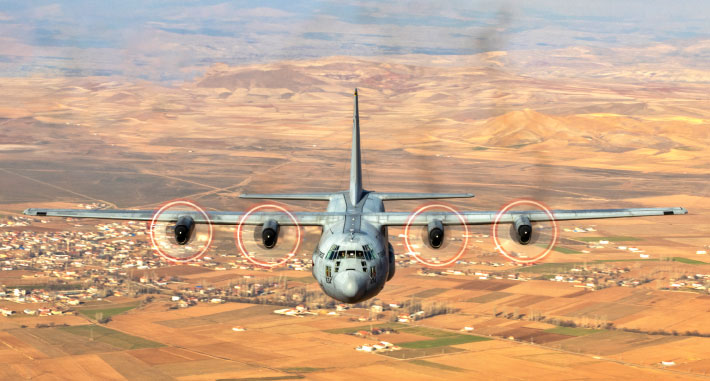
The C-130J made its first flight on April 5, 1996. It is a development project by Lockheed Martin. Of the 625 Super Hercules ordered, 541 have been delivered. The C-130J and C-130J-30 look very similar to the C-130H and C-130H-30 models. The most significant external difference from the older series is the change in the engine and propeller system. The C-130J models are powered by four 4637shp Rolls-Royce AE 2100D3 turboprop engines. These engines are equipped with Collins Aerospace Full Authority Digital Engine Controls (FADEC) and GE Aerospace/Dowty R391 six-blade composite propellers.
This powertrain provides the C-130Js with up to a 40% range advantage compared to the legacy C-130Hs while also increasing the maximum speed. Additionally, the required takeoff distance has been reduced by approximately 30%. Alongside the changes in the power group, the most significant alterations have been in the cockpit and avionics. The newly designed glass cockpit has reduced the flight crew from four to three. Unlike the previous series, a flight engineer is no longer needed. The missions are now carried out with two pilots and one loadmaster.
Another innovation in the cabin is the improved decking/roller system in the cargo area, which allows for faster loading and unloading of cargo and facilitates different configurations. Additionally, a new winch with a capacity of 6500 lb has been added to the cabin.
Both the C-130H and C-130J can carry six cargo pallets, 92 soldiers, or 64 paratroopers. The C-130J-30, on the other hand, can carry eight cargo pallets, 128 soldiers, or 92 paratroopers. The cargo area of the C-130J-30 is 55 ft long, 10 ft wide, and 9 ft high, with a load capacity of 50,000 lb. While the C-130H can carry a 35,000 lb load at a cruising altitude of 18,000 ft at 280 knots, the C-130J can carry the same load at an altitude of 28,000 ft at 310 knots, reaching the 28,000 ft altitude in a shorter time than it takes for the C-130H to reach 18,000 ft.
The tire and brake systems of the C-130Js have also been upgraded, enhancing their capabilities and extending their service life. The overhaul requirement, which was necessary for every 250 landings in legacy Hercules, has been extended to every 2000 landings.
The USAF acquired two C-130Js for development purposes, but its first customer was the UK, which ordered 25 aircraft (10 C-130Js and 15 C-130J-30s) for $1.6 billion on December 16, 1994. These aircraft were designated Hercules C.4 (C-130J-30) and Hercules C.5 (C-130J). The first of these aircraft flew in 1996, with acceptance by the RAF beginning in 1998 and completed in 2000. The RAF retired its last Hercules C.4s on June 30, 2023. The Hercules C.5s were retired earlier, with 10 Super Hercules aircraft taken out of service in 2015. Of these, eight were sold to Bahrain (2), Bangladesh (5), and the US Navy (1), while two C.5s are in storage at Marshall Aerospace facilities in Cambridge, awaiting customers.
As of December 31, 2023, Lockheed Martin has delivered 2674 C-130 and L-100 (the civilian version of the C-130) aircraft. The Hercules family continues to fly with approximately 70 users in 60 different countries. The C-130Js serve in 23 countries in 18 different configurations, with these Super Hercules having accumulated over one million flight hours.
Türkiye's Hercules Aircraft
By the 1960s, due to the turmoil in Cyprus, there was a need to enhance air transport and airborne capabilities. To meet this need, five C-130E Hercules aircraft were acquired in 1964, and the "Tactical Air Transport Squadron Command" was established with these planes. One of these aircraft, the C-130E with serial number 64-17949, crashed while landing at Akhisar Airfield Command on the evening of October 19, 1968, resulting in the martyrdom of the seven crew members onboard. Between 1971 and 1974, three more C-130E aircraft were acquired.
Since 1968, the 2nd Air Maintenance Factory Directorate has had Depot-Level Maintenance (DLM) capability for C-130 aircraft. The C-130B/E Hercules aircraft of the 222nd Squadron Air Transport Command undergo D-Level Maintenance every five years. The 1st Air Maintenance Factory Directorate currently has Depot-Level Maintenance capability for Rolls-Royce T56 Turboprop engines. Under the T56-A-7/15 Conversion Project, initiated in the second half of the 1990s, the T56-A-7 TP engines used in C-130B/E aircraft were converted to the T56-A-15 model.
In 1991-1992, six second-hand C-130B aircraft, previously flown by the US National Guard, were added to the inventory. To support the fleet, six used C-130E transport aircraft were purchased from the Royal Saudi Air Force (RSAF) in 2010 for $26.3 million. The transfer of these aircraft from Prince Sultan Airbase in Saudi Arabia to Erkilet Airbase in Kayseri took place between November 20, 2011, and January 21, 2012. Unlike the C-130E aircraft in service, the C-130E Hercules aircraft purchased from the RSAF does not have the AN/AAR-47(V)1 Missile Warning System (MWS) sensors or Chaff/Flare launchers in the nose and tail sections. Today, a total of 19 C-130B/E aircraft continue to operate under the 222nd Squadron Command.
The C-130 Erciyes Avionics Modernization project was initiated to make the existing C-130B/E aircraft compliant with the rules implemented in European and US airspace from 2005 onwards, enabling their use in these airspaces. Additionally, it aims to replace obsolete systems that threaten flight safety and reach the end of their service life with modern systems. Under the Erciyes Project, led by TUSAŞ (Turkish Aerospace) and signed in December 2006, 13 C-130E and 6 C-130B Hercules transport aircraft will be modernized. The first prototype aircraft (tail number 188), with completed design, integration, production, ground and flight tests, and qualification activities, was delivered to the Turkish Air Force (TurAF) at a ceremony held at Turkish Aerospace facilities on August 8, 2014. The second and final prototype aircraft (tail number 634) was delivered to TurAF in December 2016. Post-modernization, the aircraft were renamed C-130EM and C-130BM. This modernization will enable the C-130s to safely remain in service until the 2040s. The C-130BM/EM Hercules aircraft are equipped with a Digital Cockpit (featuring four color Multi-Function Displays (MFD) with Moving Map capability, 2 Central Display Units (CDU), and 2 Multi-purpose Central Control Computers (MCC)), a National Flight Management System (FMS), a Ground Mission Planning Unit integrated with Havelsan HvBS (MEIS - Military Enterprise Information System), and Night Vision Goggle (NVG) compatible instrument lights.
The C-130 Hercules aircraft typically operates with a crew of five, including two pilots, a navigator, a flight engineer, and a loadmaster. However, thanks to the FMS software developed by TUSAŞ engineers under the ERCIYES Project, which replaces the navigator, the crew size of the modernized C-130BM/EM Hercules aircraft has been reduced to four.
Under the Erciyes Project, which covers a total of 19 aircraft, 14 aircraft have been modernized and delivered to the Turkish Air Force to date. The 15th aircraft is expected to be delivered within this year.
We extensively utilize the A400M aircraft for a wide range of missions, from personnel transport and cargo transport to courier flights and VIP flights. Initially, the Turkish Air Force (TurAF) defined a requirement for 26 aircraft. However, due to economic reasons, the order was reduced to 10 aircraft. Increasing this order again would be the most beneficial move to enhance our transportation capabilities. If the A400M, which has high initial acquisition and operational costs, cannot be procured, the C-130J-30 Super Hercules could be considered as an alternative. The C-130J-30 may be ideal for transporting larger cargo that the C-130B/E cannot accommodate. Germany and France, both A400M users and project partners, have established a joint C-130J-30 fleet for this purpose. Although the 19 C-130B/E aircraft in our inventory appear sufficient for tactical transport capabilities after the Erciyes modernization, the structurally weaker C-130B models could gradually be replaced by C-130J-30s. This would not only enhance our tactical transport capabilities but also alleviate the burden on the A400Ms, as described above.
In this context, the Turkish Air Force is closely interested in the C-130J Super Hercules transport aircraft, which are being retired by the Royal Air Force (RAF), to support its Air Transport Fleet while modernizing the current C-130 fleet. A delegation visited the Marshall Aerospace facilities in Cambridge, UK, to inspect the aircraft and hold preliminary discussions on potential collaborations with the company if the purchase is realized. If these ongoing discussions result positively, an agreement is expected to be signed between the two countries to transfer 8 Hercules C.4 (long-bodied C-130J-30) and 2 Hercules C.5 (C-130J) transport aircraft from RAF stocks to the Turkish Air Force after undergoing necessary maintenance, repair, and retrofit at Marshall Aerospace and Defense Group facilities.
If this agreement is signed and the C-130J and C-130J-30 aircraft are added to the inventory, the position of candidates in the Liaison and Utility Aircraft project, which is being conducted by the Secretariat of Defence Industries (SSB) and is currently awaiting budget allocation, will change. The two main candidates for this project, which aims to meet the transport aircraft needs of the Land Forces, are the C295M and C-27J aircraft. The C-27J Spartan has the same cockpit design, common avionics, and the same engines as the C-130Js. Its disadvantage in initial acquisition cost can be offset by reduced operational costs due to this common architecture, making the C-27J a favorable option.
For 70 years, Hercules has been serving as the world's most successful transport aircraft, and it will continue to bear the world's load for many more years. With the ERCIYES Modernization and the potential acquisition of Super Hercules, the Turkish Air Force's transport fleet will continue to fly as a backbone for many years to come…