The Royal Saudi Naval Forces
The Royal Saudi Naval Forces (RSNF), also referred to as the Royal Saudi Navy, are the naval branch of the Saudi Arabian Armed Forces, tasked with defending Saudi territorial waters, safeguarding freedom of navigation, and protecting key commercial sea routes in the Middle East.
Introduction
The RSNF’s structure reflects Saudi Arabia’s geographical reality, with a long coastline on both the Red Sea and the Arabian Gulf. To effectively cover these two critical maritime theatres, the Navy is organized into two main operational fleets:
Western Fleet: Responsible for operations in the Red Sea and Bab el-Mandeb Strait, this fleet is based at the King Faisal Naval Base in Jeddah. It operates Saudi Arabia’s heavier surface combatants, support vessels, marines, and associated aviation units tasked with defending the western maritime approaches and contributing to multinational coalitions in the Red Sea region.
Eastern Fleet: Charged with defending Saudi interests in the Arabian Gulf, the Eastern Fleet is headquartered at the King Abdulaziz Naval Base in Jubail. This fleet covers the strategic waters of the Gulf, including approaches to the Strait of Hormuz, and fields corvettes, patrol vessels, logistics assets, and naval aviation suited to the unique challenges of the Arabian Gulf littoral.
These fleet commands are supported by additional infrastructure, including training establishments, administrative bodies, and technical support units, all aimed at enhancing the RSNF’s operational readiness and maritime defense capabilities
Saud Class Multi-Mission Surface Combatants (Modified Freedom Class Frigates – FFGHM)
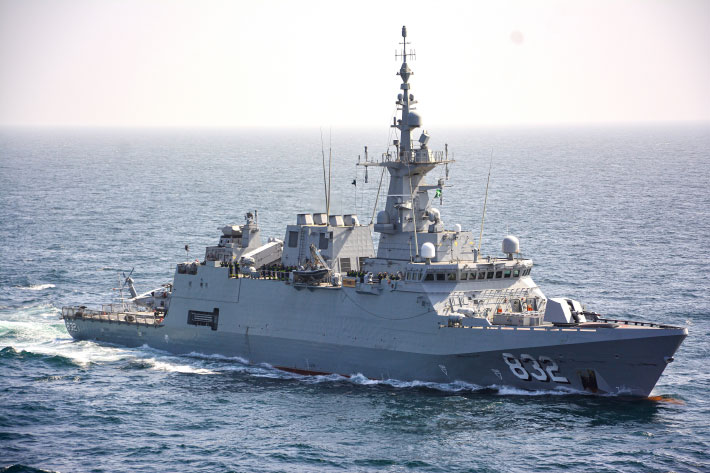
The Saud class represents the most modern surface combatants in Saudi service and is derived from the US Navy’s Freedom-class Littoral Combat Ship, heavily modified for frigate-level combat capability. The program was initiated following a US Foreign Military Sale request announced on 20 October 2015, with the contract formally awarded in 2017. Construction is being carried out by Fincantieri Marinette Marine in the United States. The first vessel of the class HMS Saud (820) was launched at the Marinette yard on 27 December 2025, one week after a blessing ceremony was held
The class includes Saud, Fahd, Abdullah, and Salman, with the first ship laid down on 28 October 2019, followed by subsequent keels in January 2021, May 2021, and October 2022. The ships displace approximately 4,000 tones at full load and measure 118.1 m in length, 17.6 m in beam, and 4.3 m in draught.
Propulsion is provided by a CODAG system combining two Rolls-Royce MT30 gas turbines and two Fairbanks Morse Colt-Pielstick diesel engines, driving four Rolls-Royce waterjets. This arrangement delivers a top speed of 30 knots and a range of about 5,000 nautical miles at 10 knots. The ships are designed to operate with a relatively lean crew complement.
The Saud class is heavily armed for its size. Surface strike capability is provided by eight Harpoon Block II anti-ship missiles, while area and point air defense is delivered through an eight-cell Mk 41 Vertical Launch System loaded with 32 CAMM (Sea Ceptor) missiles, complemented by a SeaRAM launcher with 11 RAM Block II missiles. The main gun is a 57 mm Bofors Mk 110, supported by two 20 mm Narwhal remotely operated weapons stations.
Anti-submarine warfare capabilities include triple 324 mm torpedo launchers and a low-frequency variable-depth sonar, supported by the SLQ-25 torpedo defense system. The sensor suite is centered on the Hensoldt TRS-4D AESA radar, with fire control provided by Saab CEROS 200 directors. Electronic warfare is handled by the Indra Rigel RESM system, while decoys are launched via the Mk 137 and ALEX systems. Combat management is provided by Lockheed Martin COMBATSS-21.
The ships operate a single MH-60R Seahawk helicopter and retain a limited mission bay beneath the flight deck, allowing some flexibility despite not adopting the modular LCS concept.
Al Riyadh (Modified La Fayette / F3000S) Class Frigates
The Al Riyadh-class frigates represent the first major step in the RSNF’s transition toward a modern, missile-capable surface combatant force with credible air-defense and anti-submarine warfare capabilities. Developed under the Sawari II program, the class is based on a significantly enlarged and heavily modified version of the French La Fayette-class frigate design.
Three ships Al Riyadh, Makkah, and Dammam were constructed by DCN (now Naval Group) at Lorient, France. The vessels were laid down between 1999 and 2001, launched between 2000 and 2002, and commissioned into RSNF service between 2002 and 2004.
With a full-load displacement of approximately 4,650 tones, the ships measure 133.6 meters in length, with a beam of 17.2 meters and a draught of 4.1 meters. Propulsion is provided by a CODAD arrangement, comprising four SEMT-Pielstick 16PA6 STC diesel engines delivering a total of 28,000 hp to two shafts with controllable-pitch propellers. This configuration enables a maximum speed of 25 knots and a range of around 7,000 nautical miles at 15 knots, supporting extended regional deployments. The standard complement is 181 personnel, including 25 officers, with additional spare berths.
The Al Riyadh class is notable for its area air-defense capability, a first for the RSNF at the time of entry into service. Each ship is fitted with the EUROSAM SAAM (SAAM-1) air-defense system, employing 16 Aster 15 surface-to-air missiles housed in two SYVER A43 vertical launch systems. The Aster 15 provides engagement ranges of up to 30 km, offering protection against aircraft and anti-ship missiles. The design allows for future growth, including provision for larger VLS installations capable of supporting Aster 30, although this has not been implemented.
For surface warfare, the ships are armed with eight Exocet MM40 Block 2 anti-ship missiles, arranged in two quad launchers, providing a stand-off strike capability against surface targets. The main gun armament consists of a 76 mm OTO Melara Super Rapid naval gun, supported by multiple heavy and light machine guns for close-range defense.
Anti-submarine warfare is a core design feature. The frigates are equipped with two twin 533 mm torpedo launchers for F17P heavyweight torpedoes, complemented by the Thales CAPTAS-20 towed-array sonar, giving the class a credible long-range submarine detection and engagement capability. This is reinforced by embarked aviation assets.
Electronic warfare and sensor fit is extensive for the class. Key systems include the Thales DRBV 26C Jupiter II air and surface search radar, the Thales Arabel multi-function radar for missile guidance, and the SENIT 7 combat management system. Defensive aids include DAGAIE Mk 2 decoy launchers, electronic support and countermeasure suites, and provision for anti-torpedo countermeasures. Fire control is handled by Thales Castor radar and electro-optical directors.
Each ship operates one medium helicopter, originally the AS565 Panther, with design provisions for larger platforms such as the NH90. The ships feature the DCN Samahé helicopter handling system, enabling safer flight operations in high sea states.
Operationally, the Al Riyadh class has formed the backbone of the RSNF’s Western Fleet surface combatant capability. Despite an early setback—Makkah suffered serious damage following a grounding incident in 2004 and only returned to service in 2009 after extensive repairs—the class remains a key element of Saudi Arabia’s high-end naval combat capability and continues to serve as a reference point for later RSNF surface combatant acquisitions.
Al Jubail Class Corvettes (Avante 2200 – FSGHM)
The Al Jubail class corvettes, based on Navantia’s Avante 2200 design, constitute a key element of Saudi Arabia’s fleet modernization under Project Sarawat. The initial batch of five ships—Al Jubail, Al Diriyah, Hail, Jazan, and Unayzah—was contracted in 2018, with construction carried out at Navantia’s San Fernando shipyard. Keel-laying began in October 2019, and the first ship was commissioned on 31 March 2022.
The class displaces approximately 2,200 tones at full load and measures 104.2 m in length, 14.4 m in beam, and 4.3 m in draught. Propulsion is provided by a CODAD arrangement with four MTU 16V 1163 TB93 diesel engines delivering around 23.7 MW to two shafts, enabling a top speed of 27 knots and a range of 3,500 nautical miles at 12 knots. The standard complement is about 102 personnel.
Armament is optimized for multi-role operations. Surface warfare capability is provided by eight Exocet MM40 Block 3 missiles, while air defense relies on 16 VL MICA missiles housed in a vertical launch system. Gun armament consists of a 76 mm Super Rapid main gun, a 35 mm Millennium CIWS, and two 12.7 mm remote weapon stations. For ASW operations, the ships are fitted with two triple 324 mm torpedo launchers and the Thales CAPTAS low-frequency variable-depth sonar.
The sensor and combat system suite includes the Hensoldt TRS-4D rotating AESA radar, Navantia DORNA fire-control system, and the CATIZ combat management system, integrated by the SAMI-Navantia joint venture. Electronic warfare is handled by the Indra Rigel EW suite, while electro-optic coverage is provided by multiple DORNA optronic directors. Each ship is capable of operating an MH-60R helicopter.
Following successful sea trials beginning in September 2021, Al Jubail conducted a live firing of the VL MICA missile in July 2022. In December 2024, Saudi Arabia signed a contract for three additional corvettes, with construction commencing shortly thereafter and deliveries scheduled to be completed by 2028
Al Madinah Class Frigates (F2000S / FFGHM)
Al Madinah class frigates form the backbone of the Royal Saudi Naval Forces’ Western Fleet and were constructed in France as part of the Sawari I program. The four ships—Al Madinah (703), Hofouf (706), Abha (708), and Taif—were laid down between October 1981 and March 1983 at Lorient and Seyne-sur-Mer by DCN and CNIM. They were launched between 1983 and May 1984 and commissioned between January 1985 and August 1986.
The class displaces approximately 2,000 tones standard and 2,870 tones at full load, with overall dimensions of 115 m length, 12.5 m beam, and 4.9 m draught. Propulsion is provided by a CODAD arrangement consisting of four SEMT-Pielstick 16PA6-280V BTC diesel engines delivering 38,400 hp to two shafts, enabling a maximum speed of 30 knots. The ships have a range of up to 8,000 nautical miles at 15 knots and operate with a complement of about 179 personnel, including 15 officers.
The primary surface strike capability is provided by eight Otomat Mk 2 anti-ship missiles in two quad launchers, offering a range of up to 180 km and benefiting from mid-course guidance via the ship’s helicopter using the ERATO system. Air defense is provided by the Thomson-CSF Crotale Naval system, with an octuple launcher and 26 missiles capable of engaging targets out to 13 km. Gun armament consists of a 100 mm/55 Creusot-Loire main gun forward and two twin 40 mm Breda mounts for close-range defense.
For anti-submarine warfare, the ships are equipped with four 533 mm torpedo tubes firing DTCN F17P wire-guided torpedoes, supported by a comprehensive sonar suite comprising the Thomson Sintra Diodon TSM 2630 hull-mounted sonar and the SORE variable-depth sonar. Electronic warfare systems include DR 4000 ESM, Janet ECM, and DAGAIE decoy launchers, while sensors include the Sea Tiger DRBV 15 air/surface search radar and Castor fire-control radar. Combat management is handled by the Thomson-CSF TAVITAC system.
All four ships underwent a major mid-life upgrade between 1997 and 2000, including updates to the combat system, sonar suite, Otomat missiles, and the installation of the Samahé 110 helicopter handling system. A further refit and modernization contract was reportedly signed in 2013 involving DCNS, Thales, and MBDA. The class operates a single medium helicopter and is based at Jeddah. Al Madinah was damaged in a suicide boat attack off Yemen on 31 January 2017 but was repaired and returned to port shortly thereafter.
Other Important Vessels
The HSI 32-class fast interceptor craft form a central component of the Royal Saudi Naval Forces’ coastal security, force protection, and rapid-response architecture. Designed for high-speed interception and patrol missions, the class supports port security, offshore infrastructure protection, and littoral surveillance tasks across both the Red Sea and the Arabian Gulf.
The program originated with a contract signed in April 2018 for 39 boats, followed by an additional order for 19 units in 2020, bringing the total to 58 craft. The acquisition reflects a deliberate emphasis on numbers, speed, and local industrial participation, aligned with Saudi Arabia’s Vision 2030 objectives.
The HSI 32 class measures 32.2 meters in length, with a beam of 7 meters and a draught of approximately 1.4 meters. Constructed with an aluminum hull and superstructure, the design prioritizes speed and agility. Propulsion is provided by three diesel engines driving three waterjets, enabling a maximum speed of up to 43 knots and a range of approximately 800 nautical miles at 12 knots.
Crew size varies by configuration but typically remains small, reflecting the craft’s role as a short-duration, high-intensity patrol platform. Armament is centered on a remote-controlled Nexter NARWHAL weapon station, fitted with a 20 mm M621 cannon, supplemented by 12.7 mm machine guns. Some units are additionally equipped with a LIG Nex1 multi-rocket launcher, enhancing their deterrence and close-range firepower.
Sensor and combat systems are modest but appropriate for the mission profile. The class is equipped with Simrad surface search and navigation radars, Saab electronic support measures, and the Anschütz SYNAPS/SYNTACS navigation and tactical data system, providing situational awareness and interoperability with RSNF command structures.
Industrial participation is a defining feature of the programme. While initial units were built abroad—including construction in Cherbourg, France—a substantial portion of the class was assembled locally at Zamil Offshore facilities in Saudi Arabia. The first locally built craft was laid down in September 2019 and launched in October 2020, with deliveries continuing through February 2023. Several boats have been confirmed in service at Ras Mishab and other key naval bases.
The HSI 32 class significantly enhances the RSNF’s layered maritime security posture, complementing larger surface combatants by providing fast, responsive assets optimized for the protection of ports, sea lines of communication, and critical maritime infrastructure. Consideration of additional units suggests continued confidence in the design and its operational value.
The number of auxiliary ships in RSNF inventory is very meager compared to the armed vessels
There are only 3 minehunters, 2 replenishment tankers and 2 dive support ships. As for amphibius vessels, there are two LCM’s 3 LCVP’s and 4 LCU’s.
The 3 Al Jawf minehunters were ordered from the UK in 1988 under Al Yamamah project with British Aerospace being the prime contractor and Vosper Thornycroft the shipbuilder. The ships are based on Sandone mine hunters in Royal Navy Service. They have GRP hulls. They were delivered to RSNF between 1991 and 1997. All received a mid-life upgrade between 2011 and 2018. They are based in Al Jubail.
The two replenishment tankers Boraida and Yunbou were procured under the Sawari I program together with the 4 Al Madina class frigates from France. Their cargo capacity is 4350 tones diesel, 350 tones aviation fual, 140 tones fresh water, 100 tons ammunition and 70 tons spare parts.
In 2013 a contract was signed for mid-life upgrade including remotely controlled SIMBAD launchers for Mistral air defense missiles.
Boraida was hit and damaged by a water-borne improvised explosive device from the starboard hull. She was repaired and returned to service.
International Operations
The Royal Saudi Naval Forces have played an increasingly prominent role in multinational maritime security operations in the Middle East, particularly under the umbrella of the Combined Maritime Forces (CMF) and related international constructs. The CMF is a long-standing coalition headquartered in Bahrain, established in February 2002 to promote security, stability and prosperity across some of the world’s most vital shipping lanes, including the Red Sea, Gulf of Aden, Arabian Sea, Gulf of Oman and Persian Gulf.
Among the principal components of the CMF is Combined Task Force 150 (CTF-150), a multinational naval task force dedicated to Maritime Security Operations (MSO) outside the Arabian Gulf, focusing on counterterrorism, interdiction of illicit trafficking and protection of freedom of navigation under international law. Since its inception, CTF-150 has rotated command among participating nations and Saudi Arabia has repeatedly taken the helm: first assuming command in 2018 from the British Royal Navy, then again in 2020 from the French Navy, in 2022 from the Pakistan Navy, and most recently in August 2025 from the Royal New Zealand Navy, reflecting the Kingdom’s sustained commitment to multinational maritime security.
Another CMF task force in which RSNF has participated at the leadership level is Combined Task Force 152 (CTF-152), established in 2004 to coordinate maritime security operations within the Persian Gulf alongside Gulf Cooperation Council partners; the Royal Saudi Navy assumed command of CTF-152 in August 2023, and later handed over leadership to the Kuwaiti Naval Forces in August 2024, underscoring a cooperative regional approach to securing Gulf waters. In addition to these CMF task forces, Saudi Arabia has been an active contributor to the International Maritime Security Construct (IMSC), a multinational coalition formed in 2019 to deter threats and reassure merchant shipping through strategic chokepoints such as the Strait of Hormuz and Bab el-Mandeb; RSNF leadership of the IMSC’s operational arm, Coalition Task Force Sentinel, in August 2023 marked a notable transition toward regional command of maritime security operations within this partnership.
RSNF has not been documented as commanding other specialized CMF task forces such as CTF-151 (Counter-Piracy) or the more recently established CTF-153 (Red Sea Maritime Security), Saudi assets and personnel regularly contribute ships, planning officers and operational support to multinational patrols, exercises, and security missions that enhance cooperation and deterrence against terrorism, piracy, smuggling and other transnational maritime threats throughout the region.
SAMI
Saudi Arabia’s Vision 2030 is a comprehensive socio-economic transformation plan that includes a significant focus on localising defence industries, reducing dependency on foreign suppliers, and building national technological and industrial capabilities. Within this framework, Saudi Arabian Military Industries (SAMI) was established to become a central pillar of the Kingdom’s defence industrial base, including maritime systems and naval shipbuilding.
One of the most significant industrial partnerships in the naval domain is SAMI-Navantia, a joint venture formed between SAMI and the Spanish shipbuilder Navantia S.A.
One of the most significant industrial partnerships in the naval domain is SAMI-Navantia, a joint venture formed between SAMI and the Spanish shipbuilder Navantia S.A.. This partnership has led to the construction and combat system integration of advanced corvettes for the RSNF’s Al Jubail (Avante 2200) class.
In March 2024, the SAMI Navantia Naval Systems Integration and Development Center of Excellence was inaugurated in Riyadh, aimed at developing advanced software, systems integration, cybersecurity and unmanned technologies tailored to Saudi naval requirements. This center underscores the Kingdom’s emphasis on not only assembling hardware but also maturing domestic expertise and autonomy in naval systems.
HAZEM, the first Saudi naval military system for naval combat management (CMS) is a product of this partnership. It integratively combines a comprehensive communications system, a fire control system, an integrated platform management system, a combat management system, and a training system. It was launched in 2019.
The system was created as a part of the joint 'SAMI Navantia' program to meet the requirements of the Royal Saudi Naval Forces and the naval forces of its allies. The system was developed through technology transfer from the Spanish company Navantia and based on the company's 'CATIZ' combat system.
In November 2024 SAMI Navantia announced that it has released HAZEM Lite. This combat management systems are tailored for small and medium warfare vessels, as well as vessels with space restrictions.
HAZEM Lite can be used and installed on new ships or integrated into the existing systems. Derived from the HAZEM CMS, it has been specifically designed for smaller vessels, ensuring that it retains the essential features of the original HAZEM system, including providing an open, scalable, customizable, and interoperable solution that is proven effective and robust.
Conclusion
Saudi Arabia’s maritime geography is both a strategic asset and a structural vulnerability for the RSNF. The Kingdom is uniquely positioned, with long coastlines on both the Red Sea and the Arabian Gulf, granting access to two of the world’s most economically and militarily significant maritime spaces. This dual-seaboard advantage underpins Saudi Arabia’s role as a major energy exporter and regional maritime actor, while justifying the maintenance of two distinct operational fleets.
At the same time, this geography imposes inherent strategic constraints. Access to Saudi Arabia’s Red Sea ports is dependent on passage through either the Bab el-Mandeb Strait or the Suez Canal—both critical maritime chokepoints that are vulnerable to disruption by state and non-state actors, including terrorism, piracy, regional conflict, or accidental blockage. Similarly, access to the Arabian Gulf is constrained by the Strait of Hormuz, a narrow and politically contested waterway where tensions with Iran pose persistent risks to freedom of navigation and maritime security.
As a result, the RSNF must operate in an environment where sea control cannot be taken for granted, and where safeguarding maritime access routes is as important as defending national waters. This reality helps explain the RSNF’s evolving force structure: an emphasis on missile-armed surface combatants, layered air and missile defence, anti-submarine warfare capabilities, and close integration with allied naval forces. In this context, Saudi naval modernisation is not merely a matter of prestige or regional influence, but a strategic necessity driven by geography, global trade dependencies, and the fragility of the world’s most critical maritime chokepoints