The S-80 PLUS Submarine Program
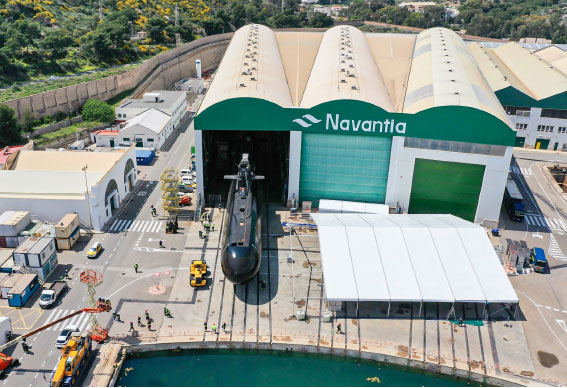
The Spanish shipyard Navantia launched the first S-80 Plus submarine S-81 Isaac Peral on 23 April 2021.
The boat is named after the Spanish Navy Lieutenant Isaac Peral y Caballero, in honor of the scientist and sailor who invented a submarine capable of launching torpedoes in 1888.
The second submarine S-82 Narciso Monturiol will be delivered in in June 2024. The deliveries for the third and fourth submarines are scheduled for April 2026 and August 2027.
The submarine is currently undergoing factory and harbor trials by Navantia. The sea trials will begin in the first quarter of 2022. The Scheduled delivery of the submarine to the Spanish Navy is in 2023.
The S-80 Plus submarines have submerged displacement of 2,965 tons. The boats are 81 meters long. Their pressure hull diameter is 7.3 meters. Their draught is 6.3 meters. The hull of the submarine is optimized for very low acoustical signature. They have a single hull with several watertight layers/surfaces.
With a crew of 32 submarines the boats have spare berthing for 8 special forces personnel. The boats have an endurance of 50 days operation away from the port.
The main propulsion is a 3,500kW electric motor. There are three 1,200 kW diesel generators that produce the power needed by the electric motor.
The S-80 Plus class submarines will have an air independent propulsion system developed in Spain. However, this AIP system based on an ethanol reformer and PEM fuel cells will be ready only for the third boat.
When finished the AIP system will have two components, the PEM and the bioethanol processor. The 300Kw fuel cell power module, supplied by the American company UTC Aerospace, will generate electricity by a chemical reaction from the mixture of pure oxygen in a gaseous state and pure hydrogen. The S-80 Plus has a hydrogen production system on board as reformed bioethanol. The Spanish Ministry of Defense (MoD) decided to go with bioethanol instead of ethanol as bioethanol can be produce in country thus eliminating the dependence on international ethanol production.
This bio reformer ensures enough hydrogen for the submarine to remain underwater for fifteen days.
The first two boats will be delivered without the AIP system. This system will be Retro fitted to the first pair during their mid-life upgrade.
The submarine has 2 battery compartments with each carrying 180 elements.
The Spanish Navy considers, like any other navy, its submarines as capital ships. The submarine’s ability of discretion and invisibility make them strategic assets. They will fulfill traditional submarine missions such as attacking enemy naval or merchant ships, laying offensive mine fields, gathering information about enemy vessels, sensors or movements. Furthermore, the S-80 Plus submarines will present the Armada with something unprecedented in their current submarines: firing missiles such as the UGM-84 Harpoon for surface vessels and BGM-109 Tomahawk cruise missiles for land attack when Spain acquires this capability.
Additionally, these submarines will operate as part of a naval task force and protect it and its capital ships against enemy submarines and other underwater threats.
The ability, firing missiles underwater is not the only novelty these boats present to the Armada, S-80 Plus class submarines have an integrated combat system. This integrated combat system was developed by Lockheed Martin and Navantia Sistemas. It compromises seven multi function operator consoles, one large tactical display, two navigation and network system cabinets, two weapon processor units, six weapon interface units one sonar array suite and one own noise monitoring system.
The CMS has in its core the SCOMBA system developed by Navantia and used in all Spanish Navy ships starting with the F-105 ESPS Cristobal Colon. Thanks to this common architecture the Armada has had a single combat system for all its ships for years, including the S-80 Plus submarines.
The ICSC allows the combat system’s weapons and sensors to be highly integrated to ensure optimal management of both information about operations and the Command-and-Control center. It enables all the necessary information to be gathered, assessed and displayed for offensive, defensive or intelligence actions that can take place at any time. This includes using weapons and countermeasures and their launching devices. Thanks to this, the combat system is able to find and track multiple targets in different scenarios and simultaneously manage several components.
Specifically, it can manage short, medium and long range active and passive sonars for exploration, attack and navigation tasks; electronic, optronic and electromagnetic detection systems for combat missions or intelligence operations; precise navigation aids; integrated communication systems, including satellite links and tactical data links with other naval vessels through ‘Link-11’ and ‘Link-22’, and weapons systems for operations at sea.
The S-80 Plus boats have six 533mm torpedo tubes. The main offensive weapon of the submarine will be the Atlas Electronic made DM2A4 torpedo. This fiber cable guided weapon can be used against both surface and submerged targets, and it has a 50km range and is capable of traveling at speeds of more than 50 knots.
The combat management system on board can control various stages of the DM2A4 heavyweight torpedo (HWT) such as pre-launch, launch and post-launch. The combat management system also allows this weapon to be fired in different types of launches: deliberate, volley (up to six torpedoes), emergency, urgent and ‘jettison’.
As mentioned before, S-80 Plus class submarines will also deploy the UGM-84 Harpoon missile. This is an encapsulated version of the successful Harpoon missiles used by surface ships. The Advance Harpoon Weapon Control System is integrated to the combat management system of these boats. This provides missile control and launch guidance, the ‘Block 1’, ‘1B’, ‘1C’, ‘1G’, ‘Block II’ versions and future compatible versions of the ‘Harpoon’ missile. The submarine is expected to use the ‘Block II’ version.
Currently the Spanish Armada does not operate Tomahawk UGM-109E Block IV All-Up-Round missiles. This is the encapsulated version of the Tomahawk Land Attack Missile (TLAM). However, all systems on board are designed and the vessel’s design includes enough volume and weight for TLAM missiles and the TLAM missile launch guidance equipment. So, when Spain acquires these missiles, they will be integrated into these submarines without any problems or delays.
The launching of the first S-80 Plus submarine was an important milestone for the whole project, which started in 2004 and which faced many uncertainties and possible cancelations.
The Spanish Navy was a good customer of French submarines. In the 60’s Spain produced the DCN designed Daphné class submarines for its navy. And later when these submarines become obsolete the Agosta class submarines in the late 70’s. They were constructed in Spain with local industrial input according to French designs. This close cooperation between two shipyards led to the creation of the Scorpène Consortium in 1992.
The Scorpène Consortium finalized its first order in 1997 from Chile. Soon two more submarines were ordered from Malaysia. Several Spanish companies were involved in the production of these submarines. Navantia was producing the stern of the submarines, the most complex part.
So, the Spanish Navy had the experience of operating French designed submarines and the Spanish ship building industry was deeply involved in Scorpène production led by France. Therefore, the selection of these, as the next generation submarines in the Spanish Navy seemed to be the most logical and obvious decision.
The Spanish authorities including the Ministry of Defense, the Navy high command and the leaders of the industry decided not to follow the most obvious and technologically safe path and decided to go on with a local submarine design, the S-80 as it was known then, for their own reasons.
This decision turned out to be a very brave one. Perhaps due to naivety or arrogance or overconfidence in their own capabilities or a combination of all of these, the decision makers did not take the technical challenges into account. This overconfidence was punished with the challenges of long delays and increased costs. The project was on the verge of cancelation, and only through improvisation, rethinking of each step to be taken and discarding immature technologies the project was able to move forward. These efforts to keep the project afloat cost almost a decade. When ordered in 2004 first submarine was scheduled for delivery in 2013, the second in 2014, the third in 2015 and the last in 2016.
The S-80A construction project is without any doubt one of the greatest industrial and technological challenges ever faced by the Spanish national defense industry. Designing a vessel of this kind is a complex and highly specialized engineering task that spotlights the technological capabilities of a country’s naval industry as well as its short comings. According to Navantia, it has learned the following lessons from the problems it has encountered during the project: developing a technical doctrine, improving resources, implementing a new, systems engineering model, transforming organization, digitizing, cataloging and validating materials and equipment.
When the S-80 program was approved, an initial budget of 2,14 billion euros was established to be paid between 2002 and 2023, the amount being advanced by the Ministry of Industry. More recently, the government was forced to increase the spending ceiling to 3,9 billion euros, which has so far left the unit cost at 976.5 million euros per ship.
One of the most challenging technical features of the S-80 Plus submarine, the Spanish designed AIP system, is still not ready and will only be implemented to the vessels in 2026 or later.
While the system creates an independence from foreign ethanol producers and gives a strategic autonomy to Spain, the novel AIP approach proved to be too difficult to complete during the projected time plan of the submarine construction program.
These boats acquired a notorious reputation for being 70 to 100 tons too heavy at one stage of the design process. The US submarine constructor General Dynamics Electric Boat was involved in the project as consultants to make the submarines buoyant again.
All stakeholders in the S-80 Plus project persevered through all problems and finally resulted in the first submarine. The Spanish S-80A project carries many valuable lessons for any nation set to design and construct its own submarines. These lessons should be examined very carefully. Smart people learn from their mistakes, wise people learn from other’s mistakes