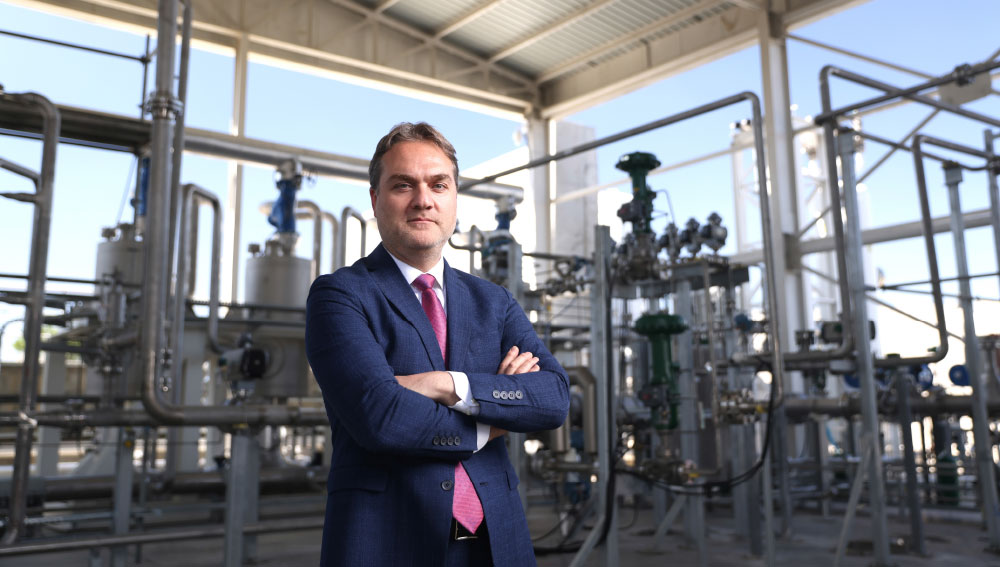
TÜBİTAK SAGE: `In July 2022, the GÖKDOĞAN Missile Was Successfully Fired from A Ground-Based System!`
Defence Turkey: Can we start our interview with an assessment of the first 6 months of 2022 from the perspective of the TÜBİTAK Defense Industries Research and Development Institute (SAGE), which was established in 1972 to conduct R&D in the defense industry as an institute of TÜBİTAK?
Gürcan OKUMUŞ: The defense industry has been hot on the agenda both in our country and in the world in recent years. Significant progress has been achieved in our country, especially in many critical projects, and systems that were developed with our national resources and high local production rate continue to enter the inventory. But if we evaluate the year 2022 from today, I think it would be correct to say that the most consequential topic is the transformation of the tension between Ukraine and Russia, which is increasing step by step into a hot conflict. This war environment in our north has brought operational and geopolitically new considerations. I believe that using high volumes of ammunition and platforms in a short time reveals that production speed in the defense industry is as important as developing new products. We can say that an important topic for our country in 2022 is the potential cooperation created by the dialogue process that started with the UAE and Saudi Arabia for our defense industry companies.
Defence Turkey: What can you tell us about TÜBİTAK SAGE's current organizational structure, personnel status/employee profile, performance, turnover in 2021, and expectations and targets for the end of 2022?
Gürcan OKUMUŞ: Today, as TÜBİTAK SAGE, we serve our national defense industry with more than 1,100 employees. The majority of our employees are researchers and research support personnel, approximately 50% of them are graduates, and 10% of them are doctoral graduates. We also have several employees who continue their master's and doctoral education.
What makes TÜBİTAK SAGE different from other known organizations is that in addition to the existing organizational structure, we have a matrix organization along with the project organizational structure. In other words, aside from their position in the traditional organizational structure, our employees can be leaders or managers in a project. With this management structure, SAGE works in a versatile way under a matrix project organization as well as a hierarchical structure, which significantly contributes to employee development. Thanks to these contributions, our annual performance increases with each passing year. Although our reference is ourselves, the number and volume of our projects continue with an increasing momentum every year. Our success, which increases every year, also shows the result of our performance.
Defence Turkey: If you have, can you share any data about the economic size of the foreign counterparts of the products developed by TÜBİTAK SAGE in the world market and the financial value you have created in the Turkish Defense and Aerospace Industry with the products you have developed so far?
Gürcan OKUMUŞ: SAGE has prevented the import of its foreign counterparts with many products it has developed so far. With guidance kits and cruise missiles alone, we ensured that more than 20 billion TL remained in our country. However, creating the domestic subcontractor ecosystem in the defense industry and ensuring strategic independence is more important. The Turkish defense industry continues to increase its power in the world defense markets. TÜBİTAK SAGE draws attention in international markets with the systems, sub-systems, and infrastructures it has developed. The development in the defense industry significantly contributes to economic growth. We also take part in this development with our high-tech products.
Defence Turkey: What can you say about TÜBİTAK SAGE's vision, goals and expectations for the next 10 years? In this context, do you have any plans for restructuring the Institute?
Gürcan OKUMUŞ: TÜBİTAK SAGE, as a leading institution, continues its activities to meet the needs of the Turkish Armed Forces (TAF). Our primary motivation is to do what has not been done before, develop our existing systems by following up-to-date technologies, and support them with our nationalization activities. In the next 10 years, new and advanced technologies for the protection of the Blue Homeland, hypersonic systems, advanced seeker technologies, artificial intelligence technologies, electromagnetic launch systems, advanced material and propulsion technologies, and advanced navigation solutions stand out as priority technologies for TÜBİTAK SAGE.
Defence Turkey: The products developed by TÜBİTAK SAGE, a well-established R&D-focused institution, are manufactured by various defense industry companies through technology transfer. However, since the "Royalty" mechanism required for the continuous development and improvement of products and the development of new variants could not be fully implemented, the institution was not able to receive the "royalty" payments that it should receive from the relevant companies, thus affecting the development speed of the products. What steps have been taken to implement the royalty mechanism in recent years? Does TÜBİTAK SAGE now receive a "royalty" payment for its products whose industrialization/serial production process is carried out by Turkish Defense and Aerospace Industry companies selected by the Presidency of Defense Industries (SSB)?
Gürcan OKUMUŞ: TÜBİTAK SAGE serves as the R&D Office of the defense industry, as well as carries out the boutique production of some critical products, and will continue to do so. We receive positive feedback from our institutions regarding the definition of the "Royalty" mechanism for the products we developed and to be a revenue source for SAGE. We expect some mechanisms to be implemented in the coming period. I believe that ensuring the continuity of product development in many areas, such as providing additional capabilities and further improvement of that product, is more important than generating income.
Defence Turkey: As far as we know, TÜBİTAK SAGE will now be able to carry out the serial production of the products it has developed with full IP rights and bid for domestic and international tenders. In this context, can you give information about the preparations you have made for the serial production and sales/bidding processes, the planned improvements and capacity increases in the existing infrastructure, and the current status of the stages implemented so far?
Gürcan OKUMUŞ: During an R&D project, a considerable number of prototypes must also be produced. SAGE produces these prototypes sometimes in its own infrastructure and sometimes by working with subcontractors. Integration processes are carried out entirely in our own infrastructure. SAGE has also developed certain capabilities for the serial production of some critical products, similar to its counterparts in the world. We have exceptional subcontractor management and qualification system. Especially with the investments made in the last 5 years, TÜBİTAK SAGE has acquired significant capabilities in both environmental tests and strategic product integration.
Defence Turkey: What can you tell us about the importance of DATA Submarine Test Infrastructure, TAYFUN Aero-trust Test Infrastructure, Ankara Wind Tunnel, and HABRAS, which are used by TÜBİTAK SAGE while developing its domestic and national projects, both for TÜBİTAK SAGE and the Turkish Defense and Aerospace Industry? What services do you provide to your customers with these infrastructures?
Gürcan OKUMUŞ: Ankara Wind Tunnel (ART) is an atmospheric subsonic wind tunnel operating under TÜBİTAK SAGE, with a closed-circuit horizontal loop test section. The test section of ART is 3.05m x 2.44m. Ankara Wind Tunnel infrastructure serves our national defense industry with the mission of producing subsonic aerodynamic databases required for both TÜBİTAK SAGE munitions as well as aircraft belonging to other defense industry organizations. With its history dating back to the 1940s when we set out with the idea of making our own aircraft, the ART is a subsonic wind tunnel that can compete with its counterparts around the world and even surpass them, thanks to the modernizations continued uninterruptedly after its incorporation into TÜBİTAK SAGE. Ankara Wind Tunnel provides test services to TÜBİTAK SAGE and other defense industry organizations with its ability to collect large amounts of data quickly and accurately. In the Ankara Wind Tunnel, various aircraft and weapon systems such as BOZOK, GÖKDOĞAN, BOZDOĞAN, TOGAN, SOM-J, ATMACA, STM UHA, ŞİMŞEK, HÜRKUŞ, HÜRJET, MMU have been tested recently, and services are also provided to universities and the civil sector. Considering the increasing demand, we expect a higher number of tests with more variety to be conducted at the ART.
TAYFUN Aero-thrust Test Infrastructure installation activities are continuing. The installation of the HAT1 (Line1) Low Flow Line has been completed as part of these activities. We continue to work on commissioning this line. On the other hand, production activities continue for the HAT1 (Line1) High Flow Line. Following the completion of construction activities, installation and commissioning activities will continue.
The Submarine Test Infrastructure has broken grounds for the Turkish Defense Industry in many aspects. Turkey has reached a certain point in the number of weapons systems that can be fired from land, air, and ships. However, the experience with submarines is relatively limited compared to the other three platforms. Considering the number and intensity of platforms in this field, gaining knowledge is a challenge in itself. In addition, launching a newly developed missile from a submarine for the first time involves numerous risks. In order to eliminate these risks and safely increase the number of tests, TÜBİTAK SAGE designed and produced the Underwater Launch Platform and established the Submarine Tests Infrastructure. With the Underwater Launch Platform, which is exactly the same as the firing system of the GÜR and PREVEZE Class Submarines, missile firing tests can be carried out without causing risks to the submarines. We provide firing test services to contractor organizations that develop all kinds of systems that can be launched from submarines.
Defence Turkey: In addition to ground tests of Turbojet, Turbofan, and Ramjet type engines up to Mach 4.85 speed, which engines have been tested so far in the TAYFUN Aero-trust Test Infrastructure, which is claimed to be able to simulate all the environmental conditions up to 20km altitude in a laboratory environment? Are the tests of the KTJ-3200 Turbojet Engine, the delivery of which was started by Kale Arge to be used in ATMACA and SOM Missiles in the firing tests to be carried out in the autumn of 2022, and the TR-40+ Turbojet Engines procured from SAFRAN Power Units Company in February 2022 to be used in the flight and firing tests of the New Generation Cruise Missile were/are also carried out in the TAYFUN Aero-Thrust Test Infrastructure?
Gürcan OKUMUŞ: System-level air-breathing engine tests of all cruise missiles developed by TÜBİTAK SAGE are carried out at TAYFUN Aero-Thrust Test Infrastructure. In order to test the flight sequence of the missile in the integrated tests of SOM and SOM-J missiles, airflow to the sensor and engine, engine ignition, and thrust mode tests can be performed thanks to this infrastructure. In this way, missile level tests can be carried out in conditions closest to real flight before firing tests, and controlled experiments that cannot be carried out under challenging real flight conditions can be tested in this infrastructure.
The development tests of the KTJ-3200 Turbojet Engine were carried out in KALE Arge's own test rigs. However, some tests of KALE Arge regarding different altitude and speed conditions are planned to be carried out in TÜBİTAK SAGE infrastructures. Missile level tests of all air-breathing engine systems, including national turbojet engine systems, are planned to be conducted at TAYFUN Aero-Thrust Test Infrastructure.
Defence Turkey: Could you enlighten our readers about the TÜBİTAK SAGE Tri-sonic Wind Tunnel (TSTT), which will allow testing at subsonic, supersonic, and transonic speeds, and the latest situation in the ongoing installation activities? When will TSTT be operational, and what capabilities will it bring to our country?
Gürcan OKUMUŞ: Tunnel design has been completed in the Tri-sonic Wind Tunnel (TSTT) investment, which continues with the Presidency of Strategy and Budget funding. Air storage system production started. We aim to begin the production of the components whose design has been completed this year. Construction works have also started, we will complete the infrastructure project by the end of the year, and we will have laid the foundation at the beginning of next year. We are currently working on transporting our infrastructures in the area where TSTT will be located and bringing electricity to supply the needed power. We aim to drive the air in the tunnel for the first time in 2024 and become operational after qualification.
TSTT will be one of the 3 blow-down tunnels with the largest test section; the others are in Canada and Serbia. The most important advantage of the TSTT over the other two tunnels will be its testing capability at high Mach numbers and wide Reynolds number range with initiation ejectors. In addition, gas storage volume and compressor capacity will enable us to position TSTT well above similar tunnels in terms of test efficiency. With the commissioning of this infrastructure, the wind tunnel test needs of the defense industry will be met with domestic resources to a large extent.
Defence Turkey: What can you tell us about the latest situation in the Ramjet and Scramjet engine studies carried out by TÜBİTAK SAGE? The first ramjet engine prototype operating at supersonic speeds under the Liquid Fuel National Ramjet Project was expected to appear in 2022. Could you briefly summarize the reasons behind the preference for liquid fuel instead of solid- propellant in ramjet engine technology for our readers?
Gürcan OKUMUŞ: This engine is being developed as part of a project classified as "Secret."
"After GÖKDOĞAN, We Are Only an Engine Away from A Ramjet-Powered Missile!"
Defence Turkey: Ramjet and Scramjet engine studies actually bring along a series of technological challenges. For example, the material technology to be used in these engines and the missiles powered by these engines must also be developed. What can you share about the studies carried out by TÜBİTAK SAGE in these areas?
Gürcan OKUMUŞ: As TÜBİTAK SAGE, our activities for establishing the necessary infrastructures for the testing of engines continue. On the other hand, our work on developing a liquid fuel ramjet engine continues at full speed. Studies on Scramjet engine development are carried out in two main branches: modeling & simulation and testing activities. A hypersonic expansion tube is used for testing this type of engine.
Defence Turkey: Could you inform us about the current situation in the Ramjet-powered Air-to-Air Missile development project?
Gürcan OKUMUŞ: As you know about the GÖKDOĞAN and BOZDOĞAN missiles, the development studies are concluding, and serial production preparations are continuing. It was planned from the very beginning that we would continue our journey in air-to-air missiles with the development of a ramjet-powered air-to-air missile. In this context, we have started preparing both our knowledge and infrastructure for developing related ramjet engines. We started the development of test infrastructures, which is indispensable for ramjet development. TAYFUN and Tri-sonic Wind Tunnel (TSTT) are all necessary infrastructures for this grand plan and further studies. Without those infrastructures, we wouldn't be able to talk about any ramjet missile development today. TÜBİTAK SAGE set its goals long ago and has been continuing to do the necessary work for years to achieve its goals. After GÖKDOĞAN, we are only an engine away from a ramjet-powered missile. Right now, we have working engines, and I can say that we are in a good position.
Defence Turkey: One of the problems that the Turkish Defense and Aerospace industry has suffered the most in recent years is brain drain, which resulted in numerous experienced engineers starting to work in companies abroad for different reasons. According to research based on LinkedIn accounts, as of May 2022, around 6,000 engineers, more than 70% of whom are from defense industry companies with an average of 10 years or more experience, are now working in foreign companies in 15 countries. What kind of studies does TÜBİTAK SAGE carry out to prevent brain drain?
Gürcan OKUMUŞ: As TÜBİTAK SAGE, we were not particularly affected by brain drain. There have certainly been some who went abroad from our Institute, but we work with awareness to support and motivate our employees in all matters, with both social, material, and moral feelings.
Under the vision of the National Technology Movement, we know that the most needed resource to make Türkiye a leading country in technology and science is the qualified manpower that will break new ground in the fields of science, technology, and innovation. With the support of the Ministry of Industry and Technology and TÜBİTAK, we attach great importance to the International Leading Researchers Program aimed at Turkish scientists living abroad and offer scholarships to reverse the brain drain. As a research institute, we employ our engineers who are educated in the country after their graduation – even while they are still in their senior year – and train them in the field of the defense industry. Although we employ more recent graduates and candidate researchers, we also employ experienced personnel in line with our needs. In the last few years, we have grown and continue to grow in terms of human resources with high momentum in line with our country's needs.
Although we are not greatly affected by the brain drain compared to our defense industry companies, we pay attention to the criticisms expressed in the surveys with our employees who have parted ways with us and take action regarding the issue. We always value our employees' requests and suggestions by establishing open communication with them. Again, we are trying to train experts in their fields by trying to improve our employees through domestic and international training programs. Together with all our employees, we want to make our country a leading authority in technology and science, with national feelings.
Defence Turkey: What can you tell us about the current status of the development activities of SOM-C1/SOM-C2 variants, which can hit a moving surface target and can be controlled by the pilot after firing via the national data link KEMENT, the guidance system in the missiles, and the test campaign carried out? Does the SOM-C1/C2 have sea-skimming capability? Has the Turkish Air Force ordered the SOM-C1/C2 yet? Will the Turkish Air Force (TurAF) also receive the SOM-C1/C2 variants while it already has the SOM-J missile?
Gürcan OKUMUŞ: Development studies for SOM-C1/SOM-C2 missiles with KEMENT national data link are continuing. We target significant progress in qualification activities by the end of 2022 and to complete the verification activities with firing tests in 2023. SOM-C1/SOM-C2 deliveries are bound to a contract. The National Tactical Data Link System developed based on the KEMENT Project is planned to be used on the missiles. SOM-C1/SOM-C2 missiles have been designed to be used against surface targets in addition to land targets and have "Sea Skimming" capability.
SOM-C1/SOM-C2 and SOM-J variants have different advantages depending on the platforms they are used and mission types. All SOM variants are customized to meet the key operational needs of the Turkish Air Force in a cost-effective manner. The use of the SOM-J Missile, which is lighter and has a lower radar cross-section (RCS) than other SOM variants, on UCAV platforms such as AKINCI and being able to be carried in the internal weapon bays of combat aircraft such as TF-X, will provide the TAF with critical capabilities.
Defence Turkey: SOM-B1 was intended to be exported to Azerbaijan before, but this sale did not occur then, as there was a problem with the French Government due to the export license of SAFRAN Power Units product TR-40 Turbojet Engine. With the introduction of the Kale Arge product KTJ-3200 Turbojet Engine do you expect the sale of the SOM missile to Azerbaijan to become relevant again? Have you received a request from the Azerbaijani authorities on this matter?
Gürcan OKUMUŞ: Integrating national components into SOM missiles is a projected activity, and studies are ongoing. The national turbojet engine is also the most important item among these activities. We believe that the completion of these activities will further pave the way for SOM's exports.
Defence Turkey: The first live-fire test of the 5th Generation SOM-J Missile, which is being developed as a state-of-the-art modern weapon system that can be used on F-16 aircraft and compatible with the F-35 Joint Strike Fighter (JSF) and the National Combat Aircraft (TF-X) internal weapon bays, was successfully carried out in October 2021 from an F-16 aircraft. The last firing test with the SOM-J was conducted in May 2022. What can you tell us about the firing tests carried out as part of the development process of SOM-J and the critical milestones that are expected to be accomplished in the upcoming period? When will the firing test against a real surface target (a decommissioned ship) be conducted with a live missile?
Gürcan OKUMUŞ: The new generation member of the SOM Family, the SOM-J Missile, is designed to fit inside the internal weapon bays of F-35 Joint Strike Fighter (JSF) and National Combat Aircraft (TF-X) and can be carried on UCAV platforms. The SOM-J Missile will be a first in the world in terms of network-enabled guided munitions with the most advanced technologies it contains for engaging surface targets. Various ETM flights, safe separation tests, and firing tests were carried out as part of the external payload certification of the SOM-J Project. In both fire test campaigns you mentioned, the SOM-J missile was subjected to very challenging flight and firing tests, and it made us proud by successfully completing the designated mission in all of these tests. In 2023, we will conduct firing tests to verify network-enabled operation and surface engagement capabilities. All firing tests are planned against floating surface targets, including a firing test against a realistic target with a live warhead.
Defence Turkey: It is stated that an optimization study has been carried out on the SOM-J Missile, whose design, development, prototype production, testing, and platform integration activities are being carried out by TÜBİTAK SAGE; in this context, the location and geometry of the air intake were changed, thereby improving flight performance. Is it possible to get information about this?
Gürcan OKUMUŞ: In order for the SOM-J to be carried in the F-35 internal weapon bays and used effectively against surface targets with point-defense capabilities, an optimization study was carried out based on operational requirements different from the existing SOM geometry and capabilities. SOM-J's radar cross-section is smaller than SOM. The location and geometry of the air intake, wing and fin structures, and other factors affecting flight performance were determined as a result of these optimization studies. The SOM-J Missile, which has low observability, sea-skimming, and evasive maneuvering capabilities, has been designed to hit its targets with high precision and has received great acclaim with its performance in all firing tests carried out so far. Very critical new capabilities will also be demonstrated in the firing tests to be carried out in the upcoming period, and we are confident that the SOM-J Missile will further increase the success Türkiye has achieved with other SOM variants.
Defence Turkey: In addition to the Link-16 tactical data link system, the SOM-J Missile is designed to be compatible with the national data link Smart Weapon Network (ASA) developed by TÜBİTAK SAGE. Can you enlighten our readers about the technical features of ASA (one-way or two-way, encrypted transmission), its differences from Link-16 and KEMENT, the need to install a pod/modem and antenna for its integration on the aircraft, and the communication range? Can ASA also be used on F-16C/D Block 40M, 50M, and 50+ Aircraft in the TurAF inventory?
Gürcan OKUMUŞ: The SOM-J Missile is designed to be used operationally on F-16 Aircraft without any capability loss. The SOM-J Missile is capable of performing its task autonomously. Moreover, it also can change its target or mission after launch or cancel the mission if requested. In order to use these capabilities operationally on F-16 Aircraft, the SOM-J Missile was developed by TÜBİTAK SAGE in accordance with the national Smart Weapon Network (ASA) developed by considering the communication needs of weapon systems. This provides the pilot with after-launch targeting and control capabilities. The ASA System is used on the aircraft without loss of station or capability and provides network-enabled communication capability at effective ranges of weapon systems. Unlike other tactical communication systems, it stands out as a customized system based on weapon system requirements.
Defence Turkey: The ASA system provides the user with after-launch missile data sharing, tracking and control of the missile by platforms, operator-assisted targeting and control capability using the seeker, and network-enabled joint operations capability between weapon systems. Is the ASA also used in the GÖKDOĞAN BVR (beyond-visual-range) Air-to-Air Missile?
Gürcan OKUMUŞ: Currently, ASA is not used in the GÖKDOĞAN Missile. With the integration of network-enabled systems and the further development of the concept, implementing the ASA System in air-to-air missiles can be evaluated in the future. Since air-to-air missiles are very swift and agile, it will not be possible to control them effectively by the launcher aircraft via pilot-in-the-loop. However, it will probably be possible to provide additional capabilities using the ASA infrastructure, such as target damage detection.
Defence Turkey: The SOM-J Missile, which is approximately 3.9m long and weighs 540kg, is planned to be integrated into Unmanned Combat Aerial Vehicles (UCAV) such as TUSAŞ’ AKSUNGUR and BAYKAR DEFENSE’s AKINCI, and it has been announced that integration studies on AKINCI UCAV started in the first half of 2021. What can you tell us about the latest situation in the integration studies and the current schedule for the flight and firing tests of the SOM-J missile from AKINCI? Will data link capability (Link-16, KEMENT, or ASA) also be provided to the aircraft when used on AKINCI UCAV?
Gürcan OKUMUŞ: The SOM-J Missile was initially developed for the F-35 internal weapon bays, but after the events in the F-35 Program, the studies for using it from different platforms, especially the F-16, were accelerated. AKINCI and AKSUNGUR UCAVs are also among these platforms. Thanks to the network-enabled feature of the SOM-J, it is possible to provide the capability you mentioned with the ASA data links to be installed on the relevant platforms. We are currently working together with BAYKAR DEFENSE for the integration of SOM-J to AKINCI UCAV.
Defence Turkey: In the meantime, as part of the product development studies completed in 2021, it is stated that the weight of the missile was reduced by 1/3 thanks to the use of composite materials instead of metal/aluminum in the SOM-J fuselage. We believe that the serial production variant of SOM-J will use a composite body, National Data Link (instead of Link-16), and Kale Arge product KTJ-3700 Turbojet Engine. To what extent do you think this is an accurate expectation?
Gürcan OKUMUŞ: Most of the critical parts in the SOM-J Missile are made of composite material, thus providing a mass advantage. We are also carrying out improvement activities to reduce the mass further. We reckon that the SSB and the Turkish Air Force will decide on serial production before completing the SOM-J verifications. We believe the SOM-J will significantly increase the Turkish Air Force's striking power.
Previous unfortunate incidents have proven that critical technologies in missile systems should be national to the utmost. Thus, we continue our coordination efforts to ensure that the solutions developed while integrating national components into SOM Missiles can also be used in SOM-J Missiles.
Defence Turkey: Studies for the nationalization of the critical sub-systems procured from abroad during the development phase of the SOM-A/B1/B2/C1/C2 and SOM-J Air-Launched Cruise Missiles (ALCMs), which were developed in line with the needs of the Turkish Armed Forces with national and domestic resources, were initiated with the support of the SSB and TÜBİTAK in recent years. Can you inform our readers about the critical sub-systems that have already been nationalized as part of the ongoing studies and the domestic production rate in the SOM Family?
Gürcan OKUMUŞ: The integration project of national components into SOM Missiles includes critical elements such as Turbojet Engine, Fuse, Radar Altimeter, GNSS Receiver, Inertial Measurement System, and IIR Detector. The development of the vast majority of these components has been completed. Integration and qualification studies of these components into SOM are also carried out in coordination. We aim to conduct the firing tests of SOM Missiles, in which national components will be used, in 2023. In this way, the foreign dependency of the SOM Missile, which will have entirely national sub-systems, will be eliminated, and it will pave the way for the export of the SOM Missile to allied countries.
Defence Turkey: TÜBİTAK SAGE also takes part in several crucial air-to-ground guidance kit projects such as SARB-83, Wing Assisted Guidance Kit (KGK), Precision Guidance Kit (HGK, HGK-2, HGK-3, and HGK-4), LGHK-84, GÖZDE, and GÖKÇE/SARB-83T. Could you briefly summarize the current development, UAV certification, and serial production activities under these projects?
Gürcan OKUMUŞ: Almost every product we have developed so far can be used on UAV/UCAVs as the payload capacity of the platforms increases. The integration activities of the products you mentioned continue within their own project processes. Sometimes we prioritize UCAVs and sometimes our warplanes. The priorities of the end user also determine our priorities. In short, I can say that all of them will enter the inventory, some of them this year and some in 2023.
Defence Turkey: Continuing its activities with the vision of full independence in the Defense Industry, TÜBİTAK SAGE completed the development activities of the first domestic and national Global Positioning System (GPS) Receiver KAŞİF and the Inertial Measurement Unit (IMU) ATLAS. TÜBİTAK SAGE integrated them into the HGK-82 and HGK-3/Mk-83 guidance kits and started deliveries in 2021 following the successful completion of firing tests in 2020. Is it possible to share information about how many KAŞİF and ATLAS systems have been produced so far and which munitions have been integrated with these systems and entered into service?
Gürcan OKUMUŞ: So far, around 1,600 KAŞİF GPS Receivers have been manufactured. Some of these KAŞİF GPS Receivers were used in the serial production of HGK-84 munitions. Aside from serial production, we carry out further development and testing activities of KAŞİF for some other guided munition, missile, and space applications. In addition to munition projects, the KAŞİF GPS Receiver can also be used in navigation systems of various platforms. In this context, the KAŞİF GPS Receiver was integrated into the fast attack crafts of the Turkish Navy and started to be used operationally.
So far, more than 200 ATLAS IMUs have been produced. Integration of these to the HGK-82 Guidance Kits continues. As part of the Guidance Kits Improvement and Development Project, we initiated studies to integrate ATLAS into the HGK-83 and KGK-82/83 guided munitions.
Defence Turkey: Can you inform us about the current studies to add a jamming detection feature to the KAŞİF GPS Receiver System and the development of the Anti-Jamming GPS/GNSS Antenna and Signal Processing Unit, developed in cooperation with TÜBİTAK SAGE – TUALCOM and will complement KAŞİF?
Gürcan OKUMUŞ: In today's battlefield conditions, taking precautions against GNSS jamming systems has become necessary. With this awareness, as TÜBİTAK SAGE, we attach great importance to developing systems that can perform under radar interference by using various measures such as jamming and deception detection, integrated navigation solutions, Terrain Referenced Navigation (TRN) systems, and Vision-Based Navigation (VBN) systems. In this sense, we are proud to provide highly valuable Anti-Jamming GNSS solutions to our national defense industry thanks to the cooperation of TÜBİTAK SAGE - TUALCOM. The Anti-Jamming GPS/GNSS Antenna and Signal Processing Unit, a product of this cooperation, is one of the most critical elements that enable the weapon systems developed by TÜBİTAK SAGE to operate under interference. Developed by TÜBİTAK SAGE, the KAŞİF national GNSS receiver works optimally with the Anti-Jamming Antenna units of the weapon systems, providing precision strike capability for our national weapon systems even under intense jamming and interference.
TUALCOM Anti-Jamming GPS/GNSS Antenna and Signal Processing Unit are used in all our systems currently under development, and we continue our efforts to add this capability to the existing guided missiles and munitions in the Turkish Armed Forces inventory.
Thanks to the cooperation between TÜBİTAK SAGE and TUALCOM, the combined use of CRPA Antenna, Antenna Control Unit, and GNSS Receiver systems, developed with national resources, provides significant advantages in terms of both navigation performance and resistance to interference. Continuing this cooperation, we aim to introduce high-performance integrated Anti-Jamming GNSS system solutions in the upcoming period.
" Within the scope of GÖKTUĞ Project, approximately 30 Missiles Have Been Produced for Test Activities!"
Defence Turkey: What can you tell us about the technical specifications (length, weight, speed, range) of the RF-guided GÖDOĞAN and IIR-guided BOZDOĞAN Air-to-Air Missiles? How many firing tests have been carried out from the aircraft so far? Can you inform us about the latest status of the tests, the serial production phase, and the delivery service schedule of the missiles?
Gürcan OKUMUŞ: Flight tests with the GÖKDOĞAN and BOZDOĞAN missiles, members of the GÖKTUĞ Air-to-Air Missile Family, started in late November 2020, and the firing test activities from an aircraft began in 2021. In this context, the first firing test was carried out with the BOZDOĞAN missile in April 2021, and the target was successfully destroyed by scoring a direct hit on the target (hit-to-kill). In October 2021, range verification and guided test missile firings were successfully carried out with GÖKDOĞAN. Finally, another successful firing test was conducted in the first week of last July with GÖKDOĞAN, Turkey's first active radar-guided (RF) beyond-visual-range (BVR) air-to-air missile, using the active radar (RF) seeker and data link.
GÖKDOĞAN is our beyond-visual-range air-to-air missile with a speed of Mach 4+, a range of 65+ km, and an active radar seeker. It can update target information via a data link. BOZDOĞAN is our within-visual-range (WVR) air-to-air missile with a speed of Mach 4+, a range of 25+ km, and an imaging infrared (IIR) seeker. It has high maneuverability thanks to thrust vector control (TVC). Firing tests of our air-to-air missiles continue successfully. So far, 3 BOZDOĞAN and 3 GÖKDOĞAN missiles have been fired from an aircraft. The missiles are expected to enter the inventory of TurAF following the completion of planned firing tests by the end of 2022.
Under the GÖKTUĞ Project, approximately 30 missiles were produced for test activities. TÜBİTAK SAGE has the capacity and infrastructure to produce our air-to-air missiles. TÜBİTAK SAGE has started to work on the production of GÖKTUĞ Missiles, and it is expected to reach a contract this year.
Defence Turkey: Can GÖKDOĞAN and BOZDOĞAN Missiles be used in F-16C/D Block 40M, 50M and 50+ Aircraft in the TurAF inventory?
Gürcan OKUMUŞ: We have been working on integrating our GÖKDOĞAN and BOZDOĞAN Missiles into different types of F-16 Aircraft in the Turkish Air Force inventory for a while. It is expected that a project will be initiated, and the contract will be signed within this year. In addition, negotiations for integrating nationally developed systems to TF-X and HÜRJET are also underway.
Defence Turkey: As part of a study completed by the Turkish Air Force in 2017, it was stated that a land-based version of the BOZDOĞAN and GÖKDOĞAN Missiles (similar to the NASAMS) were also evaluated, and a preliminary design study was conducted for an improved version of GÖKDOĞAN missile powered by a larger rocket motor (referred to as GÖKDOĞAN-ER or G-40) to compensate the reduced range and altitude capability due to land-based use (such as temperature and pressure changes). Will we see the GÖKTUĞ-ER/G-40 design as a final product? Did you receive a request from the Turkish Armed Forces in this regard? Meanwhile, it was claimed that a missile was fired from a NASAMS-style launcher as part of the GÖKTUĞ Project a while ago. Has such a firing test been carried out?
Gürcan OKUMUŞ: There are several examples of using air-to-air missiles from the ground or sea-based systems. We can show MICA VL, NASAMS, and SPYDER Systems as the most well-known examples. We are also working on using missiles developed as part of the GÖKTUĞ Project in a similar concept. Likewise, by replacing the rocket motor of the GÖKDOĞAN Missile with a larger one, we can create a domestic solution like ESSM (Evolved SeaSparrow Missile) and establish a similar structure to NASAMS. The preliminary design activities for the G-40 rocket motor were completed, but the production, testing, and qualification phases were not started as there was no request from the procurement authorities. Such systems have been used by an increasing number of countries in recent years, mainly thanks to their high mobility and multi-purpose use. Based on the assessments of the Ukraine-Russian War, we believe that ground-based air defense systems with distributed architecture would be quite effective, especially against cruise missiles. In July 2022, the GÖKDOĞAN Missile was successfully fired from a ground-based system.
Defence Turkey: Is the G-40 Air Defense Missile System, which will use GÖKDOĞAN technologies and can reach a range of 40km and reach a 40,000ft altitude still on the table? Does TÜBİTAK SAGE continue the design and development studies of the G-40 Missile, which can be used as a ground and sea-based medium-altitude air defense missile?
Gürcan OKUMUŞ: As we mentioned in the previous question, the G-40 missile was developed as a concept considering the air defense needs of our country, and its design has reached a certain stage. We believe that it can be developed quickly if the procurement authorities require it. We still think it can be considered for another interceptor variant and export product. As you mentioned in the previous questions, it can be considered as a replacement for the ESSM Missiles used on our ships or a national solution that can be used in a NASAMS-like system.
Defence Turkey: Could you share with us the latest status of the GÖKDENİZ-ER Close-in Weapon System developed by TÜBİTAK SAGE in cooperation with ASELSAN for naval platforms? TÜBİTAK SAGE’s IIR-guided BOZDOĞAN Missile was planned to be used in the GÖKDENİZ-ER CIWS System, which can be armed with at least 11 missiles and operate fully autonomously and integrated with the onboard Combat Management System (CMS). In this context, it was stated that a series of modifications would be made to the missile for use on the ship. Could you inform us about the details of the modification activities and the schedule of the firing tests to be performed with the modified naval version of BOZDOĞAN?
Gürcan OKUMUŞ: We are working on a close-in weapon system based on air-to-air missiles. We are developing this system together with ASELSAN. When we look at the examples of close-in weapon systems in the world, the most well-known example is the RAM System, which was developed from the AIM-9 series air-to-air missile. Similarly, we are working on a close-in weapon system based on the BOZDOĞAN Missile. The development process will require some minor modifications to the BOZDOĞAN Missile, which does not necessarily take a long time. The missile we intend to develop will also have some advantages over RAM, which we will share later as the design progresses.
Defence Turkey: As part of the Low and Medium Altitude Air Defense Missile System Project, the firing tests of the HİSAR Projects were successfully completed, and the HİSAR-A+ and HİSAR-O+ System prototypes were delivered to the Turkish Armed Forces with all their elements by ASELSAN and ROKETSAN. In this project, TÜBİTAK SAGE successfully designed the Warhead as the sub-contractor of ROKETSAN, which is responsible for missile design. In addition, the Laser Proximity Sensor procured from Thales UK was replaced with an RF-based Proximity Sensor developed with domestic resources due to the export restrictions. Can we get information about the work share of TÜBİTAK SAGE in the Serial Production Phase of HİSAR Projects? Under the €270 Million Serial Production Contract signed between the Presidency of Defense Industries (SSB) and the ASELSAN-ROKETSAN joint venture in the second half of 2021, 4 HİSAR-O+ Batteries were ordered for the Turkish Land Forces Command.
Gürcan OKUMUŞ: Although TÜBİTAK SAGE does not have a direct work share in the Serial Production Phase, it will be able to support ROKETSAN if needed. The Warhead we designed in this project provides the highest performance in its class against the specified target types compared to its peers in the world.
Defence Turkey: Could you inform our readers about the work share of TÜBİTAK SAGE in the SİPER Long Range Air and Missile Defense System Project developed by ASELSAN, ROKETSAN, and TÜBİTAK SAGE under the coordination of the Presidency of Defense Industries (SSB), and the latest situation in the project?
Gürcan OKUMUŞ: Within the scope of the SİPER Project, TÜBİTAK SAGE is in charge of missile design. The design studies of the missile sub-systems have been completed to a large extent, and the production phase has begun. It is aimed to complete the ground tests by the end of this year. We plan to carry out our first firing tests soon.
Defence Turkey: Can we get your assessment on the latest situation in the Long-Range Regional Air and Missile Defense System (UMBHFSS) Projects carried out in cooperation with EuroSAM and TÜBİTAK SAGE's responsibilities/work share in the Project?
Gürcan OKUMUŞ: The Long-Range Regional Air and Missile System Phase-B (UMBHFSS-B) Project started in April 2018 and was completed in October 2021. In this project, the Conceptual Design studies of the components of the Franco-Italian SAMP/T long-range air defense system were carried out according to the requirements of the Turkish Armed Forces. Following the Conceptual Design studies, candidate architectures were determined and shared with SSB. As a sub-contractor of ROKETSAN, TÜBİTAK SAGE provided system engineering support throughout the conceptual design and transferred its experience from developing air-to-air and air defense missiles to the studies.
Defence Turkey: Under the PULAT Active Protection System Project, TÜBİTAK SAGE developed the effector system, the module that will physically destroy the incoming hostile threat, and ASELSAN designed the triggering radar, wiring, and connection adapter. Can you share information about the latest status of the project and the number of PULAT Systems delivered?
Gürcan OKUMUŞ: TÜBİTAK SAGE delivered the total number of effector systems requested by the Turkish Armed Forces between 2020-2022. While serial production is carried out in the project, some development activities that will increase the system's efficiency are still ongoing. We also believe these studies will provide an important export item for our country.
Defence Turkey: TÜBİTAK SAGE is the supplier of both warheads, and solid propellant rocket motors in the KARGI Project carried out by the main contractor LENTATEK. What can you share with our readers about the warhead developed for KARGI, the technical specifications of the solid propellant rocket motor, and the deliveries made?
Gürcan OKUMUŞ: As part of the KARGI Project, TÜBİTAK SAGE developed a low smoke solid-propellant rocket motor and delivered ten live rocket motors to LENTATEK. We also developed High Explosive Blast-Fragmentation Warheads for the system. We will provide three live warheads under the project. In addition to the Warhead and Rocket Motor, TÜBİTAK SAGE also provides some pyrotechnic igniters to LENTATEK, along with the fuse and proximity sensor in this project.
Defence Turkey: The UCAV integration and certification studies of the KUZGUN Miniature Precision Guided Munitions Family started in 2021. Multiple KUZGUN munitions can be carried on both UCAVs and warplanes and will have swarm capability thanks to the national data link developed by TÜBİTAK SAGE as part of the Smart Weapon Network studies. Can we get information about the current situation of the KUZGUN Family and the planned schedule for the flight/firing test campaign as part of the certification studies? The first member of the KUZGUN Family to be tested was announced as the KUZGUN-SS (freefall glide), which is expected to be fired from a UCAV platform this year.
Gürcan OKUMUŞ: Verification activities for the Free Gliding (SS), Solid-Propellant (KY), and Turbojet Engine (TJ) variants of the KUZGUN Guided Modular Munition Family continue. KUZGUN-SS platform integration activities have been going on for a few months and are now completed. Captive Carry Flight Tests are also planned to continue this month. Similar platform integration tests are expected to be carried out with KUZGUN-KY in 6 months and KUZGUN-TJ in less than a year after the completion of engine tests.
Defence Turkey: Since there was no engine option during the development process of the TÜBİTAK SAGE product KUZGUN-TJ Guided Modular Munitions with a compatible engine diameter (KUZGUN-TJ 180mm diameter) and features (600N/Newton thrust), PBS Velka Bites Company product TJ40 Series Engines with lower thrust capacity was selected, and ground tests were started. In addition, negotiations were started with Kale Arge and IDEALAB Companies. Has TÜBİTAK SAGE selected a domestic engine supplier for the KUZGUN-TJ and determined a schedule for the first flight/fire test?
Gürcan OKUMUŞ: We follow the domestic mini–Turbojet Engine development projects. When a suitable engine is designed in terms of cost and performance, we can begin integration activities for KUZGUN-TJ.
Defence Turkey: Mr. OKUMUŞ, thank you for sparing time for our readers and sharing such interesting information with us