Turkish Air Force (TurAF) Interim Fighter Requirement & Ongoing Efforts Could Eurofighter be an Option for the TurAF`s Interim Fighter Requirement?
234 F-16C/D fighters in TurAF inventory are currently operated by 10 different Squadrons (113th, 401st, 132nd, 151st, 161st, 181st, 182nd, 191st, 193rd and 152nd) deployed at 7 different air bases (Eskisehir 1st MJB, Konya 3rd MJB, Merzifon 5th MJB, Bandırma 6th MJB, Diyarbakır 8th MJB, Balıkesir 9th MJB and İncirlik (Adana) 10th MJB) around Türkiye Most of them have been modernized to the latest Block 50+ standards under the Peace Onyx-III (PO-III) and F-16 MSM/CCIP Programs. The F-16C/D Fighting Falcon combat aircraft, that forms the backbone of the TurAF’s airpower, will be deactivated from service starting from 2030 and is to be replaced by Turkiye’s next generation National Combat Aircraft (abbreviated as MMU in Turkish), also known as TF-X.
Türkiye is likely to procure some 150 to 200 TF-Xs (Main Contractor TUSAŞ’ production goal is 400) in the long term to replace F-4E 2020s and F-16s. The MMU/TF-X Program has become even more important for Türkiye since the F-16C/D combat aircraft, which forms the backbone of TurAF’s airpower, will be deactivated from service starting from 2030 (Block 30TM and Block 40M versions) and deliveries of F-35As to the TurAF were halted (procurement of up to 110 aircraft were planned) by the US Government in July 2019. On July 16, 2019, Türkiye’s participation in the F-35 MTU/JSF Lightning II Program as a Level 3 Partner was suspended indefinitely, only four days after the launch of the delivery of the first group of equipment of the first TurAF S-400 Triumph Area Air and Missile Defense System Battery to Mürted Airfield Command (about 30km to the northwest of the capital, Ankara) and the delivery of 5th Generation F-35A lightning II aircraft to the TurAF was halted.
The first MMU/TF-X Blok-0 aircraft is supposed to be delivered for testing purposes in 2025, and following the ground tests the maiden flight is expected to be performed with the first flying prototype aircraft in December 2026. However, in his statement to CNN Türk on November 10, 2021, Turkish Aerospace (TUSAŞ) President & CEO Temel KOTİL stated that the TF-X is expected to start its engines for the first time on March 18, 2022, its roll-out ceremony will be held in 2023 (Block-0). After 3 years of ground tests, the TF-X will perform its maiden flight on March 18, 2025 (Block-0), complete its flight tests between 2025 - 2028, and be delivered to the Turkish Air Force on March 18, 2028. KOTİL also said that indigenous turbofan engines, which will be developed and produced with national capabilities, will be used in the TF-X starting from 2030 (expected to have a maximum thrust capacity of 30,000-35,000lb each). During the 2022 Farnborough International Airshow, TUSAŞ President & CEO Temel KOTİL once again underlined that the MMU/TF-X will perform its first flight on March 18, 2025, and delivery of the first aircraft to the TurAF will be performed in 2028. According to KOTİL the first 7 MMU/TF-X aircraft will be powered by GE’s F110 Turbofan Engines (F110-GE-129E) and starting from the 8th aircraft the 35,000lb class indigenous turbofan engine will be used. TUSAŞ applied to the US Government for 5 engines in 2019 and 5 engines in 2021 to procure a total of 10 engines in two separate batches for the TF-X aircraft. In early June 2022 Abdurrahman Şeref CAN, Head of Aircraft Department at the Presidency of Defense Industries (SSB), disclosed that F110 Engines have been delivered to Türkiye. But he did not share any information about how many of the 10 ordered engines were delivered to Türkiye. Meanwhile in June 2022, the SSB issued a Request for Proposal (RFP) for a new tender to select the Main Contractor Company for the MMU/TF-X Engine Development Project Phase-II, which constitutes the second phase in the development process of the new generation national turbofan engine that will power the National Combat Aircraft (TF-X). TRMotor Güç Sistemleri (TR-M) and TEI, which carried out Phase-I activities, submitted bids for the MMU/TF-X Engine Development Project Phase-II tender. It was announced that TAEC Uçak Motor Sanayi A.Ş., a Kale-Rolls-Royce Joint Venture, will submit its bid in July.
As part of the Detailed Design and Qualification Phase, three Development (Prototype) Aircraft will be produced by the end of 2026 (all in Block-0 configuration). Production of MMU/TF-X Block-I Aircraft are planned to be started in 2029 and the first flight to be executed by end of 2029. Under the IOC/FOC (Initial Operational Capability and Full Operational Capability) & Serial Production Phase, which will cover the years 2030-2040+, over 10 MMU/TF-X Block-I Aircraft will be produced between 2030-2033, and additional Blocks will be built between 2034-2040 (such as Block-2, Block-3, and Block-4, in other sources Blocks are named as Block-10/20/30/40). The Block 0 aircraft is expected to be in 4th++ Generation configuration and the Block-I prototypes, that are expected to feature 4.5th Generation Fighter performance and sensor fusion capability, will be in air superiority configuration. Even if everything goes as planned, it is not possible for the TurAF to declare an Initial Operational Capability (IOC) by mid 2030s with the first TF-X/MMU Squadron. According to our sources the MMU/TF-X will gain Full Operational Capability by 2040.
The retirement of the remaining F-4E 2020s in the mid-2020 and the absence of F-35As combined with the schedule of the MMU/TF-X Program will likely result in a quantitative and qualitative gap for the TurAF.
Does the TurAF Need an Interim Aircraft?
The issue of whether the Turkish Air Force (TurAF) needs an interim fighter aircraft until the MMU/TF-X aircraft becomes operational in the mid 2030s has been a matter of public debate especially soon after Türkiye was suspended indefinitely from the F-35 Lightning II JSF Program in July 2019, and when France and Greece agreed to the sale of 18 Rafale F3-R fighter jets to the Greek Air Force (GAF) in August 2020. Having a territorial dispute with neighboring Türkiye over energy resources in the Aegean Sea and the Eastern Mediterranean, Greece has earmarked €11.5 billion (US$14 billion) for the modernization of its Armed Forces over the next five years.
Thanks to its advanced capabilities including RBE2-AA Active Electronically Scanned Array (AESA) radar, SPECTRA integrated defensive aids system, the front-sector electro-optical system or Optronique Secteur (OSF, claimed to be able to detect air targets at ranges up to 100km and surface or sea targets at up to 6km and able to identify targets at 40km range) and Meteor air-to-air missile the 4.5 Generation Rafale F3-R fighter jets have potential to change the power balance in the Aegean skies against TurAF F-16C/Ds. Procurement of 24 Rafale F3-R fighters (Greece also ordered an additional six new aircraft to make up a squadron of 24 in March 2022) from France, is one of a number of efforts to recapitalize the Greek Air Force (GAF)’s combat fleet. In this context, Greece is also upgrading 84 of F-16C/D Block 52/52+ aircraft with Pratt & Whitney F100-PW-229 engine in GAF service to the 4++ Generation F-16V Blok 72 level under a program that was approved by the US Government in October 2017.
Meanwhile, on November 6, 2020, the Greek Government delivered a Letter of Interest (LoI) covering the procurement of 18-24 F-35A Lightning II 5th Generation fighter jets to the US Department of Defense. The Greek Minister of National Defense, Nikolaos PANAGIOTOPOULOS, held a meeting on May 24, 2022, with executives of the Program (JSF PO - Joint Strike Fighter Program Office) for the F-35 fighter aircraft. And on June 30, 2022, Greek Prime Minister Kyriakos MITSOTAKIS announced that a Letter of Request (LoR) was sent to the US to officially request the purchase of 20 F-35 aircraft. “Our intention is to acquire an F-35 squadron with a possible option for a second one. Sending a Letter of Request (LoR) which has happened in the past few days is part of this process," Prime Minister MITSOTAKIS told reporters at the end of a two-day NATO summit in Madrid. The initiated process may lead to the delivery of the first batch of F-35A Lightning II aircraft for the Greek Air Force in 2027 or 2028. If it is realized, the acquisition of F-35 aircraft will further strengthen the country's deterrence capability and will undoubtedly further widen the balance of power between Türkiye and Greece in the Aegean Sea, after the purchase of 24 Rafale F3-R fighter jets and the upgrades of 84 F-16C/Ds to V version.
Under a contract valued at an estimated €1.92 billion (US$2.35 billion) Greece ordered a total of 18 Rafales from France. The deal, approved by the Greek parliament in December 2020, comprises 12 second-hand Rafales from French Air and Space Force stock (10 single-seat B version and 2 twin-seat C version) and 6 new-build aircraft, along with a logistic support package for a period of 4.5 years. A separate €400 million deal was also signed to purchase MBDA Meteor beyond-visual-range air-to-air missiles (BVRAAMs) and to upgrade missiles already in the GAF inventory, namely Mica air-to-air missiles, Scalp cruise missiles, and Exocet anti-ship missiles, for carriage by the Rafales. The GAF received its first Dassault Rafale fighter jet, a former French twin-seat Rafale B F3-R, during a formal handover ceremony that took place on 21 July, 2021 at Dassault Aviation Flight Test Center in Istres. Greece took delivery of the first batch of 6 second-hand Rafales from France on January 18, 2022. The 6 Rafales landed at Tanagra Air Force Base, some (43 miles) north of Athens. The 4.5th Generation Rafale F3-R fighter jets will be operated by 332nd Squadron deployed at Tanagra Air Force Base. Meanwhile, Greece has extended the Rafale F3-R fighter acquisition contract by 6 aircraft. The follow-on contract was signed in Athens on March 24, 2022, by Eric TRAPPIER, Chairman and CEO of Dassault Aviation, and Vice-Admiral Aristidis ALEXOPOULOS, Director General of Armaments and Investments of the Greek Ministry of Defense. With these 6 new-build Rafales the number of Rafale fighter jets to be operated by the GAF will increase to 24 (12 second-hand and 12 new-build). According to Dassault Aviation, the 18 Rafales relating to the first contract will be fully deployed in Greece by the summer 2023 and the delivery of 6 additional Rafales will start in 2024 summer. The Rafales F3-R fighter jets are set to replace the GAF’s older Mirage 2000s that have not been brought up to the more advanced Mirage 2000-5 Mk 2 standard. Categorized as a 4.5th Generation platform for its radar-evading stealth profile, agility and state-of-the art sensors and weaponry, the Rafale is much more advanced than the GAF’s other frontline fighters.
The first of 84 Greek Air Force (GAF) F-16 fighters to be upgraded to the 4++ Generation F-16V Block 72 standard took to the skies for the first time on January 17, 2022. The 61-minute test flight with the first GAF F-16C (carrying the serial number of 005) upgraded to Block 72 standard was conducted by a US test pilot. After completing a short test campaign in Greece, the prototype F-16V was ferried to the US at the beginning of February 2022 for completion of the conversion and to undergo evaluation and certification process. The next three F-16C/Ds upgraded to the F-16V standard at HAI facilities are also expected to be ferried to the U.S. to join the test fleet. Under the contract valued around US$1.5 billion the F-16V upgrade program is being carried out at the Tanagra facility of Hellenic Aerospace Industry (HAI).
Currently the F-16V Block 70/72, an option for both new production F-16s and F-16 upgrades, is the latest and most advanced F-16 on the market. The F-16V configuration includes numerous enhancements designed to keep the F-16 at the forefront of international security. The F-16V provides advanced combat capabilities in a scalable and affordable package. The key elements of the F-16V modernization are the installation of the Northrop Grumman AN/APG-83 Scalable Agile Beam Radar (SABR, with 20+ target track capability), a sensor with an active electronically scanned array (AESA), a modern commercial off-the-shelf (COTS)-based avionics subsystem, a large-format, high-resolution display; and a high-volume, high-speed data bus. The cockpit has a new Center Pedestal Display (CPD, which provides critical tactical imagery to pilots on a high-resolution 6”x 8” screen) and is compatible with the Joint Helmet-Mounted Cueing System (JHMCS-II). Other improvements include a new modular mission computer, digital flight control computer, an Automatic Ground Collision Avoidance System (Auto GCAS), enhanced electronic warfare capabilities with L3 Harris’ AN/ALQ-254(V)1 Viper Shield all-digital and integrated EW Suite, Legion-ES Infrared Search and Track (IRST) System, Link 16 Theater Data Link, and an Advanced Identification Friend or Foe (AIFF, AN/APX-126) interrogator system.
As a response to the Greek Government’s efforts to recapitalize the Greek Air Force (GAF)’s combat fleet, and to keep its airpower deterrence by the mid-2030s, Türkiye has firstly started Series Modernization of F-16C/D Block 30 aircraft under the ÖZGÜR Project and decided to have them fitted with the indigenous GaN based AESA radar being developed by ASELSAN. The F-16 AESA Nose Radar Development Project Phase - 1 Protocol was signed between the SSB and Prime Contractor ASELSAN in March 2019. The ÖZGÜR Program Prototype Phase covered the modernization and certification of an F-16C Block 30TM, which did not receive avionic upgrades under the Peace Onyx-III (PO-III, covers 10 prototype aircraft) and the F-16 Modernization Serial Assembly (MSM, covers 165 aircraft and performed during 2009-2015) Projects, with a national avionic suite solution that contains an indigenous Mission Computer with a national Operational Flight Program (OFP), and an AESA Radar (optional). The contract signed between the SSB and Prime Contractor Turkish Aerospace (TUSAŞ) on March 6, 2012, became effective on May 24, 2012. The prototype F-16C Block 30TM (tail number 87-0019) modernized under the ÖZGÜR Program is equipped with three Colored Multi-Function Displays (CMFDs, including a CCD-68 Central Cockpit Display), along with an indigenous Mission Computer on which a national Operational Flight Program (OFP) was run, and it has executed a series of flight tests until 2020, when the Prototype Phase of the ÖZGÜR Program was completed. Speaking at the 9th Air and Avionics Systems Seminar on June 6, 2022 Head of the SSB Aircraft Department Abdurrahman Şeref CAN disclosed that the Serial Modernization Phase of the ÖZGÜR Program has been launched and when they are ready for use, domestically produced weapon and sensor systems, including ASELSAN’s AESA fighter radar and the AVCI-II HMDS (fighter version of AVCI HMDS currently in use on board T129 ATAK Helicopters) will be integrated into the aircraft in the near future. With over 1,000 GaN-based Transmit/Receive (T/R) modules (each with 20w capacity and peak power of 30w) the X-Band AESA fighter radar of ASELSAN is claimed to have equivalent or even better capabilities than the AN/APG-83 SABR GaAs AESA radar on F-16V Blok 70/72 Viper aircraft. However, it is a question of interest whether the ÖZGÜR Serial Modernization Phase can be implemented smoothly within the framework of the arms sales embargo/blockade applied by the US Congress to Türkiye since 2018. The US Government has previously blocked the export of some US origin parts to be used in the development and production phases of the F-16 AESA Nose Radar to ASELSAN. Meanwhile under the F-16 Block 30 Structural Improvement Project that was launched in August 2015, the structural life of F-16C/D Block 30 aircraft in the inventory of the TurAF are being increased from 8,000 hours to 12,000 hours. Within the scope of structural improvement activities, engineering studies were carried out for the renewal and revision of 1,200 to 1,500 structural parts per aircraft and integration on F-16C/D Block 30 aircraft was started. As of 2022 Q1 structural upgrade of 12 F-16C/Ds have been completed and aircraft were returned to the TurAF service. Efforts to increase the structural service life on the 13th of 35 F-16 Block 30 aircraft are currently ongoing.
As a second step in response to the Greek Government’s efforts to recapitalize the Greek Air Force (GAF)’s combat fleet, on September 30, 2021 the Turkish Government submitted a Letter of Request (LoR) to the US Government, covering the procurement of 40 new-build F-16V Block 70 fighter jets and some 80 upgrade kits for the modernization of 29 Block 50+ and 50 Block 40M aircraft to the Block 70 level in the TurAF inventory. Negotiations with the US delegation on modernization of the existing F-16C/D aircraft and procurement of new F-16V Block 70 aircraft started in December 2021 in Türkiye. Since then, several visits and bilateral meetings have been held on this issue both in Türkiye and in the US. As of June 2022, the deal, which is expected to cost around US$6 billion, is still working its way through the Foreign Military Sales (FMS) process, which is subject to approval by the US State Department as well as the US Congress, which can block deals. In November 2021 dozens of members of the US House of Representatives sent a letter to Secretary of State Antony BLINKEN opposing the sale of F-16V Block 70 fighter jets to Türkiye. In May 2022 Greek Prime Minister Kyriakos MITSOTAKIS visited the White House and the US Congress to discuss the 5th Generation F-35 Lightning II purchase. During his visit MITSOTAKIS urged the US Government against selling F-16V Block 70 fighter jets to Türkiye additional modernized F-16s and upgrading its fleet. During his address at the US Congress on May 16, 2022, regarding the F-16V Blok 70 fighter jets sale to Türkiye, Greek Prime Minister MITSOTAKIS said, “Please also note, the last thing, the last thing that NATO needs at a time when our focus is on helping Ukraine defeat Russia's aggression, is another source of instability on NATO's southeastern flank. And I ask you to take this into account when you make defense procurement decisions concerning the Eastern Mediterranean.”
However, since Türkiye won some goodwill in Washington following Russia's invasion of Ukraine, in May 2022 Defense News reported referring to comments by members of Congress that if Türkiye would “plays its cards right,” it can convince the US Congress to allow a roughly US$6 billion purchase of 40 F-16V Block 70 fighter jets and some 79 modernization kits from Lockheed Martin to upgrade its existing F-16 fleet. Even Secretary of State Antony BLINKEN on April 28, 2022, said that Foreign Military Sales to key US partners like Türkiye and India should be expedited, and bureaucratic hurdles removed. Türkiye’s recent opposition to Finland and Sweden’s admission into NATO and plans to launch another operation against US-allied Kurdish YPG terrorists in northern Syria was expected to lead to reversal of the positive mood towards Türkiye in the US Congress and feared to lead Congress members to use their power to block a potential F-16V Block 70 sale to Türkiye. The Governments of Finland and Sweden formally applied for NATO membership on May 18, 2022, and on May 19, President of Türkiye Recep Tayyip ERDOĞAN announced that Türkiye would block fast-track NATO membership for Finland and Sweden.
Meanwhile, according to MoND 2022 Corporate Financial Status and Expectations Report, which published in July 2022, the Letter of Request (LoR) for the procurement of 40 x new-build F-16 Block 70s and the Viper Modernization of 79 x F-16 Block-40/50+ aircraft and simulators in TurAF service was submitted to Office of Defense Cooperation Türkiye (ODC-T) on May 25, 2022. According to Report, in order to increase the export rates of Turkish Defense Industry companies in the international arena, to contribute to the development of the domestic and national defense industry, and to reduce the negative impact that may occur on the balance of payments on behalf of our country an Offset Agreement will be signed with the main contractor Lockheed Martin by the end of 2022.
On June 1, 2022, speaking at the reception organized on the occasion of the TurAF’s 111th anniversary, Turkish MoND Hulusi AKAR underlined that talks regarding the supply of F-16Vs from the United States are going in a positive direction. MoND AKAR said: “We have carried out our work within a certain procedure for the procurement of Block 70 Vipers and the modernization of our other aircraft. We believe that our ally, the US, will meet this need of Türkiye. I believe that this will not be ignored by the US administration in terms of collective defense and interoperability.” “Both the meetings held with the US delegations coming to Türkiye and the contacts of the delegation going to the US with the Congress members were in a positive atmosphere and a ground was formed for the continuation of the contacts,” he added.
On June 28, 2022, NATO Secretary General Jens STOLTENBERG disclosed that Türkiye, Finland and Sweden have signed a memorandum that addresses Türkiye’s concerns, including around arms exports, and the fight against terrorism, The trilateral memorandum, signed by the Foreign Ministers of the three countries, paved the way for Finland and Sweden’s NATO membership. Just a day after Türkiye lifted its veto on the entry of Finland and Sweden into NATO and said it would accept Sweden's and Finland’s bids to join the NATO alliance, on June 29, 2022, the Biden administration reaffirmed its intent to sell F-16V Block 70 fighter jets to Türkiye to upgrade the TurAF’s existing F-16 fleet. Celeste WALLANDER, the Pentagon’s Under Secretary of Defense for International Security Affairs, told reporters that the US fully supports the fighter modernization because her government understands that Türkiye is “a very capable and highly valued strategic NATO ally.” It’s not clear whether the F-16V Block 70 sale to Türkiye will go through, but many observers expect it to do so as a gesture of unity following Türkiye’s lifting of objections to Finland and Sweden joining the NATO alliance. “We should sell them the F-16 jets and modernize those jets as well,” US President Joe BIDEN said in a press conference following the NATO Leaders’ Summit in Madrid. “There was no quid pro quo with that—it was just that we should sell. But I need congressional approval to be able to do that, and I think we can get that.” It can be said that the 40 F-16V Block 70 fighter jets and some 80 modernization kits sale to Türkiye now awaits US Congress approval after President BIDEN, and the US Department of Defense (DoD) voice support. According to sources following Türkiye’s lifting of objections to Finland and Sweden joining the NATO alliance, negotiations on the F-16V Block 70 sale have sped up and in this context the US Government has started its efforts to extend the validity period of the LoR document, which will expire in September, and in this context, it has requested information from the relevant US companies for price updates. If everything goes well the Letter of Offer and Acceptance (LOA) between the US and Turkish Government for the sale of F-16V Block 70 aircraft is expected to be signed by the end of 2022. Meanwhile, on July 14, 2022, the US House of Representatives approved an amendment to the annual defense spending bill that restricts the sale of F-16V fighter jets and modernization kits to Türkiye. The amendment put forward by New Jersey lawmaker Frank PALLONE passed 244-179 with strong Democratic support and 60 votes of approval coming from Republicans. It prohibits the sale or transfer of F-16s and modernization kits to Türkiye unless President BIDEN certifies the transfer is in the US's national interests and guarantees to the US Congress that in the 120 days prior to the transfer, the Turkish Government has not "violated the sovereignty of Greece, including through territorial overflights." However, speaking to reporters on July 18, 2022 following a cabinet meeting in Ankara MoND, AKAR underlined that there should be no such conditions like ‘I will give you this, but you will not do that'. He also stressed that despite the recent US House legislation, Türkiye's process to acquire F-16 fighter jets from the US continues. “We continue our negotiations with logical parameters in the talks between military delegations. The process continues. We will continue our work in military, political and diplomatic terms. Our hope is that common sense prevails, and reasonable and logical solutions emerge,” AKAR said.
In order to avoid CAATSA sanctions the F-16V Blok 70 Program is managed by the Turkish Ministry of National Defense (MoND) rather than the Presidency for Defense Industries (SSB), which has been under the CAATSA sanctions due to the S-400 Triumph Air & Missile System acquisition from the Russian Federation. If it is realized the deal will certainly act as a cost-effective stopgap solution for Türkiye until the TF-X/MMU enters the service of the TurAF with meaningful numbers by the mid-2030s. Together with the ÖZGÜR Program the F-16V Block 70 purchase and upgrade will allow Türkiye to maintain an airpower strong enough to deter and, should deterrence fail, to prevail in any future conflict in the Aegean and Mediterranean Seas.
It should be noted that even if Türkiye does ultimately get the green light from the US Congress and the US Government by the end of 2022 for the F-16V Block 70 deal, it would likely take until 2028 at least to take full delivery of the 40 new-build F-16V Block 70s and the full upgrade of the 79 (29 Block 50+ and 50 Block 40M aircraft) F-16C/Ds would likely to be completed by the early 2030s. The Greek Air Force’s 84 F-16V upgrade program, for example, received US Government approval in October 2017 and according to Lockheed Martin it would be completed by June 30, 2027. In order to make more room for the F-35 line in Texas and to support the growing demand for new F-16s from partner nations, in 2017 Lockheed Martin decided to move the F-16 production line from Fort Worth, Texas to Greenville in South Carolina. The new facility, which is producing F-16 Block 70/72 fighter aircraft, was established three years after Lockheed’s F-16 line in Fort Worth, Texas, wrapped up production. Today, the Greenville plant is the only assembly line in the world still building the F-16 fighter jets. The first F-16Vs were expected to be rolled off the production line in the fourth quarter of 2022 (almost two years behind schedule). However, due to the delay experienced in the production process schedule, which largely stems from an international supplier’s staffing difficulties during the coronavirus pandemic, according to Lockheed Martin the first F-16V is scheduled to come off the assembly line in Greenville early next year (2023). The Greenville plant is said able to roll-out three F-16V aircraft per month. Currently, the United States has approved the sale of 137 F-16V Block 70/72 fighter aircraft to allied countries. Today, the Greenville production line looks set to run through by the end of 2026, with orders for 16 F-16V Block 70s being produced for Bahrain (the first F-16V Block 70 customer), 14 for Slovakia, 25 for Morocco (Block 72), 66 for Taiwan, 8 for Bulgaria and 8 F-16V Block 70s for Jordan. Jordan has officially signed a Letter of Offer and Acceptance (LOA) for the sale of 8 new production F-16V Block 70 fighter aircraft in June 2022. A General Electric F110-GE-129 turbofan powers the Block 70, while the Block 72 uses a Pratt & Whitney F100-PW-229. Otherwise, the two variants are similar. The new factory in Greenville also carries the responsibility for overseeing the modernization of some 405 existing F-16s to F-16V configuration.
Considering the increased global demand for the F-16V Block 70/72 fighter jets and the extreme workload at LM’s Greenville F-16 production line, in order to speed up the delivery schedule, TUSAS may reopen the F-16 production line and resume the production of F-16 fuselages if the US Government and Prime Contractor Lockheed Martin approve. The F-16V Block 70 deal is essential for Türkiye to keep the TurAF’s F-16 fleet up-to-date until late 2030s, when they will be replaced gradually with TF-X/MMUs.
Meanwhile, in addition to launching Series Modernization of F-16C/D Block 30 aircraft under the ÖZGÜR Project and the formal process to procure 40 new-build F-16V Block 70 fighter jets and some 79 upgrade kits for the modernization of 29 Block 50+ and 50 Block 40M aircraft to the Block 70 level in the TurAF inventory through the FMS approach by submitting the LoR document to the US Government on September 30, 2021, Türkiye also signed an agreement with Qatar to deploy up to 36 warplanes and not more than 250 troops in Turkish territories in 2021. Within the scope of the defense cooperation between Türkiye and Qatar a Technical Agreement was signed on March 2, 2021, by Chief of Turkish General Staff (TGS) General Yaşar GÜLER, and Qatari Armed Forces Chief of Staff Lt. General Ghanim Bin Shaheen Al-GHANIM. ‘The Technical Agreement Between the Government of Republic of Türkiye & the Government of the State of Qatar on Temporary Deployment of Qatari Military Aircraft and Support Personnel in the Territory of the Republic of Türkiye’ was ratified by the Turkish Grand National Assembly (TGNA) on March 17, 2022, signed/approved by President ERDOĞAN on March 31, 2022 and issued in the Official Gazette on April 1, 2022 and would allow Qatar to deploy up to 36 warplanes (including F-15QAs, Rafale F3-Rs, Eurofighter Tranche 3s and C-17 Globemaster IIIs) and not more than 250 troops in Türkiye, using Turkish airspace and bases for training flights. Under contracts awarded several years ago the Qatari Emiri Air Force (QEAF) will ultimately field 36 Rafale F3-Rs, 36 (or even 48) F-15QA and 24 Eurofighter Typhoon Tranch 3 fighter jets. The QEAF participated in the 15-day Anatolian Eagle 2021/2 Exercise held at the 3rd Main Jet Base Anatolian Eagle Training Center (AKEM/AETC) in Konya between June 21 and July 02, 2021, with 4 Rafale F3-R fighter jets. Within the scope of the Technical Agreement and the QEAF’s participation in the Anatolian Eagle Exercises the TurAF has gained opportunities to get first-hand information on the capabilities of the Rafale fighter jet and train its fighter pilots on QEAF Rafale jets as well as to develop tactics to counter the Rafale F3-R fleet of Greece. According to rumors within the scope of the TurAF’s interim fighter requirement Türkiye was also interested in Rafale in the past years and carried out negotiations with Dassault in early 2021 on Rafale fighter jets. However, French President Emmanuel MACRON is said to have allegedly blocked talks on Rafale aircraft purchase. On the other hand, even though they have had a successful performance against F-16s in the Anatolian Eagle Exercises, it is stated that the TurAF, which had the opportunity to get first-hand information on Rafale during the Anatolian Eagle Exercises, is no longer interested in Rafale due to logistical troubles experienced and due to the fact that Rafale is expensive to sustain and maintain.
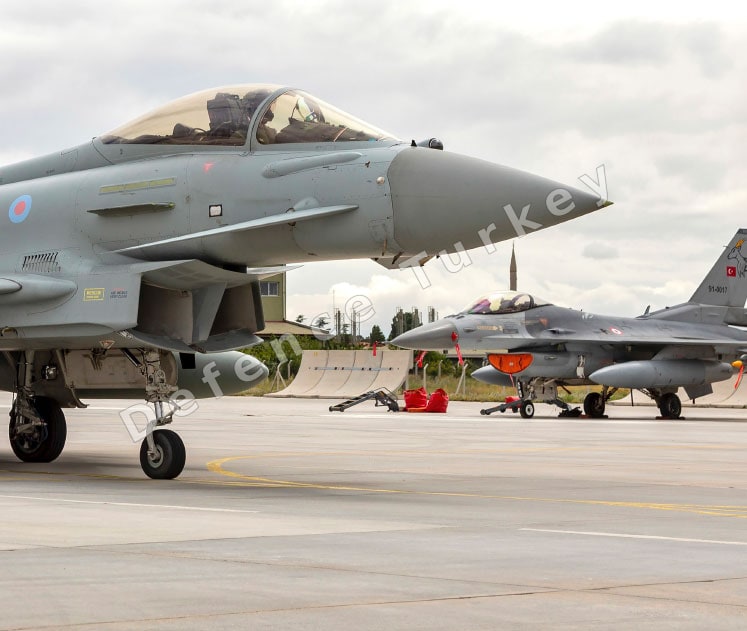
In the event that the US Congress and or US Government would block and refuse the F-16V Block 70 sales to Türkiye, the Turkish MoND and the TurAF have also considered procuring both second-hand and new-build 4.5th Generation Eurofighter Typhoon twin-engine fighter jets from the UK as a stopgap option. According to sources Türkiye is considering the purchase of 20 second-hand Tranche 1 and 60 new-build Tranche 3/4 Eurofighter Typhoons from the UK. Considering the very close relations between the UK and Türkiye, the purchase of the Eurofighter from the UK seems like a realistic ‘Plan B Option’.
Eurofighter Typhoon demonstration during the Royal International Air Tattoo on July 16,2016 at RAF Fairford, Gloucestershire, UK
RAF & Eurofighter Typhoon Fleet
The Eurofighter Typhoon is a twin-engine, canard-delta wing, multirole aircraft, designed and built by a consortium of three companies: Airbus Defense & Space, BAE Systems and Leonardo; working through a holding company, Eurofighter Jagdflugzeug GmbH (Eurofighter GmbH), which was formed in 1986. The project is managed by the NATO Eurofighter & Tornado Management Agency (NETMA), which acts as the Prime Customer. To date, the Eurofighter Program has logged 681 aircraft orders to 9 nations around the globe.
As of June 2020, more than 550 Eurofighter Typhoon aircraft have been successfully delivered to 7 countries: Germany, United Kingdom, Italy, Spain, Austria, Oman and Saudi Arabia; and ordered by 2 more: Kuwait (28x Tranche 3+) and Qatar (24x Tranche 3+). With units operating worldwide, the Eurofighter Typhoon fleet completed over 686,100 flying hours with unparalleled operational statistics from Europe to the South Atlantic and the Middle East. Eurofighter GmbH has so far received two contracts to build a total of 58 Tranche 4 aircraft of 38 Eurofighters for the German Air Force (in November 2020) and 20 Eurofighters for the Spanish Air Force (in June 2022). On June 23, 2022, the NATO Eurofighter and Tornado Management Agency (NETMA) signed a contract for the acquisition of 20 Tranche 4 Eurofighter jets. Known as the HALCON Program, the order will cover the delivery of a fleet of E-Scan (Electronically Scanned) radar equipped fighter aircraft consisting of 16 single-seaters and 4 twin-seaters to replace the F/A-18 fleet operated by the Spanish Air Force on the Canary Islands starting from 2026. The acquisition, valued at €2.043 billion, was approved by Spain’s Council of Ministers on December 14, 2021, and includes the aircraft, engines, a simulator, and the necessary support services.
The Royal Air Force (RAF) received its first operational squadrons at Coningsby, Lincolnshire in 2004, with a subsequent squadron at Leuchars, Fife in 2008. The RAF is the biggest Eurofighter Typhoon customer (with a total of 160 Eurofighter jets in 3 Tranches) and the UK is a key member of the Eurofighter Typhoon Consortium. Having served the RAF for nearly two decades, the Eurofighter Typhoon currently forms the backbone of the RAF’s capabilities, fulfilling air-superiority missions such as Quick Reaction Alerts (QRA) over the Falkland Islands and air policing duties with NATO allies in the Baltic and Black Sea region. The Eurofighter Typhoon will continue to form the backbone of the RAF until at least 2040.
The RAF has procured a total of 160 Typhoons in 3 Tranches, of which 53 are Tranche 1, 67 are Tranche 2 and 40 are Tranche 3. The 160th and last Typhoon (ZK437, in Tranche 3A standard) was delivered to the RAF on September 27, 2019. The RAF has committed to having a standardized Tranche 1 fleet, and their Block 1 and 2 Typhoons underwent the Retrofit 2 (R2) upgrade to bring them up to the Block 5 standard. The process took 7 months for Block 2 aircraft and 12 months for Block 1 aircraft and was completed in November 2012. A total of 43 Typhoons were upgraded over 6 years and the final Typhoon to be upgraded was ZJ932, which returned to 11(F) Squadron. The RAF retired 16 Tranche 1 twin-seat (two-seat) Eurofighter Typhoons under a process known as Reduce-To-Produce (RTP) and stripped them for spares and scrapped. With the introduction of ground-based training systems and simulators, the twin-seat Typhoons found themselves out of favor and most were scrapped.
The 67 Tranche 2 and 40 Tranche 3 aircraft delivered to the RAF were upgraded to a full multi-role capability in three years (2015-2018) under Project Centurion valued at £425 million, which enabled them to carry and fire the deep strike cruise missile Storm Shadow, air-to-air missile Meteor and the precision attack missile Brimstone and to effectively replace the Tornado GR4s, which were retired in March 2019. Project Centurion was broken down into two main elements: Phase 2 Enhancement (known as P2E), which added the Meteor beyond-visual-range air-to-air missile and the Storm Shadow standoff cruise missile. It was then followed by Phase 3 Enhancement (P3E), which added the Brimstone 2 air-to-ground precision attack missile. Meanwhile, as announced at the Royal International Air Tattoo in July 2022, within the scope of a £2.35 billion modernization program, the RAF Eurofighter Typhoon fighter jets (Tranche 3) will be equipped with the state-of-the-art European Common Radar System (ECRS) Mk2 radar. According to information released by the UK Ministry of Defense, the ECRS Mk2 radar is vital to the Typhoon’s battlefield control, and will enable the aircraft to simultaneously detect, identify, and track multiple targets in the air and on the ground in the most challenging operating environments. To be inducted into service towards the end of the decade, the ECRS Mk2 radar will provide pilots the ability to suppress enemy air defenses using high-powered jamming and engage targets while beyond the reach of threats. In addition, as part of the modernization program, the Typhoon fleet will be upgraded with the latest in mission management and cockpit interface to exploit the range of radar capabilities, as well as an upgraded navigation system and enemy radar jamming technology. Additional upgrades will ensure that RAF Typhoons can counter emerging threats. The 40 RAF Tranche 3 Typhoons will be upgraded with the new radar, with the option to upgrade the earlier Tranche 2s with it as well, since the Tranche 2 and 3 use different computer hardware and they run different software to the older Tranche 1 aircraft, making it difficult to maintain the same capabilities across the fleet.
Of the 53 Tranche 1 aircraft received by the RAF, 30 remain in the inventory. Of these, 20 are in active service while the remaining 10 are stored at RAF Shawbury. In March 2021, the UK announced plans to retire the RAF's fleet of Tranche 1 Eurofighters by 2025. The retirement of the Tranche 1 Typhoon aircraft was announced in a Defense Command Paper published on March 19, 2021. The Tranche 1 jets were originally slated for retirement by 2019 but were retained following the 2015 Strategic Defense and Security Review (SDSR), which recommended 23 Tranche 1 Typhoons be given a life extension to keep them in service until 2040. According to UK MoD the projected average flying hours for each of the Tranche 1 aircraft, when they reach their respective Out of Service Date, is around 2,545 flying hours (covers only 42.4% of their airframe fatigue life). So, the Tranche 1 aircraft will be retired in 2025 with an average of nearly 60% of their airframe fatigue lives remaining. The Eurofighter Typhoon airframe has been designed for a 25-year service life, equivalent to about 6,000 flying hours in normal use. The RAF currently utilizes Tranche 1 Typhoons for air defense (Quick Reaction Alert [QRA]) and aggressor training roles.
Could Eurofighter be an Option for the TurAF’s Gap Filler Fighter Requirement?
In fact, the Turkish Air Force (TurAF) is familiar with the Eurofighter Typhoon. Eurofighter's export-oriented efforts at Eurofighter GmbH are based on the lead nation principle rather than centralized marketing. Whether the customer is Saudi Arabia, Qatar, or Switzerland, acquisitions have always taken place within the framework of a political or strategic partnership with one or a group of countries. In this respect, Alenia Aeronautica (currently Leonardo), the Italian partner of the Eurofighter Consortium, carried out intensive marketing and promotion activities in Türkiye between 2004 and 2011. However, within the framework of the decisions taken at the Defense Industry Executive Committee (SSİK) meeting held on December 12, 2006, Türkiye chose the F-35A Lightning II and F-16C/D Block 50+ (Peace Onyx IV) as its Next Generation Fighter and Gap Filler requirements, respectively. However, despite the preference of the TurAF for the F-35A and F-16C/D Block 50+, Eurofighter GmbH, the company located in Munich, Germany and executing the Eurofighter Typhoon Program, persistently continued its marketing and promotion activities in Türkiye. Assessing that Türkiye’s next generation fighter jet needs would be 40 to 80 in the long term, the company, within the scope of the new marketing strategy it set in November 2010, offered Türkiye a proposal to jointly develop the Eurofighter 2020 Aircraft, incorporating Tranche 3A and Tranche 3B technologies.
Within the scope of the Eurofighter Consortium marketing and promotion activities, a Turkish delegation consisting of officials from the Turkish Air Force and the SSB visited the Italian Air Force’s Grosseto Air Base as per the invitation made by the Italian Air Force. On February 22, 2005, Colonel Mustafa İLHAN and an unnamed pilot from the TurAF participated in flight test lasting 45 minutes on two Eurofighter Typhoon Tranche 1 two-seat aircraft of the 4th Squadron Command. However, Turkish pilots flying in the rear cockpit of the aircraft were not satisfied with the performance of the aircraft. Officials from Eurofighter GmbH at the time attributed this dissatisfaction to the fact that the aircraft in question was a Tranche 1 type and a training version. Officials claim that because the test flight consisted of simply takeoff, a brief tour, and landing, the real performance of the aircraft could not have been seen in its entirety. Additionally, the avionics of Tranche 1 aircraft had not yet attained their full maturity. On the other hand, Eurofighter Typhoon Tranche 1 and Tranche 2 combat aircraft belonging to the British, Italian and Spanish Air Forces participated in the International Anatolian Eagle Exercises conducted at the 3rd Main Jet Base in Konya in 2008, 2009, 2010, 2012, 2014 and 2015, thus the TurAF had the opportunity to test and become familiar with the 4.5 Generation Eurofighter combat aircraft in a realistic combat environment.
With the implementation of the F-35A Lightning II and F-16C/D Block 50+ Projects, the Eurofighter Consortium had ceased its marketing and promotion activities for the Eurofighter Typhoon Aircraft. However, following the US Government's indefinite suspension of Türkiye’s participation in the F-35 MTU/JSF Lightning II Program, in which Türkiye was a Level 3 Partner, on July 16, 2019, using Türkiye’s acquisition of the S-400 Triumph Air and Missile Defense Systems from the Russian Federation as an excuse, and the suspension of deliveries of F-35A aircraft to the Turkish Air Force, the requirement for “gap filler” aircraft for the TurAF until the TF-X fighter jets enter service was once again a topic of public concern. Following the Greek Air Force (GAF)’s decision to modernize the 4++ Generation F-16V Block 70 and the subsequent order for the 4.5 Generation Rafale F3-R, discussions and research on the need for interim aircraft gained momentum among opinion of the Turkish public. During this process, SSB President İsmail DEMİR voiced the claim that the Su-35 Aircraft could be purchased from Russia, and DEMİR said in his statement on September 4, 2019, “The Su-35 Aircraft can only be an interim solution for us. The talks with Russia are just getting started. We must have in-depth discussions about our cooperation and other topics.” In October 2019, an article published in the Daily Sabah newspaper claimed that the Republic of Türkiye and the Russian Federation had advanced the negotiations for the Su-35 and that the Su-35s to be purchased in 2 batches (18+18 for a total of 36 SU-35s) would be deployed in Malatya. At that time, the option of purchasing only the Su-35 fuselage from Russia and equipping the aircraft with domestically designed and produced avionics, similar to the project model previously implemented with Leonardo as part of the T129 ATAK Project, was being considered. Experts, however, believed it was unlikely that this option would be realized.
While the need for interim aircraft for the Turkish Air Force was being discussed in Türkiye, two Eurofighter Typhoon Tranche 1 aircraft of the UK’s Royal Air Force (RAF) arrived at the 3rd Main Jet Base Command in Konya on November 16, 2020, as part of NATO joint training, while the Air Chief Marshal of the Royal Air Force (RAF) Sir Mike WIGSTON visited Ankara and Konya. According to the information we have received, two EF Typhoon Tranche 1 single-seat aircraft (with tail numbers ZJ914 and ZJ939) of the RAF 9th Squadron Command flew in the “aggressor” role in an air-to-air operations in Konya against 2 F-16C aircraft of the 132nd Weapons and Tactics Squadron Command during training flights (11 sorties in total) and performed very impressively in all air-to-air engagements (thanks to the powerful ECR-90 CAPTOR radar and advanced electronic warfare self-defense system). In late August 2021, two F-16C Block 50 (belonging to 191st Cobra Fleet Command, armed with AIM-9X and AIM-9L/M air-to-air missiles), CN235 and E-7T AEW&C aircraft of the Turkish Air Force conducted training flights with two Eurofighter Typhoon Tranche 2 Aircraft of the RAF over Romania.
In March 2022, it was reported in the national and foreign press that Türkiye might procure around 80 Eurofighter Typhoon combat aircraft from the UK, while in May 2022, Commander of the Turkish Air Force General Hasan KÜÇÜKAKYÜZ paid an official visit to the UK upon the invitation of the RAF Air Chief Marshal Sir Mike WIGSTON, and during his visit, he first held a meeting at the Ministry of Defense to strengthen the existing cooperation between the two countries' Air Forces. Subsequently, General KÜÇÜKAKYÜZ visited RAF Coningsby Air Base with his counterpart and received information about RAF Quick Reaction Alert (QRA) and watched the Typhoon Demonstration Team. The RAF Coningsby Air Base hosts the 3rd Squadron (the first RAF front line Squadron that flew with the Eurofighter Typhoon), the 11th Squadron (one of the 2 QRA Squadrons within the RAF), the 12th Squadron (RAF/QEAF Joint Squadron - pilots of Qatar Emiri Air Force QEAF that ordered 24 Eurofighter Typhoon Tranche 3 Aircraft are trained in this Squadron), the 29th Squadron (RAF's Typhoon OCU Squadron), and the 41st Squadron (Test and Evaluation Squadron) as well as the Typhoon Demonstration Team supported by the 29th Squadron. RAF Coningsby Air Base, located in Lincolnshire and employing around 3,000 personnel, is responsible for the protection of the skies of Southern England as one of the two RAF Quick Reaction Alert (QRA) Stations established within the RAF to protect British airspace. The RAF protects the skies of Northern England with the QRA Station at Lossiemouth Air Base in Northeast Scotland.
In May 2022, İsmail DEMİR, the President of the Defense Industries, visited London, the capital of the United Kingdom, with a delegation including representatives from Turkish Defense and Aerospace industry companies. The Turkish Fighter Project and the turbofan engine that will be utilized in the aircraft were the main topics of discussion between the two parties during the visit, and according to the press various meetings were held with BAE Systems and Rolls-Royce. On May 20, President of the SSB DEMİR shared his evaluation about the visit with members of the press and stated that the export restrictions imposed on Türkiye by the UK regarding defense industry products have been lifted. DEMİR also expressed that during the meetings with the UK, they discussed not only bilateral relations, but also how they could cooperate in some activities and defense industry projects to be carried out in third countries, and that the approach of the UK party officials was very positive in this regard.
On June 1, 2022, Samuel Doveri VESTERBYE, Managing Director of European Neighborhood Council (ENC), claimed in a tweet on his Twitter account that BAE Systems is in talks with Türkiye to sell 80 Eurofighter Typhoon combat aircraft. İsmail DEMİR, whom I had the opportunity to meet on June 8 during the EFES-2022 Combined Joint Live-Fire Field Exercise, said in response to a question about the procurement of Eurofighter Typhoon aircraft, “There is no such subject on our agenda.”
Meanwhile, Turkish Ministry of National Defense (MoND) shared a post on its official Twitter account on June 19, 2022 and announced that the F-16C/D Aircraft taking off from the 3rd Main Jet Base Command (Konya 132nd Weapons and Tactics Squadron) and 6th Main Jet Base Command (Bandırma, 161st Squadron), Eurofighter Typhoon FGR4 Aircraft of the UK’s Royal Air Force (RAF) and ITS Margottini, TCG Salihreis and TCG Heybeliada ships conducted “NATO Air-Maritime Training” in the Eastern Mediterranean. During the training, Eurofighter Typhoon Tranche 2 and Tranche 3A Aircraft with tail numbers ZK311 and ZK369, operating within the 140th Expeditionary Air Wing of the 3rd Squadron (Fighter Squadron) Command based at Mihail Kogalniceanu Air Base in Romania, carrying Litening III Targeting Pods under the fuselage, conducted air-refueling with the RAF's A330 MRTT Voyager Tanker Aircraft, which took off from Agritori RAF Air Base in Southern Cyprus. On June 21, 2022, the RAF shared the following information about the training with a post on its official website: “RAF Typhoon aircraft from 3 (Fighter) Squadron recently carried out air to air training serials alongside the Turkish Air Force as part of a NATO bilateral training opportunity. The Typhoons, currently operating from Mihail Kogalniceanu air base in Romania under the 140th Expeditionary Air Wing (EAW), undertook 2v2 training with Turkish Air Force F-16s, as well as carrying out simulated beyond visual range missile firing drills to rehearse essential skills.”
The International Anatolian Eagle Training, which was conducted at the 3rd Main Jet Base in Konya between June 20 and July 1, 2022, was also carried out with the participation of Eurofighter Typhoon Tranche 2 and Tranche 3A Aircraft with tail numbers ZK311, ZK369, ZK374 and ZK437 (ZK437, delivered on September 27, 2019, is the 40th Tranche 3A and 160th Eurofighter Typhoon Aircraft delivered to the RAF), which are operating at the 140th Expeditionary Air Wing (EAW) of the RAF 3rd (Fighter) Squadron Command, based at Mihail Kogalniceanu Air Base in Romania. On July 3, 2022, the RAF shared the following information about the Anatolian Eagle 2022/2 Training with a post on its official website: “RAF Typhoons and personnel, operating in Romania as part of Operation BILOXI, have deployed to Türkiye for a multinational exercise with Turkish, Jordanian, Pakistani and Azerbaijani aircraft. The exercise saw RAF Typhoons employed in multiple realistic combat scenarios, acting as blue force conducting air operations against simulated adversary aircraft. The RAF Typhoons flew alongside F-16s from the Turkish, Pakistani and Jordanian Air Forces and Su-25s from the Azerbaijani Air Force as well as Turkish AKINCI Combat Unmanned Aerial Vehicles.”
According to the information we have received, the UK is offering Türkiye the sale of 20 of the 30 Eurofighter Typhoon Tranche 1 aircraft with the source codes (the other 10 are kept in storage as part of the Sustainment Fleet) and 60 Tranche 3 or new production Tranche 4 aircraft. It then offers Türkiye a cooperation in the TEMPEST 6th Generation combat aircraft project. A source pointed out that with the Eurofighter Typhoon and TEMPEST offer, the UK is giving a message of support to Türkiye, which is going through political unrest with NATO allies such as the US and Germany, and that the UK can now directly offer Eurofighter Typhoon aircraft to Türkiye thanks to the abolition of the former allocation of work/region in the Eurofighter Consortium, and that the UK may also offer Tranche 2 & 3 Aircraft from its own inventory to Türkiye through a grant, against the possible objection of the Consortium member countries (the UK may order new aircraft for itself instead of Tranche 2 and Tranche 3 Aircraft to be given to Türkiye.) Accordingly, Tranche 1 Typhoons will be able to be used in the integration and testing of national air-to-air and air-ground weapon/ammunition and sensor systems thanks to the sharing of their source codes with Türkiye. In this way, Eurofighter Typhoon Tranche 1s will be able to serve both in the air-defense (interceptor) role and replace the F-4E 2020 Phantom aircraft used in the 401st Test Squadron Command, which will be retired by 2025. Accordingly, Tranche 1 Aircraft will be able to be used in the integration and testing of national air-to-air and air-ground weapon/ammunition and sensor systems thanks to the sharing of their source codes with Türkiye. In this way, Eurofighter Typhoon Tranche 1 aircraft will be able to serve both in the air-defense (interceptor) role and replace the F-4E 2020 Phantoms used in the TurAF inventory. Although it does not have a “swing role” capability (the ability to perform multiple roles within a sortie) like the Tranche 3A version, the Eurofighter Tranche 1 with its air superiority and limited air-surface attack capability, can be fitted with Air-to-Air IIR/RF Guided Missiles such as GÖKDOĞAN, BOZDOĞAN and GÖKHAN, and with SOM Family Cruise Missiles such as SOM-J, GEZGİN and ÇAKIR, with the KUZGUN Guided Modular Munition Family - Miniature Bomb, air-surface munitions such as KGK, LGK and TEBER, and with national pod systems such as ED Pod, EH Pod and ASELPOD, especially thanks to source code sharing, and can turn into a “Game Changer” for the Turkish Air Force. Even if the TurAF acquires F-16V Block 70, I believe it would be beneficial also to acquire 20-30 Eurofighter Tranche 1 aircraft with their source codes. In this way, I believe the need for a new generation combat aircraft that can be used both for air superiority missions until the first F-16V Block 70 Squadron becomes operational, as well as for the integration and testing of national weapon and sensor systems to replace the F-4E 2020s (it can also serve as a test bed within the scope of the TF-X Project) can be met both in terms of schedule and cost effectiveness.
The Eurofighter Typhoon Tranche 1 aircraft is fitted with ECR-90 CAPTOR, a coherent X-Band (8-12GHz) multi-mode pulse doppler radar. Featuring a mechanically steered antenna with a diameter of around 60cm, the ECR-90 CAPTOR is able to detect large transport aircraft at a distance of approximately 370km and supersonic combat aircraft such as the Mig-29 with a 5m2 RCS at a distance of 185km, and intercept it at a distance of 90km to 150km. The CAPTOR Radar, on which 1.2 million lines of code software runs, has an average output in excess of 1kW and can track 24 targets and engage 6 to 8 targets simultaneously. In addition to the CAPTOR Radar, which can produce SAR images with a resolution of 1m at a distance of 80km, Tranche 1 Typhoons also incorporate the PIRATE FLIR/IRST System, which can detect targets at a distance of 145km, track 200 targets simultaneously and have the ability to identify targets at a distance of 40km. Eurofighter Typhoon Tranche 1 aircraft do not feature METEOR Air-Air Missile capability (Phase 2 Enhancement B/P2Eb software is required for this) due to the outdated software they run, and use AIM-120 AMRAAM missiles (RAF has ordered 200 AIM-120D AMRAAMs worth US$ 650 million for Tranche 1 aircraft, AIM-120D can also be used on F-35B Lightning IIs) and ASRAAM missiles for the air-to-air role. If requested by the end user, Tranche 1 aircraft can be modernized, as in the case of Spain, and subjected to a software-intensive modernization to be compatible with Tranche 2 and Tranche 3. Spain, which decided to modernize its 15 Tranche 1 Aircraft, received its first aircraft from the Main Contractor Airbus Defense & Space in February 2019. However, due to the fact that there is outdated software running on the Tranche 1 Typhoons no problems are expecting in sharing source codes of this software version with Türkiye.
The UK, which decided to retire its Eurofighter Typhoon Tranche 1 Aircraft early in March 2021, has been looking for a market for Tranche 1 Aircraft for some time. In this respect, in April 2022, it was reported in the international press that Serbia was negotiating with the UK for the supply of 30 Tranche 1 Aircraft.
History of Eurofighter Marketing Efforts in Türkiye
Because of its close political and defense industrial ties with Türkiye, in early 2000s Italy was tasked within the Eurofighter Consortium to coordinate marketing and industrial cooperation efforts with Türkiye. Under this tasking, as a member of the Eurofighter Consortium (Eurofighter GmbH, co-ordinates the design, production and upgrade of the aircraft) and one of the leading subsidiaries of Finmeccanica, Alenia Aeronautica led the Eurofighter campaign in Türkiye and promoted the Eurofighter Typhoon for the Turkish Air Force (TuAF) starting from 2004.
Within the scope of Gap Filler Fighter (30 F-16 Block 50+ ordered under PO-IV Program for attrition purposes) and new generation Future Combat Aircraft (FCA) Project (F-35A Lightning II selected) requirements/tenders of the TurAF, Alenia Aeronautica (now Leonardo) conducted an intensive marketing effort in Türkiye. In 2006 in order to let Eurofighter be a viable option for Türkiye, Eurofighter Consortium (Alenia Aeronautica) offered alternative industrial participation for different numbers of aircraft (40, 80, 120 etc). In this context, company offered an industrial participation amounting US$9 billion for a quantity of 120 aircraft to Türkiye, US$6 billion for 80 aircraft and US$3.2 billion for 40 aircraft. Even the TurAF had announced the selection of F-16 Block 50+ and F-35A Lightning II respectively as its gap filler and future combat aircraft in 2006, Alenia Aeronautica did not suspend its marketing efforts and tried hard to sell up to 40 Eurofighter Typhoons, as replacement for the overdue F-4E Phantom II aircraft flying in an air defense/interceptor role, until the end of 2011.
As part of its marketing efforts Alenia hosted a Turkish Air Force (TurAF) Delegation, included two fighter pilots, at the Grosseto Air Base of the Italian Air Force and provided them opportunity to fly Italian twin-seat Eurofighter Typhoon Tranche 1 aircraft in February 2005. However, TuAF pilots, flew two twin-seat Eurofighters, were not too impressed with the Eurofighter performance. Meanwhile, Eurofighter Consortium had developed the ‘Fifth Full-Partner’ concept in their approach during 2005 and invited Türkiye to participate in the Eurofighter Program.
As part of its marketing efforts Alenia Aeronautica brought Eurofighter Typhoon Tranche 1 to the IDEF ‘05 Fair and Eurofighter Consortium brought Tranche 1 and Tranche 2 aircraft to Türkiye in 2008, 2009 and 2010 under the Anatolian Eagle Exercises held at the 3rd Main Jet Base located in Konya to demonstrate the aircraft to TurAF officials. And, finally during Fimeccanica’s Ankara Office opening ceremony held on November 11, 2010, the then Italian Deputy Defense Minister Guido CROSETTI and Finmeccanica COO Giorgio ZAPPA invited Türkiye one more time to participate in the Eurofighter Consortium and underlined that Türkiye could accommodate both the F-35 Lightning II and Eurofighter because the functions of the two aircraft are different. Though at every opportunity the Eurofighter GmbH and Alenia officials stressed that they were not trying to compete with the F-35, and pointed out that Italy and the UK had opted for both platforms, it is a fact that every Typhoon acquired would eat away the JSF budget and would consequently decrease the F-35 number. Türkiye was looking at up to 116 F-35 Lightning II, which was expected to cost around US$16 billion over the 10-year period.
Within the scope of their new marketing strategy determined in November 2010, the Eurofighter Consortium offered Türkiye the opportunity of joint development of the Eurofighter 2020 (EF 2020) Eurofighter 2020 (EF 2020), the next version of the Eurofighter. At that time, I was invited to Eurofighter GmbH Headquarters at Hallbergmoos/Munich on December 3, 2010. EF 2020 was indeed a Eurofighter Typhoon aircraft with Tranche 3A and Tranche 3B technologies onboard including; a CAPTOR-E AESA radar, Conformal Fuel Tanks (2x and each with 1,500lt capacity), uprated engine (EJ230 with 15% more thrust without any major modification on existing EJ200), reduced RCS, stealth kits, further enhanced DASS, further enhanced FCS, new IDM, more network enable capabilities and thrust vectoring nozzles (with 3D-deflection capability) for improved super cruise, take-off and landing performances as well as new weapons integration to preserve and further enhance the Typhoon’s swing role capability such as; METEOR air-to-air missile, Storm Shadow and Taurus air-to-ground cruise missiles, HOPE and HOSBO gliding bombs, Small Diameter Bomb, Brimstone two mode missile and ARM missiles for the SEAD role. During my visit to Eurofighter GmbH Headquarter, officials stressed that Türkiye would not face any limitation to access Eurofighter technology including stealth technologies to be introduced in EF 2020 aircraft and source codes. According to company offcials, Turkish Industry could participate in the Eurofighter Program not only as a manufacturer but also as a designer (by taking part in EF 2020’s components, engines and avionics design and development processes) and as it happened in T129 ATAK Program, they could co-operate to customize the existing platform to meet the TuAF’s requirements. They also underlined that the EF 2020 would provide a perfect step for Turkish Industry in Türkiye’s indigenous next generation fighter aircraft (TF-X/MMU) development studies after the 2020s.
Conclusion
Although the option to procure Eurofighter Typhoon combat aircraft from the UK was initially considered as an alternative plan to the ongoing efforts covering the procurement of 40 new production F-16V Block 70s and some 80 modernization kits from the US to upgrade the aircraft in the inventory to Block 70 level, it appears that the UK is aiming for a more comprehensive collaboration with Türkiye.
The UK, which has developed new policies and strategies with the aim of becoming a power center after BREXIT, wants to see Türkiye on its side as part of this goal. In this regard, the UK, which did not apply the CAATSA sanctions previously announced by the US Government to İsmail DEMİR, the President of the SSB, who visited the UK in May, decided to lift the export restrictions imposed on Türkiye with the efforts of the MoND, the SSB and the Turkish General Staff. The UK Government also supports British Defense Industry firms to participate in programs such as the Turkish Fighter and HÜRJET in Türkiye. It is considered that the UK aims to work together in the TEMPEST Program (the 6th generation combat aircraft with twin-engine and delta wing design, which is planned to replace the Eurofighter Typhoon Aircraft from 2040 onwards, and which can perform manned or unmanned missions) after Türkiye, to which it provides technical/know-how support under the TF-X Program, reaches a certain level of maturity in aviation and engineering. In this respect, the Eurofighter acquisition may reveal new opportunities for Türkiye in its participation in the TEMPEST Program.
By purchasing the Eurofighter Typhoon instead of the Russian Su-35, which was previously on the agenda, Türkiye will also send a warm message to the Western world both politically and militarily by proving that it is turning its face back to the West. Turning to the UK instead of Russia is also considered to be a significant message for Europe and NATO. On the other hand, Türkiye's purchase of Eurofighter Typhoon aircraft from the UK despite Germany will undoubtedly be a message to the German government. Perhaps Germany, on this occasion, will put its thinking cap on and reevaluate its policy decisions regarding the restrictions it has been imposing for the export of defense products (both new systems and sensors, and the sale of spare parts and maintenance and repair services needed for the existing ones) on Türkiye, a NATO member and ally, which are critical for the deterrence and continuity of the operational capability of its Armed Forces