An Overview of Fixed Wing Air Platform Procurement & Modernization Programs of the Turkish Air Force
TurAF also operates some 170 Trainers (including 68 T-38M jet trainers, 13 NF-5A/B 2000s [to be replaced with HÜRJETs, deliveries of the first batch of 14 HÜRJETs to the TurAF will be launched during the first half of 2025] in the Turkish Stars Acroteam inventory, 39 KT-1Ts, around 20 SF-260Ds [being replaced with Super Mushshaks], 10+ Super Mushshak IIBs (in total 52 aircraft ordered under a contract signed with PAC [Pakistan Aeronautical Complex] and less than 20 T-41Ds), and around 90 Transport/Support aircraft (including 10 A400Ms [procurement of 6 more is under negotiations], 4 E-7T AEW&C aircraft [being upgraded with ASELSAN’s ESM/ELINT System, that replaced EL/L-8382. Test flight of the first modernized E-7T conducted in June 2024. E-7T fleet will also receive comprehensive modernization in coming years. For this purpose a feasibility study covering both hardware and software on the E-7Ts has been conducted under TUSAŞ coordination and with participation of ASELSAN, HAVELSAN and Turkish Technic in 2023], 19 C-130B/E Hercules [6 Bs and 13 Es, undergoing avionics upgrades under the ERCİYES Project, + 12 C-130J Super Hercules will be procured from RAF stocks], 1 C-160D Transall, 49 CN235-100Ms [receiving avionics upgrade, 45 in Transport/Air Ambulance/Training role, 3 in SIGINT/ELINT configuration and 1 in Open Skies Agreement (ASA) configuration], and 7 KC-135R Stratotankers [recently upgraded to Block 45.1 level in the USA under a FMS contract]).
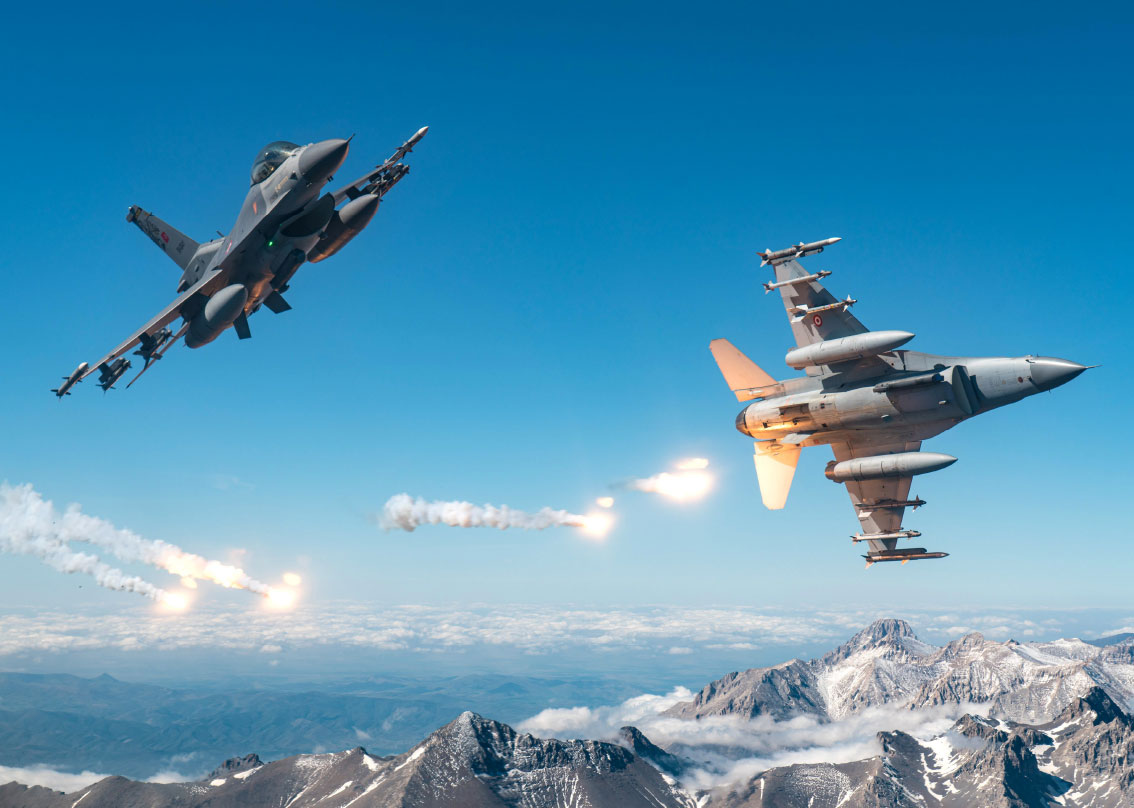
The TurAF’s 234 F-16C/D fighters are currently operated by 8 different Squadrons (113th, 401st, 132nd, 151st, 152nd, 161st, 181st and 193rd) deployed at 7 different air bases (Eskisehir 1st MJB, Konya 3rd MJB, Merzifon 5th MJB, Bandırma 6th MJB, Diyarbakır 8th MJB, Balıkesir 9th MJB and İncirlik (Adana) 10th MJB) around Türkiye. Most of them have been modernized to the latest Block 50+ standards under the PO-III and F-16 MSM/CCIP Programs. The F-16C/D Fighting Falcon combat aircraft, that forms the backbone of the TurAF’s airpower, will be deactivated from service starting from mid 2030s and is to be replaced by Türkiye’s next generation KAAN National Combat Aircraft (abbreviated as MMU in Turkish), also known as TF-X. The 5th Generation KAAN TF-X/MMU will replace both the F-4E 2020 Phantom II all-weather fighter-bombers serving at the 111th Squadron that belong to the 1st Main Jet Base (MJB) Command located in Eskisehir and F-16C/D Fighting Falcon combat aircraft currently in the service of the TurAF during the first quarter of the 2030s.
The T-41Ds are used for Screening Flights, while the SF-260Ds are used for Primary Flight Training. T-41Ds and SF-260Ds have been planned to be replaced with MFI-395 Super Mushshak Primary Trainer Aircraft produced by Pakistan Aeronautical Complex (PAC). The T-38M Advanced Jet Trainer Aircraft will fly until 2030 and is then to be replaced by the Next Generation Advanced Jet Trainer (AJT) version of the HÜRJET (T-X) which is developed by TUSAŞ, Turkish Aerospace.
As a modern, cutting-edge air force, configured and trained to the highest Western/NATO standards, the TurAF is able to execute the full spectrum of air operations and has demonstrated how sharp and strong its claws are during the recent cross-border operations in Syria, Iraq and even in Libya.
Turkish Aerospace Sector
All estimates show that Turkish Defense and Aerospace Industry’s export figures will grow further in 2024 and could easily passed $6 Billion target. The export figures of the Turkish Defense and Aviation Industry for the first half of 2024, shared with the public by Turkish Exporters Assembly (TİM) on July 3, also supports this estimation. According to TİM data during first 6 months of 2024 Turkish Defense and Aerospace Industry exported around $2,883 Billion worth of defense and aerospace products, which represents 21,6% increase compared to the same period in 2023. Prof. Dr. Haluk GÖRGÜN, Secretary of Turkish Defense Industries, announced this milestone on his social network page X. Emphasizing that their goal is to achieve a permanent increase in the export of high-value-added products, in his social media post Secretary GÖRGÜN said, “Our Defense and Aerospace Industry exports amounted to $563 Million in June. Our exports in the first 6 months reached $2,883 Billion, showing a 21,6% increase compared to the same period last year.” Turkish Defense and Aerospace Industry exports had hit its record high monthly figure of $876 Million in May 2024. Secretary GÖRGÜN also underlined that new contracts with a total value of over $10,240 Billion were also signed in 2023 and while the average export amount per kilogram in Türkiye is $1,57 the average price of Turkish Defense & Aerospace export products has exceeded $65 Dollars (represents 14% increase compared to 2022) per kilogram. The sector’s previous monthly export record was achieved with $719.1 Million of exports in December 2023. The Turkish Defense & Aerospace Sector’s total arms exports amounted to $330,244 Million in January, $299,897 Million in February, $358,224 Million in March, $350,391 Million in April and a $876.046 Million in May 2024.
The backbone of the Turkish Aerospace Sector is formed by state-owned Turkish Armed Forces Foundation (TAFF) companies; Turkish Aerospace (TUSAŞ), TEI, ASELSAN, ASPİLSAN and HAVELSAN, which also contribute a considerable share in turnover and export figures. With a Decree published on December 24, 2017 the TAFF companies, Türkiye’s major defense industry institutions, have been officially attached to the Turkish Presidency. However, opportunities are also emerging for private companies such as BAYKAR TECHNOLOGY, ALP AVIATION (a joint venture between the Sikorsky Aircraft Corporation and the Alpata Group of Türkiye), Turkish Engine Center (TEC), Kale Arge, Kale Pratt & Whitney Engine Industries, and AYESAŞ/LENTATEK.
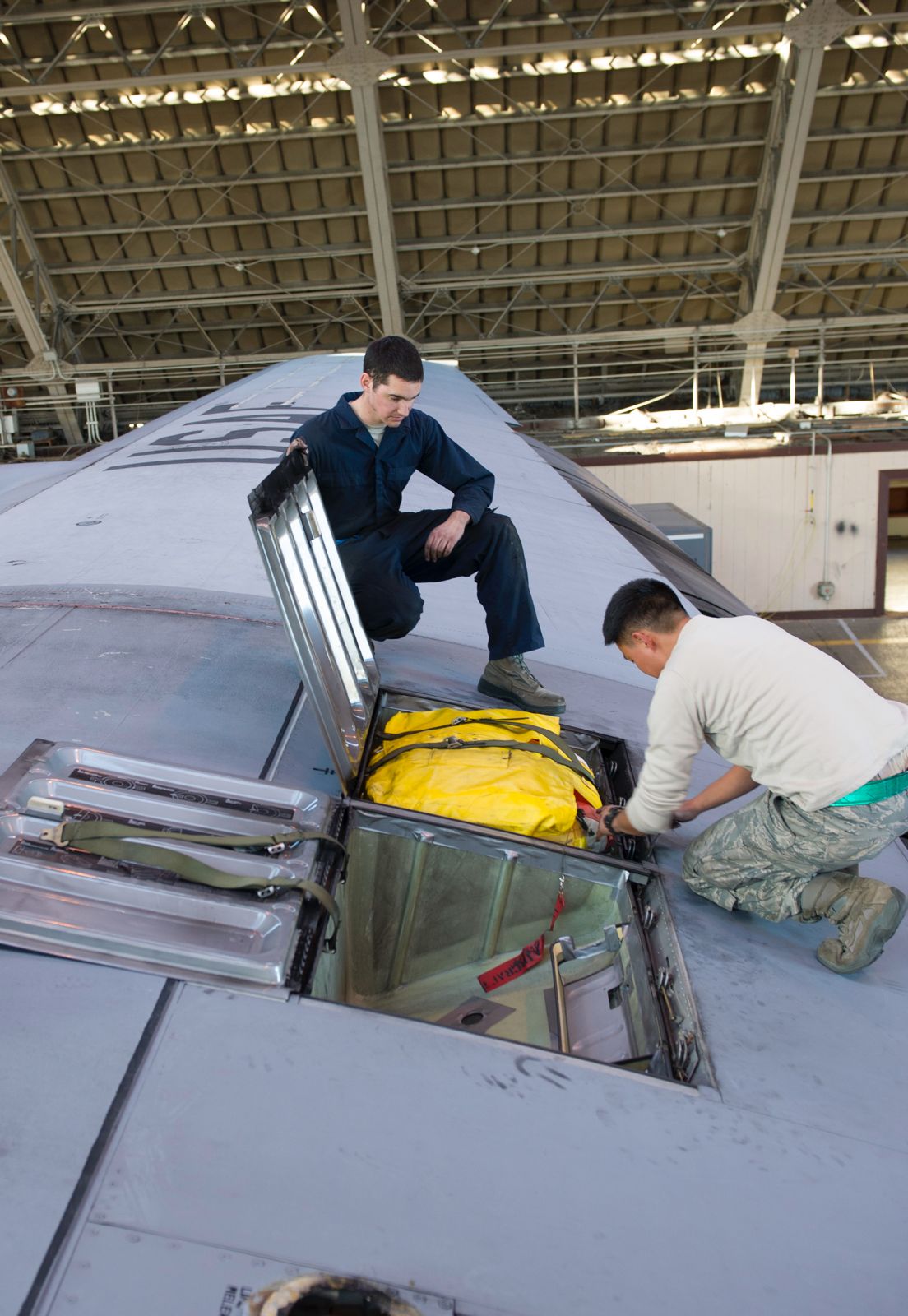
Military factories of the Turkish Air Force (TuAF), such as 1st Air Maintenance Factory Directorate (AMFD) in Eskisehir, 2nd AMFD in Kayseri and 3rd AMFD in Ankara have been removed from the structure of TurAF and General Staff organization and affiliated under the Turkish Ministry of National Defense (MoND) General Directorate of Military Factories (AFGM) as of February 2017. The 1st AMFD is the largest maintenance facility where the Factory Level Maintenance needs of combat and jet training aircraft in TurAF service are met, It carries out Factory Level Maintenance and Modifications (FASBAT) of F-16C/D, F-4E 2020, NF-5A/B 2000 and T-38M aircraft in the Turkish Air Force inventory. It also undertakes the maintenance, repair and revision works for F110-GE-100C&129/129D Turbofan Engines, J79-GE-17C, J85-CAN-15N and J85-GE-5H Turbojet Engines used in these aircraft and TF-33 Turbofan Engines used in E-3A AWACS aircraft, T56-A-15 LFE, TYNE-Mk-22 and CT7-9C Turboprop Engines used in C-130B/E, C-160D and CN235-100M Transport Aircraft, various types of models engine starters such as T700 used in S-70 Black Hawk Helicopters, Makila 1A1 powering Cougar Helicopters and JFS (F-16C/D 210shp powered Gas Turbine Engine for F-16C/D) & GTC (210shp Gas Turbine Engine for C-130 and C-160 Aircraft) types (they give the engine the first movement). The 1st and 2nd AMFD have mainly taken roles in modernization projects such as the F-16C/D PO-III, F-16C/D Block 30 DB-100 Recce Pod Integration, F-16C/D Block 30 Structural Improvement Program, F-4E 2020, F-5 2000, F-4E/TM (ŞİMŞEK), RF-4E/TM (IŞIK), T-38M (ARI) and C-130B/E (ERCİYES) Modernization Programs, and are providing maintenance/overhaul services to the fighter/bomber and transport aircraft in the TurAF inventory. On the other hand, the 3rd AMFD, located in Ankara, provides maintenance, repair and overhaul services for avionics and the land-based radar and missile systems which are in the service of the TuAF.
Remarkable Programs and Products of the Turkish Aerospace Sector
The year 2023, when the 100th anniversary of the Republic was celebrated, witnessed the debuts of several high-tech made-in-Türkiye aerospace products such as; the KAAN Turkish Fighter (MMU/TF-X), HÜRJET Advanced Jet Trainer and Light Combat Aircraft, T625 GOKBEY Light Transport/Utility Helicopter, T929 ATAK-II Heavy-Class Attack Helicopter, TUSAŞ ANKA-III and BAYRAKTAR TB3 UCAVs, as well as first flight tests of Electronic Support Pod (EHPOD) and Electronic Warfare Pod (EHPOD) on F-16C Block 40 aircraft within the scope of EW Certification Test Campaign, the delivery of first three F-16 Block 30TM aircraft (including two prototypes one in single seat and the other is in twin-seat configuration) upgraded under the ÖZGÜR Avionics Modernization Program to the Turkish Air Force (TurAF). Moreover, ASELSAN’s MURAD AESA Radar integration efforts on the F-16C Block 30TM (ÖZGÜR prototype) and AKINCI UCAV were launched simultaneously. The first flight of the ASELSAN’s MURAD-100A AESA Radar, which brings F-16C/D Block 30 ÖZGÜR Aircraft to the level of 4.5 generation aircraft, was performed on 15 February 2024 with the ÖZGÜR Modernized F-16C Block 30TM prototype aircraft. MURAD-100A AESA Radar is developed for the F-16 and AKINCI UCAV. The MURAD-200A version will be installed on KIZILELMA and ANKA-III Turkish Unmanned Combat Aircraft/Combat Unmanned Aerial System (abbreviated as TİSU/MİUS in Turkish). KAAN MMU/TF-X National Combat Aircraft, on the other hand, will be equipped with the MURAD-600A AESA Radar. According to ASELSAN’s 2023 Annual Report the Preliminary Design Phase of the MURAD-600A was completed and the Critical Design Phase was launched in 2023. The Light Combat Aircraft (LCA) version of the HÜRJET will be also integrated with MURAD AESA Radar.
Although Turkish Aerospace Sector’s strength is still unable to rank among the first echelon, Türkiye is still insisting on developing more advanced next generation domestic manned and unmanned fixed wing and rotary wing aircraft. In this context, indigenously developed 5th Generation fighter jet KAAN Turkish Fighter (MMU/TF-X)’s first prototype GTU/P0 and twin-seat, single-engine supersonic next generation Advanced Jet Trainer (AJT) HÜRJET’s first prototype, dubbed P1, performed their first engine runs on February 12 and January 30, 2023 respectively and started their slow taxi tests on March 17 and March 18 respectively. HÜRJET P1 conducted its maiden flight on April 25, 2023 and as of June 5, 2024 a total of 66 sorties of test flights were conducted during which HÜRJET accumulated a total of 65 hours and 50 minutes flight hours. On July 11, 2024 in his social network page X, TUSAŞ General Manager Dr. Mehmet DEMİROĞLU disclosed that HÜRJET has successfully performed its 79th sortie. In his social media post DEMİROĞLU said, “HÜRJET is progressing at full speed! It successfully completed its 79th sortie and reached a speed of Mach 0.9 at an altitude of 30,000 feet. We will continue to strengthen our aviation.” HÜRJET which will be the first made-in-Türkiye manned aircraft to exceed the sound speed. HÜRJET will conduct a flight demonstration during FIA24 in July 2024. Turkish Aerospace’s HÜRJET aircraft and T625 GÖKBEY TLUH will fly for the first time abroad in the U.K. at the Farnborough International Air Show (FIA24) during July 22-26.
The GTU/P0 prototype of KAAN made its maiden flight on the morning (at 08:50) of February 21, 2024 and made a smooth landing after a short stay in the air. KAAN performed its first flight from Mürted Airfield, adjatent to TUSAŞ facilities in Kahramankazan, Ankara. During its first flight, KAAN stayed in the air for 13 minutes, reaching an altitude of 8,000 feet and attained a speed of 230 knots. Test pilot Barbaros DEMİRBAŞ was in the pilot’s seat for the first flight of KAAN. DEMİRBAŞ expressed his impressions of the first flight with the following words: “I experienced the power of the engines and the agility of KAAN more profoundly than ever before. My confidence grew as I performed the maneuvers in the maiden flight profile. The landing at the end of the flight was flawless - exactly as planned in terms of speed and precision. It felt as though I had been flying with KAAN for years.” With the successful completion of the first flight, which garnered global attention, Türkiye joined the ranks of countries producing 5th Generation fighter jets.
Under the National Combat Aircraft KAAN Project initiated by the Secretariat of Defense Industries (SSB), the second flight was successfully conducted by Turkish Aerospace (TUSAŞ) on May 6, 2024. During its second flight, KAAN remained airborne for 14 minutes, reaching an altitude of 10,000 feet and a speed of 230 knots. Simultaneously, for the configuration to be delivered to the Turkish Air Force Command, aircraft and system requirements were defined, and the Preliminary Design Phase was completed. Following the second flight, Secretary of Turkish Defense Industries, Haluk GÖRGÜN met with the Test Pilots and the Project Team, stating: "We are excited, and at the same time, proud. We witnessed another important day in Turkish aviation history. KAAN made its second flight today, having completed its first flight on February 21. The first flight achieved the planned pre-flight objectives successfully. After evaluating and analyzing the data obtained from the first flight, preparations for the second flight were completed, and we conducted our second flight this morning. Like the first flight, it was very successful. The data obtained from this flight will be evaluated by the entire team, and preparations will continue for subsequent flights. I thank all our employees, engineers, pilots, and test pilots involved, and I hope it will be auspicious for our nation. Everyone was incredibly excited from the early hours of the morning, praying and hoping for this flight to take off and land successfully. All those who contributed tried to be here, experiencing this moment together." KAAN is expected to have all the capabilities of 5th Generation Fighter Aircraft, including high maneuverability, low radar cross section, an open avionics architecture, enhanced situational awareness, precise targeting, and interoperability.
KAAN MMU/TF-X 5th Generation National Combat Aircraft
In order to meet Turkish Air Force (TurAF) requirements beyond 2030s, the TF-X National Combat Aircraft (abbreviated as Milli Muharip Uçak/MMU in Turkish) Development Program was launched in accordance with Decision No 545 adopted at the Defense Industry Executive Committee (DIEC, the highest decision-making body on defense procurement in Türkiye) dated December 15, 2010. Featuring Low Observability and Super-cruise capabilities and to be equipped with domestically developed systems and sensors, the KAAN MMU/TF-X will be a 5th Generation indigenous air superiority fighter with secondary ground attack capability.
Designed to meet the operational requirements of the TurAF between 2030 and 2070, the KAAN Turkish Fighter, is a proposed single-seat, twin-engine all-weather multi-role fighter being developed by Prime Contractor Turkish Aerospace (TUSAS) with technological assistance from BAE Systems. KAAN will replace the F-4E 2020 Phantom IIs and F-16C/D Fighting Falcon combat aircraft currently in the service of the TurAF during the first quarter of the 2030s.
Türkiye is likely to procure some 150 to 200 KAAN in the long term to replace F-4E 2020s and F-16C/Ds. The KAAN MMU/TF-X Program has become even more important for Türkiye since the F-16C/D combat aircraft, which forms the backbone of TurAF’s airpower, will be deactivated from service starting from 2030 (Block 30TM and Block 40M versions) and deliveries of F-35As to the TurAF were halted (procurement of up to 110 aircraft were planned) by the US Government in July 2019.
Spoke to GDH Defence on July 7, 2024 TUSAŞ General Manager Dr. Mehmet DEMİROĞLU, who takes over from Temel KOTİL in June 2024, shared some striking information about the latest status of the KAAN National Combat Aircraft. Stating that they aim to produce a total of 250-300 KAANs in the first stage, at least 100 of which will be for the Turkish Air Force, DEMİROĞLU announced that the number of countries showing serious interest in the project has already reached to 5. DEMİROĞLU emphasized that the visit of Saudi Defense Minister Prince Khalid bin SALMAN’s to TUSAŞ on July 3, during which KAAN’s first prototype GTU/P0 performed a taxi demo, is an indicator of this interest. Apart from Saudi Defense Minister, President of Uzbekistan and Malaysian Defense Minister also inspected KAAN at TUSAŞ facilities and TUSAŞ has negotiations with Azerbaijan, Indonesia and Pakistan for the sale of and participation in the KAAN Project. He also disclosed that KAAN's first delivery model, dubbed Blok-10, will appear in 2025, and the first test flight with Block-10 version will be executed in 2025. Test campaign will last until 2028. TUSAŞ aims to start deliveries of the first batch of 20 KAAN to TurAF in December 2028. He also pointed out that integration of the indigenously developed turbofan engines on the KAAN is expected to be launched in late 2020s. “Our goal is to continue producing KAAN in the early 2030s with our engine, a turbofan engine that will be able to support both the 5th and 6th generations,” DEMİROĞLU said.
The KAAN Turkish Fighter will have new generation features including; Low Observability, High Maneuverability (to be better than F-16C), Internal Weapon Bays (has both cheek and a large centerline/ventral internal weapons bays), External Weapon Carriage (for NATO and Indigenous weapons), Increased Situational Awareness, Interoperability with AEW&C aircraft, UCAVs and AARs, Super Cruise, Advanced Avionics for Sensor Fusion (5th Generation avionics suit) and Independent Operation Capability (no need for other A/C). The aircraft will be equipped with an indigenously developed gallium-nitride (GaN) MURAD-600A Active Electronically Scanned Array (AESA) Radar, Integrated Processing Computer (Mission Computer), Integrated EW Suit, as well as an Integrated Electro-Optical System (all around optic sensors which is abbreviated as BEOS in Turkish and will have a similar function as the Electro-Optical Targeting System [EOTS] on the F-35). BEOS will consist of; KARAT-100 Infrared Search and Track (IRST) System (on top of the nose in front of the cockpit), TOYGUN-100 Integrated Electro-Optical Targeting System (below the forward fuselage), IRIS-300 Infrared Missile Warning System, LİAS-300 Laser Warning System and YILDIRIM-300 DIRCM System. The KAAN Turkish Fighter will also feature the TULGAR Helmet Mounted Sight System (HMDS, there is no HUD at the cockpit) and an Integrated Cockpit Display System (panoramic cockpit display) like that on the F-35 Lightning II aircraft. ASELSAN has been contracted to develop the indigenous AESA Radar, BEOS, IRST System, HMDS and EW Suit. Within the scope of the MMU/TF-X Program, ASELSAN also is developing the Integrated RF System (abbreviated as BÜRFİS in Turkish) for the KAAN Turkish Fighter. MURAD-600A AESA Radar will be part of BURFİS and will feature both nose and tail cone antenna arrays. Unlike conventional radars that use a single antenna for both transmitting and receiving signals, the MURAD-6000A employs multiple modules to enhance signal management.
TÜBİTAK, on the other hand, has been contracted for the development of the Integrated Processing Unit (IPU, a mission computer and abbreviated as BÜİT in Turkish). TÜBİTAK BİLGEM delivered the prototype of Integrated Processor Unit developed for the KAAN MMU/TF-X at the end of August 2022 as part of the Integrated Processor Unit Project. The Integrated Processor Unit (IPU) and Avionic Interface Unit (DCU) prototypes featuring 1 x IPU and 4 x DCUs have been installed on the KAAN’s first prototype that dubbed ‘Development and Test Aircraft (GTU/P0). This computer system, which manage the aircraft systems by taking the pilot’s commands, provides information to the pilots via the Integrated Cockpit Display System and allows giving commands on the touchscreen. Several new technologies, such as the new multi-core version of the National Real-Time Operating System, Deterministic Network Technology, Avionic Digital Video Bus, and High-Speed Multi-Core (128x) Processors, are used on this prototype chassis. The IPU is a very important national technology for the KAAN, and TÜBİTAK BİLGEM will deliver more advanced versions in near future. The KAAN Turkish Fighter also features a pair of starter generators (produced by local company VOLT TECHNOLOGY) each able to generate 125kW.
Within the course of the KAAN Program, new capabilities and equipment will be added to the aircraft under a “Block Development Approach”, and in each Block, the level of local content ratio will increase. The Block 0, Block 10 (2028) and most of the Block 20 (2030) aircraft will be powered by General Electric’s F110-GE-129E engines and starting from Block 30 the KAAN will gain true 5th Generation capabilities with indigenous 35,000lb class turbofan engines featuring stealthy exhaust nozzles for low-observability. With plans to perform its maiden flight in 2033 and to be inducted into TurAF service starting from 2035, the Block 30, 5th Generation multi-role model will have the capability to perform a full air-to-air and air-to-ground combat missions and to feature increased local content share thanks to indigenously developed turbofan engines, sub-systems and avionics. According to our sources the KAAN Turkish Fighter will gain Full Operational Capability (FOC) by 2040. The Block 0 aircraft (GTU/P0 prototype) is in 4th++ Generation configuration and the Block 10 prototypes, that are expected to feature 4.5th Generation Fighter performance (including AESA radar and will have better and superior capabilities in many aspects to F-16V Block 70s and Rafale F3Rs) and sensor fusion capability, will be in air superiority configuration.
According to TUSAŞ, throughout the production process of KAAN GTU/P0 prototype they have collaborated with more than 100 domestic companies and 24 of the 30 critical subsystems onboard the aircraft were supplied by domestic suppliers. TUSAŞ claims that currently, KAAN maintains a 90% indigenization rate, with continuous efforts underway to indigenize parts sourced from foreign companies. TUSAŞ, Turkish Fighter Subcontracts Manager Osman Eldar DÖNMEZ disclosed that more than 200 companies, both local and foreign, are taking part in the KAAN Project. TUSAŞ is set to produce a total of 29 KAAN prototypes by the end of 2028, including the aircraft they will deliver to the Turkish Air Forces Command starting from December 2028. KAAN Turkish Fighter Chief Engineer Emre YABAN, on the other hand, stressed that they are committed to advancing KAAN into a 6th Generation fighter and it will play a pivotal role in the future in managing ANKA-III Turkish Unmanned Combat Aircraft/Combat Unmanned Aerial System (abbreviated as TİSU/MİUS in Turkish) and Super ŞİMŞEK Loyal Wingman. Fort his purpose TUSAŞ has been working on the development of the Autonomous Wingman (OKU) Concept, a pivotal element in ensuring air force dominance in both the current and projected operational environments for the next decade, driven by cutting- edge technologies. Initially designed for the Turkish Fighter KAAN and ANKA-III, the concept is intended to evolve into a Turkish Aerospace product and standard in the upcoming period and be used in other platforms.
By 2028, GTU/P0+7 KAAN MMU/TF-X prototypes will be manufactured. Former TUSAŞ President & CEO Prof. Dr. Temel KOTİL had previously disclosed that first 7 MMU/TF-X aircraft will be powered by GE’s F110-GE-129E Turbofan Engines and starting from the 8th prototype (in 2028) the 35,000lb class indigenous turbofan engine, being developed by TRMotor Power Systems (TR-M) and TEI, will be used. KOTİL had also underlined that after testing 2 years indigenous engine will be started to be deployed onboard the series production KAAN aircraft in 2030.
Prototypes and first batches series production KAAN Turkish Fighters are to be powered by a pair of F110-GE-129E Turbofan Engines, each generating 29,500 lb of thrust. The F110-GE-129E engines are expected to be used in GTU/P0, Block 10 aircraft (2028/2029) and most of the Block 20 (2030) aircraft and then switch to the indigenous 35,000lb turbofan engine from Block 30 onwards. While the first batch of 10 engines procured directly from GE, engines for the series production aircraft are expected to be assembled at TEI facilities in Eskisehir, Türkiye with a local content share of over 50% if an agreement can be reached with GE and the US Government. According to sources TUSAŞ has signed a contract with GE Aerospace for the supply of 80 F110-GE-129E engines. In May 2023 the then SSB İsmail DEMİR disclosed that around 40 KAAN aircraft will be delivered with F110-GE-129E engines.
According to TUSAŞ data the KAAN MMU/TF-X, which consists of over 20,000 parts, is 21 m long, 6 m high, has a wingspan of 14 m, a service ceiling of 55,000 ft, a top speed of Mach 1.8, and can pull +9/-3.5G. However, according to the posters in the MMU/TF-X Hangar, the maximum speed of the aircraft is Mach 2, the maximum ceiling is 60,000 ft, the service ceiling is 55,000 ft, the maximum payload capacity is 20,000 lb, the G-limit is +9G/-3G, and turn rate is 9G at Mach 0.9 and 15,000 ft and 4G at Mach 0.9 and 30,000 ft.
The Critical Design Review (CDR) Phase of the first Block 10 type delivery aircraft, which is expected to make its first flight in 2025, is planned to be started in September 2024 and to be completed by the end of the year. With the completion of the PDR Phase of the First Delivery Aircraft (Block 10) in early 2023, the Preliminary Design Phase of the KAAN Turkish Fighter Program, with a budget of $1,3 Billion, the Implementation Schedule (To) of which started in September 2018, has also been officially completed. In May 2024 TUSAŞ’ former President & CEO KOTİL disclosed that within the scope of KAAN Project they spent $2 Billion.
On April 18, 2024, contract for the Detailed Design and Qualification Phase (Phase-I Stage-II) of the KAAN National Combat Aircraft Project was signed between TUSAŞ and the Secretariat of Defense Industries (SSB). According to the project plan, this Stage consists of detailed design and qualification of the aircraft, and is expected to run till 2029. Two more KAAN prototypes will be constructed by 2026. It is estimated that the Detailed Design and Qualification Phase (Phase-I Stage-II) and IOC/FOC will cost approximately $7,3 Billion, while an additional $14 Billion will be required for the Serial Production of the 5th generation KAAN Turkish Fighter. Unit cost for a prototype aircraft is estimated at $120 Million, while Serial Production KAAN Turkish Fighter is estimated to cost $80 to $100 Mllion.
HÜRJET Next Generation AJT & LCA Development Project
The HÜRJET is a twin-seat, single-engine supersonic Next Generation Advanced Jet Trainer (AJT) and Light Combat Aircraft (LCA). It is being developed by TUSAS under a Protocol signed between Turkish Aerospace (TUSAŞ), the Secretariat of Defense Industries (SSB) and the TurAF on July 2, 2018. The initial studies for the “Advanced Jet Trainer & Light Attack Aircraft (HÜRJET) Project” were started in July 2017 and the Project was officially launched on August 14, 2017, as a company funded project (which was funded from TUSAŞ’ own resources) after receiving a green light to go ahead from the TUSAŞ Board.
The HÜRJET Project is aimed at the development of an indigenous next generation Advanced Jet Trainer (AJT), able to perform supersonic flight to replace the T-38M AJTs and NF-5A/B 2000 aircraft in the service of the TurAF in 2030s, and a Light Combat Aircraft (LCA) able to perform a Close Air Support (CAS) role to assist and release the load off the TurAF’s F-16C/Ds shoulders. TUSAŞ also envisions a maritime variant of the HÜRJET capable of operations on aircraft carriers and naval vessels, expanding its utility into naval aviation for strategic maritime missions. The indigenous advanced jet trainer HÜRJET will be utilized to train and prepare pilots for the next generation KAAN National Combat Aircraft (NCA) in the 2030s. Currently the TurAF operates 68 T-38M Advanced Jet Trainers in Advanced Jet Training and Combat Readiness Transition Training at Çiğli Air Base (2nd Main Jet Base Command) in İzmir.
On January 12, 2022, at the Defense Industry Executive Committee Meeting, a decision was taken for Serial Production for HÜRJET, and in the first phase, and in December 2022 orders were placed for the first batch of 4 aircraft (in Block 0 configuration + 12 options) for the TurAF. According to this contract by the end of 2025 TUSAŞ will deliver 4 HÜRJETs in Block 0 configuration (HÜRJET P1, P2, P3 and P4 prototypes) to be to the TurAF and the deliveries of other 12 aircraft in Block 1 configuration will be completed by the end of 2028. According to our sources, after receiving the aircraft, TurAF will give them back to TUSAŞ and they will be used in flight test campaign. Thus, the test camping, which would normally last for 2 years, will be completed in 6 months, thus a shorter delivery schedule will be guaranteed for the other 12 mass production HÜRJET Block 1 aircraft. With the contract signed on April 18, 2024, between TUSAŞ and the SSB a firm order for 12 additional HÜRJET Block 1, which was included as an option in the agreement signed in December 2022, was placed. The new Block 1 HÜRJETs will supplement Block 0 aircraft ordered in December 2022. HÜRJET Block 1 aircraft will first serve in the Turkish Stars Squadron (134th Acroteam Squadron Command), an acroteam of the Turkish Air Force Command, based in Konya, at 3rd MJB and will replace NF-5A/B 2000 aircraft currently in the service.
TUSAŞ has planned to produce four prototypes (P1, P2, P3 and P4) in Block 0 configuration for flight tests under the HÜRJET Next Generation AJT & LCA Development Project, plus a Static Test Aircraft (Full Size Structural Test Aircraft), and a HÜRJET fuselage for the Iron Bird Test System. In addition, an Engineering Development Simulator called “HÜRJET 270,” which has a 270-degree field-of-view visual system, has been produced to be utilized for tests in a virtual environment. In addition, an HÜRJET cockpit fuselage was shipped to the ejection seat manufacturer Martin Baker for canopy tests.
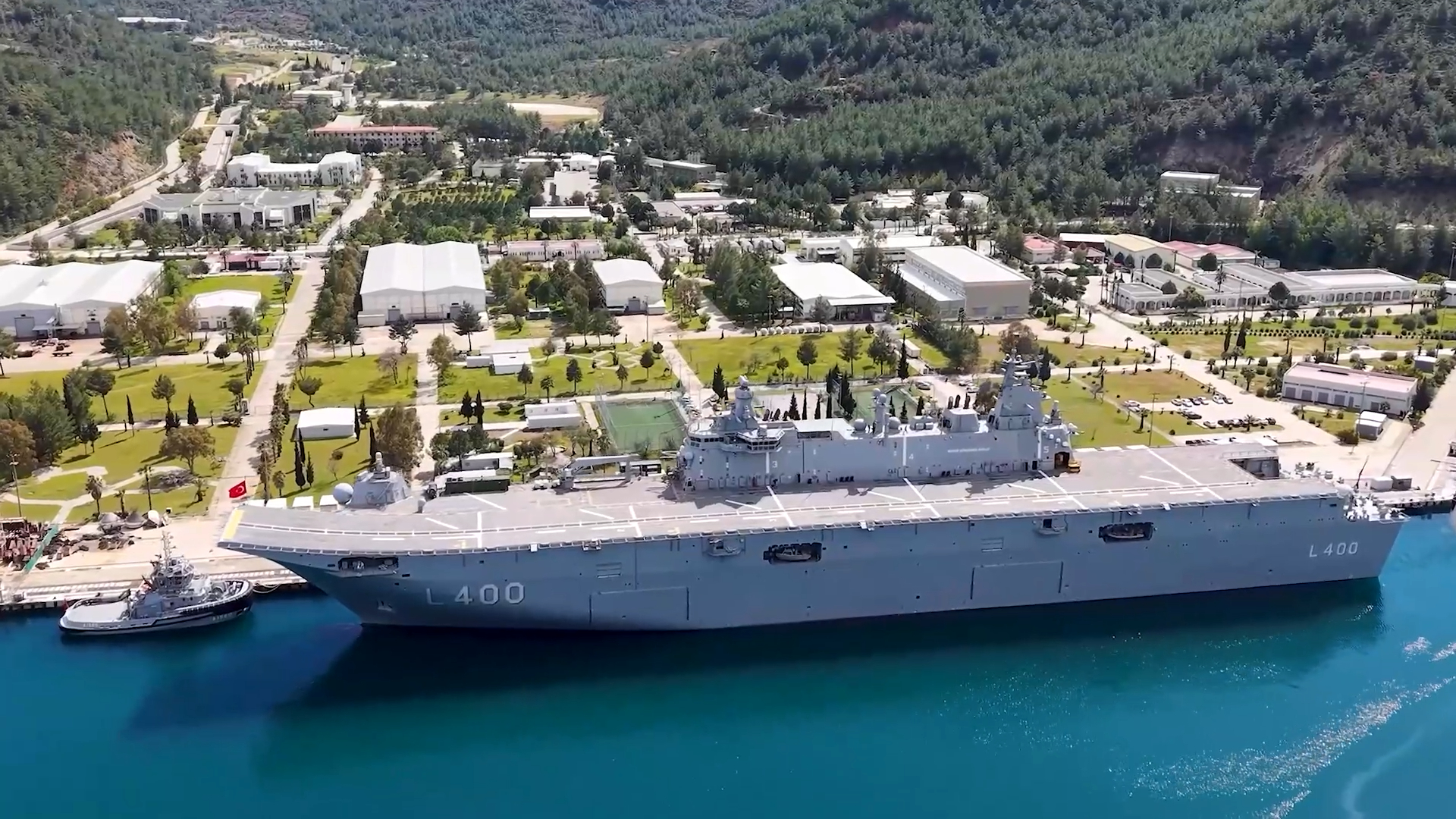
According to TUSAŞ each HÜRJET consists around 8,000 parts and it is aimed to produce two HÜRJETs per month during the serial production phase. The HÜRJET AJT, the first of which is expected to be delivered to the TurAF in 2025, will be capable of performing tasks such as Combat Readiness Training, Light Attack (Close Air Support), Air Policing (Armed and Unarmed), “Red Aircraft” Mission in Training Programs, Aerobatic Demonstration Aircraft and Carrier-Based Aircraft (navalized version of HÜRJET will be also deployed on Turkish Navy’s future National Aircraft Carrier, which planned to have a total length of 285 m, width of 72 m, draft of 10,1 m, and displacement of 60,000 tons and will feature a STOBAR [Short Take-Off, Barrier-Arrested Recovery] aircraft launch and recovery system). With a length of 13,6 meters, a wingspan of 9,5 meters, and a vertical tail height of 5,1 meters, the HÜRJET boasts a wing area of 35 square meters. Powered by a General Electric F404-GE-102 Turbofan Engine generating 17,600 lb of thrust, the HÜRJET is designed to have a maximum speed of Mach 1.4, G-limit of +8G/-3G, a service ceiling of 13,716 m (45,000 ft), a climb rate of 39,000 ft/minute, a range of 2,222 km (1,200 nm) and a payload capacity of 2,721 kg. With its advanced human-machine interface (HMI), glass cockpit design, digital flight control system (fly-by-wire), and internal tactical and virtual training systems, HÜRJET will offer a new-generation aircraft flight experience. Following the production of four flight prototypes for the Trainer version, TUSAŞ plans to produce a new prototype for the Light Combat Aircraft (LCA) version.
During Paris Air Show 2023 on June 22, TUSAŞ’ former President & CEO Temel KOTİL disclosed that TUSAŞ has signed a contract with GE Aerospace for the supply of 100 F404-GE-102 Turbofan Engines under the HÜRJET Program. For HÜRJETs a total of 200 (100 firm + 100 optional) F404-GE-102 Turbofan Engines will be procured. TEI has been in negotiations with GE Aerospace for a while to be able to manufacture some parts and perform final assembly of some of these engines.
Meanwhile, the Design Phase of HÜRJET Project was completed in November 2023. Within the scope of the HÜRJET Project, a Critical Design Review Meeting was held in two separate sessions with the participation of the Secretariat of Defense Industries (SSB), Directorate General of Military Factories (AFGM) and TUSAŞ. At the first session held on October 3-4, 2023, presentations were made on various aircraft systems, accompanied by discussions where participants shared their views. During the second session held on November 20-21, 2023, the Project's current status was evaluated. Subsequently, following the presentations and the gathering of opinions, the design phase activities concluded. The experience gained and lessons learned from HÜRKUŞ Project enabled TUSAŞ to achieve a weight reduction of 1,2 tons in HÜRJET, which successfully completed its maiden flight on April 25, 2023. TUSAŞ efforts to improve HÜRJET are ongoing. In December 2022 TUSAŞ’ former President & CEO Temel KOTİL disclosed that within the scope of HÜRJET Project they spent $1 Billion.
After conducting about 300 flights on “HÜRJET 270,” Engineering Development Simulator the first production prototype of the HÜRJET Next Generation AJT & LCA, dubbed P1, took-off at 07:35 am from Mürted Airfield on April 25, 2023, with Chief Test Pilot Ercan ÇELİK at the controls, to perform its maiden flight, which lasted 26 minutes. According to TUSAŞ, during its successfully completed maiden flight HÜRJET P1 climbed to an altitude of 14,000 ft and reached an air speed of 250 knots (463 km/h).
Since then, HÜRJET P1 continues to undergo flight tests according to its design envelope. Within the scope of its flight test campaign the HÜRJET P1, Türkiye's first manned jet-powered aircraft, engaged in a formation flight with the Turkish Stars on September 2, 2023. During the 37-minute flight, accompanied by the Turkish Stars, HÜRJET reached an altitude of 15,403 feet and a speed of 351 knots. Following a successful landing on the runway, HÜRJET then joined an elephant walk with the Turkish Stars NF-5A/B aircraft. As of July 11, the HÜRJET P1 has conducted a total of 79 sorties during which a total of over 70 flight hours have been accumulated.
TUSAŞ believes that by mid 2030s they could sell 100 HÜRJETS to the TurAF and 300 HÜRJETS to the export customers. The countries that are ranked first in HÜRJET's customer list and have a certain number of orders are as follows: Azerbaijan, Spain, and Canada. Negotiations between TUSAŞ and these countries/companies are ongoing.
HÜRJET was previously offered by TUSAŞ in the international tender held by the Malaysian Air Force in 2022 for its 18-aircraft Light Attack Aircraft requirement, however even it was shortlisted eventually it lost out to the KAI’s FA-50 in the tender.
The Spanish Air and Space Force (SASF) has been in search of a new generation jet trainer aircraft sine 2023 to replace the SF-5Ms (license-produced by CASA). They plan to have new aircraft in 2028 in Spain for the training of fighter and attack pilots. Turkish Aerospace’s HÜRJET is one of 4 candidates (including Boeing T-7, KAI T-50 and Leonardo M-346) of the SASF to replace its aged SF-5M Freedom Fighter Advanced Jet Trainers (designated as AE.9). If selected, the HÜRJET Next Generation AJT would replace the SASF’s 19 Northrop SF-5Ms operated by Ala 23 (23rd Wing) based in Talavera La Real (Badajoz) airbase, which gives advanced flight training to SASF pilot candidates to fly EF-18M Hornets and Eurofighter Typhoons. Ala 23 has two squadrons – 231 Escuadrón (Squadron) for the students and 232 Escuadrón (Squadron) for the instructors. The squadrons use the same pool of 19 SF-5M Freedom Fighters which have been in SASF service for 54 years. Spain has previously selected Pilatus PC-21 (designated as E.27) turboprop trainers (in November 2019) as replacement for C-101 Aviojets Trainers and placed an order of a total of 40 aircraft in two batches (24 [was delivered during September 2021 and June 2022] +16). Integrated SASF Training System involves a two-phase flight training program, with pilots beginning to fly the PC-21 (replaced the T-35C Pillan and C-101 Aviojets) at San Javier airbase before they are streamed onto the advanced flight-training phase at Talavera La Real with Ala 23 (on the SF-5Ms). So, if SASF select the HÜRJET, which promises innovative technologies and functionalities, the total number of aircraft has the potential to increase from 24, for which negotiations are currently ongoing, to 40. According to sources, Spain offered Türkiye to pay for the purchase of 24 HÜRJETs through the sale of 6 A400Ms to the Turkish Air Force over Airbus (i.e. through barter method). TurAF has been working for a while to increase the number of A400Ms in its inventory, which is 10, but could not make additional purchases due to budget constraints. Sources revealed to Defence Türkiye that, SASF will soon sent a delegation, to include also pilots, to TUSAŞ facilities in Ankara to get first-hand information on HÜRJET and to examine the aircraft.
Cadiz-based Spanish company Airtificial is among foreign companies that TUSAŞ cooperate in the development phase of HÜRJET. Airtificial is producing active and passive inceptor controls (flight control sticks) for Turkish Aerospace’s (TUSAŞ) HÜRJET Next Generation AJT. Airtificial announced April 3, 2024 that they have secured a two-phase contract worth €4,8 Million ($5,2 Million) to produce the inceptors for the series production HÜRJET AJTs.
F-16 Block 40M/50M Structural Improvement Project
The Turkish Air Force, which wants to subject the Block 40M and Block 50M Aircraft in its inventory to structural modernization, as in the Block 30s, has initiated a Project to procure the necessary structural renewal kits for 46 aircraft in the first stage, and the request has been forwarded to the US authorities through official channels. In order for the procurement process to be carried out automatically and quickly without the need for notification to Congress for approval in terms of financial value, the number of aircraft/modernization kits has been determined as 46 for the first phase, and a sufficient number of structural improvement kits are planned be procured for the remaining Block 40M and Block 50M aircraft in the second phase. The F-16C/D Block 40M and Block 50M Structural Modernization Project in question will be carried out in the facilities of the 1st Air Maintenance Factory Directorate (AMFD) and for this purpose, a new hangar with a capacity of 16 aircraft will be built within the 1st AMFD campus (when the project starts, around 20 F-16 aircraft are expected to be withdrawn from flight and be on the ground for modernization operations). The project is expected to be approved by the US authorities (Draft Offer and Acceptance Letters reached the Ministry of National Defense in February 2024) and the new hangar construction activity is expected to start around 2026-2027 following completion.
Meanwhile, in February 2019, Türkiye presented a Letter of Request (LoR) for Link 16 Multi-Functional Information Distribution Systems (MIDS) Block Upgrade II (MIDS BU II) and Automatic Ground Collision Avoidance Systems (AGCAS) for 199 F-16 Aircrafts in the Air Force Command's inventory. Since the procurement of Link 16 MIDS BU II will be a key factor in increasing Türkiye's interoperability with NATO, in April 2023, the Administration formally notified Congress of a possible avionics sale that would include these systems, and in April 2023, the US State Department announced that it had approved a possible Foreign Military Sale (FMS) of US$259 Million to the Government of Türkiye to support the upgrade of existing F-16 aircraft and related equipment. The contract includes software improvements of operational flight program (OFP) avionics with AGCAS capability and hardware modifications to enable integration of MIDS BU II. Due to the fact that the current MIDS terminals (F-16C/D Block 40M and Block 50M) and MIDS-LVT terminals (F-16C/D Block 50+) on F-16C/Ds are outdated and their inability to work with updated crypto as it is not approved by the US Government, Turkish Air Force has been experiencing problems in relation to Link-16 Tactical Data Connection for almost two years. Until April 2023, the US Government had not approved the sale of MIDS BU II terminals to Türkiye and the integration of MIDS BU II terminals into Turkish Armed Force F-16s. MIDS terminals on USAF fighter aircraft have undergone Block Upgrade II (BU II) to meet crypto-modernization, improved throughput, and frequency remapping requirements. It is expected that the integration work of the new avionics equipment on the Block 40M and Block 50M Aircraft will be carried out in this new hangar, which will be built at the 1st AMFD facilities, together with the F-16 Block 40M/50M Structural Improvement Project.
F-16 Block 70 Procurement and F-16V Modernization
In order to meet the interim fighter aircraft needs of the Turkish Air Force (TurAF) until the first KAAN National Combat Aircraft Squadron becomes operational in the early 2030s, both the F-16 Block 70 Procurement and F-16V Modernization Project, and Eurofighter T3+ Procurement Project, dedicated for air superiority role, were initiated for air superiority capability. There is a need for both aircraft types, and the projects in question are progressing through separate channels.
After monthslong negotiations between Ankara and Washington following Türkiye’s approval of Sweden’s NATO membership in January, 2024 the US State Department announced June 6, 2024 that Türkiye signed the draft of the official Letter of Offer and Acceptance (LOA), for the estimated $23 Billion purchase of the most advanced version of the F-16s, the Block 70, also known as “Viper.” Within the scope of the F-16 Block 70 Viper Procurement and F-16V Modernization Project, on September 30, 2021, Türkiye submitted a Letter of Request to the US Government to supply 40 new production F-16 Block 70 Viper Combat Aircraft and 79 Upgrade Kits for the upgrade of 29 Block 50+ and 50 Block 40M aircraft in the TurAF inventory to the F-16V level. Negotiations with the US delegation started in Türkiye in December 2021. In a statement published in the press on January 4, 2024, Minister of National Defense Mr. Yaşar GÜLER announced that the technical meetings with the USA within the scope of the Project were completed, since it is a foreign military sale, the official notification regarding the sale was submitted to Congress on January 26, 2024 for the approval process by the US State Department and since there was no objection to the sale within the 15-day legal objection period, the sale of 40 new production F-16 Block 70 Viper Combat Aircraft and 79 F-16V Modernization Kits and the ammunition, materials and equipment to be used in these aircraft to Tuürkiye was approved by the US Congress and it became official in February 2024. Within the scope of the project, the draft of the official Letter of Offer and Acceptance (LOA), which includes all information regarding the detailed breakdown and cost of sale of the F-16 Block 70 Aircraft and F-16V Modernization Kits that the USA will sell to Türkiye, reached to Turkish MoND in February 2024, and following the monthslong negotiations between Ankara and Washington the draft LOA was signed on June 6. The Project Schedule will come into force in coming months, following the signing of the final LOA by the authorities of both countries.
The Project package with an estimated value of $23 Billion include 40 new production F-16 Block 70 fighter jets, 79 F-16V upgrade kits, 48 F110-GE-129D TF Engines (8 spare), 149 AN/APG-83 SABR AESA Radars, 168 Integrated Electronics Combat System ( AN/ALQ-257 IVEWS or equivalent systems), 858 LAU-129 Ammunition Arrays, 44 M61 Vulcan 20mm Canons, 16 AN/AAQ-33 Sniper Advanced Targeting Pods, 952 AIM-120C-8 AMRAAM Air to Air Missiles, 864 GBU-39/B Miniature Bombs, 96 AGM-88E AARGM Anti-Radiation Missiles, 401 AIM-9X Block II Sidewinder Air to Air Missiles, 1437 JDAM Smart Guidance Kits and an unspecified amount of LEGION infrared search and tracking system (IRST). Contrary to expectations, rather than L3 Harris’ AN/ ALQ-254 (V)1 Viper Shield which is recommended for F-16 Block 70 FMS customers, the TurAF F-16 Block 70s and F-16V fighter jets will be equipped with AN/ALQ-257 Integrated Viper Electronic Warfare Suite (IVEWS, Integrated Viper EH Suite), a Northrop Grumman product developed and produced for the US Air Force. The AN/ALQ-257 IVEWS features internal and integrated ultra-wide band coverage (including millimeter wave type threats) and a new generation digital Radar Warning Receiver. In this context, procurement of a total of 168 units of AN/ ALQ-257 IVEWS supply is planned, and of these, 119 units (40 F-16 Block 70 and 29 F-16C/D Block 50+ (already equipped with AN/ALQ-211(V)4 AIDEWS internal EH Self Defense System) and 50 units of Block 40M (installed with AN/ALQ-178(V)3 internal EW Self-Defense System, but it was proven in domestic and international exercises that the system was insufficient to jam and blind AESA type radars) will be installed on the above mentioned aircraft. I consider that the remaining 49 AN/ALQ-257 IVEWS Suites can be installed on F-16C Block 50M Aircraft equipped with AN/ALQ-178(V)5+ internal EW Self-Defense System under the SPEWS-II Project.
Negotiations continue with the US authorities regarding the final assembly and modernization of the aircraft at TUSAŞ and 1st AMFD facilities in Türkiye. In a statement he made on March 11, 2024, Minister of National Defense GÜLER said about the Project: “It is a $23 Billion Project, but there is no such thing as we will receive the entire package. We will do whatever is in Türkiye's interest. Our negotiations continue regarding the production and modernization of F-16s in Türkiye," Meanwhile, according to the information reflected in the press in the bilateral meetings held with the delegation of the Armed Force Committee of the US House of Representatives, who came to Türkiye in March 2024 to hold various contacts and was accepted by the Turkish Minister of National Defense (MoND) Yaşar GÜLER within the scope of their visit, among the important topics on the table were F- 16 Block 70 Procurement and F-16V Modernization Project and ÖZGÜR Project. Accordingly, during the bilateral negotiations, the request for official approval from the USA for the ÖZGÜR Avionics Modernization Projects was repeated, while the information that there would be a reduction in the quantities of the F-16V upgrade kits was conveyed to the other party. It is claimed that Türkiye has decided to procure much less than 79 F-16V upgrade kits (probably only 29 kits will be procured to upgrade 29 existing Block 50+ aircraft to F-16V level) and munitions to save billions of dollars amid spending cuts at home.
ÖZGÜR Project
With the ÖZGÜR Project, which was launched by the Defense Industry Executive Committee (SSİK) Decree dated December 15, 2010, within the framework of the requirements and demands of the TurAF, it was aimed to equip an F-16C Block 30 Aircraft, which had not undergone avionic modernization under the Peace Onyx III Project (PO-III), with a national avionics suite, including an indigenous Mission Computer with National Operational Flight Program (OFP) and AESA Radar, and certify it. The contract signed between the SSB and Main Contractor TUSAŞ on March 6, 2012 and entered into force on May 24, 2012. Within the scope of the ÖZGÜR Project, in which ASELSAN served as the Main Subcontractor, the first prototype F-16C Block 30 Aircraft (tail number 87-0019) was modernized and equipped with three Color Multi-Function Displays designed and produced by ASELSAN (CMFD, 2 x CMFD-55 Color Multi-Function Cockpit Central Screen with dimensions of 5" x 5" and 1x CCD-68 Central Cockpit Display with dimensions of 6" x 8") and are also the indigenous Mission Computer running the national OFP which is an ASELSAN product. After being equipped with the domestic avionics suite, the first power was given to the aircraft on February 9, 2016, the first engine start-up was carried out on April 5, 2016, and the first running test on the runway was carried out on May 2, 2016. Subsequently, the first aircraft modernized within the scope of the ÖZGÜR Project (F-16C Block 30 Aircraft with tail number 87-0019) conducted its first flight test on May 9, 2016, and was subsequently subjected to extensive flight tests. Later, modernization work on the second prototype aircraft, the double-seater F-16D Block 30 Aircraft, started and according to the SSB, the official acceptance of the two aircraft was completed in May 2023.
With the scope of the ÖZGUR Project, thanks to the nationalization of the Mission Computer onboard F-16 Block 30 Aircraft, external dependency in avionics modernization was eliminated, national ammunition and pods were integrated without external dependence, a pilot-friendly and operationally effective new digital cockpit design was made, 22 LRUs and 12 weapons were replaced and integrated, and approximately 75 harness replacements and 50 panel modifications were made. Under the F-16 Block 30 National Mission Computer and Avionics Suite Development (ÖZGÜR) Project, which is the most comprehensive study ever done on the F-16 in Türkiye, F-16C/ D Block 30 prototypes have been equipped with National Mission Computer, System Interface Unit, Cockpit Upper Front Control Panel, Fuel Hydraulic Indicator, Engine Display Screen, Emergency Indicator, National Sound Safety Device, National Friend - Foe Identification (IFF Mode 5/S) System, Multi-Mode Receiver, Inertial Navigation System, Interface Blinding Unit, AVCI-II (TULGAR) Helmet Integrated Sight/Targeting System, Central Cockpit Display (CCD) and Color Multi-Function Displays (CMFD). Qualification tests were successfully completed with the two ÖZGÜR Project prototypes, which were painted with digital camouflage after modernization, and the official acceptance of the aircraft was made in May 2023. When the new national ammunition development works are completed and new systems and new indigenous equipment such as AVCI-II/TULGAR Helmet and X-Band MURAD-100A AESA Nose/Fire Control Radar, which are currently being developed by ASELSAN with flight tests ongoing on prototype aircraft, it is planned to be integrated them into the aircraft to be modernized within the scope of the Serial Production Phase.
The first flight of the ASELSAN’s MURAD-100A AESA Radar, which brings F-16C/D Block 30 ÖZGÜR Aircraft to the level of 4.5 generation combat aircraft, was performed on 15 February 2024 with the ÖZGÜR Modernized F-16C Block 30TM prototype aircraft. MURAD-100A GaN based AESA Nose Radar with X-Band Transmit Receive (T/R) modules has the capabilities of simultaneous air-to-air and air-to-ground missions, multitarget detection/tracking, under-cloud surveillance with SAR, beyond-visual-range missile guidance, high-resolution imaging, and electronic warfare functions including broadband radar spectrum monitoring (ESM) and directional electronic jamming (ECM). This radar offers several advantages over traditional systems, including electronic beam steering, which allows for quicker target detection and tracking, higher image resolution, and increased resistance to electronic countermeasures. It is stated that the MURAD-100A AESA Fire Control Radar, which features a total of 1,152 GaN based X-Band Transmit/Receive modules, will have at least matching even better performance to that of the AN/APG-83 SABR on F-16 Block 70 Vipers and it will go far beyond the AN/APG-68(V)9 Radar onbord the F-16C/D Block 50+ aircraft in the TurAF inventory in terms of target detection and tracking range performance.
According to the SSB 2023 Activity Report, 3 F-16 Block 30TM, modernized in 2023 within the scope of the ÖZGÜR Modernization Project, were delivered to the TurAF.
F-16 Block 30 Structural Improvement Project
Under the Peace Onyx I Project I (PO-I), a total of 160 F-16C/D Aircraft were supplied for the Turkish Air Force, including 43 Block 30 (34 C and 9 D versions) and 117 Block 40 (102 C and 15 D versions). Under the Peace Onyx II Project (PO-II), a total of 80 F-16C/D Block 50 Aircraft, 68 of which were C and 12 D versions, were put into TurAF service. Under the Peace Onyx III Project (PO-III), a total of 171 Block 40 and Block 50 aircraft (+ 2 Block 30) underwent comprehensive avionics modernization between July 2007 and April 2015 (including TVI, LTF and MSM Phases) and after modernization, the aircraft were classified as Block 40M and Block 50M. The F-16C/D Aircraft procured under the PO-I Project were subjected to Falcon UP Structural Improvement modernization at TUSAŞ facilities between 1993 and 1999, and their airframe/structural service life was increased to 8,000 hours. In July 2014, a call was issued by the US Air Force to sign a contract with Lockheed Martin Company as the sole source for the Falcon STAR Plus Structural Improvement work through FMS for the 14 F-16D Block 40 Aircraft remaining in the inventory of the Turkish Air Force. In this call text, the implementation period of the structural improvement work in question was given as November 1, 2016 and October 31, 2018. F-16 Block 70 Aircraft have a new production fuselage with a service life of 12,000+ hours. The airframe life of the F-16C/D Aircraft, which will be modernized at the F-16V level, is also increased to 12,000+ hours with the structural improvement efforts applied.
In order for the 35 F-16C/D Block 30 Aircraft in the Turkish Air Force inventory to serve until 2040, the F-16 Block 30 Structural Improvement Project was initiated to increase their airframe life of 8,000 hours to 12,000 flight hours, and a contract was signed between the SSB and the Main Contractor TUSAŞ on August 10, 2015. While Lockheed Martin Company, which supplied the structural improvement kits needed in the project, took part as a subcontractor, the 1st AMFD was assigned for the modernization of 10 out of 35 aircraft.
The first Block 30 Aircraft, whose structural improvement was completed in the project, was delivered in July 2020, the 5th aircraft in March 2021, the 6th aircraft in May 2021, the 8th aircraft in July 2021 and the 12th aircraft in August 2022. Although deliveries to the Turkish Air Force were planned to be completed in August 2023, this schedule could not be met due to delays. In his speech at the F-16 Block 30 ÖZGÜR-II Serial Modernization Project and Block 40M/50M ÖZGÜR-II Prototype Aircraft Modernization Project Signing Ceremony at IDEF '23 Fair, Secretary of Turkish Defense Industries Haluk GÖRGÜN stated the end of 2025 as the completion date for the Structural Improvement Project of 35 F-16C/D Block 30 Aircraft.
F-16 Structural Improvement and ÖZGÜR Modernization Series Phase
The 1st AMFD which previously carried out the modernization of 16 aircraft in cooperation with TUSAŞ under the Peace Onyx llI Project, is also cooperating with TUSAŞ under the F-16 Structural Improvement Series Phase and ÖZGÜR Modernization Series Phase. In this context, the 1st AMFD will apply Structural Improvement to 10 F-16 Block 30 Aircrafts in the Turkish Air Force inventory and ÖZGÜR Modernization to 12 F-16 Block 30 aircraft. Within the scope of the F-16 Block 30 Structural Improvement Project, Bulkhead, fitting and longereon changes are made in the aircraft, critical points are strengthened, flexibility is provided to the determined points with the new connector pattern, and many structural elements connected to these changes and additions are checked and renewed. With this comprehensive study, the service life of the aircraft is increased from 8,000 flight hours to 12,000 flight hours.
While the first 11 aircraft were subjected to only Structural Improvement modernization at TUSAŞ facilities, Block 30s started to undergo both Structural Improvement and ÖZGUR Avionics Modernization processes simultaneously starting from the 12th aircraft. The first 11 F-16C/D Block 30 aircraft, whose Structural Improvement was completed and delivered, will go back to TUSAŞ facilities and undergo ÖZGUR Avionic Modernization there. During our visit of 1st AMFD in December 2023 , there were a total of 7 F-16C/D Block 50M, Block 40M and Block 30M aircraft in Maintenance of which 3 were project aircraft (F-16C Block 30s prepared for the F-16 Structural Improvement and ÖZGÜR Modernization Serial Phase) and 4 were for paint renewal and replacement of large structural parts (such as Spar, Bulkhead and Longereon).
The F-16C Block 30 Aircraft which is the first of the 12 aircraft to be modernized (both Structural Improvement and ÖZGÜR Modernization) at the 1st HBFM facilities, was also among the project aircraft in question. The modernization (Structural Improvement + ÖZGÜR Modernization) of the first aircraft which was received on May 31, 2023, is planned to be completed in August 2024. It is planned to spend 25,000 Man x Hours of labor for each aircraft under the F-16 Structural Improvement and ÖZGÜR Modernization Serial Phase, which has approximately 2,000 work cards.
We had the opportunity to see and photograph the F-16C Block 30 Aircraft which was the first aircraft that received both ÖZGÜR and Structural Improvement modernizations at TUSAŞ facilities, while its fuselage was being prepared for sanding and painting in Hangar We photographed the F-16C Block 30 Aircraft which is the second aircraft that received both ÖZGÜR and Structural Improvement modernizations at TUSAŞ facilities, while it was being painted in the Corrosion Control and Aircraft Painting Complex (New Paint Workshop). While the first ÖZGÜR Prototype has digital camouflage on it, the ÖZGÜR Aircraft that will be delivered to the Fleet leave the Factory painted in a gray pattern. After the paint renewal and gray pattern painting processes were completed within 30-32 working days, the F-16C Block 30 Aircraft with tail number 87-0013, which was delivered in early February 2024, became the first ÖZGÜR Project aircraft to be delivered to the TurAF F-16 Squadrons and started its flights. It is expected that the 1st AMFD will also take part in the F-16C/D Block 30 ÖZGÜR-II Series Modernization Phase, which will include the MURAD-100 AESA Radar integration, and in this context, the integration work on some aircraft will be carried out at the 1st AMFD facilities. The 1st AMFD will also take part in the Series Phase of the F-16C/D Block 40M/50M Aircraft ÖZGÜR-II Modernization Project.
As stated above, the structural improvement/strengthening work that will allow the structural service life of the F-16C/D Block 40M and Block 50M Aircraft in the Turkish Air Force inventory to be extended until 2050 will be carried out with the facilities and capabilities of the 1st Air Maintenance Factory Directorate (AMFD). With this work, it is expected that the structural life of the aircraft will be extended by 4,000 hours, as in the Falcon STAR Structural Improvement work. In this context, the design limit of the structural service life for Block 40M and Block 50M aircraft will be increased from 8,000 hours to 12,000+ hours. Following the Falcon STAR, each aircraft has a new maximum operational weight of approximately 39,000 pounds, due to its use of an array of weaponry from Global Positioning System guided bombs to radar-guided, air-to-air missiles. The previous designed weight for the F-16 was 22,500 pounds.
ÖZGÜR-II Projects
The Contract Signing Ceremony for the F-16C/D Block-30 ÖZGÜR-II Series Modernization Project and F-16 Block 40M/50M ÖZGÜR-II Prototype Aircraft Modernization Project, initiated by the Secretariat of Defense Industries (SSB), to address the modernization requirements of the Turkish Air Force Command, and to be executed by the Prime Contractor Turkish Aerospace (TUSAŞ) in cooperation with ASELSAN, TUSAŞ, TÜBİTAK SAGE, ROKETSAN and AFGM (1st AMFD) took place on July 26, 2023 during IDEF ‘23 Fair.
Under the F-16C/D Block-30 ÖZGÜR-II Series Modernization Project, several key objectives are set to be achieved. These include obtaining External Load Certification for various ammunition types, miniature bombs, and the ASELPOD Targeting Pod System. Additionally, the Project aims to integrate MURAD-100A AESA Nose Radar into ÖZGÜR Aircraft. Within the scope of the Fighter Electronic Warfare System (FEWS, comprising RWR, RF Jammer and MWS) and GÖKDOĞAN (RF guided indigenous BVR missile of TÜBİTAK SAGE) Integration Project Contract, modernized F-16C/D Block 30TM ÖZGÜR aircraft will be integrated with; T-Link National Data Link (L-Band), IFF Combined Interrogator Transponders (CITs), Radio Navigation Equipment (RNE) and 9681 V/UHF airborne radio sets as well as with BOZDOĞAN BVR missile and HGK-82 smart munitions.
The F-16C/D Block 40M/50M ÖZGÜR-II Prototype Modernization Project aims to integrate national equipment and ammunition into F-16C/D Block 40M/50M prototype aircraft (I think there will be one C and D version from each Block). In particular the ÖZGÜR Suite and MURAD-100A AESA Radar along with other critical components such as FEWS, T-Link, IFF CITs, RNE, ASELPOD, 9681 V/UHF airborne radio sets, SOM, HGK, KGK, LGK, GÖKDOGAN and BOZDOĞAN munitions will be interated into the prototype aircraft. Structural improvement engineering activities will also be conducted on F-16 Block 40M/50M prototype aircraft, with the goal of eventually implementing these improvements across the serial production.
The deliveries for the F-16C/D Block-30 ÖZGÜR-II Series Modernization Project are expected to be completed between 2025 and 2027, while the deliveries under the F-16C/D Block 40M/50M ÖZGÜR-II Prototype Modernization Project are projected to conclude between 2028 and 2030. With the completion of these projects, F-16C/D Block 30TM, 40TM and 50TM ÖZGÜR Aircraft will gain similar capabilities and features as the F-16 Block 70 Viper and F-16V aircraft, and will also be able to carry national ammunition and pod systems thanks to the national Operational Flight Program (OFP). According to the information shared with the public by ASELSAN, the company’s workshare in the F-16C/D Block-30 ÖZGÜR-II Series Modernization Project and F-16 Block 40M/50M ÖZGÜR-II Prototype Aircraft Modernization Project, in which TUSAŞ act as Prime Contractor, is worth $1,98 Billion.
Eurofighter Tranche 3+ Prourement Project
With the Eurofighter Typhoon Procurement Project initiated by the Turkish Ministry of National Defense (MoND) in order to meet the TurAF’s need for modern aircraft with air interception and air superiority capabilities, it is aimed to supply two squadrons (each with 20 aircraft) of new production Eurofighter Tranche 3+ (the same configuration given to the Qatar Emiri Air Force with Leonardo’s ECRS Mk-0 AESA Radar) aircraft from the UK through BAE Systems along with necessarry source codes. The 1st AMFD will play a critical role in the rapid induction of the new production Eurofighter Tranche 3+ aircraft into the TurAF inventory, in terms of depot level maintenance and sustainment capability of the aircraft and the EJ200 Turbofan Engines on them. While England, Spain and Italy, members of the Eurofighter GmbH Consortium, gave the green light for the sale of Eurofighters to Türkiye, diplomatic contacts and negotiations have been held for about a year to persuade Germany, which objects to the sale.
Eurofighter user countries, including the UK, sign a Performance Based Logistics (PDL/PBL) Agreement for the maintenance and support of the Eurofighter fleet. BAE Systems, for example has been providing services to the Royal Air Force (RAF) Eurofighter Typhoon fleet under the Typhoon Availability Service (TAS) contract since 2009. After rapidly bringing the aircraft into the TurAF inventory Türkiye aims to get maintenance and support service from the manufacturer BAE Systems under a PBL Contract for the first 4-5 years. During this period, which is defined as ‘transition period’, Türkiye will establish the necessary critical capabilities required for the maintenance and support of the Eurofighter Typhoon aircraft and its EJ200 Turbofan Engines at the 1st AMFD facilities. And following the this ‘transition period’ TurAF aims to be able to carry out the maintenance, overhoul and support of its future Eurofighter Tranche 3+ fleet on its own capabilities. In this context, while Türkiye brings this demand to the agenda in every official meeting, negotiations are also held with BAE Systems for the Eurofighter Typhoon aircarft and Rolls-Royce for the EJ200 engines in line with this demand, and there is information that both companies have a positive approach to the issue. The 1st AMFD currently has Depot Level Maintenance (DLM) capability of Rolls-Royce T56 Turboprop Engines. The T56-A-7 TP Engines used in C-130B/E Aircraft were converted into the T56-A-15 model with the T56-A-7/15 Conversion Project launched in the second half of the 90s. A BAE Systems delegation visited the 1st AMFD facilities in the first half of December 2023, saw the capabilities on site and received information about ongoing activities.
Within the scope of the project, negotiations continue with both the partner countries of the Eurofighter Consortium, Germany, England, Italy and Spain, and with the BAE Systems.
Minister of Turkish National Defense (MoND) Yaşar GÜLER, while answering the questions of the MPs during the discussions of the Ministry's 2024 budget at the Grand National Assembly of Türkiye’s Planning and Budget Commission on November 16, 2023, announced that the works for the purchase of Eurofighter Typhoon fighter jets were continuing and said the following: "We want to buy Eurofighter. It is a very effective aircraft. These aircraft concern England, Germany and Spain. Both England and Spain say 'yes', and now they are trying to convince Germany. England and Spain say 'we will solve that problem'. If possible, we plan to purchase 40 Eurofighter aircraft." A large delegation from Italian Defense Industry companies accompanied Italian Prime Minister Giorgia MELONI during her official to Türkiye took plae on January 19, 2024. And the Eurofighter sale was among the agenda items during the bilateral meetings held witihin the scope of this visit. On February 1, 2024, Ministry of National Defense sources pointed out that Türkiye's demand for Eurofighter procurement continues and said, “Our demand continues. A positive approach on this issue is expected from Germany, one of the consortium countries. Meetings and actions are ongoing.” Turkish MoND Yaşar GÜLER went to England for official contacts on February 27, 2024, and exchanged views on defense and security issues with British Minister of Defense Grant SHAPPS and Chief of General Staff Admiral Anthony RADAKIN. It is considered that the sale of Eurofighter to Türkiye was also on the agenda during bilateral negotiations. Regarding the Eurofighter Procurement Project, in a statement he made on March 11, 2024, Minister of National Defense GÜLER said, “Our attempts to purchase Eurofighter aircraft continue. In this context, it would be the right approach for our allies to make decisions in line with the spirit of the Alliance (NATO) and the common security perspective. Our British interlocutors state that they are working to persuade Germany,". During the three-day official visit of German President Frank-Walter STEINMEIER to Türkiye on 22-24 April 2024, the sale of Eurofighter Typhoons to Turkiye was among the agenda items and after the bilateral meeting with STEINMEIER at the Presidential Complex on April 24, at the joint press conference held, President Recep Tayyip ERDOGAN said, “I want us to completely remove the restriction we face in the defense industry from our agenda. We hope that Türkiye and Germany will talk about joint production projects from now on, not about obstacles, especially in the field of defense,".
In his statement issued on July 12, 2024 following his meeting with German Chancellor Olaf SCHOLZ that took place on July 11 during the NATO summit in Washington DC, President ERDOĞAN urged German Chancellor SCHOLZ to lift a block on the sale of Eurofighter Typhoon aircraft to Türkiye. SCHOLZ’s government has blocked sale of Eurofighters to Türkiye. "We discussed the Eurofighter issue among ourselves. SCHOLZ did not have a negative approach regarding this issue. In the continuation of our discussions on the issue and in the meetings that my Minister of Defense held with his German counterpart in Germany, we saw that there was a trend in the most positive direction possible. There are such positive developments on both the German and British sides. We will all follow it together. I hope the outcome will be beneficial."
In case the Eurofighter jets sale to Türkiye is finalized, an option such as shifting the Tranche 3+ aircraft produced for the Qatar Emiri Air Force (QEAF) to the Turkish Air Force was also brought up in order to shorten the delivery schedule to meet Türkiye's urgent needs. However, this option is no longer valid as the contract signing has been delayed. Because, as you may remember, a contract worth 7.5 Billion Dollars was signed in 2017 for the supply of a total of 24 Eurofighter T3+ jets, 20 of which are single-seat and 8 of which are double-seat configuration, for the Qatar Emirates Air Force. 8 of these aircraft were delivered in 2022 (the first 4 aircraft were delivered on August 15, 2022), and 10 were delivered in 2023. The remaining 4 aircraft were supposed to be delivered by mid-2024. If the contract had been signed in 2023, the first Eurofighter T3 delivery to Türkiye could have been made in 2024 with the implementation of this option.
ERCİYES Project and Second-Hand C-130J Super Hercules Procurement from RAF Stocks
Turkish Air Force (TurAF) currently operates a total of 19 C-130B and C-130E Hercules Medium Military Transport Aircraft. Between 1964 and 1973, a total of 8 new production C-130E Hercules entered the TurAF service. One of these planes, with serial number 64-17949, crashed while landing at Akhisar Airport Command on the evening of October 19, 1968, and 7 crew members on the plane were martyred in the accident. 6 C-130B Hercules belonging to the US Air National Guard, donated in 1991, were added to the inventory. In order to support the fleet, 6 used C-130Es, which were put up for sale by the Royal Saudi Arabian Air Force (RSAF) in 2010, were purchased for $26.3 Million and they were transferred from Prince Sultan Airbase in Saudi Arabia to 12th Air Transport Main Base Command in Erkilet/Kayseri between November 20, 2011 and 21 January 2012. The tail numbers of the planes, which were brought to the 12th Air Transport Main Base Command after flights ranging from 4 hours 15 minutes to 5 hours, are as follows; 70-1610, 68-1608, 68-1606, 67-455, 65-451 and 68-1609. Unlike the C-130Es in TurAF service, the C-130E Hercules purchased from the RSAF do not have AN/AAR-47(V)1 Missile Warning System (MWS) sensors in the nose and tail section and Chaff/Flare launchers (CMDS).
As of December 29, 2023, a total of 11 aircrafts, including 2 prototype aircraft (C-130E with tail number 63-13188 and C-130B with tail number 61-2634), have been delivered while the modernization and pre-delivery final inspection activities of the 12th, 13th, 14th and 15th aircraft were continuing under the ERCİYES (Avionics Modernization of C-130E/B Aircraft) Project, which covers the avionics modernization of a total of 19 C-130E/B aircraft (13 C-130Es and 6 C-130Bs). Under the ERCİYES Project, which includes 19 aircrafts, the 15th aircraft was scheduled to be delivered to TurAF by mid 2024. The integration and installation of the avionics modernization kit on each C-130 aircraft takes nearly 6 months, while the depot-level maintenance and repair takes approximately 6-7 months. Thus, the maintenance of the aircraft covers both the depot-level maintenance and repair and avionic modernization at the same time. The C-130B/Es are designated as C-130EM and C-130BM after te ERCİYES modernization.
The 2nd AMFD, which has had the Depot Level Maintenance (DSB) capability for C-130B/E Hercules since 1968, continues its efforts to renew the Lockheed Martin approved Maintenance Center Certification received in 2009. The C-130B/E Hercules of the 222nd Air Transport Squadron Command is subjected to FASBAT every 5 years.
Within the scope of ERCİYES Project the C-130BM and C-130EM Hercules are equipped with a Digital Cockpit comprising 4 Color Multi-Function Displays with moving map capability, 2 Central Display Units (CDUs) and 2 multifunction Central Control Computers compatible with international navigational requirements, as well as with a multifunction Mission Computer with high operational efficiency, National Flight Management System (FMS), Ground Mission Planning Unit compatible with the Air Force Information System, and display and lighting systems compatible with Night Vision Goggles. Within the scope of the ERCİYES Project, the C-130BM and C-130EM Hercules are also fitted with the MIDS Terminal and Link-16 Tactical Data Link System. Thus, the C-130BM/EM aircraft has now become capable of conducting integrated operations with the E-7T Airborne Early Warning and Control Aircraft, F-16s and command control elements. With the Link-16 Tactical Data Link Integration activities, the aircraft gained interoperability with other platforms in the inventory (ability to share video, audio, and text (in short message format) with other friendly and allied elements). Through the digital cockpit compatible with Night Vision Goggles (NVG), safe navigation capability has been secured at night, day and under all weather conditions. Besides, the aircraft has gained the capability to allow for night jumping (both parachutists and loads) at low altitudes. Within the scope of the project, Turkish Aerospace (TUSAŞ) is responsible for the integration of the avionics system, consisting of 118 devices from 23 different systems, the integration of the National Flight Management System (FMS), which assumes the role of the navigation officer, the integration of Link-16, and the development of the Ground Mission Planning Unit. The Operational Flight Program (OFP - with nearly 3.2 million lines of code) used in the national mission computer (Central Control Computer) to control and manage the new avionic equipment onboard the aircraft was developed by TUSAŞ engineers in accordance with DO-178B Level-A standards.
The C-130B/E Hercules have a crew of five; two Pilots, Navigator, Flight Engineer, and Loadmaster. Thanks to the National FMS software developed by TUSAŞ engineers and replaced the Navigator under the ERCIYES Project, the number of crew in the modernized C-130BM/EM Hercules is reduced to four.
Meanwhile, in order to support its aging Hercules fleet the TurAF has been interested in the RAF’s C-130J Super Hercules Transport Aircraft, which were decommissioned by the RAF in June 2023, as additional A400M purchases cannot be made due to budgetary problems. In this context, a delegation went to England, examined the aircraft at the Marshall Aerospace facilities in Cambridge and held preliminary discussions on the cooperation with the company in case the purchase was made. In case the ongoing negotiations are concluded positively, it is expected that an agreement will be signed between the two countries for the transfer of RAF C-130Js to the TurAF after passing through necessary maintenance, repair and overhaul operations at the Marshall Aerospace facilities in Cambridge. The negotiations were originally covered the procurement of C-130J-30 (C4, with stretched fuselage) and C-130J (C5, with standard-length fuselage) Super Hercules from RAF stocks at Marshall Aerospace and Defense Group Company facilities. The 2nd AMFD aims to gain DLM capability for C-130J Super Hercules within the scope of cooperation with Marshall Aerospace and Defense Group Company. It is stated that the C-130J Super Hercules procurement process, the work of which started in 2023, may take 1.5 years, and that both the avionic systems and engines on the aircraft, which are in good condition in terms of fuselage structure, must be overhauled before delivery.
Due to budget cuts, on March 22, 2021, the RAF decided to decommission the 13 Hercules C4 and 1 Hercules C5 type C-130J Super Hercules in its inventory, which it previously announced that it will use until 2030, and sell the aircraft as military equipment through the Defense Equipment Sales Authority (DESA). Marshall Aerospace and Defense Group provides maintenance support services for operations, storage, maintenance and international sales of aircraft taken out of service. The RAF became the launch customer of these aircraft with the order for a total of 25 C-130J Super Hercules, 10 of which were in C5 and 15 of which were in C4 configuration, given to Lockheed Martin Company on December 16, 1994 for $1.6 Billion. The first flight with the first C-130J Super Hercules produced for the RAF was conducted on April 5, 1996, and the RAF put the first Super Hercules into service in 1998 (RAF Lyneham Base). Two C-130-J30 (C4) were crashed during landing in Iraq on February 12, 2007 (ZH876) and August 25, 2017 (ZH873) respectively and were put out of service. 10 C5 Super Hercules were taken out of service with the decision taken in 2015. 8 of these were sold off to Bahrain (2x), Bangladesh (5x) and US NAVY (1x), while 2 C5s were in storage at Marshall Aerospace facility at Cambridge Airport, waiting for their second-hand customers. Instead of the C4 with tail number ZH873, which was written off after crashing in August 2017, one of the C5s in stock was overhauled and started to serve again in No. 206 Squadron. Therefore, following the decommision of 10 C5s in 2015, 13 C4 long-bodied and 1 C5 short-bodied C-130J Super Hercules remained in RAF service. As of March 2023, there were only 7 C-130Js left in RAF No 206 Squadron flying C-130J Aircraft. The RAF has retired its last C-130J Super Hercules in service as of 30 June 2023