Turkish Armed Forces ACV-15 Modernization and Life Extension Program

In 1967, the US Army Ordinance Office started the MICV-65 program for a new armored vehicle in response to the amphibious Soviet BMP family Infantry Fighting Vehicles. The same year, FMC (Food Machinery Corporation) Ground Systems Division (later become United Defense, today BAE Systems) started to improve the M113 Armored Personnel Carrier (APC). Contracted by the US Army, FMC built two prototypes under the designation XM765. These vehicles were derived from the earlier XM701 prototype aimed to replace the M113 under the MICV-65 program. The XM765 was based on the proven M113 APC, modified to incorporate a fully enclosed one-person turret and a sloped rear deck with firing ports so that the infantry could fight from within the vehicle. Although the US Army evaluated the XM765, it was rejected in favor of the M2 Bradley (XM723), stating that the army needed a better-protected and more mobile vehicle.
FMC continued development as a private venture, resulting in the Product Improved (PI) M113A1, the first prototype of which was completed in 1970, and decided to market it for export as a cheap alternative to the M2 Bradley and a possible upgrade to the M113 APC. The PI M113A1 had an enclosed weapon station in the center of the hull, placed behind the engine and the driver with the commander's cupola to the rear of the turret. This arrangement caused poor situational awareness for the commander with very poor forward visibility. FMC returned to the drawing board, and the vehicle was redesigned with the commander seated behind the driver on the left side of the hull, and the turret was relocated to the rear of the engine on the right side of the hull. This vehicle was subsequently designated the AIFV (Armored Infantry Fighting Vehicle).
The first country to order the AIFV was the Netherlands. Four evaluation vehicles were built, and after a series of demonstrations in 1974, the Netherlands ordered 880 vehicles in 1975, which were designated YPR-765. The Dutch government later altered the order to a total of 2,079 vehicles. The first batch of 1,264 was co-produced with FMC, and the second batch of 815 vehicles was manufactured locally under license. The Philippines received 45 AIFVs in 1979. In July 1979, Belgium placed an order for 514 AIFV-B and 525 M113A-B (similar to the M113A2) to be built under license in Belgium by Belgian Mechanical Fabrication. The first vehicles were delivered in 1982 through to 1988.
The hull of the AIFV is made of welded aluminum, with an additional layer of spaced steel laminate armor bolted onto the side and front. The voids of the appliqué armor are filled with closed-cell polyurethane foam, which increases buoyancy for amphibious operations. Original production AIFVs can swim using only a front-mounted trim vane. The vehicles are propelled in the water by their tracks. The engine is on the front right of the hull. It is coupled to a three-speed automatic transmission by a transfer gear case. The complete power pack can be removed through a front hatch. The power train is similar to the M113A1, with a larger capacity radiator and turbocharger, while the transmission features heavy-duty components, universal joints and final drives from the M548 tracked cargo carrier.
The driver sits at the front on the left side of the engine. There is a single-piece hatch cover that opens to the right. The driver has four M27 day periscopes; the center one can be replaced by a passive infrared periscope for night driving. The commander is seated behind the driver and has a cupola, which can be traversed through a full 360°. It has a single-piece hatch cover that opens to the rear. The cupola has five periscopes, four M17 day periscopes, and the fifth with 1x to 6x variable magnification.
The troop compartment is at the rear of the hull. A large power-operated ramp allows access through the rear of the vehicle. The ramp also features an emergency door for quick dismount and entry. There is a single-piece hatch that covers the top of the troop compartment. The compartment accommodates seated infantry, with six sitting back-to-back (three on each side) facing outward and one man sitting between the commander and the turret facing the rear. There are five firing ports, two on each side of the hull and one on the ramp at the rear. The side-firing ports are equipped with M17 day periscopes, and the rear one is fitted with an M27 day periscope. There are two armored diesel fuel tanks at the rear (one on each side of the ramp), which are separated from the interior of the vehicle by an armor plate.
The original production vehicles feature a torsion bar-in-tube spring arrangement, which almost doubles the effective length of the torsion spring and gives an improved ride compared to the M113A1 APC. The vehicles also use identical tracks, road wheels, and suspension elements to the M113A1. AIFV has five dual rubber-tire road wheels with the drive sprocket at the front and the idler at the rear (there are no return rollers).
Main armament consists of an Oerlikon Contraves 25 mm KBA B02 cannon with a dual-belt ammunition feed. The turret holds 180 rounds of ready use ammunition with another 144 rounds stored in the hull. Mounted to the left of main gun is a 7.62 mm FN MAG coaxial machine gun, which has 230 rounds of ready use ammunition, with a further 1,610 in reserve inside the hull. The turret has electro-hydraulic controls for traverse (a full 360°) and gun elevation (-10° to +50°) at a speed of 60°/sec at both axes. Dutch vehicles are also equipped with six-barrel 76 mm electrically operated smoke grenade dischargers mounted at the front, just above the large trim vane.
ACV-15 and the Turkish Armed Forces
FNSS developed the ACV-15 based on the AIFV to meet the Turkish Land Forces Command's future operational requirements for an Infantry Fighting Vehicle (IFV) capable of accompanying Main Battle Tanks in armored divisions or mechanized brigades. During the early 1980s, the Turkish Armed Forces started working on a new AIFV project when it was apparent that its current fleet of armored vehicles was no longer sustainable as a first-line Armored Personnel Carrier (APC).
On November 7, 1985, the newly established Turkish Defense Industry Development and Support Administration (SaGeB, restructured as the Undersecretariat for Defense Industries/SSM in 1989, now Defense Industry Agency/SSB) submitted an international request for proposal (RFP) for a new infantry fighting vehicle family. Seven companies responded to the proposal, which includes technology transfer to the Turkish industry, with 50 to 70% local content. In the same year, FMC and NUROL sowed the seeds of the FNSS (FMC-NUROL Defense Industries Inc.) joint venture with a memorandum of understanding and participated in the tender.
In October 1986, three companies were shortlisted, the FMC Armored Infantry Fighting Vehicle (25 mm cannon), the GKN Defense (today BAE Systems Land Systems) Warrior (30 mm RARDEN cannon), and the Krauss-Maffei/Diehl Puma (20 mm cannon).
These vehicles underwent extensive tests, including mobility, high-altitude, cold weather, road, cross-country, and various obstacle trials, and the Turkish Army decided that AIFV platform was the best option. After examining the proposals, the SaGeB decided to start negotiations with the FMC-NUROL Partnership (FNSS) in January 1988 and in June 1988, the SaGeB contracted FNSS to produce 1,698 AIFVs in 4 different configurations. The ACV Project officially went into effect on August 15, 1989, with a total value of US$1.076 billion for 1,698 vehicles.
The first 285 hulls were produced by CMI Defense (Cockerill Mechanical Industries) in Belgium beginning in late 1989. Delivery of the hulls was spread over three years, with the first hulls completed in Belgium in late 1990. The remaining 1,413 hulls were produced entirely in Türkiye. CMI shipped the necessary tooling and equipment to Türkiye and a new factory was built at Gölbaşı, Ankara, under the supervision of the SSM. Assembly started in August 1990, and serial production began in late 1991. The local content, which was 24% in the first year of the program, increased to 76% by the end of the program.
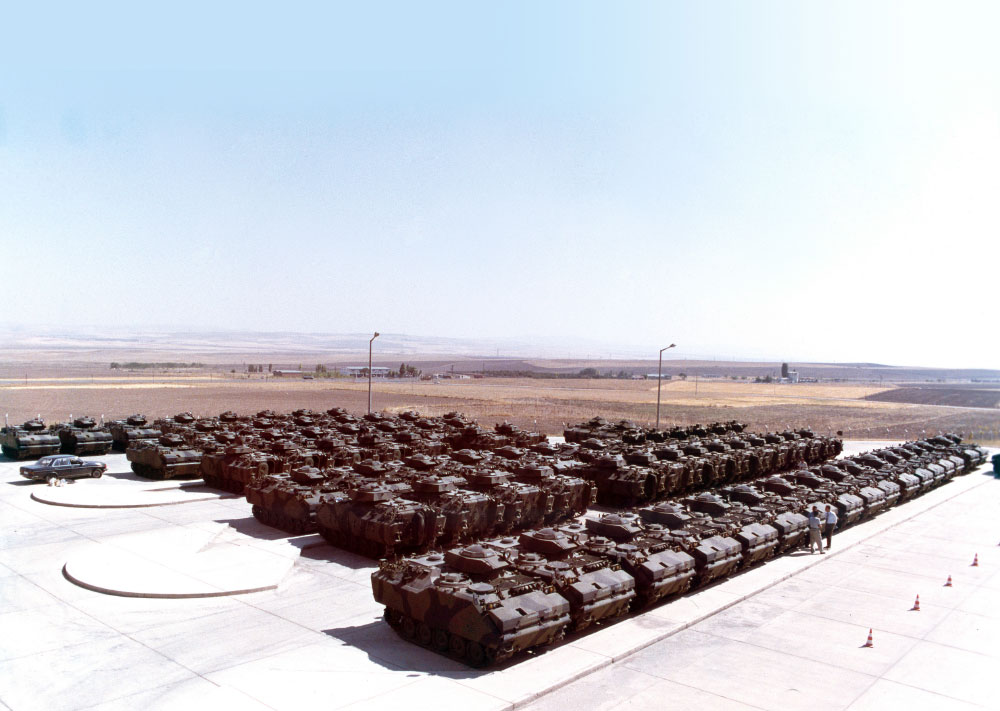
The first vehicles were delivered in 1992, and the production spanned until 1997. In 2000, an additional order was subsequently placed for a further batch of 551 vehicles in Advanced Armored Personnel Carriers (AAPC) configuration with superior survivability compared to the M113 APC. These vehicles were delivered to the Turkish Land Forces Command between December 2001 and December 2004 and armed with an externally mounted 12.7 mm M2 HB machine gun. With additional contracts, FNSS produced more than 2,000 vehicles in four different configurations by 2003. Throughout the entire program, a total of 2,249 vehicles were delivered to the Turkish Land Forces, including 1,381 Advanced Armored Personnel Carriers (AAPC), 650 Armored Infantry Fighting Vehicles (AIFV), 48 Armored TOW Vehicles (ATV), and 170 Armored Mortar Vehicles (AMV).
During the production run, several changes were made to the vehicle's armament, including different turret packages and power packs. The first 135 AIFVs were fitted with a DAF Special Products (no longer in production) one-man turret armed with an Oerlikon Contraves (Rheinmetall) 25 mm cannon and a 7.62 mm coaxial machine gun (7.62 mm MG3 machine gun built under license by MKEK). In May 1992, the AIFV specification was updated, and the turret was replaced with the French GIAT Industries (now Nexter Systems) DRAGAR one-man turret armed with a 25 mm Nexter M811 cannon and a 7.62 mm coaxial machine gun (has a traverse of 360° and elevation from - 8° to + 48°). The installation of GIAT turrets onto the vehicles started in 1997. The total order was for 515 turrets; the first 67 were delivered directly from France, while the remainder were manufactured in Turkey by NUROL Defense (turret) and MKEK (25 mm cannon).
The first batch of 200 vehicles was delivered with a power pack consisting of a 265 HP Detroit Diesel 6V-53T engine and a TX100-1A transmission. Later batches included a more powerful 300 HP diesel engine, a fully automatic Allison X200-4 transmission with 4 forward speeds and one reverse, and hydrostatic steering similar to the M113A3 power pack. Subsequently, the first 200 vehicles with 265 HP engines were upgraded with the new power packs. Unlike the YPR-765, the Belgian and Turkish vehicles use torsion bar only suspension, similar to the M113A2.
The 14-ton ACV-15 is 5.56 m long, 2.90 m wide, and has an overall height of 2.97 m. The vehicle has a standard crew of three (commander, gunner, and driver) with seating for eight combat-ready infantrymen in the troop compartment (one passenger sits between the commander and turret facing the rear, and seven are seated on bench seats at the side of the vehicle facing inwards). It is protected against heavy-caliber 14.5×114 mm armor-piercing rounds. The ACV-15 hull is completely sealed off, and the vehicle is fully amphibious without preparation, except for the retractable trim vane assembly folded on the front hull. It can reach a max speed of 6.3 km/h in water propelled by its tracks. Standard equipment includes a night vision system for the driver, a CBRN (Chemical, Biological, Radiological, and Nuclear) protection system (overpressure type), a better electrical system (24 V), and smoke grenade launchers for concealment (12 standard, 24 optional). The vehicle is also equipped with firing ports, which allow infantrymen to fire their weapons from within the vehicle.
FNSS also developed several different configurations for the export market. These vehicles were exported to United Arab Emirates (UAE), Saudi Arabia, Malaysia, Jordan, and the Philippines. The export variants include the Armored Engineering Squad Vehicle (AESV), Armored Recovery Vehicle (ARV), Armored Forward Artillery Observation Vehicle (AFOV), Armored Command & Control Vehicle, Armored Ambulance (AMEV), Armored Anti-Tank Vehicle, Armored Fire Support Vehicle, and the Armored Infantry Fighting Vehicle (AIFV). The vehicles are equipped with 12.7mm machine guns, 40mm grenade launcher cupolas, or one-man FNSS Sharpshooter turrets armed with ATK Gun Systems 25 mm M242 Chain Gun & 7.62 mm coaxial machine gun.
ACV-15 Modernization and Life Extension
The Armored Combat Vehicle (ACV) Modernization Project was launched by the Turkish Defense Industry Agency (SSB) to upgrade ACV-15s in the Turkish Armed Forces inventory. In this context, the SSB and Aselsan signed a contract worth 900 million Turkish Liras on December 31, 2019. A separate contract was also signed between FNSS and Aselsan on December 31, 2019, for prototyping, qualification activities, integration of all mission equipment, serial production, and logistics support in addition to all modernization activities.
In the first phase of the program, 133 ACVs will be upgraded with modern weapon systems and high-tech mission equipment by the main contractor Aselsan in collaboration with FNSS, the original manufacturer of the vehicles.
The vehicles will be fitted with a NEFER Unmanned Turret designed and manufactured by ASELSAN, which is armed with one 25 mm automatic cannon and a 7.62 mm coaxial machine gun, Laser Warning Receiver (LWR), YAMGOZ Close Range Surveillance System, Driver's Vision System (ADIS), Direction Finding and Navigation System, Commander-Gunner, and Driver Display Panels.
The subcontractor FNSS will carry out maintenance and repair activities and integrate HVAC (Heating, Ventilation, and Air conditioning), Fire Extinguishing, and Explosion Suppression Systems into the ACV platforms. In addition to the modern weapon systems and high-tech mission equipment, the ACV's armor and mine protection levels will also be upgraded and fitted with advanced mine-resistant seats and spall liner, significantly increasing their survivability and combat capabilities platforms on the battlefield.
Aselsan's NEFER unmanned turret is developed primarily against armored land targets. While it can be mounted on 6x6 and 8x8 wheeled or tracked vehicles, its indigenous design enables the integration of both NATO and Russian-origin weapons. Through its extensive surveillance and remote-control capabilities, NEFER enhances situational awareness of the gunner in their proximity while the vulnerability to attacks is decreased drastically.
The fully stabilized turret provides shoot-on-the-move capability allowing the crew to engage stationary and moving targets thanks to its onboard computerized fire control system and two-axis stabilized independent sight system. The NEFER turret has a traverse of 360° and elevation from -10° to +60°. Standard equipment of the turret also includes a day and night imaging system, Laser Range Finder, automatic target tracking capability, and automated ballistic calculation system. The NEFER turret provides ballistic protection Level 2 STANAG 4569 and weighs around 1800 kg when armed with a 25mm cannon and ammo. The turret can hold 200 30mm or 240 25mm rounds for the main gun and 100 12.7mm or 500 7.62mm for the coaxial machine gun.
Under the project, Aselsan and FNSS delivered the pre-prototype of the upgraded ACV-15 for testing and evaluation in October 2020, and the driving and firing tests were carried out in May 2021. Making an announcement on his social media account on April 15, 2022, the President of the Defense Industry Agency, Prof. Ismail DEMİR, stated that the first upgraded ACV-15s would be delivered to the Turkish Land Forces at the end of 2022.
In issue 105 of Aselsan Magazine (May 2020), it was shared that Aselsan, using its own resources, is also working on an unmanned technology demonstrator integrated with the AKKOR PULAT Active Protection System (APS) in addition to its Main Contractor role in the Armored Combat Vehicles (ACV) Modernization Project. According to the images shared in the magazine, an autonomous control unit, radar systems, ultrasonic sensors, and LIDARs (Laser Imaging Detection and Ranging) will be integrated into the ACV-15 as part of technology demonstration activities, and the vehicle will be transformed into an unmanned ground vehicle. Furthermore, the AKKOR PULAT APS is also planned to be fitted to the unmanned (ACV) to increase its survivability on the battlefield. Considering that the AKKOR PULAT APS intercepts projectiles 2-3m away from the vehicle, it is not known for the time being whether a more robust armor option is planned to prevent the effect of Jet (metallic penetrator produced by the shaped-charge explosion)