TÜRKİYE`S Defense Exports Reached 3,6$ Billion in First Half of 2025
Turkish Defense & Aerospace sector has achieved a significant milestone, recording exports totaling $3,603 Billion in the first six months of 2025. This marks a 25% increase compared to the same period last year, according to Secretary of Defense Industries Haluk GÖRGÜN.
SSB GÖRGÜN announced on the social media platform X that Türkiye’s defense and aerospace exports in June 2025 alone reached $623 Million, reflecting a 10.4% year-over-year increase. “Our total exports over the last 12 months have recorded a 23.1% increase, amounting to $7,454 Billion. This growth is not just a statistic but the real-world reflection of a development architecture designed with vision,” GÖRGÜN stated.
He emphasized that, in line with the Secretariat of Defense Industries (SSB)’s export strategy, the number of exporting companies has grown, and the product mix has shifted in favor of high-tech solutions.
“We are making the Turkish Defense & Aerospace Industry visible across the globe through international collaborations that are deepening not only on a regional but also on a global scale. We are reshaping an ecosystem — from large-scale companies to small and medium-sized enterprises (SMEs) — within a framework of sustainable exports, global competitiveness, and domestic production. I wholeheartedly congratulate all sector stakeholders who contribute to this success and all workers who add value through their hard work, as they account for 3% of our country’s total exports,” he added.
High-Tech, Combat-Proven, NATO-Compatible
Over the past two decades, Turkish Defence & Aerospace Industry has evolved into a globally competitive, self-sufficient defense ecosystem. It now possesses the capacity to design, develop, and manufacture a wide range of high-tech, cost-effective, and combat-proven systems that meet NATO standards. These systems meet the majority of the requirements of the Turkish Armed Forces (TAF) and are increasingly in demand internationally.
Thanks to policy initiatives spearheaded by the Türkiye’s defense and security procurement agency Secretariat of Defense Industries (SSB), Türkiye’s domestic defense sector now meets at least 80% of the TAF’s military system needs, significantly reducing foreign dependency.
June 2025 Export Performance
According to data released by the Turkish Exporters Assembly (TIM) on July 2, 2025, Turkish Defence & Aerospace Industry exported $622,9 Million in June, compared to $741,8 Million in May 2025— a monthly decline of approximately 16%. However, compared to June 2024 ($564.2 Million), exports grew by 10.4% year-over-year. The highest monthly export volume in the first half of 2025 was recorded in March, totalling $883,9 Million.
Overall, Türkiye’s defense and aerospace exports totaled around $3,603 Billion in the first half of 2025, compared to $2,882 Billion in the same period of 2024, showcasing robust growth.
Ambitious Targets for 2025 and Beyond
Following a record-breaking $7,154 Billion in exports in 2024 (including NATO and service exports), policymakers set an ambitious export target of $8 Billion for 2025. Given the current pace and anticipated second-half performance, the sector is well-positioned to exceed this goal.
At a press briefing in November 2024, Secretary of Defense Industries Haluk GÖRGÜN outlined key goals for 2025:
$7,3 Billion in exports
Sector turnover to reach $18,2 Billion
110,000 employees in the defense and aerospace workforce
Increase the domestic production rate to 82%
At the "2024 Evaluation and 2025 Goals" Press Meeting held on January 14, 2025, GÖRGÜN updated the 2025 export target and further revealed a long-term export vision:
$8+ Billion in annual defense exports by end-2025
$10 Billion annual exports within next two years
These objectives aim to position Turkey as a top-tier global defense exporter. Finally, reflecting the Turkish government’s strong backing for the sector, Türkiye’s 2025 defense and security budget, including the Defense Industry Support Fund, was set at 1,608 Trillion, a significant increase from 1,1335 Trillion in 2024.
Strategy and Sectoral Vision: 2024–2028
The 2024–2028 International Cooperation and Export Strategy Document, released under the leadership of the SSB in July 2024, along with the 2024–2028 Defense Industry Sectoral Strategy Document (published on September 17, 2024), lays out a clear vision for growth:
Sector employment, which stood at 90,969 in 2023, is expected to exceed 150,000 by 2028.
Sector turnover is projected to grow to $26 Billion.
Export volumes are targeted to reach $11 Billion, placing Turkey among the world’s top 10 defense exporters.
The strategy outlines key priorities, including:
Enhancing global competitiveness and sustainability
Developing future-oriented technologies using domestic resources
Strengthening institutional and sectoral capacity
Export Financing & DEDAS Expansion
To support this export-oriented vision, the SSB will introduce new financing models. The Government-to-Government Direct Military Sales (DEDAS) model will be expanded to reinforce collaboration with friendly and allied nations.
By the end of 2025:
A government-backed export credit mechanism will be launched to support partner countries with limited defense budgets.
Export and product development credit will be made available to domestic firms to enhance their competitiveness.
Additionally, the SSB aims to implement a total of four DEDAS projects by year-end, further institutionalizing this model as a key pillar of international defense cooperation.
With a sharp increase in exports, growing self-sufficiency, and a clear long-term strategy backed by government support, Turkish Defense & Aerospace Industry is rapidly solidifying its position as a global defense powerhouse. The sector’s strong performance in the first half of 2025 suggests that it is well on track to meet—and potentially surpass—its ambitious targets for the year and beyond.
Türkiye to Allocate 5% of GDP to Defense & Security Investments
On June 25, 2025 NATO concluded a historic Summit in the Hague, Netherlands. According to the Hague Summit Declaration, NATO leaders committed to allocating 5% of their annual Gross Domestic Product (GDP) to defence and security expenditures by 2035.
Under this new framework, Allies pledged to dedicate 5% of GDP to defense-related investments—comprising 3.5% for core defense requirements and 1.5% for defense- and security-related areas such as infrastructure and industrial development. This represents a significant increase from NATO’s previous benchmark of 2% of GDP.
In 2024, Türkiye allocated 2.13% of its GDP to defense spending. In line with the Hague Summit Declaration, Türkiye has committed to gradually increasing this figure to 5% over the next 10 years.
At the press conference that was held following the 2025 NATO Hague Summit, in response to a question from Defence Turkey magazine, “What path will Türkiye follow to increase its defence spending from 2% to 5% of GDP? President ERDOĞAN said, “As of now, over the next 10 years, the steps we take will naturally be funded from the national budget. By gradually allocating the necessary share from the national budget, we will fulfill our commitment to NATO.”
According to NATO data, Türkiye's defense and security spending stood at approximately $16,6 Billion in 2023. This figure rose by around 37% in just one year, reaching $22,7 Billion in 2024—equivalent to 2.13% of Türkiye’s GDP for that year. To achieve the 3.5% GDP target in 2024 alone, Türkiye would have needed to spend an additional $15 Billion.
As of 2024, Türkiye ranks as the world’s 17th largest economy, with a GDP of $1,323 Trillion. Meeting the 5% target will necessitate generating additional revenue through taxes or alternative financial mechanisms. A 5% allocation corresponds to approximately $66,15 Billion—a substantial sum. With this level of funding, the Turkish Armed Forces and internal security services could potentially be fully modernized within just a few years.
During 2020 – 2024 Türkiye’s Defense Exports Soar by 103%, Rises to 11th Globally
Türkiye has emerged as a major global arms exporter, more than doubling its defense exports over the past five years, according to a report from the Stockholm International Peace Research Institute (SIPRI) released on March 10, 2025.
SIPRI data revels that Türkiye’s share of global arms exports rose from 0.8% in 2015–2019 to 1.7% in 2020–2024, marking a 103% increase and positioned the country as the 11th largest arms exporter worldwide as of 2024. During 2015– 2019 Türkiye had entered the top 15 global exporters for the first time thanks to a near-doubling of its exports compared to 2010–14.
The surge in defense exports is driven by growing demand for Turkish-made unmanned aerial vehicles (UAVs), armored vehicles, weapons & munitons and naval platforms, especially in Middle Eastern, Asian, and African markets.
During this period the main recipients of Türkiye’s arms exports were the United Arab Emirates (UAE), Pakistan and Qatar. Accounting for 18% of Türkiye’s total arms exports the UAE was the largest buyer and followed by Pakistan and Qatar with 10% and 9.9% respectively.
According to the SIPRI report Türkiye exports arms around the world, with 33% going to its Middle Eastern neighbours and another 32% to states in Asia and Oceania in 2020–24. In addition, Türkiye’s exports to Europe grew by 469% and those to Africa by 296%, with Nigeria and Morocco emerging as key buyers, between 2015–19 and 2020–24. The growth in exports to Europe was largely due to transfers to Ukraine, which saw a staggering 1.460% increase.
Between 2020 and 2024, Türkiye has made significant efforts to increase its arms exports to Africa, partly to find new markets for the Turkish Defense & Aerospace Industry and partly to increase its political influence in the region. Several African states import Turkish arms (including UAVs, naval vessels, T129 ATAK Combat Helicopters, HÜRKUŞ Basic Trainer Aircraft and wheeled armoured vehicles) for reconnaissance and counterterrorism operations. Factors making Turkish arms relatively attractive to some states in the region may include avoiding geopolitical risks associated with great power competition. In West Africa alone, Türkiye and Russia each supplied 11% of the region’s total arms imports between 2020 and 2024, trailing only China and France.
BAYKAR at the Forefront of Turkish Defense Exports
Turkish Defense & Aerospace Industry achieved remarkable milestones in 2024, setting new export records and strengthening its global presence. With over 3,500 sector companies, more than 1,100 projects, an R&D budget nearing $3 Billion, a localization rate reaching 80%, and a project volume exceeding $100 Billion the industry reported $7,154 Billion in defense and aerospace exports, reflecting a 29% increase compared to 2023 and surpassing the initial target of $6,5 Billion. Turkey exported 230 different defense products to 180 countries, with over 50% of sales directed to NATO allies, 27% went to Europe, and 25% the United States. This achievement secured Turkey’s position as the 11th largest defense exporter globally. According to Secretary of Defense Industries Haluk GÖRGÜN export contracts signed in 2023 and 2024 exceeded $20 Billion in total value.
Key industry players significantly contributed to this success. BAYKAR led the sector with $1,831 Billion in exports, followed by TUSAŞ ($750 Million), ASFAT ($644 Million), MKE ($610 Million), and ARCA Savunma ($600 Million). Baykar has exported its UAVs to at least 35 countries, playing a pivotal role in conflicts in Ukraine, Libya, Azerbaijan, Burkina Faso and Sudan. According to the Center for a New American Security, Türkiye produces 65% of global UAV exports, with Baykar responsible for 60% of Türkiye’s UAV share. Over 90% of Baykar’s products are exported. Of the 3,500 firms in the defense sector, 1,600 have exported, with 169 achieving exports of $1 Million or more.
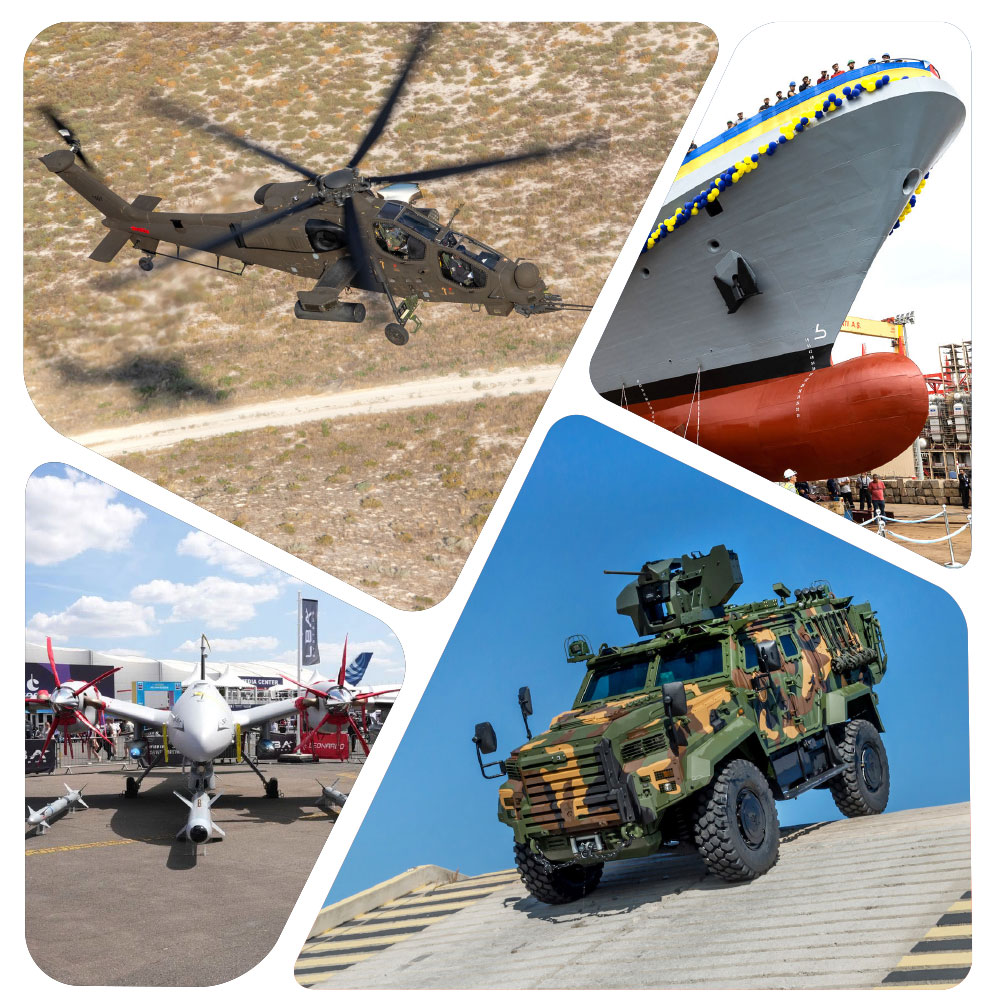
The primary export categories included unmanned aerial vehicles (UAVs), armored land vehicles, naval platforms, missile systems, electro- optical equipment, and small arms. The Turkish Defense & Aerospace Industry exported over 4,500 land vehicles to 40 countries, corvettes to 3 countries, approximately 140 naval platforms to over 10 countries, munitions and missiles to 42 countries, and UAVs, Armed UAVs, and UCAVs to over 50 countries. The industry exported electro-optical systems and stabilized weapon systems to more than 20 countries, helicopters to 8 countries, radars to 10 countries, weapons, rifles, and pistols of various sizes to 111 countries, and HÜRKUŞ aircraft to 2 countries, further expanding Türkiye’s footprint in the global defense market.
The Turkish Defense & Aerospace Industry exporting across the entire spectrum, beyond just production. According to Secretary of Defense Industries GÖRGÜN, the unit value per kilogram of UAVs exceeds $10,000. For an electro-optical system, the value is $20,000 per kilogram. The per kilogram export value of the T129 ATAK Combat Helicopter, which is one of the high added value indigenously developed platform solutions of the Turkish Defense & Aerospace Industry, is around US$10,000. With these products, Turkish Defense & Aerospace Industry provides high added value on a global scale.
Imports Decline as Türkiye Boosts Domestic Industry
While exports soared, Türkiye’s arms imports dropped by 33%, from 1.7% in 2015–2019 to 1.1% in 2020–2024. This shift reflects Turkish Government’s push to reduce dependence on foreign suppliers and expand its indigenous defense production.
Despite this decline, Türkiye continues to import key systems from Europe. According to the SIPRI report between 2020 and 2024, contributing 34% of the country’s total arms imports Spain was the largest arms supplier to Türkiye, followed by Italy (24%) and Germany (19%).
Türkiye’s Growing Strategic Influence
Türkiye’s rapid rise as a defense exporter reflects a broader strategic goal of military-industrial self-reliance and geopolitical influence. By supplying NATO standart, affordable and combat proven effective systems—such as drones and armored vehicles—to emerging markets and conflict zones, Türkiye is increasingly seen as a key player in the global arms trade.
As international tensions persist and demand for defense systems rises, Turkish Defense & Aerospace Industry is expected to continue expanding its global footprint, particularly across Africa, South Asia, and Eastern Europe