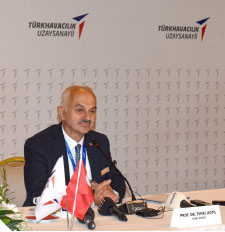
TUSAŞ President & CEO Prof. Temel KOTİL: “MMU, HÜRJET and ATAK-2 Programs Are Our priority”
Meeting with the members of the press on August 18 within the scope of the 15th International Defense Industry Fair IDEF '21, Turkish Aerospace (TUSAŞ) President & CEO Prof. Temel KOTİL gave information about the ongoing activities of TUSAŞ and leading projects such as MMU, ATAK, GÖKBEY and HÜRJET.
Underlining that as TUSAŞ, they focus entirely on National Combat Aircraft (abbreviated as MMU in Turkish), HÜRJET and ATAK-2, Temel KOTİL stated that the activities under these projects continue at full steam. KOTİL expressed that the hangar roll-out of MMU will take place March 18, 2023 and that HÜRJET and ATAK-2 will take to the skies on the same date. “
“TUSAŞ is a technology company and we develop and produce technology-oriented products. ANKA is currently in serial production, the project is almost completed. Another project is GÖKBEY. Preps for serial production of GÖKBEY are underway. I hope we will deliver 3 helicopters to the Gendarmerie General Command next year. Certification flights are currently being conducted and are about to be completed. ATAK-2 is an 11-ton class attack helicopter. The current ATAK helicopter is called T129 and it is a 5-ton class helicopter. GÖKBEY, on the other hand, is 6-ton class helicopter. Our priority now is on the T929 helicopter, which we call ATAK-2. Another project that will defend and protect our country is our National Combat Aircraft. The hangar roll-out and the first engine run will take place on March 18th,2023. HÜRJET will be ready for the take-off in 2022. HÜRJET and T929 ATAK-2 will fly on March 18, 2023, on the anniversary of Çanakkale Victory, the National Combat will be rolled out, and our T625 GÖKBEY will be delivered.”
Emphasizing that the projects conducted by TUSAŞ not only contribute to the survival of Turkey but also to the training of young engineers, KOTİL added: “
“What I have just described is the projects necessary to defend Turkey's survival, and their valuable contribution is that we recruit young engineers, train them, and give them 'on the job training'. We have now over 4000 engineers, recruiting about 1000 engineers per year. They are always given 'on the job training’. Therefore, the biggest contribution of these projects to Turkey is that at the end of the day, 10,000 engineers gain experience in making combat aircraft and helicopters. Since this has not been achieved much until now, we did not have many engineers in Turkey. As a maximum, we were bringing the experienced people from foreign countries, but they were less interested in coming to Turkey. In case of need, we also employ foreign engineers. In 5 years, these projects will be completed. Thus, Turkey has 10,000 engineers and technicians who have experiences in building combat aircraft and helicopters by having on-the-job training.”
TUSAŞ President & CEO Prof. Temel KOTİL, Executive Vice President of Aircraft Prof. Atilla DOĞAN and Executive Vice President of Unmanned Aerial Systems Ömer YILDIZ, PhD, answered the questions of the members of the press about the projects and products in the Q&A Section.
Stating that both the GÖKSUNGUR and supersonic UAV projects are in progress regarding the jet powered UAV projects, KOTİL emphasized that TUSAŞ focused primarily on ATAK-2, National Combat Aircraft (MMU) and HÜRJET rather than the UAVs. He expressed that they should complete these projects first and said, "Wait for humanoid systems from TUSAŞ., not UAVs.”
Answering the question about whether HÜRJET is suitable for use in LHD Anadolu, Executive Vice President of Aircraft Prof. Atilla DOĞAN stated that the design purpose of HÜRJET was primarily for a jet trainer and that they had made some preliminary works on this issue. DOĞAN pointed out that HÜRJET can take off with its current engine power without the need for any additional design and underlined the need for an 'arresting gear' system on board for the aircraft to land.
Answering the question about the delivery of AKSUNGUR to the Turkish Armed Forces, Executive Vice President of Unmanned Aerial Systems Ömer YILDIZ, PhD, said that the related efforts on this issue are continuing. YILDIZ also noted that AKSUNGUR, which is in the service of the General Directorate of Forestry, has flown almost 1000 hours.
Stating that the negotiations on Phase-3 are in progress within the scope of the T129 ATAK Program, Temel KOTİL said that there will be no strength related or structural change in the helicopter in Phase-3, only the equipment on it will be changed. KOTİL also added that production activities continue, planned as 2 helicopters/per month.
Touching upon the electric unmanned model of the T629, which was displayed previously in February, Prof. Temel KOTİL said that it was just a 'proof-of-concept', not a flyable version.
Answering the question about the impact of the embargoes and sanctions against Turkey on the projects, KOTİL said that the CAATSA sanctions imposed by the U.S. have no effect on the T70 Program thus so far.
Giving information about the National Combat Aircraft project, Prof. Temel KOTİL informed that special preps for MMU are in progress, 1,000 engineers are currently working on the project and this figure will increase to 3,000. “We need a lot of engineers. It requires 6,000 engineers. We currently have 1,000 engineers in the National Combat Aircraft project. That figure is reaching 3,000. We have also established our facility.”
KOTİL: “MMU Will Have Sensor Fusion”
KOTİL underlined that Sensor Fusion, which is one of the key features of the 5th Generation Fighter Aircraft, will literally be implemented in the MMU. “The MMU will have both an IRST on the nose and an EO sensor below the nose. There will be a real sensor fusion on the aircraft. The MMU/TF-X is a 5th generation fighter jet. Actions are taken step by step in aviation. As TUSAŞ, our top priority, which we think we achieved, was the correct determination of the outer body design of this aircraft. The most essential parameter of invisibility is the outer body geometry, so we have the ability to fully simulate where incoming radar waves reflect and where they reflect back. 'Load distribution' also had to be made correctly on this aircraft. Therefore, in terms of aircraft structure, subsystems and hydraulic systems, we are on the right track.”
Stating that the MMU will be produced in blocks, KOTİL also said that the PDR (Preliminary Design Review) phase is still ongoing. “The Air Forces Command as a user, and SSB and TUSAŞ as the project owners come together to make aircraft several Block Configurations. The aim of this is to fly the aircraft with certain features, not with all features, then to gain additional capabilities and afterwards to add new capabilities. We make such block configurations with the direction of the Turkish Air Forces. We should keep in mind that the MMU/TF-X is a 5th Generation fighter jet, similar to that of the U.S.’ F-22, F-35, Russian Su-57 and Chinese J-20. It is in the same class. We will of course add something new on it in time.”
“As you know, our aircraft, which will be rolled out on March 18, 2023, is to be block-I. In the meantime, we'll start the production activities for two more aircraft. Further studies are conducted regarding geometry and other features; the design will change in due course and be improved. This will be changed even after 20 years. While the PDR continues, we continue aircraft construction. We are not following the classical methodology in aircraft construction. Our focus is on the proper body geometry and the forces because these are irreversible. Hydraulic systems, pneumatic systems, fuel systems must be all appropriate; they are also irremediable.”
Temel KOTİL also gave information about TUSAŞ Composite Manufacturing Facility and stated that MMU/TF-X is a completely composite aircraft, except for certain parts: “The MMU/TF-X is a completely composite aircraft. There is also some titanium and aluminum frame inside, in other words there are load-bearing elements, but the remainder is fully composite. The autoclaves in our new composite facility will have a diameter of 6m, large enough for the aircraft whole wing. The wings will be processed in one piece. What matters is not the size of the facilities, but the technology used inside. That's why our aim is to make it a Center of Excellence in the field of composites. To achieve this, we have engineering tools and our own software. In short, we want to be a world brand in composite. We are planning to be inaugurated the composite facilities end of this year.





