WHAT IS BALTIC AIR POLICING?
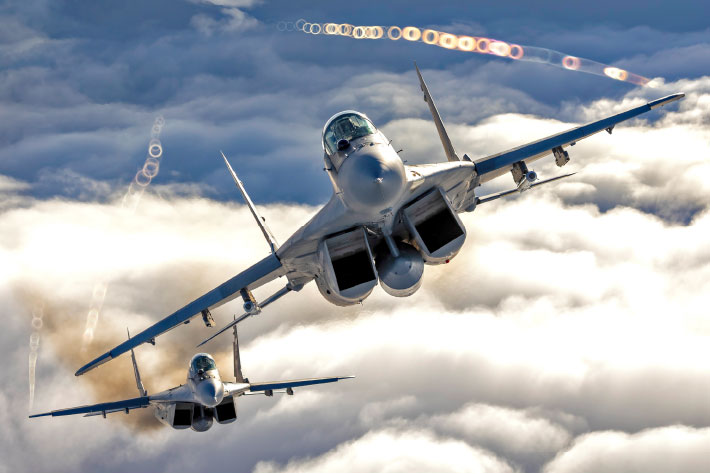
In the heart of Europe, on the coast of the Baltic Sea, between NATO and EU members Poland and Lithuania, there is a small piece of land of 223 km2 called Kaliningrad. This strategically important region is Russian territory. Kaliningrad Oblast, which has no land connection with Russia, is 370 km away from its homeland at the closest point. Of course, since there is no possibility of connection by land, both military and civilian transportation to this Oblast can only be provided by sea and air. As you can see, Russian jets generally do not use transponders, do not communicate with Air Traffic Control or prepare a flight plan when entering and leaving this region, which is surrounded by NATO and European airspace. This is where the demanding prevention activities that make up a large part of the Baltic Air Policing (BAP) Mission begin. In short, the most basic aim is to prevent Russian jets from flying in this region by waving their arms.
BAP is the result of agreements made to achieve a single standard of security in NATO/EU airspace for NATO member states that do not have the necessary air capabilities. Since the three Baltic states, Lithuania, Latvia and Estonia, which joined NATO on 29 March 2004, do not have the necessary air assets to contribute to NATO Air Command on their own soil, Alliance members provide protection to these countries through the Baltic Air Policing.
Air policing is a purely defensive mission, with 17 NATO member countries contributing to it so far. Although countries usually participate in the Air Policing mission, which is planned at a high level of readiness on a 24/7 basis, with 4 aircraft, this number can rarely go up to 6. While only 1 country was on duty in the same period until May 2014, after the 2014 crisis between Russia and Ukraine, it started to be carried out by 3 or 4 countries with 12-16 aircraft. After 2015, the number of countries varies between 1-3 and the number of aircraft varies between 4-13 according to the period. The number of personnel participating from each country also varies between 50-100.
As in the past, NATO will continue its air policing duties as long as needed to protect its airspace. For this purpose, each NATO member country will continue to show unity and solidarity, even if they come from different countries and different cultures.
ITALY DEPLOYS F-35 FIGHTERS TO POLAND IN SUPPORT OF NATO DETERRENCE AND DEFENSE
The first two Italian F-35A fighter jets arrived at Malbork Air Base on September 13, 2023. The jets - augmented by two other aircraft - will patrol the skies over the European eastern flank.
“The deployment of modern 5th generation fighter aircraft to Poland – just half a year after the end of a similar deployment by Royal Netherlands Air Force F-35 – demonstrates NATO’s ability to forward position advanced fighter capabilities in a flexible manner,” said Major General Gianluca Ercolani, Chief of Staff at Allied Air Command. “It is another proof of the fact that Allies are operating integrated by design under efficient air command and control arrangements to execute meaningful deterrence and defense along the eastern flank,” he added.
“With the offer of our 5th generation fighter aircraft to NATO, we underscore that Italy is fully committed to supporting the Alliance’s collective enduring missions”, said Lieutenant Colonel Ciro Maschione, Commander of the Italian F-35 Detachment “Task Force Air – 32° Wing”. “Since 2019, the Italian Air Force has seamlessly deployed their F-35s to NATO Air Policing and Air Shielding missions in Iceland and Estonia – as a matter of fact our Eurofighters are leading the 63rd rotation of NATO ‘s Baltic Air Policing in Lithuania in parallel to this F-35 deployment”, he added.
In the afternoon of September 21, 2023, two F-35 of the Italian Air Force Task Force Air-32nd Wing executed their first alert scramble out of Malbork Air Base, Poland under NATO orders.
NATO radars picked up the tracks of Russian aircraft flying in international airspace over the Baltic Sea close to NATO borders. Launched by NATO's Combined Air Operations Center at Uedem to investigate the incident, the Italian F-35s intercepted and identified two Russian Federation Su-30 FLANKER fighter jets which were not on a flight plan and had not contacted to Air Traffic control.
Upon identification, the F-35s escorted the Russian jets towards national Russian borders. The encounter was conducted in a professional manner and the NATO F-35/ returned to Malbork Air Base upon completion of the mission. At no time did the Russian aircraft enter NATO airspace. NATO fighter jets regularly launch for such routine missions along the Alliance’s borders e.g. on the Baltic Sea shores to keep Alliance populations and territories protected.
“During this initial period of deployment in Poland, we carried out approximately 200 hours of flight and several A-Scrambles guaranteeing the security framework required by NATO," declared the Commander of the TFA Lieutenant Colonel Ciro Maschione, “The activity conducted by the Task Force is the tangible demonstration of the operational projection capacity that the Italian Air Force and Armed Forces are able to express wherever they are called to intervene. The results obtained with the use of the fifth generation F-35 aircraft have once again testified to the leadership role that the Air Force has in the use of the valuable weapon system."
ITALIAN TASK FORCE AIR 32nd WING
The Task Force is equipped with four fifth generation F-35A Lightning II aircraft from the 6th Wing of Ghedi and the 32nd Wing of Amendola. F-35 aircraft operated by the 13th Squadron of the 32nd Wing and the 102nd of the 6th Wing are fifth geneariton, omnirole, supersonic, single-seat, single engine aircraft, capable of expressing innovative capabilities that guarantee information superiority.





