Wide Area Airborne Surveillance by ESEN
ESEN System Integration, founded in February 2012, is located in Ankara, Turkey. ESEN’s major shareholder is Reno, NV, US based Sierra Nevada Corporation (http://www.sncorp.com). ESEN is focused on the defence, aerospace and aviation industry and currently working on various projects including Intelligence, Surveillance, Reconnaissance (ISR) Systems, Image Processing and Exploitation, Remote Sensing, Homeland Security Solutions, Data Fusion and Transformation, Embedded Systems and Avionics.
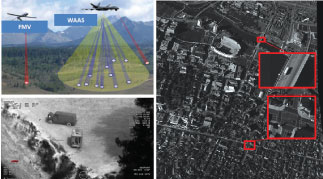
One of the challenging projects that ESEN is currently working on is Wide Area Airborne Surveillance (WAAS). WAAS is defined as the ability to provide surveillance over a city-sized region known to be associated with a specific activity in order to increase the chance of detecting and observing the activity, identify the entity, track the entity forward in real time or backwards forensically. Traditional surveillance systems provide Full Motion Video (FMV) over a small coverage area. On the other hand, WAAS systems provide very high-resolution motion imagery (low frame rate) on a city-sized area. This kind of imagery is called Wide Area Motion Imagery (WAMI).
The system, made up of multiple imaging cameras mounted on a remotely piloted or a manned aircraft, can transmit live images to soldiers on the ground or to analysts tracking enemy movements. It can send numerous images to different users; by contrast, traditional FMV today shoots video from a single camera over a "soda straw" to an area of size a building or two. Any operator subscribed to the airborne system is able to view its region of interest; in other words, this dissemination scheme provides real-time surveillance to operators and increases tactical operation’s success.
With this new technology, operators/analysts will no longer have to guess where to point the camera. WAAS systems will be looking at a whole city, so there will be no way for the adversary to know what the system is looking at.
As the coverage area of the surveillance system becomes larger, the number of targets to be detected and the intelligence data existing in the region of interest increases dramatically. Standard tracking procedures (mostly relying on video analysts) will not work on this scale due to the infeasible operator workloads. In order to cope with the requirements of WAAS systems, advanced Processing, Exploitation and Dissemination (PED) software will be needed.
WAAS system is composed of the following main components:
Airborne
Platform
WAAS Sensor Suite
Processing, Exploitation, Storage and Communication
Ground Centre
Communication
Processing, Exploitation and Dissemination (PED)
On-line Analysis
Off-line Analysis
Storage
Mobile User Terminals
ESEN is currently working on a complete WAAS solution to monitor city sized regions in real-time including the sensor suite, airborne processing and ground/mobile stations.
The WAAS system provides the following capabilities:
City sized region surveillance in real time
Surveillance of multiple high-resolution portions of the imagery
Real-time motion detection and tracking of vehicles and dismounts of the whole field of regard
Built-in and operator customizable unusual pattern/activity detection
Exploitation capabilities fitted for regional needs
Archiving data that are gathered throughout the mission (airborne and ground station achieving)
Forensic analysis on the archive
Automated real-time event management optimizing operator workloads
Ground station is the gateway for the analysts to the motion imagery and metadata and it provides the analysts with extensive exploitation capabilities. In addition to the ground station, the system is capable of streaming real-time imagery and intelligence to mobile stations in order to support tactical operations.
Just tracking targets in WAMI will not be sufficient for a successful surveillance system. As the field of view increases, the number of tracks will increase in this region so it will not be feasible for the operators to track all of these targets and produce intelligence data manually. The WAAS system will be able to track all of the identified targets and store in its database. The system automatically detects predefined signatures of the tracks and any other unusual activity. This type of tracking is called Activity Based Intelligence. Activities such as coordinated meetings; grouping/de-grouping of people and coordinated motion of people can be detected and tracked. Then these activities are further processed to produce future predictions, such as possible risks.
ESEN is planning to demonstrate first prototypes of the system at the IDEF’13 in May 2013 at Istanbul.





