50 Years Chasing The Phantom
By the 1960s, the striking power of the Türk Hava Kuvvetleri (Turkish Air Force-TURAF) was formed by the F-84 Thunderstreak and F-100 Super Saber aircraft, which were acquired through the assistance program. In addition to these, TurAF was also operating a small number of F-5 Freedom Fighter and F-104 Starfighter aircraft. Due to the problems that started in Cyprus in 1960 and the crisis that escalated with Greece after the intervention on the island in 1964, the need for a new multi-role fighter plane emerged in the early 1970s.
The acquisition of 36 F-4E Phantom II by Greece under the Peace Icarus Project in 1971, highlighted the necessity of meeting the modern and powerful aircraft need of the Türk Hava Kuvvetleri. Contract negotiations with the USA started in February 1972 and were completed in a short time, and the Peace Diamond project was launched within the same year. A total of 40 F-4E Phantom II aircraft were ordered, and the project was financed from the national budget.
With the arrival of two F-4E Phantom II (73-1016 and 73-1017) aircraft to the 1. Ana Jet Üs Komutanlığı (1th Main Jet Base Command) with US pilots on August 30, 1974, the Phantom page was officially opened in the history of Turkish aviation, and the incoming Phantoms entered service with the 113 “Tayfun” Filo (113th “Typhoon” Squadron), established the same year at Eskişehir. F-4Es were taken to the Turkish skies for the first time by Tayfun Squadron Commander Major Ergin Celasin and Captain Ziya Alemdar with the Phantom 73-1016 on September 2, 1974. Squadron personnel became combat-ready in mid-1975. With the introduction of F-4E Phantom IIs, the Weapon Systems Officer (WSO) class, which was not exist in the Turkish Air Force, was introduced and “Şimşek” (“Lightning”) Air Wing, which was established under the Squadron in 1976, began the combat readiness training of the F-4E Phantom II weapon system officers. 8 F-4E Phantoms, delivered in 1974, were assigned to the 113 Filo. Of the 32 planes that delivered in 1975, 12 were assigned to the 113 Filo, and the remaining 20 were assigned to the 112 “Şeytan” Filo (112nd “Devil” Squadron). As part of the Peace Diamond II Project, 32 F-4E Phantom II and 8 RF-4E Phantom II aircraft were ordered in total. An interesting feature of the Peace Diamond II Project is that the 5000th serial production F-4E was delivered to the Turkish Air Force with the tail number 77-0290 within the scope of this project. The 172 “Şahin” Filo (172nd “Falcon” Squadron) and the 111 “Panter” Filo (111th “Panther” Squadron) were modernized with the aircraft that had been purchased since April 1978 under the Peace Diamond II Project.
As part of the Peace Diamond III Project, 15 F-4E Phantom II aircraft were supplied from the Aircraft Maintenance and Regeneration Center (AMARC) in the USA from July 1981 to April 1984. These planes, which were purchased under the Peace Diamond III project, were assigned to the 173 “Şafak” Filo (173th “Dawn” Squadron) after painted in Southeast Asia (SEA) camouflage.
Within the scope of the Peace Diamond IV Project, 15 ex-USAF F-4E aircraft were purchased between 1984 and 1985 to replace the losses of the four Phantom squadrons. These planes were followed by 40 ex-USAF Aircraft F-4E Phantom II aircraft with Peace Diamond V Project in 1987. These aircraft were first modernized in the 131 “Ejder” Filo (131st “Dragon” Squadron) and later in the 132 “Hançer” Filo (132nd “Dagger” Squadron) at 3rd Main Jet Base Command in Konya.
In 1991, military aid was received from the USA and its allies as a result of the support given to Operation Desert Storm, launched by the US-led coalition to remove Iraq from Kuwait. In this context, as part of the Peace Diamond VI Project, 40 ex-U.S. Air National Guard Aircraft F-4E aircraft were received between 1991-1992.
Innovations coming to the Turkish Air Force with Phantoms
Phantoms caused radical changes in the Turkish Air Force as new generation aircraft. A good command of English was required for the documents (Standard Operating Procedure – SOP, Flight Manual etc.) used in both the training in the USA and in Turkey. This was given great importance in the training. The most difficult thing for the pilots assigned to the F-4 was that the aircraft was operated by two people. Pilots who had flown in a single-person fighter aircraft for many years had difficulty adapting to the sound coming from the rear cockpit. Someone else's speech surprised them. The F-4 had a specific division of labor where the pilot in front was responsible for flying the aircraft and the SSO in the back was responsible for using the weapon systems. Therefore, the biggest difficulty was experienced in this area.
With the delivery of F-4E Phantom II aircraft, modern munitions such as TV-guided AGM-65A/B Maverick air-to-ground missiles (AGM), AN/AVQ-23 Pave Spike laser targeting pods, laser-guided 500 and 2000 lb GBU-10/12 Paveway I/II and electro-optical guided 2000-pound GBU-8 HOBOS bombs were also entered to the TurAF inventory. In this way, the Turkish Air Force gained the precision strike capability against air-ground targets for the first time in its history. In addition to these modern munitions, medium-range semi-active radar homing AIM-7E Sparrow and short-range infrared heat-seeking AIM-9B/P Sidewinder missiles were started to be used for air-to-air missions. Furthermore, one of the most effective electronic countermeasures (ECM) system, ALQ-119 pods were also introduced to increase the electronic warfare capability and protect the aircraft against radar-guided surface-to-air (SAM) missiles. Thanks to the APQ-120 radar, which is considered to be the advanced technology system of its time, the F4E Phantom II can carry out interceptions day and night, in all weather conditions. Thus, the 112th and 172nd Squadrons were assigned as an all-weather fighter-interceptor squadron with Sparrow and Sidewinder missiles. 12 aircraft had TISEO (Target Identification System Electro-Optical), which could fire TV-guided electro-optical missiles 20-24 miles from the target.
The first encounter of the Turkish Air Force with air refueling was the Gulf Crisis. With the increasing tension in the region, the number of American tanker aircraft arriving at Incirlik increased rapidly. During this period, the first training of the Phantoms with American tankers began and the Squadrons began to gain air refueling experience.
Modernization made to keep up with the times
Making its maiden flight in 1958, the Phantoms represents the technology of the 1960s. Thanks to their standard APQ-120 radar system, the Phantoms successfully carried out air-to-air missions until the mid-80s. However, by the 90s, the existing F-4E Phantom II aircraft in the Turkish Air Force inventory reached high values in terms of both airframe life and flight hour rates. Eventually, they have become outdated and could not respond to current needs and threats. Turkey had two alternatives to maintain its strong military position in the region and to increase its deterrence. In line with this need, Turkey would either replace the old Phantom aircraft with a new twin-engine fighter-bomber or upgrade some of the existing F-4E Phantom II aircraft with a comprehensive modernization project to increase their service life for at least 20 more years. Turkey favored the modernization option for economic reasons. Turkey’s 30 years of experience in training, equipment, materials, repair, maintenance, and logistic support capability were also played a significant role in this decision.
The IAI solution based on the Kurnass 2000 developed for the Israeli Air Force included the replacement of the existing radar with ELTA product EL/M-2032 and the integration of AN/ALQ-178[V]3 electronic countermeasure system, MXF-484 VHF/UHF radio, HOTAS flight control system, heads-up display (HUD), integrated INS/GPS navigation system, airborne videotape recorder (AVTR), full-color multi-function displays (MFD), a new mission computer and MIL-STD-1553B data bus. Furthermore, the aircraft would gain the ability to ability to fire Popeye-I air-to-surface guided missiles (ASM) and carry ELTA EL/L-8225 electronic warfare pod.
. According to the agreement, 26 of the 54 F-4E Phantom aircraft were to be modernized in Israel, and the remaining 28 were to be upgraded in the 1st Air Supply and Maintenance Center of the Turkish Air Force located in Eskişehir. According to the agreement, Israel would provide the necessary structural and avionic modernization kits for the 28 planes to be modernized in Turkey, train Turkish engineers for avionic integration, establish a System Integration Laboratory (SIL), and transfer this laboratory to Eskişehir. Thanks to this technology transfer provided by Israel within the scope of the project, the 1st Air Supply and Maintenance Center was planned to acquire the capability to carry out the desired structural and avionic changes on the aircraft by improving the technological infrastructure of the center.
The most significant improvement that increases the strike capability of the Terminators is that the F-4E/2020 aircraft can fire Popeye missiles. The Popeye is a solid-rocket powered stand-off missile weighing 1,360 kg (3,000 lb) with a 340 kg (750 lb) blast fragmentation or 360 kg (800 lb) I-800 penetrating warhead and imaging infrared or TV guidance. It has a reported range of 100 km, depending on its launch altitude. The missile can also be controlled directly through the data link.
The first two F-4E/2020 (73-1032 and 68-0498) were delivered to the Turkish Air Force with a ceremony held on January 27, 2000.
During its 50 years adventure in Turkey, which started on August 30, 1974, Phantoms served in nine different squadrons (111,112,113,131,132,171,172,173, and 401) and introduced the Turkish Air Force to modern radar, ECM and ammunition. In addition to working with advanced weapon systems, Phantoms had another significant contribution; thanks to the Terminator modernization projects, the Turkish Air Force and Turkish Defence Industry gained unprecedented experience in system integration, product development, and their testing procedures.
Turkish Air Force celebrates the 50th anniversary of the Phantom
There is a special bond between aviation enthusiasts and Phantom in Turkey, as well as all over the world. It is not just an aircraft, it is a concept that connects people. This bond is so strong in Turkey that Phantom's nickname is Baba (Father). Those who served and flew with the Phantom trusted its so much, just like he trusted his father. The Phantom would never let you down and would bring you home safely.
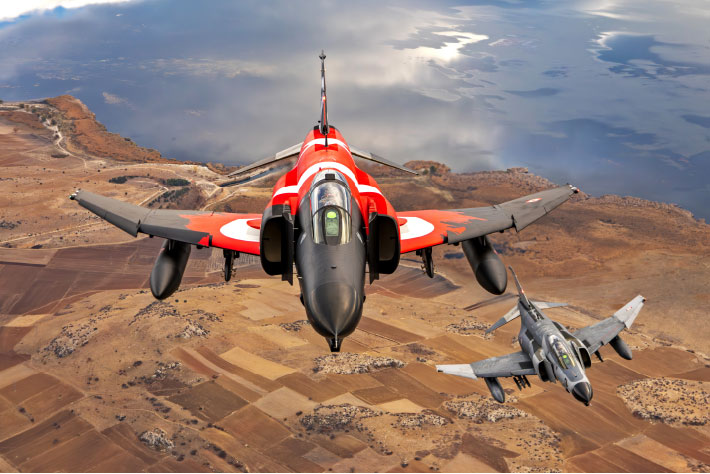
Few aircraft have served in an air force for 50 years. The Turkish Air Force celebrated the living legend's fifty years of service with a series of events. These events also include firsts for Türkiye. The first of these events was an air-to-air photography session. What makes this shoot different from previous ones is that for the first time, civilian photographers had the chance to photograph the Phantom from the open ramp of a cargo plane.
The session started with a briefing held at the 111 Filo Komutanlığı. Phantom drivers, photographers and the A400M team came together to plan the flight and shoot. The bad weather conditions were the most challenging part, it was necessary to stay below ten thousand feet in order for the cargo ramp to be open and the weather conditions in the region made this difficult. It was possible to go below the cloud in and around Lake Beyşehir, which is 160 miles from Eskişehir.
Another difficulty was that the ramp-open speed limit of the A400M and the minimum steady flight speed of the F-4E Phantom were very close to each other. Another challenging factor was adjusting the positions of both the A400M and the Phantoms without getting into each other's jet wash. This also limited maneuvers. Another disadvantage of jet wash is that it distorts the clarity of the photo. To avoid this, the Phantoms mostly flew at lower altitudes than the A400M. The shooting was carried out at a speed of 180 - 200 knots at altitudes of 8 to 10 thousand feet.
Another first was that low-level flight training was followed by photographers for the first time. There is no fixed low-level flight training area in Türkiye. Pilots use different valleys for this purpose depending on the type of mission and aircraft type. These valleys are generally in the Aegean and Eastern Anatolia. Eskişehir is a city built on a plain, it is difficult to find a valley nearby. 111 Filo personnel scanned the area to find a suitable area for photographers. The place they found was actually a water reservoir of a dam. The width and depth of the valley were ideal for both flying and photography.
Unfortunately, the weather was cloudy on the day of the shoot; the weather reports received before the flight predicted that the clouds would become suitable for flying in the afternoon. A pilot from the squadron was in the area as an observer and gave the necessary approval for the flight to begin at 14:30. With the first pass at 15:13, an unforgettable day began for aviation enthusiasts. The two Phantoms made more than 20 passes in more than half an hour. Combined with the humidity in the air and high-speed maneuvers, incredible shots were captured. There were around 350 local and foreign photographers in the region. I hope that low-level flight training will be provided for us photographers in the future.
The next day, a 50th anniversary ceremony was held at the 1. Ana Jet Üssü, Eskişehir with the participation of the Turkish Air Force Commander. More than 650 spotters and more than 30 journalists, active and retired personnel attended the event. The ceremony began with the flights of four phantoms, in which the air force commander participated.
After taking off, the Phantoms flew in various formations for half an hour and saluted the spotters upon landing. The Air Force Commander, flying in a specially painted aircraft for this ceremony, arrived at the area prepared in the parking area. Here, he was greeted by the first Turkish Phantom pilot and first Squadron commander which he was retired Air Force Commander, Ergin Celasin.
The ceremony continued in the afternoon with a flight of 4 Pahntoms. After performing various maneuvers, 6 more Phantoms were added to these planes on the ground. Spotters were saluted by performing an elephant walk with 10 planes.
Phantom took its place in Turkish skies with the first squadron established in Eskişehir 50 years ago, and now the only remaining fleet continues its duty with the 111. Filo. Phantom, which has started a new era in Turkish aviation, will continue to contribute to the country's defense for a while longer. Phantom Phorever...