A JOURNEY WITH YOUNG PEOPLE IN NATO`S DEFENSE RESEARCH ACTIVITIES
In the 1990s, during my first assignment at the Department of Defense Research under the Turkish General Staff, I was introduced to an environment where operations research, war gaming, technology monitoring, and assessment activities were integrated. Following the restructuring efforts, I personally participated in, we initiated activities to implement Scientific Decision Support Activities within the Turkish Armed Forces (TSK) under a three-phase plan, directly linked to the highest decision-making authority. I witnessed the realization of the first two phases of the plan we had envisioned (the Scientific Decision Support Branch and the Scientific Decision Support Center), and I personally worked in all positions within these structures. During this process, we not only developed the approaches and models needed for analyses aimed at meeting the TSK’s requirements but also closely followed the models, methodologies, approaches, and technologies used by international military organizations, particularly NATO, and other countries.
Established in 1952 with four panels under the names of combustion, aerospace medicine, flight testing, and instrumentation, the Advisory Group for Aerospace Research and Development (AGARD) expanded under the valuable guidance of Von Karman, reaching 200 panel members in the 1960s and updating the number of panels to nine in the 1970s, with 500 panel members. During this period, the Defense Research Group (DRG), consisting of around 500 experts actively engaged in research, development, or management in academic institutions, government agencies, or industry-related sectors, conducted activities in 11 panels. Due to the need for greater coordination and cost-effectiveness, these two core activities (AGARD and DRG panels) were merged under the NATO Research and Technology Organization, headquartered in Paris, France, in January 1998, encompassing air, land, sea, and space R&D activities under one umbrella. As a result of the NATO Reform, the NATO Science and Technology Organization (STO) was established in July 2012. In place of the NATO Underwater Research Center (NURC), the Center of Maritime Research and Experimentation (CMRE) was formed. The Research and Technology Agency (RTA), created to support STO activities, was transformed into the Collaborative Support Office (CSO).
In 1998, with the restructuring within the Turkish General Staff, defense research and technology monitoring and evaluation activities began to be monitored by the Scientific Decision Support (BİLKARDES) Branch and the Technology Monitoring and Evaluation (TİD) Branch. Applications of military operations research techniques, decision making, analysis and evaluation of concepts, concept development, optimization, etc. were carried out by the System Analysis and Studies (SAS) Panel studies by the BİLKARDES Branch, and other panel activities by the TİD Branch. The first meeting of the SAS Panel, which held its 58th meeting in Stockholm, was held in Istanbul at the Harbiye Officer's Club. In the second phase of activating scientific decision support activities in the Turkish Armed Forces, the Scientific Decision Support Center, which was established directly under the decision maker, was prepared with the aim of monitoring, evaluating and transferring to the country's needs the NATO Research and Technology Organization and the panels under it, the armament groups under the Conference of National Armaments Directorate (CNAD), and the studies under the NATO Industry Advisory Group (NIAG). This principle order revealed the importance of the activities under these three organizations and the relationship between the activities. In other words, it was stated that a need that emerged in the NATO Arms Groups was researched in the panels under the Research Technology Organization, conceptually modeled, prototyped under the NATO Industry Advisory Group and then transformed into a product. The importance of coordination and synchronization on a national basis between these three groups was underlined in the principle order.
I must express that we were not successful in adopting a holistic approach in this matter. Participation in these activities and their monitoring were unfortunately perceived more as an opportunity for international travel than as addressing a critical need, which hindered sustained participation. An exception to this, however, was my nearly uninterrupted involvement in the System Analysis and Studies Panel under the NATO Science and Technology Organization, which I previously mentioned in relation to its development in defense research, since 1998. During this process, I would like to highlight that we were part of the first group, which included countries like Canada, Germany, Italy, Norway, the Netherlands, Sweden, the United Kingdom, and the United States, determined by the level of activity and participation in panel activities. Moreover, under the leadership of esteemed Prof. Dr. Gülay Barbarosoğlu, research projects led by Turkey were carried out, such as the "Helicopter Mission Planning Decision Support System in Disasters and Military Operations," "NATO Human Resources Management," "Gamification of Cyber Defense and Resilience," "Multilayer Operations War Game," and "Participation of Generation Z and Millennials in Defense Organizations," among other technical working groups. I would also like to mention that in recent years, the heads of the working groups in the System Analysis and Studies Panel, where I once served as Deputy Chairman, were individuals under the age of 30. One of these young individuals, Mr. Levent Berke Çaplı, became the youngest "Working Group Chairman" within the Panel and was also awarded the "Early Career Analyst" Award.
Given that our country has a young population, and that the research within the NATO Human Resources Management working group revealed that the average age of personnel working in NATO institutions and organizations is quite high, the presence of our young working group leaders has brought attention to how our country, particularly its young population, can be integrated into the activities of this organization. In this context, following our discussions with other countries, a working group was established to organize a NATO Summer School, with the participation of Germany, Italy, Turkey, Croatia, and Switzerland.
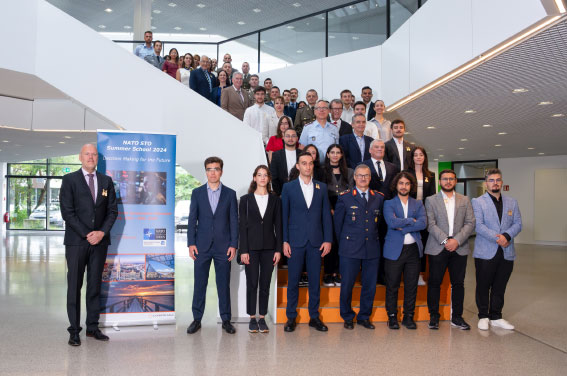
The first NATO Summer School was held from July 16 to 19, 2024, in Munich, Germany, at the Bundeswehr University Munich (Universität der Bundeswehr München), hosted by Germany, in order to conduct a simulation and evaluate its results. Selected students, particularly senior university students from the working group member countries, participated in the NATO Summer School. The Bundeswehr University provided accommodation and meals for the students, as well as offering various social and cultural activities as part of the summer school.
The main objective of the NATO Summer School was defined as increasing the presence of the younger generation in NATO research activities by providing them with educational and scientific knowledge. A diverse program was created to attract the attention of students, focusing on topics related to operations research and analysis, including an applied war game. The goal was to inform university graduates or students about the institutions and organizations within the NATO framework, their missions, interrelations, ongoing scientific and technological activities, and employment opportunities within NATO. Another goal was to engage with the students and learn, in social and cultural settings, the reasons that might be keeping them away from participating in NATO activities. In this context, a survey prepared by the working group "Participation of Generation Z and Millennials in Defense Organizations," chaired by Ms. Elçin Ada Sayın under Turkey's leadership, was also conducted at the summer school. The criterion for determining the success of the NATO Summer School will be the increased visibility of NATO in university graduates' and students' participation in NATO and NATO activities.
At the NATO Summer School, organized by the NATO Science and Technology Organization (STO) to promote collaborative research and development activities among NATO and its member countries, participants were provided with examples of the applications of model-based and data-driven operations research techniques in the defense sector. These examples included lessons on the impact of new technologies on defense, techniques to be used in military decision-making processes, and the implementation of war game applications.
The "Opening Speech" at the NATO Summer School was delivered by Major General Wolfgang Gabelein from the German Air Force, while the "Welcome Speech" was given by Colonel Matthias Kinkel from the German Army and Dr. Altan Özkil from Atılım University. Information regarding the NATO Science and Technology Organization and the NATO Summer School was provided by Prof. Dr. Stefan Pickl from the Bundeswehr University Munich and Mr. Jeroen Groenvelt.
In his opening remarks, Major General Wolfgang Gäbelein, Director of the Defense Planning Office at the Bundeswehr University, emphasized that NATO requires scientific support from top-tier technological experts to fully benefit from new technologies. He underlined the importance of the NATO Summer School by stating, "Maintaining technological superiority over adversaries requires winning the competition for talented minds."
The first lesson of the summer school, titled "Decision-Making in NATO," was delivered by Ms. Jackie Eaton, Senior Operations Research Specialist at NATO's Lessons Learned Center, based in Portugal. Her presentation covered NATO’s founding and reasons for existence, military activities within NATO, decision-making processes, and the role of the Lessons Learned Center in providing decision support for NATO’s decisions. The second lecture, "Artificial Intelligence in Military Decision-Making," was delivered by retired Major General Reinhardt Wolski from the German Armed Forces. The fourth lecture, titled "Measuring Defense Capabilities Using Commercial War Games," was presented by Dr. Zenon Mathews from Switzerland. Dr. Mathews explained capability-based defense planning, challenges in quantifying capabilities, the use of commercial war games in capability quantification, and provided an example of how procurement projects can be selected to maximize "peacetime air surveillance" and "air surveillance under tension."
On the second day of the summer school, the program began with a lecture on war games, their development and use, the benefits they provide, and the relationship between war games and decision support systems, delivered by Lieutenant Colonel Leonardo Lorusso from the Croatian Air Force. Following this, a war game called "Littoral Commander" was played, moderated by officers from the German and Croatian Armed Forces. Students were observed to participate enthusiastically in the war game. In the afternoon, Dr. Altan Özkil delivered the first lecture, titled "The Role of Operations Research, War Games, and Exercises in Military Decision-Making Processes." Dr. Özkil provided an overview of operations research, its history, methodologies, example applications of operations research methods, the tools and equipment used, the relationship and differences between war games and exercises, and the role of operations research, war games, and exercises in military decision-making processes. The final lecture of the second day, titled "Energy Security and Modern Analytics," was delivered by Prof. Dr. Daniel Nussbaum from the U.S. Naval Postgraduate School.
On the last day of the NATO Summer School, the program started with a lecture titled "Leadership and Decision-Making" delivered by retired Major General Dr. Dieter Budde from the German Armed Forces. The second lecture of the day, "The Potential and Challenges of Using Biometrics" was given by Mr. Mario Stavano, a member of the System Analysis and Studies Panel from Italy. Following this, Colonel Marijan Paljević from the Croatian Armed Forces delivered a lecture on "How NATO Membership Has Affected the Republic of Croatia" Dr. Kevin LePage, from the NATO STO Center for Maritime Research and Experimentation (CMRE), provided an introduction to CMRE’s responsibilities, operating procedures, and projects. The final lecture, "Intelligence Analysis: Systems of Non-State Actors" was given by Marina Alonso-Villota, who is conducting her PhD research at Bundeswehr University, Germany. Alonso-Villota focused on the working methods of current non-state actors who use terrorism as one of their goals, the tactics they employ, the courses of action that could be taken against them, analytical models such as the Pressure-Manipulation-Persuasion Framework, and the Non-State Actor Systems (SNSA) Tag. The NATO Summer School concluded with a closing session led by Prof. Dr. Stefan Pickl from the Bundeswehr University and Colonel Matthias Kinkel from the Bundeswehr Defense Planning Office.
In the limited time available to select students, 12 students, primarily from engineering departments, were chosen from among the 85 applicants from Turkey after interviews. Additionally, one Turkish student currently interning at the NATO Communications and Information Agency also participated, bringing the total number of participants from Turkey to 13. A significant portion of the Turkish students were double major students, and their foreign language proficiency, self-confidence, leadership qualities that stood out during the activities, enthusiasm for collaboration, and positive attitudes towards working with other students drew attention from both the NATO Summer School organizing committee and all the instructors involved in the program. Very positive feedback was received regarding the Turkish students.
Following its first trial held in Munich, Germany, the NATO Summer School initiative will be carried out in 2025 and 2026 under the leadership of Turkey, in collaboration with Germany, Italy, and Croatia, by the RLS SAS-197 group titled "NATO Summer School: Decision Making for the Future". In this context, the upcoming sessions will be conducted in Turkey, Naples (Italy), and Zagreb (Croatia). For the session to be held in Turkey, Ankara or Istanbul is being considered. Ankara is favored due to the concentration of defense industry companies in the city and the potential contributions and support that could be provided by these companies to the Summer School.
In conclusion, the NATO Summer School, hosted by the German Armed Forces from July 16 to 19, 2024, in Munich, with the participation of students from five different countries, was successfully completed, and positive feedback was received from the participating students. It is anticipated that this initiative will increase young people's interest in institutions and organizations, particularly NATO, operating within the defense industry, and ensure that these organizations attract talented minds to maintain their competitive edge