A Look at TurAF’s Aerial Refueling Aircraft Capabilitiy & Potential Candidates to Replace its Aging Tanker Fleet
Aerial refueling has always fascinated me, especially if you witness it live in the air; your amazement increases even more. It is very impressive to see two aircraft, 25,000 ft. above the ground, flying close to each other in coordination and refueling at a speed of around 600 km. They not only fly in a straight line but also maneuver together. Suppose the refueling aircraft is a big one, your excitement increases as well. When you look out the window, the refueling aircraft fills your entire field of vision. Interestingly, the Fokker C-2A, which took off on January 1, 1929, was refueled in the air for seven days by a Douglas C-1 transport aircraft. Fokker C-2A remained aloft for 150 hours and 40 minutes. During that flight, 5660 gallons of fuel and 245 gallons of oil were transferred between the two aircraft.
Today, tanker fleets are essential to keeping operations running. Without tankers, your combat aircraft cannot reach their targets. Your transport aircraft cannot deliver supplies and personnel to the other corner of the world when needed. You cannot get your injured personnel to hospitals where they can get immediate medical attention without tankers. That's why tankers are strategic aircraft.
When these aircraft were first needed, refueling was conducted by aircraft converted from propeller-driven cargo planes to aerial refueling planes. Over time, as the engines of the aircraft that needed to be refueled were replaced by jet engines and their capacities increased, the tankers available became insufficient. When the B-52 aircraft entered service, this shortcoming became more evident. Three B-52 bombers flew non-stop around the globe for 45 hours and 19 minutes as part of Operation Power Flite, a demonstration of the U.S. Strategic Air Command (SAC) fleet's intercontinental flying capacity, in 1957. This flight covered a distance of 39,152 kilometers. For this flight, 78 KC-97 Stratofreighter tanker aircraft were utilized. The KC-97 was able to carry 53 thousand pounds of fuel, while the B-52 could carry 243 thousand pounds of fuel. The search for a new jet-powered tanker aircraft started as a result of this situation. Meanwhile, Boeing launched the Boeing 367-80 project with its own funds. This was an aircraft project of the company that would be the basis for a passenger plane to be used as military cargo aircraft/tankers as well as by civil airlines. When the Air Force requested proposals from manufacturers (Boeing, Douglas, and Lockheed) for a new jet-powered tanker aircraft, only Boeing had an operational model in hand, while the others' proposals were only projects on paper. Due to the urgency, 29 KC-135s were purchased from Boeing as a temporary solution. Over time, the Air Force procured a total of 830 KC-135s, 732 of which were initially classified as "temporary." Thus, the ratio of one KC-135 to one B-52 was preserved for nearly 20 years.
The Vietnam War was the first conflict in which the strategic importance of tankers became apparent. This conflict was referred to as the "First Tanker War." In this war, combat aircraft were largely supported and operated with tankers. The Gulf Crisis, which began with Iraq's annexation of Kuwait, brought tankers' capabilities to light as well. The U.S. Air Force (USAF) tankers transported 28.2 million gallons of fuel to the Gulf region during Operation Desert Shield over the course of 4,967 sorties. The U.S. and allied tankers conducted 15,434 sorties and transported 110.2 million gallons of fuel during the course of the 43-day Operation Desert Storm, averaging 300 sorties per day.
The Turkish Air Force's (TurAF) first experience with tanker aircraft was during the Gulf Crisis. With the increasing tension in the region, the number of tanker aircraft arriving at Incirlik Base increased rapidly. During this period, the first training with the U.S. tankers began, and our squadrons started to gain experience in aerial refueling. On April 19, 1993, the 142nd Squadron began its deployment to Ghedi/Italy with 18 F-16s in order to participate in Operation Deny Flight, which was conducted between April 12, 1993, and December 20, 1995. During the operation, the 142nd Squadron flew 2,443.45 hours / 533 sorties. Flights on Combat Air Patrol (CAP) missions generally lasted between 3 to 4 hours, with a total of 5 to 6 hours in the air, traveling to and from the patrol area. During the flight, the aircraft were refueled by tankers waiting over the Adriatic Sea. (191st Squadron pilots stayed in the air for nine hours, making it the longest combat flight). On December 14, 1995, Operation Decisive Endeavor started. During this operation, the Turkish Air Force continued its air surveillance of the no-fly zone over Bosnia-Herzegovina. Air defense missions continued with attack missions against ground targets in the following period. With these operations, the Turkish Air Force participated in a multinational operation and experienced the importance of joint operations and aerial refueling. In light of these experiences, two KC-135R aircraft were first leased from the U.S. Army in 1995, followed by seven KC-135R Tanker aircraft purchased in 1997. KC-135Rs, whose primary mission was aerial refueling of F-4E Phantom II and F-16C/D Fighting Falcon aircraft, were also used to transport cargo and personnel. Up until the A400M aircraft entered the inventory, the KC-135Rs served as the backbone of the Air Transport Fleet, with the longest range and maximum payload capacity.
Current TurAF tankers were originally delivered to the U.S. Air Force in the KC-135 configuration between 1959 and 1963, decommissioned in 1993 and stored at the 309th Aviation Maintenance and Refurbishment Group (AMARG), and then modernized into the KC-135R configuration and handed over to the Turkish Air Force between December 1997 and July 1998. The KC-135R tanker aircraft in the 101st Tanker Squadron's inventory, the youngest of which is 59 years old, started to suffer from metal fatigue. The maintenance, repair, and operating costs of the aircraft are gradually increasing. KC-135R aircraft were modernized with Global Air Traffic Management (GATM) System avionics in the early 2010s. The first modernized KC-135R aircraft was delivered in April 2011, and all KC-135Rs underwent Compass Radar and Global Positioning System (Pacer-CRAG) modernization in the early 2000s. Aircraft previously went through Pacer-CRAG modernization are now being subjected to Pacer-CRAG Block 45.1 modernization in the U.S. within the framework of a recent decision. In this regard, the modernization of one KC-135R Stratotanker Aircraft has been completed in the U.S., and the other six aircraft in the fleet will be subjected to Pacer-CRAG Block 45.1 modernization. As part of the Pacer-CRAG Block 45 Avionics Upgrade Program, which is being implemented at the U.S. Air Force's Tinker Air Force Base in Oklahoma, the cockpit of the aircraft is outfitted with new liquid crystal displays, and the necessary updates for radio altimeter, autopilot, digital flight management system and other modules are made. The aircraft will be able to operate effectively until 2040 in terms of their avionic systems.
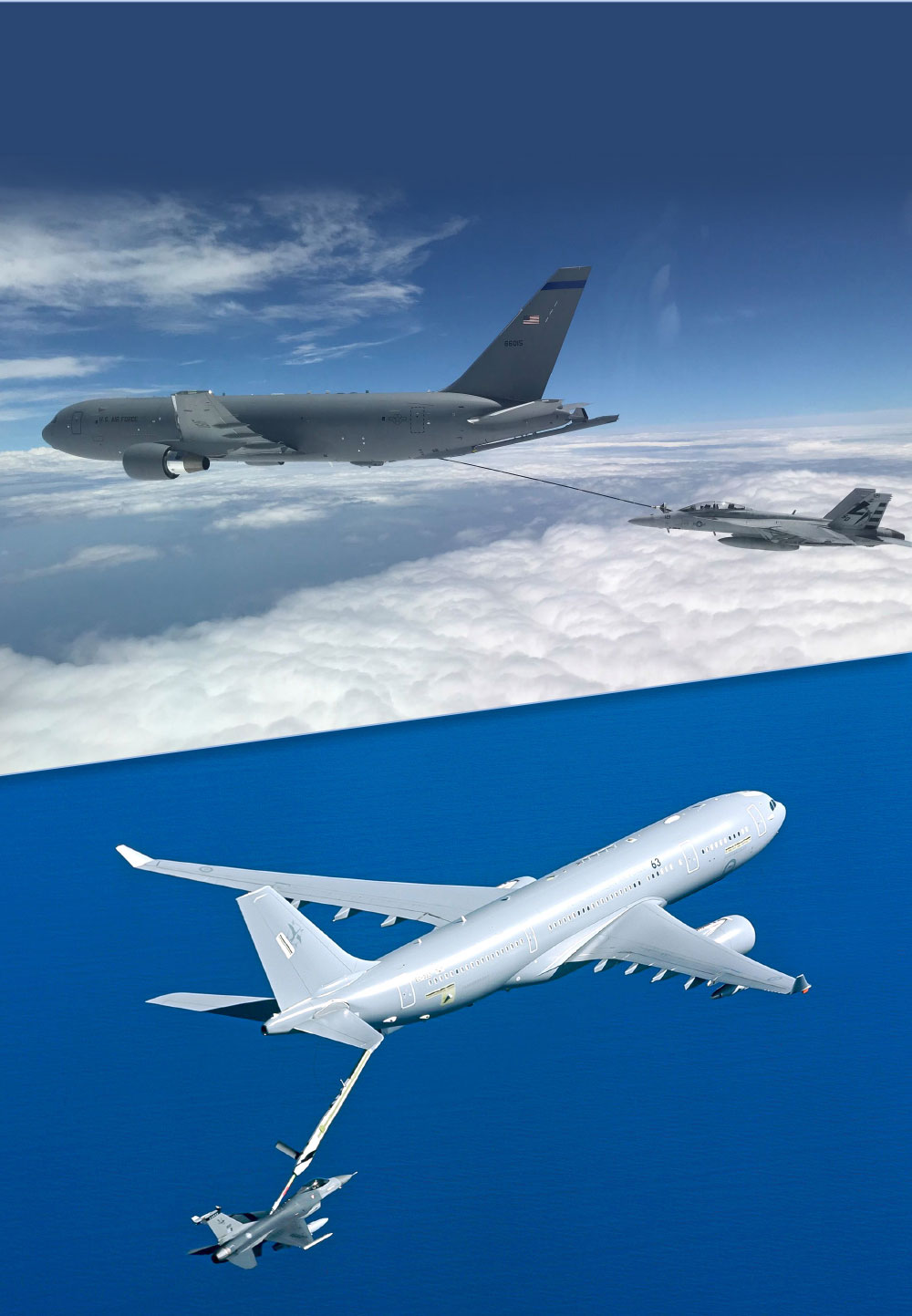
The Turkish Air Force will soon need to buy new aircraft to replace its outdated aerial refueling aircraft. The Boeing KC-46 and the Airbus A330 MRTT are the two options that are currently available on the market. Let's take a quick look at these two options.
A330 MRTT
Developed based on Airbus' popular A330-200 wide-body passenger aircraft, the A330 MRTT Multi Role Tanker Transport has an overall length of 58.80 m, a height of 17.40 m, and a wingspan of 60.3 m. It has a maximum take-off weight (MTOW) of 233 tons and a maximum landing weight (MLW) of 182 tons. It has a maximum payload/cargo capacity of 45 tons and is powered by General Electric (GE) CF6-80E1A3 (320kN) or Rolls-Royce Trent 772B (316kN) engines. The A330 MRTT can carry 111 tons of fuel with the existing fuel tanks on the wings and tail. Thanks to this structural advantage, the A330 MRTT does not need any additional fuel tanks, and there is no need to make any modifications to the fuselage. The A330 MRTT can carry up to 45 tons of additional cargo in the cabin. The A330 MRTT has the capacity of offloading 64 tons of fuel to a receiver aircraft during a 5-hour loitering mission at over 500 nm from its take-off point.
A total of 66 A330 MRTTs have been ordered so far by Australia (the first country placed its order), France, NATO, Saudi Arabia, Singapore, South Korea, the United Arab Emirates, and the United Kingdom, and 54 of them have been delivered.
The A330 MRTT can be equipped with three different refueling systems for air-to-air refueling. The first is the Cobham 905E under-wing refueling pods. Under-wing pods provide simultaneous hose and drogue refueling (Typhoon, F/A-18, etc.) and can deliver 1,300 kg of fuel per minute. The second is the Fuselage Refueling Unit (FRU), which offers higher fuel transfer capacity for aircraft with high fuel capacity, such as the A400M and C295, and can deliver 1,800 kg of fuel per minute. The third is the Aerial Refueling Boom System (ARBS, for receptacle-equipped aircraft such as F-15/F-16). Controlled by a fly-by-wire system, ARBS can deliver 3,600 kg. of fuel per minute. Unlike other tanker aircraft in service, the Fuel Operator Console, where the fuel transfer is controlled, is positioned in the cockpit (also in the same position on the KC-46A). The operator remotely manages the refueling process with the day and night vision cameras. To increase refueling safety, ARBS employs two engines that are redundant to each other, and even if one of the engines fails, the system can complete its mission with a single engine (the fuel flow rate is slightly reduced).
The Airbus A330 MRTT has become the world's first aerial tanker certified for automatic refueling after testing with the Republic of Singapore Air Force (RSAF).
As part of the Strategic Transport Mission, the A330 MRTT can also transport 40 tons of cargo and 300 military supplies to a distance of 4,500nm, 30 tons of cargo and 200 rescue personnel with their equipment to a distance of 5,500nm, and 250 people to be removed from the danger zone to a distance of 6,500nm with 20 tons of cargo.
KC-46A Pegasus
Developed from the Boeing 767 jet airliner, the KC-46A Pegasus has been under development for more than a decade and is designed to take on operations previously handled by the KC-135R Stratotanker and KC-10 Extender. It features boom and probe-and-drogue systems capable of refueling all US, allied, and coalition military aircraft in compliance with international refueling procedures. In 2011, the U.S. Air Force signed a contract with Boeing to modernize and replace its more than 60-year-old KC-135 fleet, and 179 KC-46As were decided to be manufactured at Boeing's factory in Everett, Washington.
Developed from the 767-200 wide-body passenger aircraft, the KC-46A aircraft has an overall length of 50.50 m, a height of 16.10 m, and a wingspan of 47.50 m. It has a maximum take-off weight (MTOW) of 188.2 tons and a maximum landing weight (MLW) of 140.6 tons. With 96.2 tons of fuel and 29 tons of maximum payload/cargo capacity, the aircraft uses Pratt & Whitney PW 4062 (289.13 kN) engines.
The KC-46A, just like the A330 MRTT, is equipped with three different refueling systems. With one aerial refueling pod under each wing and a drogue system under the fuselage, it can refuel aircraft utilizing the probe-and-drogue system. The Advanced Aerial Refueling Boom, which is also controlled by the fly-by-wire system under the fuselage, can refuel receptacle-equipped aircraft.
Rather than using a single boom operator seated or prone at the tail looking out a window, the Aerial Refueling Operator Station (AROS) seats two operators at a video station at the front of the aircraft. They view images from a series of multi-spectral cameras distributed around the aircraft. Due to the problems with the Remote Vision System (RVS) that feeds video to the AROS, the desired quality of the image is not obtained. The system, which cannot provide depth perception and lead to blackouts and washouts on the video displays during refueling caused by shadows or direct sunlight, hinders the boom operator's ability to perform his duty properly. The aircraft has been struggling with technical issues due to problems with the RVS, costing Boeing billions to fix and delaying its integration. To overcome all these challenges, a new version of RVS has been developed. RVS 2.0 is expected to alleviate problems in depth perception with new cameras and a full-color, high-definition screen. Boom operators with hundreds of hours of experience on older refuelers still prefer the KC-46, even with its current drawbacks. The most important reason for this is that in the old system, the position of the operator and the limitations of the aircraft made it an extremely taxing and difficult job. In the new system, the operator works in a much more comfortable setting with much more automation and significantly less workload.
The reason for these orders is that Japan is already a KC-767 user, and Israel will receive the aircraft with FMS. Despite these sales, the A330 MRTT presently dominates the tanker market since it offers a higher capacity, is more technologically advanced, and is trouble-free. A total of 7 A330 MRTT aircraft are planned to be procured for the Turkish Air Force under the project, which will be managed by Military Factory and Shipyard Management Company (ASFAT Inc.), to replace the 7 KC-135R Stratotankers already in the inventory. According to the current plan, ASFAT, on behalf of MoND, will select the 7 aircraft with the fewest engine flight hours among the A330-200 passenger aircraft in the Turkish Airlines (THY) fleet during the initial phase (there are 14 A330-200 aircraft in the fleet). After that, the first aircraft will be prepped for MRTT conversion, with the initial process expected to take six months (for example, the paint will be wiped out, and the seats in the cabin will be removed). It is expected that the structural conversion work on the aircraft will be performed at the 2nd Air Maintenance Factory Directorate with the help of technical assistance and relevant documentation to be provided by Airbus. The first A330-200 aircraft, which will undergo a 6-month transformation process to become a "green aircraft," will then be transported to Airbus Defense & Space's facilities in Getafe, located 20 km south of Madrid, the capital of Spain, for the 12-month MRTT structural transformation (conversion) work. Additionally, several Turkish staff will take part in the first aircraft's structural transformation activities at the Getafe facility and undergo on-the-job training. It is reported that the MRTT structural transformation work on the second A330-200 can be completed at Getafe facilities, if necessary, albeit still unconfirmed. However, the structural transformation work on the other five aircraft is scheduled to be completed in Turkey. THY Technic, which provides maintenance and repair services for A330-200 aircraft and their avionic systems, is also expected to take part in the structural conversion activities.
In order to ensure that the tanker aircraft, which are of strategic importance for the Turkish Air Force as in other Air Forces across the world, continue to serve flawlessly in the coming years, projects are underway both for the improvements on the existing KC-135Rs and for the new KC-330 MRTTs that will replace these aircraft in time