Anatolian Eagle 2021/2 Training Press and Distinguished Observer’s Day & MMU Project Briefing
The Press Day event of the Anatolian Eagle 2021/2 (AE-2021/2) Training was held on June 30, 2021, with the participation of nearly 160 reporters and photographers/spotters from local and foreign media organizations.
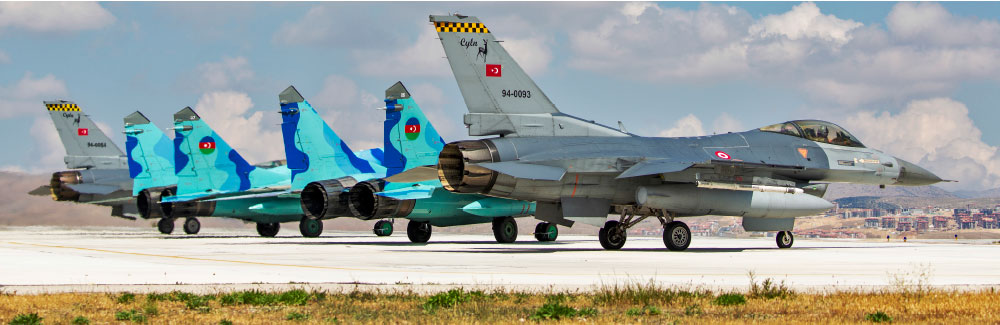
In this year’s international Anatolian Eagle 2021/2 Exercise, Azerbaijani Air Forces participated with 2x MIG-29s and 2x SU-25s, Qatar Air Force with 4x Rafale jets, Pakistan Air Force with 5x JF-17s, and NATO with 1x E-3A AWACS aircraft. Turkish Air Force attended the event with 40x F-16C/D from 6 F-16 Squadrons (including 8 F-16C/Ds from the 132nd Squadron that acted as the Aggressor Squadron), 1x E-7T Aircraft, 2x KC-135R Stratotankers, and 1x ANKA-S. Turkish Naval Forces also participated with 2x Frigates and 2x Fast Attack Crafts. Bangladesh, Belarus, Bulgaria, Burkina Faso, Georgia, Iraq, Sweden, Kosovo, Lebanon, Hungary, Malaysia, Nigeria, Romania, Tunisia, Ukraine, Oman, Jordan, and Japan also participated as observers.
According to the Commander of the Anatolian Eagle Training Center, Lieutenant Colonel Turgay TÜMER, the Anatolian Eagle Training Center is one of the three tactical training centers with similar capabilities in the world and the only tactical training center in Europe. The exercise area covers Lake Tuz (Tuz Gölü) and its surroundings with a size of 300 x 400km, enabling participant aircraft to employ their flight tactics without any limitations and without being affected by civilian air traffic (120nm x 216nm, also has a secondary 140nm x 75nm Naval Missions exercise area in the Eastern Mediterranean). Since the establishment of the center in 2001, a total of 43 training terms (24 international and 19 national) and a total of 24,222 sortie flights (38,827 hours) have been accomplished with the participation of 35,657 personnel and 2.920 aircraft from 15 countries.
At the Press Briefing of the AE-2016/2 Training, which was carried out with 1,205 personnel and 67 aircraft and the last Anatolian Eagle Exercise I followed, it was stated that since 2001 a total of 38 training terms and about 22.869 sorties (34.000 hours) had been performed with 32.367 personnel and 2.674 aircraft from 14 friendly and allied countries and NATO elements.
Within the scope of Anatolian Eagle Trainings, two separate Eagle Sorties are carried out, one in the morning and one in the afternoon. During Anatolian Eagle 2021/2 a total of 450 sorties were conducted and following joint and combined mission types were executed; Close Air Support, Anti-Surface-Air Operations (ASFAO) in Maritime Environment, Dynamic Targeting and Time Sensitive Targeting. 8 F-16C/D Aircraft from the 132nd Squadron acted as the Aggressor Squadron (Red Force/opposing force). SDT’s national ACMI (Air Combat Maneuvering Instrumentation) Pods are used on 4 of these aircraft.
During the Press Day event, first, a short briefing on AE-2021/2 Training was held in the morning by the Commander of the Anatolian Eagle Training Center, Lieutenant Colonel Turgay TÜMER, at the Anatolian Eagle Training Center (AKEM/AETC) Briefing Hall. Then, the participants went to the aircraft parking area and the runway to view the planes that would fly (Eagle sortie) within the scope of the training. After photographing the take-offs and landing of the two F-4E 2020 aircraft, we went to Kartal Cafeteria for lunch. As part of the afternoon program, the participants first watched the performance of the Janissary Band. Subsequently, a group of reporters and spotters were taken to the runway to view the landings of the planes that took off in the morning, while another group stayed in another area to watch the Solo Türk and Turkish Stars shows. After the flight demonstrations, the press briefing was started at the AKEM/AETC Briefing Hall. First, the Turkish Air Force National Combat Aircraft Program Director Colonel Cihangir YAY (he was promoted to the rank of Brigadier General as of August 30, 2021) gave a highly comprehensive presentation about the MMU/TF-X Project. Then, the 3rd Main Jet Base Commander, Brigadier General Fidan YÜKSEL, made a short speech on the AE-2021/2 Training and shared some figures with the audience. The Press Day event ended with the closing speech of Air Force Commander General Hasan KÜÇÜKAKYÜZ on Anatolian Eagle Trainings.
MMU/TF-X Project Presentation
I will briefly share the notes I took during the MMU/TF-X Project Presentation made by the Turkish Air Force National Combat Aircraft (MMU/TF-X) Program Director Brigadier General Cihangir YAY, some of which contains quite striking information that has not been shared before:
In his presentation, Brigadier General YAY emphasized that the MMU/TF-X was designed to meet the operational needs between 2030 and 2070. Stating that the System Requirements Review (SSR) Phase, which is currently in progress, is about to be completed, Brig. Gen. YAY said that the System Functionality Review (SFR) Phase would be completed by the end of 2021. Noting that the Preliminary Design Review (PDR) Phase of the project will be completed in 2023, Brig. Gen. YAY stated that they are a little behind the project schedule, but they are making great efforts to catch up (after mentioning 2022 was written in the slide he shared). With the completion of the PDR Phase, the Preliminary Design Phase of the Project will also be completed. As part of the Detailed Design and Qualification Phase, the Roll-Out ceremony of the MMU/TF-X prototype in Block-0 configuration will be held in 2023 according to the Program Plan. Subsequently, the Critical Design Review (CDR) Phase is expected to be completed in 2024. The first MMU/TF-X Blok-0 aircraft will be delivered for testing purpose in 2025, and following the ground tests the maiden flight will be performed with the first flying prototype aircraft in December 2026. As part of the Detailed Design and Qualification Phase, three Development (Prototype) Aircraft will be produced by the end of 2026 (all in Block-0 configuration). Production of MMU/TF-X Block-I Aircraft will begin in 2029 and the first flight to be executed by end of 2029. Under the IOC/FOC (Initial Operational Capability and Full Operational Capability) & Serial Production Phase, which will cover the years 2030-2040+, over 10 MMU/TF-X Block-I Aircraft will be produced between 2030-2033, and additional Blocks will be built between 2034-2040 (such as Block-2, Block-3, and Block-4, in other sources Blocks are named as Block-10/20/30/40). Meanwhile, spoke to Defence Turkey magazine during TechnoFest 2021 TUSAŞ General Manager Temel KOTİL disclosed that they have planed to perform first flight on March 18, 2025 and to perform first delivery on March 18, 2028.
During his presentation Brig. Gen. YAY also shared information on the weapon systems carried at internal and external stations of the MMU/TF-X Aircraft. Accordingly, the Air-to-Air Weapons will consist of BVR (Beyond-Visual-Range) missiles such as METEOR, AMRAAM, MICA, and GÖKDOĞAN, WVR (within-visual-range) missiles such as AIM-9X, ASRAAM, and BOZDOĞAN, and another missile named "SPEAR." Although it may be confused with the MBDA product SPEAR air-to-ground smart munition at first, since it is included in the Air-to-Air Weapon Load section, it could be an indigenous missile that is being developed with national capabilities. Speaking at the HGK-82 (Precision Guidance Kit) Delivery Ceremony held on June 24, 2021, Minister of National Defense Hulusi AKAR announced that the ramjet BVR air-to-air missile, which was officially started to be developed by TÜBİTAK SAGE a few months ago, was named GÖKHAN (that's why it is called the national METEOR Missile). The MMU/TF-X Aircraft will also feature a single-barrel internal gun. Air-to-Ground Armament of MMU/TF-X will consist of SOM-B1/B2, and SOM-J, HGK-82/83/84, KGK-82/83, LGK-82/84, Miniature Guided Bomb (MB), NEB, TEBER-82/83, GBU-10/12/24/31/38/54, Mk-82/84, and the AKBABA National Anti-Radiation Missile, that mentioned for the first time in an official presentation. The MMU/TF-X will be able to carry up to 1.000lb munitions at internal weapon bays. It will also be able to carry 370 and 600-gallon fuel tanks as well as a Reconnaissance Pod at external hardpoints.
Brig. Gen. YAY pointed out that the MMU/TF-X, which will be about the size of F-15, will have Super cruise capability (performing supersonic flight without activating the afterburner). In the presentation, it was stated that the Super cruise speed of the MMU/TF-X will be slightly lower than the 5th Generation aircraft. It was emphasized that although the maximum cruise speed of the MMU/TF-X is higher than today's ground attack aircraft, it will be lower than the average of 4th and 5th generation air superiority fighters. On the other hand, the acceleration capability of the MMU/TF-X at transonic speeds (just below or just above the speed of sound) is planned to be higher than the average of 4.5 generation aircraft. Colonel YAY pointed out that Mach 1.6 - 2.0 speeds meet the operational requirements of the Turkish Air Force (TurAF). Brig. Gen. YAY also emphasized that MMU/TF-X can perform both SEAD (Suppression of Enemy Air Defenses) and DEAD (Destruction Enemy Air Defenses) missions and shared a few slides regarding the mission scenarios.
Another important information shared during the presentation by Brig. Gen. YAY was the planned RCS (Radar Cross Section) values of MMU/TF-X. The targeted RCS value for the MMU/TF-X is -10 to -20 dBsm (0.1m2 to 0.01m2, Low Observability. "dBsm:" Radar Cross Section of the target in decibels. "RCS:" Radar Cross Section of the target in square meters). Brig. Gen. YAY stated in his speech that lower RCS would exceed their current capabilities. Since RCS = 10 (Decibels/10), the RCS value will be between 0.1m2 and 0.01m2. I spoke with experts who have extensive knowledge on the subject. They pointed out that the RCS value of 0.1/0.01m2 is reasonable and noted that if MMU/TF-X's RCS values were given as 0.00001, it would not be convincing. One of the experts said, "It is surprising that they give a figure like -10 to -20 dBsm. Even in this design, stealth disappears at 30° and 140°. In other words, it would be more believable if they gave the dBsm value between 0-20."
Taking the floor after Brig. Gen. YAY's presentation, the 3rd Main Jet Base Commander, Brigadier General Fidan YÜKSEL, gave a short speech in English on the purpose of the Anatolian Eagle Training and the participation in the AE-2021/2 Training. Stating that a total of 20 aircraft from NATO and three foreign countries, including Azerbaijan, Pakistan, and Qatar, participated in the AE-2021/2 Training, Brigadier General YÜKSEL said that the Turkish Air Force participated with a total of 44 aircraft in different roles and types. He noted that within the scope of the AE-2021/2 Training, which started on June 14, 2021 (movement of aircraft and personnel to the 3rd MJB), a total of 441 Eagle Sorts are planned (330 of which were performed by the Blue elements) and that 26 air-to-ground targets will be engaged (with 87 munitions) within this scope. Brigadier General YÜKSEL said, "We are on the 8th day of the training. We performed an important part of the planned sorties. The flights will be completed on July 2, 2021." Delivering the closing speech, Air Force Commander General Hasan KÜÇÜKAKYÜZ stated that the AE-2021/2 Training, which will be held between June 21 and July 2, 2021, was followed by 44 observer personnel from 21 countries and nearly 160 local and foreign press members (deployment of participating elements, initial briefings, and familiarization flights took place between July 14-18). Pointing out that AE Training plays a vital role in contributing to the trust and cooperation between Turkey's allies, Gen. KÜÇÜKAKYÜZ emphasized that one of the main objectives of the Anatolian Eagle Excercise is to meet the operational training needs and to increase the combat readiness of the personnel. General KÜÇÜKAKYÜZ said, "When we consider the statistics of the past years and the ongoing training, I believe that the AE exercise has achieved its purpose." Underlining that the only constant need despite the ever-changing nature of technology is trained manpower aside from the modern weapons and warfare equipment, Gen. KÜÇÜKAKYÜZ said, "The most important force multiplier of the Turkish Armed Forces (TAF) is this trained and qualified personnel." In the last part of his speech, Gen. KÜÇÜKAKYÜZ thanked the personnel of the participating countries and wished safe travels for their return.
Notes on MMU/TF-X Program
Turkey’s next generation National Combat Aircraft (abbreviated as MMU in Turkish), also known as TF-X, is a proposed single-seat, twin-engine all-weather multi-role fighter being developed by Prime Contractor Turkish Aerospace (TUSAS) with technological assistance from BAE Systems. The MMU/TF-X will replace the F-4E 2020 Phantom IIs and F-16C/D Fighting Falcon combat aircraft currently in the service of the Turkish Air Force (TurAF) during the first quarter of the 2030s. Unit cost for the prototype is estimated for US$120 Million but each series production MMU/TF-X is targeted to cost US$80 Million.
According to MMU/TF-X General Characteristics data that was released by TUSAS during PAS 2019, the aircraft would measure 21 meters in length, have a 14-meter wingspan, would be 6m in height, with a wing area of around 60sqm and a maximum takeoff weight (MTOW) of over 60.000lb (27.215kg+). To be powered by a pair of 35.000lb class indigenous turbofan engines (prototypes and first bathes series production MMU/TF-Xs are to be powered by a pair of F100-GE-129E engines, each generating 29.500lb of thrust. While first batch of 10 engines procured directly from GE, engines for the series production aircraft are expected to be assembled at TEI facilities in Eskisehir, Turkey with local content share of over 50%). The MMU/TF-X is intended to have a maximum speed of Mach 1.8, a service ceiling of 55.000ft and a combat radius of 600 nautical miles carrying four beyond-visual-range (BVR) and two within-visual-range (WVR) air-to-air missiles and internal fuel. The MMU/TF-X will be capable of pulling negative 3Gs to positive 9Gs.
Within the course of the MMU/TF-X Program, new capabilities and equipment will be added to the aircraft under a “Block Development Approach”, and in each Block, the level of local content ratio will increased. According to current road map there will be 3 years between each block. The first MMU/TF-X prototype will be in Block-0 configuration and is expected to be rolled-out on March 18, 2023. The Block-0 configuration will not feature either stealth capability or some of the main internal avionics and equipment (such as AESA radar) and various sub-systems onboard the aircraft will be procured from abroad such as turbofan engines, integrated cockpit display system (panoramic cockpit display) and landing gears.
The Block-0, Blok-I and Block-II aircraft are expected to be in 4th++ and 4.5 Generation configurations. The Block-I prototypes, that expected to feature 4.5th Generation Fighter performance and limited sensor fusion capability, will be in air superiority configuration with limited air-to-ground engagement capability. MMU/TF-X delivery to the TurAF is expected to be commenced in 2029 and the first aircraft that expected to enter TurAF service will be in Block-I configuration. The TurAF is expected to declare Initial Operational Capability (IOC) with Block-I MMU/TF-X in 2031. According to TUSAŞ (Turkish Aerospace), deliveries of first batch of 20 MMU/TF-X will be completed in 2034. In time TUSAŞ will gain the capability to manufacture two TF-X aircraft per month and a total of 24 aircraft per year. According to Presidency of Turkish Defence Industries (SSB), design activities and wind tunnel tests of the MMU/TF-X will continue in 2021 and sub-system designs will be also started.
The Block-0, Block-I (2029) and Block-II (2032) aircraft will be powered by General Electric’s F110 Turbofan Family (probably F110-GE-129E version due to twin engine configuration), and starting from Block-III (2035) the MMU/TF-X will gain true 5th Generation capabilities with indigenous 35.000lb class turbofan engines featuring stealthy exhaust nozzles for low-observability. Planned to perform its maiden flight in 2033 and to be inducted into TurAF service starting from 2035 the Block-III, 5th Generation multi-role model, will have the capability to perform a full air-to-air and air-to-ground combat missions and to feature increased local content share thanks to their indigenously developed turbofan engines, sub-systems and avionics. According to our sources the MMU/TF-X will gain Full Operational Capability by 2040.
General Electric’s F110 Turbofan Family has been selected as a stopgap solution until Turkey has built its indigenous turbofan engine for the MMU/TF-X. For the MMU/TF-X prototypes a total of 10 F110 engines have been ordered so far in two batches (5+5). A total of 7 MMU/TF-X prototypes will be manufactured, including the two aircraft for ground tests, EMI/EMC tests and radar tests. The MMU/TF-X aircraft is planned to be powered by a pair of indigenously developed turbofan engines to be developed by TR Motor Power Systems, a national engine consortium (formed by TUSAS and the SSB). According to current schedule indigenous engines will be ready for flight test in next 12 years, so first flight could only take place in 2033 on a MMU/TF-X Block-III version. TR Motor Power Systems had previously declared that the first set of indigenous turbofan engines would be ready for testing on the MMU/TF-X in 2028 and the MMU/TF-X would perform its maiden flight with indigenous turbofan engines in 2029. According to unconfirmed information that I obtained from our sources Turkey (TR Motor Power Systems) will soon sign a contract with Ivchenko Progress from Ukraine for cooperation in the development of 35.000lb class turbofan engine (dubbed TF-141) to power TF-X aircraft. On February 14, 2021 TR Motor Power Systems secured a contract from TUSAŞ for the design, development and manufacture (with technical support from Ivchenko Progress from Ukraine) of the Auxiliary Power Unit (APU) and Air Turbine Start System (ATSS) to be installed on MMU/TF-X aircraft.
Even if it will be an all-weather, multirole fighter the MMU/TF-X’s primary role would be air-superiority. Like the F-22 Raptor air superiority fighters the MMU/TF-X has both cheek and ventral (in tandem configuration) internal weapons bays. The foreground ventral internal weapon bay can hold 2 METEOR or GÖKHAN medium/long-range (BVR) air-to-air missiles and the rear ventral internal weapon bay can hold up to 4 air-to-ground munitions (up to 1.000lb in total) such as Miniature Guided Bomb (MB). Each cheek weapons bay, on the left and right of the fuselage, can hold a launcher for one short-range (WVR) air-to-air missiles such as BOZDOĞAN and AIM-9X.
The MMU/TF-X will also have new generation features including Low Observability, High Maneuverability (to be better than F-16C), Internal Weapons Bays, External Weapons Carriage (for NATO and Indigenous weapons), Increased Situational Awareness, Interoperability with AEW&C aircraft, UCAVs and AARs, Supercruise, Advanced Avionics for Sensor Fusion (5th Generation avionics suit), Intra Flight Data Link System (IFDL, to provide wide-band data-sharing [such as Radar, EOTS and IRST data] capability during flight between TF-X aircraft as in the F-35 and F-22), Link-16, Semi-Autonomous Operation Capability (semi-autonomous aircraft will provide necessary feedback to quarantine mission success to the pilot via HMDS, the TF-X will feature a capability that will ensure that even if a pilot that has died, the aircraft would be able to return to base safely thanks to Artificial Intelligence capability) and Independent Operation Capability (no need for other A/C). The aircraft will be equipped with an indigenously developed ejection seat, Star Tracker, National Data Link (ASELSAN’s T-Link in L-Band and TF-X will be able to sent/share IR, Radar and Video data via data link over SatCom), Fiber-Optic Inertial Navigation System, gallium-nitride (GaN)-based AESA Radar (ASELSAN will deliver the prototype radar in 2026), Integrated Processing Computer (Mission Computer), Infrared Search and Track (IRST) System (in front of the cockpit), Integrated EW Suit, as well as an Integrated Electro-Optical Targeting System (which is abbreviated as BEOS in Turkish and will have a similar function as the Electro-Optical Targeting System [EOTS] on the F-35), Helmet Mounted Sight System (HMDS, there is no HUD at the cockpit) and an Integrated Cockpit Display System (panoramic cockpit display) like that on the F-35 Lightning II aircraft. ASELSAN has been contracted to develop the indigenous AESA Radar, BEOS, IRST System and EW Suit. Negotiations regarding the Integrated Cockpit Display System (panoramic cockpit display) and HMDS are currently on-going. TÜBİTAK, on the other hand, has been contracted for the development of the Integrated Processing Unit (IPU, a mission computer and abbreviated as BÜİT in Turkish). Within the scope of the MMU/TF-X Program, ASELSAN also is developing the Integrated RF System (abbreviated as BÜRFİS in Turkish) for the MMU/TF-X. The indigenous IFDL System will utilize sophisticated data link design and software-defined radio technology to enable advanced communications within and among formations, or flights of TF-X aircraft. This capability significantly enhances situational awareness and operational effectiveness for TF-X pilots, providing unmatched levels of connectivity during flight operations.
If it can be implemented and realized as planned the MMU/TF-X Program would elevate Turkey into the “elite” of the handful of nations such as the USA, Russia and China who have afforded the development and production of a 5th Generation Fighter.