BIRTH OF AN AIR SUPERIORITY FIGHTER F-15
Almost 50 years after its first flight, the F-15 Eagle is still the main strike force of many Air Forces around the world. It was designed to replace its successor, the multi-role, two-seat F-4 Phantom II, at the height of the Cold War in the mid-1960s. Initially designed for interception and air superiority roles, the design of the F-15 was shaped by lessons learned from the Vietnam war. It would have a "bubble" canopy providing superior visibility, light but high-thrust F100 turbofan engines, advanced avionics, a powerful radar with look-down/shoot-down capability, and high-tech missiles. It would also incorporate a 20mm M61Vulcan gun for close air combat.
Because of its high price and capabilities, only a few countries had the permission and money to buy it. Despite its small number of users, it started to show its capabilities on the battlefield from the beginning. In 1979, Israel achieved its first aerial victory with the F-15A. After that day, the F-15 never lost its superiority in air combat. It shot down more than 100 enemy planes without any casualties. With a 108-0 kill rate, it became the world's most successful and deadliest modern fighter aircraft.
In the following years, the air-to-ground capability was added to the air-to-air capability, and the F-15E Strike Eagle was born. The F-15E started a new era in air strikes. Not only did it allow its crew to attack with high precision, but it also increased their chances of survival with its enhanced capabilities. The first serious test of the F-15E was the 1991 Gulf War. Having successfully completed its missions, the F-15E has been in service as the world's most capable strike aircraft ever since.
F-15E Strike Eagle
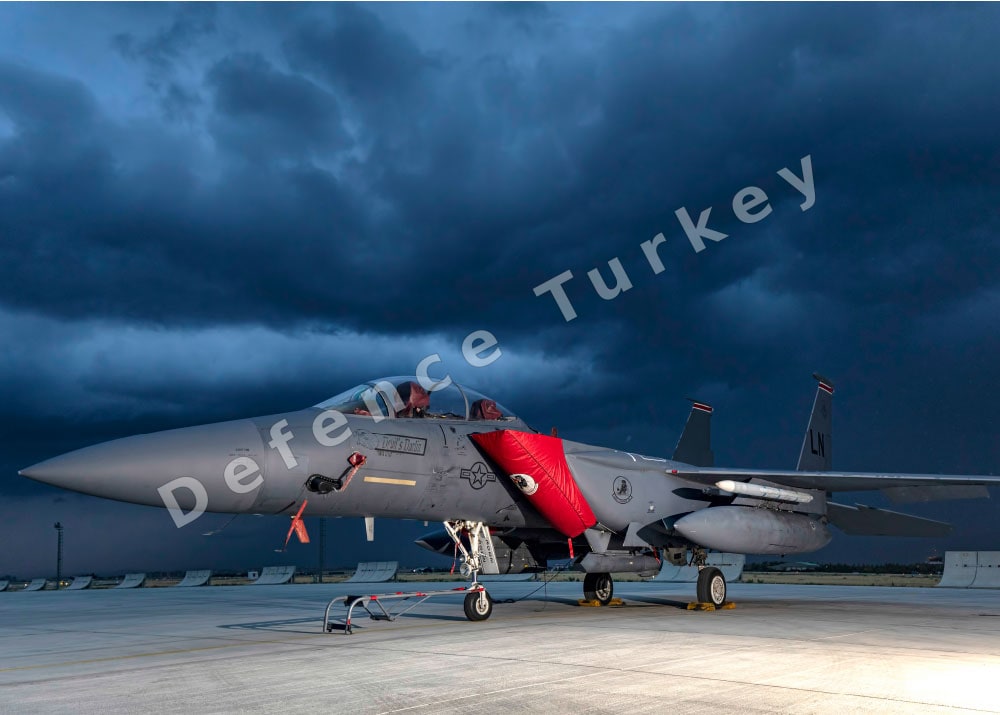
The F-15E was designed as a high-performance, all-weather, multi-role (air-to-air and air-to-ground) aircraft. The F-15E made its maiden flight on December 11, 1986. A total of 236 were produced for the U.S. Air Force. Its primary weapons for the air superiority role are the 20mm cannon along with radar and IR-guided missiles. For the air-to-ground role, the F-15E uses the LANTIRN (Low Altitude Navigation and Targeting Infrared for Night) system. The system, consisting of AAQ-13 navigation and AAQ-14 targeting pods, is mounted externally under the engine intakes. It can fly at very low altitudes day and night with the navigation pod's terrain-following capability and detect and identify targets with the aiming pod. It can attack ground targets with high-precision using different guided or unguided bombs, especially laser-guided munitions. In 2005 the AAQ-14 targeting pod was replaced by the advanced AAQ-33 Sniper targeting pod. Another feature of the F-15E is its CFTs (Conformal Fuel Tanks). Thanks to these additional fuel tanks mounted along the engine intake ramps, it can carry 1,500 US Gallons (5,600 L) of fuel internally. Each CFT also features six weapons hardpoints (in two rows of three in tandem). In this way, the range of the aircraft increases without sacrificing the number of bombs carried. With its long-range and munition capacity, the F-15E has become one of the best deep-strike aircraft in the world.
Special versions of the F-15E were also produced for non-USAF users; Israel (F-15I), South Korea (F-15K), Saudi Arabia (F-15SA), Singapore (F-15SG), and Qatar (F-15QA).
Unlike the standard F-15Es, the F-15I features different avionic systems to meet Israeli requirements. If we list them: central computer, communication systems, GPS and Inertial Navigation Systems (INS), Elisra SPS-2110 integrated airborne electronic warfare (EW) suite, Radar Warning Receivers (RWR), additional chaff/flare launchers, Elbit DASH helmet-mounted display (HMD) system, and weapons such as Python-4, Spice, Delilah, and Popeye.
The F-15K also features different subsystems from the American F-15Es. The main difference is that the F110-GE-129A engine was selected in the first batch of 40 F-15Ks. However, the second batch of 21 F-15Ks is powered by the F100-PW-229 engines like the USAF F-15Es. The AGM-84E SLAM-ER and KEPD-350K Taurus cruise missiles are the primary weapons it will use to hit North Korean targets.
The most modern and advanced version of the Strike Eagle at the time when ordered by Saudi Arabia, the F-15SA would be the basis for the F-15EX. Saudi Arabia is also upgrading the F-15S purchased between 1995-1999 to the F-15SA level. F-15SAs are equipped with the latest generation computers, radar technology, infrared sensors, and electronic warfare systems. The most important is the APG-63(v)3 Active Electronically Scanned Array (AESA) Radar. Another important feature is that the F-15SA was the Eagle's first variant with a Fly-By-Wire (FBW) system. The most significant part of this sale is that although the F-15S they bought before lacked certain capabilities (No CFT, limited radar) due to Israel's concerns, this time, they are even more capable than the current USAF F-15Es. Under the US$29.4 billion deal, Saudi Arabia bought 84 new production F-15SAs and upgraded 68 F-15Ss to the SA level. The Saudi F-15SAs use F110-GE-129C engines.
Based on the F-15SA developed for Saudi Arabia, the 36 F-15QAs ordered by Qatar are the most state-of-the-art variant of the Eagle to date. The F-15QA features the same digital FBW flight control system as the F-15SA and two significant developments over the F-15SA, the new cockpit, and structural enhancements. The F-15QA is the first Eagle to feature the new Advanced Cockpit System with Large Area Display. The F-15QA is the variant upon which the U.S. Air Force's new F-15EX will be based.
The USAF needed a new aircraft to replace the aging F-15C/D Eagles. Although the F-35 project continues, this aircraft does not fully meet the requirements. Boeing's F-15EX offer was accepted for an aircraft that will serve alongside the F-35 and replace the F-15C/Ds. The F-15EX should be seen as a complement to the F-35, not a replacement.
The F-15EX configuration boasts impressive features such as the all-glass Large Area Display (19x11 inch high-resolution screen), JHMCS II helmet-mounted display, revised inner wing structure, fly-by-wire controls, APG-82 AESA radar, and the addition of outer wing weapon stations. In addition to these features, the F-15EX has an advanced mission computer, a low-profile head-up display (HUD), updated radio and satellite communications systems, the highly advanced Eagle Passive Active Warning Survival System (EPAWSS), and Legion Pod-mounted infrared search and track (IRST) system.
The APG-82 radar will provide next-generation air-to-air and air-to-ground capabilities for F-15EX aircraft. It uses proven technologies from the Super Hornet's APG-79 and F-15C's APG-63(V)3 AESA radar systems. The APG-82 radar has the largest antenna array among existing fighters. Thus, it can detect smaller targets from a longer distance. When combined with the new mission computer, Advanced Display Core Processor II (ADCP II), with high processing power, the radar becomes one of the most advanced AESA radars in the world. Compared to the current F-15E's APG-70 radar, system reliability is increased by 20 times while offering increased range and enhanced multi-target tracking and precision strike capabilities.
Another advanced avionics component of the F-15EX is the Multifunctional Information Distribution System - Joint Tactical Radio System (MIDS JTRS). The MIDS JTRS is a 4-channel radio that runs the complex Link 16 waveform plus up to three more communication protocols, including the Tactical Targeting Network Technology (TTNT). This advanced terminal can also host and provide computer processing to run routing and platform-specific applications, lowering integration costs. Using software applications for expanded capabilities, the MIDS JTRS terminal goes beyond traditional tactical data links with greatly expanded operational effectiveness.
The advanced all-digital Eagle Passive Active Warning Survivability System (EPAWSS) provides the F-15 with fully-integrated radar warning, geolocation, situational awareness, and self-protection solutions to detect and defeat surface and airborne threats in highly contested, dense signal environments. The EPAWSS is equipped with advanced radio frequency (RF) electronic countermeasures (ECM), enabling deeper penetration against modern integrated air defense systems and providing rapid response capabilities designed to protect the aircrew. Thanks to the IR missile warning receivers on the system, it can detect all kinds of incoming missile threats.
Another sensor of the F-15EX is the infrared search and track (IRST) system known as the Legion Pod. The Legion Pod is a sensor that uses the infrared spectrum to help pilots passively range, track and intercept enemy aircraft in radar-denied environments. The pod also increases the effectiveness of the F-15EX on the battlefield by detecting enemy aircraft from previously unavailable extended ranges.
The most significant advantage of the F-15EX Eagle II against 5th Generation aircraft is its weapon carrying capacity. Thanks to the Advanced Missile and Bomb Ejection Racks (AMBER), the F-15EX will be able to carry 22 air-to-air missiles in a single sortie. Alternatively, it can carry eight air-to-air missiles and 28 Small Diameter Bombs (SDB), or seven 2,000-pound bombs and eight air-to-air missiles. Thus, the F-15EX will be able to act as a bomb truck and carry large hypersonic weapons that will not fit in the internal weapons bay of 5th Gen warplanes. Boeing has specifically highlighted this capability in its press release regarding the new Air Force contract. "The F-15EX carries more weapons than any other fighter in its class and can launch hypersonic weapons up to 22 feet long and weighing up to 7,000 pounds," the statement says.
Boeing officially delivered the first F-15EX (tail number 20-001) to the U.S. Air Force on March 10, 2021, at its facility in St. Louis, Missouri. The U.S. Air Force plans to purchase at least 144 of these planes to replace the aging F-15C/D Eagle. There are also ongoing discussions about buying more to replace the F-15E Strike Eagle. The development processes of the previous F-15SA and F-15QA models significantly reduced the production time and cost of the F-15EX. As an example, the U.S. Department of Defense (DOD) approved a plan that would allow the Air Force to save US$108 million and shorten the test program by at least one year by waiving certain survivability testing requirements for the F-15EX. Thanks to the new avionics and fuselage design, the operating cost of the F-15EX has been significantly reduced compared to the current F-15s. The hourly operating cost of the F-15EX is around US$27,000.
10% of the U.S. Air Force's current F-15C/D fleet is grounded due to structural fatigue. 75% of the fleet has exceeded its planned service life. The average age of aircraft is 37. In addition to increasing flight and maintenance costs, this situation severely reduces the overall combat readiness rates. The F-15EX is the ideal solution to quickly and economically replenish the aging Eagle fleet. Having similar radar and electronic warfare capabilities as the 5th generation aircraft minus the stealth feature, the Eagle II is an excellent alternative to the latest generation aircraft with the wide variety of munition it can carry.
The Legend of the Eagle, which started 50 years ago, can continue for another 50 years with the newly produced F-15EX, thanks to its improved service life of 20,000 hours…