FNSS Aims to Reach $500 Million Turnover as of 2018
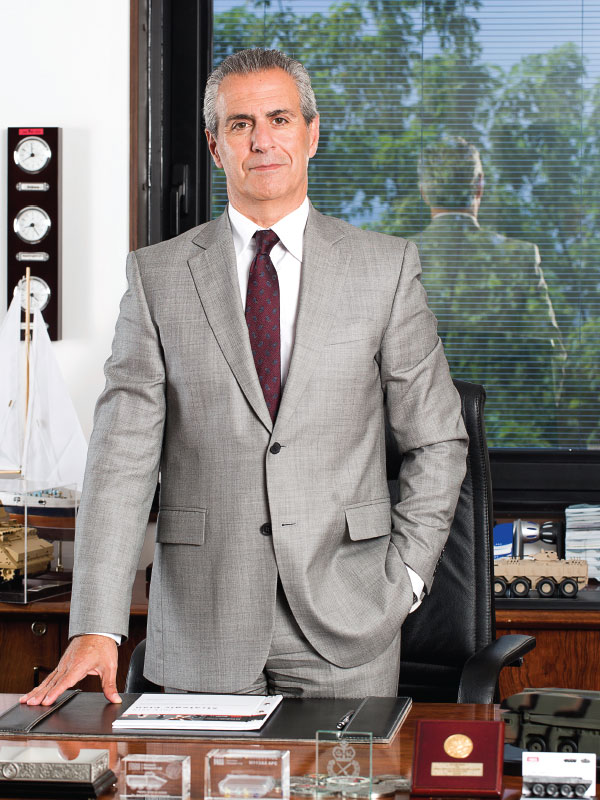
Defence Turkey: Mr. Nail Kurt, first of all I would like to thank you for your time. Can you provide us with your insight regarding FNSS in 2014 as well as updates for the first half of 2015?
I would say that in terms of growth and sales figures, our position is very positive. As FNSS, we set a 10-year strategic plan. We also have a compressed version of this strategic plan that has 3-year and 4-year projections. Now we are moving with the compressed projections. In the defence industry, it is not always possible to accomplish everything as scheduled, as delays can occur. Requirements vary, therefore slowing down decision-making, as we experienced with a couple of our projects. However, these delays will not be reflected in terms of sales for 2014 and 2015. For 2016 and 2017, our progress may be slower than our forecasted numbers, but we will continue to our growthprocess as planned.
Within the period 2006 - 2007 FNSS experienced low revenue of $ 25 - 30 million. After that point, we increased our turnover step by step. As a company, in 2014, we achieved a turnover of $220 million, while our budget was set at the $200 million level. We managed to exceed our budget expectations by 10 %; as a result, we set our 2015 budget at $ 280 million. I think we are on track by the end of the year to achieve $300 million. We have already reached our budget target in the first six months of the year, starting the year with growth and thus increasing our profitability. We are very satisfied with the financial resultsof our progress this year.
Defence Turkey: In a previous interview we had with you in 2013 you said that after 2014, you are expecting a jump in growth. We’ve left 2014 behind 2015 is almost over; as a company did you achieve the growth that you expected?
As I mentioned, we can confidently say that we did achieve this jump in 2015. Our turnover was $200 million in 2014 and we are forecasting to reach $300 million by the end of 2015. We made a jump of almost 50 %. Depending upon the contract dates we will sign, we expect to reach our $500 million budget targetfrom 2017. However, it is more likely, we will reach this figure in 2018.
Defence Turkey: We are talking about tremendous growth in a three-year period…
If you consider turnover for 2006 revenue was $25 million, we’re talking about a 20 - fold growth rate. As of 2015 we have already achieved 10 - fold growth. In those years, we realised that FNSS’s turnover rates were not desirable. In the first 15 years of FNSS, our average turnover was approximately $110 - $120 million. We have already achieved to double the average of the first 15 years.
Defence Turkey: Can you share with us the effect of domestic and international sales on the 50% jump in turnover?
A large per cent of the sales are from exports. Most of our sales are conducted in Malaysia and Saudi Arabia. In addition to this turnover, a small portion of the turnover is the Air Defence Project with Aselsan. I’d like to note that even in 2006, when our turnover was $20-30 million, exports constituted 85% of our sales.
Defence Turkey: Therefore, that makes your company Turkey’s most successful company in the field of Exports. Can you share your thoughts regarding this?
Yes, we can say that. But is this a sustainable and an ideal situation? We also need to debate this topic. To be successful, the portion of exports and local salesshould be in a 50 % balance. Maybe it would be60 % - 40 % or 55 % - 45 %. But this rate has to be up and down. Exports over 80 % may seem a great success, but it doesn’t necessarily mean that it’s a healthy success under certain circumstances. Of course, Turkey has not opened Land System projects yet. Under the requirements of the Turkish Land Forces, the “Altay” Main Battle Tank Development Program was implemented, and only recently the “Kirpi” MRAP project was brought to life. Currently we are in the tender process for the Anti-Tank Vehicle (STA) project. This bid is pending decision by the Undersecretariat for Defence Industries. The tender process for the Special Purpose Wheeled Armoured Vehicles for the upcoming years will probably be awarded as well. The Armoured Amphibious Assault Vehicle (ZAHA) program, under the program of LPD (Landing Platform Dock)is also waiting in line. Serial production of the Main Battle Tanksprogram, will be on the near future agenda. There are 4 important Land Systems projects exist in the coming period that are expected to go through the tender stage.
Defence Turkey: As these programs are activated, do you think your domestic and export sales will be in balance?
We think we can get a significant share of these programs. Therefore, this will increase our domestic sales as well.
Defence Turkey: Mr.Kurt, FNSS is especially active in the Middle East, Central Asia and in the Far East markets. As for exports in these markets, and the other markets in the world, what type of developments have happened over the last two years?
In the markets that you are referring to, there are different maturity levels, and we continue our work there. We currently have two main important topics. We are very close to finalising one and the other has already been finalised recently. At the IDEF exhibition in Turkey, in the 25 tonne class, for the Medium–Weight Tank Development Program the Joint Development Project was signed between Indonesia. For this program, we will jointly develop a Medium Weight Tank with our Indonesian partner PtPindad.We are currently in the process of receiving engineers from Indonesian to Turkey. Therefore, T+ 0 will begin this year. At the end of the joint development process, we will begin serial production orders. With our Indonesian partner, PT PindadCompany, we plan to begin joint serial production after the development phase. According to the production schedule, we have at least a 3-year time line.
Defence Turkey: What type of model will result from this program?
The first stage is aimed at joint development by gathering engineers from both companies. The Indonesian side will be more involved in determining end-users’ needs. At the same time, they will be involved in vehicle design and will receive training. The prototype workwill begin with the maturation of the design phase. According to our plans, one prototype will be built in Indonesia and one will be built in Turkey. The prototype will be built by PT. Pindad in Indonesia. During the first stage of production in Indonesia we will certainly be providing support.
Defence Turkey: What will the project schedule be like?
With the qualifications, we estimate this to be a 3-year schedule.
Defence Turkey: Mr. Kurt, Could you please provide us some insight information about export projects that you are working on?
We are competing with Turkish and international companies to capture a program in one of the Middle East countries. Our discussions continue, and if we capture this project, we can say it will be as important as our contract in Malaysia.
Defence Turkey: In Saudi Arabia and Malaysia there is a very well established domestic market. Is there an initiative to put this successful business model into practice in other countries?
This model can be implemented to other countries as well. We can implement this model in any country that desire to increase local capabilities. Our position in Saudi Arabia and in Malaysia did not occur immediately. It took a while for us to build trust and find a stable position within the country. Following the success of the first agreement, the 2nd and the 3rd contracts followed immediately. Our history with Saudi Arabia goes back approximately 11 years. In Malaysia we are approaching 15 years of history and during this process, we’ve signed four consecutive contracts. We’re now executing the fourth contract. In Saudi Arabia we’re in the fifth and sixth consecutive contracts. Because of the continuous contracts with these countries, they become our “Home Market”. These countries are very pleased to do business with us. We are also very pleased to participate with these countries which are financially a win - win situation, bringing continuity to our business.
To establish the same success with another country, we have to fulfil certain conditions. First, we must sign a large contract and we must complete that contract successfully.It certainly takes time and effort to build a new business, producing a reliable product, and success is built upon mutual respect, goodwill, good service and good pricing. After the completion of the first contractand the following contracts, new market become another “Home Market” for us. In this context, I believe, at least one other country will become a “Home Market” for us in the next 2 – 3 years.
Defence Turkey: The AV-8 program continues to deliver military vehicles to Malaysia. How is the program progressing?
The program is progressing very well. Of course, the implementation of the project was very difficult. FNSS is the main system’s manufacturer and platform provider in this program. In front of giant companies like Thales and Denel, our Malaysian partner DEFTECH is fully responsible for the execution of the project and this imposes on us a serious responsibility. I think FNSS successfully handled this challenge. We are in the third year of this program and we are on a successful path. We continue our relations with our customer. We are very happy to receive positive feedbacks from each and every levels of the customer.Deliveries started this year. We sent approximately 40 - 50 kits to Malaysia. However, there is still an on-going learning curve for DEFTECH with the production and delivery process. So far this year, 20 vehicles were delivered and put into service. By the end of the year, approximately 69 additional vehicles will be delivered. I would say that we’re ahead of our timeline. We have about 40 FNSS personnel in Malaysia providing support to DEFTECH during the production, assembly and testing processes. Deliveries will continue in 2016 - 2017. We aim to complete all deliveries in 2017.
Defence Turkey: Following the completion of the series production contract, have you declared any new requirements regarding the upcoming project?
At this size, there is a need identified for two brigade-sized vehicles. We will discuss the following opportunities when the time comes.
Defence Turkey: Mr. Kurt, will we see FNSS involvement in the Main Battle Tank in the near future?
Of course you will see it. For the Main Battle Tank development program, FNSS was in a very challenging competition, but unfortunately we lost that tender. Of course, being outside of this project, plus having prepared the prototype, in the long run it did not help our industry, the end-users, and it did not provide a benefit to FNSS. We believe that 20 years of FNSS experience should be used in Turkey’s production and development programs of tracked vehicles, providing a national benefit for Turkey. We are creating the necessary initiatives to become a major player in terms of mass production.
During ADEX Exhibition SSM Undersecretary Prof. İsmail Demir declared to press that there would soon be a competition for “Altay” serial production program. Right after SSM Land Systems Department Head gave us the directive to get prepared for the completion. Thereby we are deadly serious in our preparations to win the competition and to produce “Altay” main battle tanks. In fact, having one of the top engineering capabilities and the proven performance of mass deliveries FNSS is the most powerful candidate for being the prime for “Altay” serial programme. We believe that missing FNSS -probably the only global brand of Turkish Defence Industry- out of the program is not in favour of neither the end user nor the competitive environment.
With an expected 1.000+ units of order, the cost of “Altay” serial deliveries would exceed $10 billion in the long run.For the public good, the reasoning of the contract price shall be convincingly explainable. For us the only way to be convincing is to initiate a competition for serial production program in between the proven capable candidates. Common good here is to sustain the current competitive environment in Turkish land systems industry.
Thereby we believe that, “Altay” serial program has the potential to shape the future of the Turkish Land Systems Industry and crucial in means of its sustainability. By applying proper strategies in serial program, SSM would foster and create at least one -may be two- leader companies in global land systems sector.
Defence Turkey: Can we say that FNSS is fully prepared to shoulder the Altay mass production responsibility?
Sure, eminently. I want to remind that, up to day FNSS successfully manufactured and delivered more than 3.000 armoured vehicles, 2.249 of which delivered to Turkish Army. FNSS is definitely, by far more experienced in mass production of armoured vehicles than any other candidate in Turkey. Prototyping and serial production are different disciplines that require various infrastructure and experience. Thus, the argument that FNSS is the most appropriate company to run the “Altay” serial production program with would not be wrong.
Defence Turkey: You promoted the New Generation Tracked Armoured Fighting Vehicle “Kaplan-20 “at IDEF 2015. How is the progress with vehicle development and the testing process?
The production of the “Kaplan-20” prototype vehicle is continuing. The prototype vehicle we introduced at the IDEF exhibition was produced in a short period of time for the exhibition.We will not be using it as our test prototype. We have started the production of the test prototype. We will do our own qualification testing in the coming year. Next year we are also planning to start production of the heavier version of the “Kaplan”.
We will probably begin testing the new version in the following year.
Defence Turkey: Considering the needs of the world army, what would you like to say about this vehicle and the future market in this area?
Including Turkey, we see the need for such a vehicle in every market. As you know, until now, we had been producing 15 to 19 tonnes tracked armoured vehicles. However, these vehicles are under license of another country. We do not want to get permission from another country to be able to sell these vehicles. In this context, strategically, for FNSS, we are not planning to produce or develop ACV (Armoured Combat Vehicle) programmes. On the other hand, the original designs of the platform go back to 35 years. In this respect, it was necessary for us to look into much more modern systems, open to upgradeable electronic infrastructure and high-end design was inevitable. Consequently, the “Kaplan-20” series appeared. We have been working on this vehicle for two and a half years. We are preparing a more technologically advanced infrastructure for these vehicles.
We have seen that the world armiesshifted their requirements to heavier vehicles. The users now prefer the 20 - 25 tonne class vehicles. Also we see that some countries are using 30 tonne class vehicle. Thus, it was necessary for us to create an open architecture for the 20 tonnes class vehicle in order to grow from the original designs. We have been discussing the design of this class for 4-5 years. We started two and a half years ago and we achieved the “Kaplan-20” concept.
Within a 5 – 10 year period, Turkey, along with many other countries, are expected to define the requirements for this vehicle class. Therefore it can be readily available, with not only the electronic systems on the platform but we will continue to work on the turret systems as well. This turret can also be a modern two-man turret. If desired, it can also be an unmanned turret.
Defence Turkey: So, have you selected partner companies that will work within this program?
We have identified the power-pack companies as well as the companies that will develop the fire control systems. But we are open to any changes and any new partners that enhance the performance of the vehicle.
Defence Turkey: One of the new vehicles that was revealed at the IDEF exhibition was your PARS 4x4 vehicle. Previously FNSS had not entered the in the 4x4 class. In that context, was it only developed for the STA (Anti-tank Vehicle) program or are you planning to find a market place for the 4x4 class with different configurations?
We developed the PARS 4x4 vehicle for the Anti-Tank Vehicle (STA) programme with Nurol Machinery. We created a specific design with versatile functions and reconnaissance capabilities. Nurol Machinery signs off on each stageof the vehicle’s development. If we win this tender, Nurol Machinery will manufacture the PARS 4x4 vehicle. During the tender process, the Undersecretariat for Defence Industries decided to release the tender documents to two companies (Otokar and FNSS). Nurol Machinery is the single source for many internal security projects.The “Ejder 4x4”currently is being produced for Police Special Forces. Moreover, Nurol Machinery is producing “TOMA” Riot Control Vehicle for the police, an intervention vehicle for social events. As internal security purchases are mostly the 4x4 class from Nurol Machinery, we have a division of labour among us. In this context, Nurol Machinery will our base for 4x4 class production.FNSS or Nurol Machinery might capture the business; but manufacturing will still be done by Nurol Machinery.
Defence Turkey: Will your partnership continue in the international market?
We are very strong in many international markets.Of course, we will promote this vehicle in the international markets. On the other hand, there are current markets where Nurol Machinery is ahead; they will work effectively in those markets. As partner companies we will promote this vehicle in our active markets.
Defence Turkey: Mr. Kurt, Last June, FNSS successfully completed the qualification of the SABER One-Man Medium Calibre Turret. How do you position yourself, in that you develop weapons systems, compared with competitors in the world?
Currently in the world, there is no production of a 25mm One-Man Turret. Vehicle sizes increased. As the vehicles got bigger, the tactical requirements changed, such as the commander and sniper sitting side by side in atwo manned turrets, In small vehicles you have to use a one manned turret. This turret can be considered with the M113, for use on Armoured Combat Vehicles or on certain wheeled vehicles. With this turret, an effective ACV (Armoured Combat Vehicle) can be builtin a limited budget. There has been a transition toward using 25mm unmanned turrets, There are almost no one manned turrets in the market. I think we are unbeatable in this area. The SABER 25 turret is significantly modern version of our Sharpshooter turret. There is a serious requirement from a country in which we are currently in contact. The requested number of turrets is also very high. We have plans to go to trial in the near future for this customer.
Defence Turkey: We know that FNSS place high value and great importance to its R&D activities. You brought your R&D centre into operation in the last quarter of 2013. In the context of R&D, what advantages and gains are you seeing as a result of rapidly meeting the needs in this ever changing global environment?
In the rapidly changing global economic and industrial world, if you do not invest enough in R&D, and if not enough priority is given to the needs of this rapidly changing world, this means suicide. If R&D is used effectively, you will be much more efficient in the future. In this context, we have done our part as FNSS. In order to be open to improvements, we built a new R&D facility. We are now talking about a 650 personnel company that makes the design development and production. We have budgeted approximately 200 R&D employees by the end of the year.We have already added around 160 R&D employees to our site. When we look at the company proportionally, I think the figures look great for a company with a manufacturing capability such as ours. Nevertheless, we believe we can further improve this figure. In this R&D centre, we run product development projects for customers and also we run our own internal product development projects such as “Kaplan” by using our own resources. In addition, we run a system based joint work program with universities. We have approximately more than on-going40 R&D projects. 2 of these projects are contracted and others are financed by our own internal resources. This year, approximately $ 7-7.5 million has been allocated on R&D resources.
Defence Turkey: In the area of R&D investments are you planning to increase your available capacity in the coming period?
We can increase the capacity. The feasibility of this subject needs to be done well. I believe,we will grow financially, and the physical size of our manufacturing plant will increase our business volume, and will make many contributions to our profitability and our revenue. Meanwhile there is not much linear relationship. As a priority, we targeted to increase our profits, sales and volume. As I mentioned earlier, we do not want to grow physically without growing financially. Our approach is to work in partnership with companies of similar size or smaller. I believe,this approach needs to be utilised much more. FNSS, for the last 25 years, has been providing support to SMEs, and to our other stakeholders.We were in the forefront in this industry by sharing jobs early on. We have always seen the benefits of this approach. With this business model, as you are sharing the work while you are growing the business, also you can adjust the volume when the business is decreasing. As a single company, you can always function as growing company; however, when the business decreases it is detrimental. In the defence industry, consistency and stability are desired but not guaranteed. Therefore you have to make very careful and smart growth plans. For us, the next 5 years seem to be very bright, but after that, predictions are much more difficult. We intend to continue our growth while trying to minimise the risks of a negative scenario that may occur.
Defence Turkey: Let’s talk a little bit more about R & D projects, in 2016 will FNSS introduce a new platform and are there any system surprises for Turkey?
There are two very important products that we have shown in the recent term and we are about to complete their qualifications. If you would ask me what could be a surprise in 2016, it might be theIndonesian medium weight tank. In addition, we want to finish the qualifications of the “Kaplan” 30mm weapon system on our vehicle in 2016. Other than that, I don’t think we will see any surprise product announcements 2016. Of course surprise concepts and the use of the new systems will attract everyone’s attention once again at IDEF 2017.
Defence Turkey: Mr. Kurt, regarding niche areas for FNSS, what are your thoughts on buying small companies that produce critical technologies; and how do you approach mergers or activities abroad?
We are examining them. I can address that; within ourselves and in our strategic plan, as well as concepts, I can declare that we are open to them. Of course we’re looking to assess opportunities as they arise. It is not logical for a company like FNSS to buy one or two companies each year. Finally, we have established ourselves in Saudi Arabia as a joint venture company. This formation was indeed an important step for us. I cannot say if we will establish another joint venture later this year or if we will buy a company. Rather than buy, we tend to look for partnership with other companies. Of course, if we see an irresistible opportunity, that should not to be missed, we will evaluate and consider it.
Defence Turkey: As FNSS, you are in the social sphere, involved in many projects that raise awareness. In this context, in recent years after you participated at the first MILDESIGN 2011 competition in 2011, the second competition MILDESIGN 2015 occurred, and with a wider audience. Mr. Kurt, what would you like to say about reflections of this competition to the country about the Company? Are there also plans in future for such a competition to be done on an international scale with wider participation?
The difference between the 2015 competition and the 2011 competition was international involvement. There are between 5 - 10 experts in the world in their field globally and 4 of them were in our jury. Therefore, I think we have taken a significant step toward raising this competition to international level. Because of the high calibre jury and the significant prize awards, it attracted great attention to this competition and it attracted a lot of participation. Our team has made a serious effort for this contest. Between 5 and 10 of our personnel focused only on the competition. If you ask what is needed to enlarge this competition and reach higher attendance rates and to a wider audience; I personally made an open call to all sectors at the IDEF exhibition at the award ceremony, saying, “Come, let’s do it together, let’s make this contest on behalf of Turkey.” Unfortunately, however, we still did not get a response to this call. Of course, we will continue to make similar competition on our own as FNSS. But time will only tell if we have the power to grow this competition. We think it is very important because of the fact that we do it on behalf of Turkey. Making this bigger is not completely in our hands. The competition in 2015 had a very large attendance, above our expectations. If we wouldn’t have made pre-elimination there would have been over 300 participants. With the pre-elimination we reduced this number to 100 participants and we grouped them. Nevertheless, it was a very difficult choice. The number of participants in this competition was very reasonable and I think it added value to the competition. We left behind a successful competition. I would say that resounded throughout the world. We received incredibly nice feedback and comments. I think this has become one of the most important competitions in the world in this area. The MILDESIGN the contest-winner, I think, won’t have trouble finding a job on a global scale. In this context, we will not wait another five years. We are planning to organize a new competition in the next 3 years.
Defence Turkey: What do you think about the industrialisation of the selected designs in the competition?
In this competition we are looking for something a bit futuristic. Creative power and creative intelligence is actually considered here. We do not want to restrict the imagination of the participants. We want to expand the world of imagination. Of course, we won’t select a product that is not capable of production. There are indeed, futuristic sides in the designs. There might be a structure or model that is impossible to build at this time, but in 10 years that idea might become feasible. We just do not want to kill the ideas, we want to evaluate them, but it doesn’t mean that just because it’s a contest winning idea that we will build it immediately. You will easily understand what I mean when you look at the winning vehicles.
Defence Turkey: Mr. Kurt, we would first like to thank you for this delightful interview. Finally, do you have a message you want to convey to our readers?
First and foremost I would to thank you. We see that Defence Turkey magazine is always with us. Abroad at every fair, wherever we go you are with us. In this sense, you build our morale and in the sector, together with your distinguished colleagues, you fulfil a beautiful mission. Every sector of every industry needs the absolute power of the press. You are our strength.
I would also like to add the following. I think that Turkey’s Defence Industry is a very special sector fulfilling a very important mission. I think the Turkish defence industry’s technological know-how, infrastructure and investments, make it one of the rare sectors in Turkey. Local contributions provide significant added value in the technological sector and in this sense I think we’re ahead. I would like to mention that, with the leadership of the Undersecretariat for Defence Industries, I believe it is very important we continue with the already taken strategies. At every opportunity, I restate myself, in that we are very grateful to the Undersecretariat for Defence Industries. We wish to continue and expand these same strategies.