History of Turkish Army Aviation Command and Army Aviation School Command
The foundations of army aviation, dating back to the establishment of the Aviation Commission within the General Staff on June 1, 1911, were laid by the Land Forces Command in 1948 with the establishment of an Air Group named Artillery Aviation affiliated with the Artillery Class in Polatlı, and in 1957, the Air Group was renamed as the "Army Aviation School."
The first Army Aviator Badge was created in 1911. Subsequently, featuring two crossed cannon barrels underneath, this badge was first worn on graduates' uniforms in June 1949. By 1954, it transitioned to a gold color, and the crossed cannon barrels were removed, resulting in its current final form.
The Army Aviation School was relocated to Güvercinlik Airport in 1958, and the first Instructor Pilot Course was initiated in 1962.
The period between 1960 and 1970 holds particular significance due to the development of facilities by the Army Aviation School and the increasing integration of modern aircraft and helicopters into Army Aviation. In 1964, the Army Aviation introduced metal-bodied aircraft into its inventory with the acquisition of Dornier Do-27S and Cessna U-17S type aircraft. Following this, in 1965, training with twin-engine aircraft commenced with the deployment of Dornier Do-28 type aircraft.
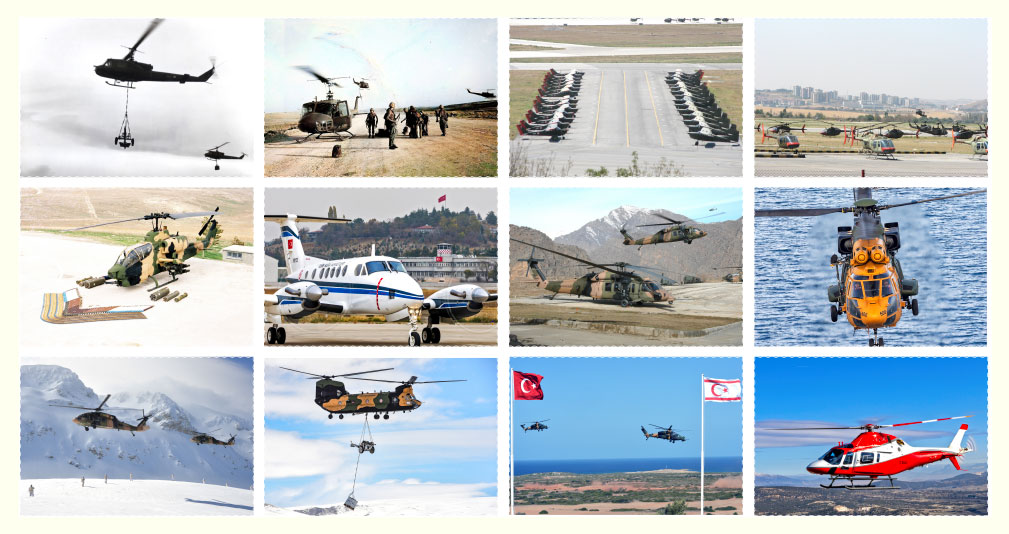
With the establishment of the Helicopter Battalion in early 1966 and the introduction of OH-13S and AB-204 (UH-1) Helicopters, the Army Aviation began to prioritize helicopter missions alongside fixed-wing operations. Subsequently, on July 16, 1966, the first Helicopter Company was formed with an initial fleet of 20 AB-204 helicopters.
OH-58A Kiowa Helicopters were introduced into the inventory in 1968. During the 1990s, these OH-58A Helicopters underwent modifications for training purposes.
The Army Aviation School Command trained only the pilots and technicians of the Land Forces Command until 1968. Since then, it has expanded its training scope to include pilots and technicians from the Gendarmerie General Command's aircraft and helicopters, as well as helicopter pilots and technicians from the Naval Forces Command and the Ministry of Interior, all meeting international standards.
The Turkish Army Aviation, which participated in the Cyprus Peace Operation on July 20, 1974, successfully completed the mission without any casualties or fatalities.
Until 1975, introductory courses in helicopters were provided to fixed-wing instructors and pilots for short durations. However, starting from this year, these courses transitioned to become basic helicopter courses.
In 1977, the Army Aviation Department was separated from the Artillery, Missile, and Aviation Department, becoming an independent department within the Turkish Land Forces.
In 1975, the first international flight missions to Greece, Italy, France, and the United Kingdom were conducted using the C-421 Aircraft.
Until December 16, 1981, the Army Aviation School conducted its flight activities at Güvercinlik Main Airbase Airport and the unpaved Sırt Airfield. Following the commissioning of the concrete-paved Temelli Airfield (Martyr Army Pilot Senior Lieutenant Gürcan ULUCAN), it started to perform its flight activities at the Temelli Airfield.
Since 1984, the Turkish Army Aviation Command has conducted numerous successful missions against separatist terrorist movements and continues to execute effective operations in the Anti-Terrorist Operations Zone with its trained pilots.
The first simulator-supported flight training program was initiated by the Simulator Flight Training Board, established within the Turkish Army Aviation School Command in 1989. Recognizing the high costs associated with aircraft-based flight training, the introduction of the UH-1H Simulator in July 1990 significantly reduced training costs, thereby making a substantial contribution to the national economy.
The 1990s were a pivotal period for Army Aviation. The introduction of advanced aircraft like the S-70 Black Hawk, AS-532 Cougar, and AH-1W Super Cobra into the inventory, along with the capability to fly using Night Vision Goggles (NVG), and their extensive use in counterterrorism operations, underscored the indispensable role of the Army Aviation Branch within the Land Forces.
In 1993, the Unmanned Aerial Vehicle Systems (İHAS) Command was established.
In 1993, Flight Training Courses with Night Vision Goggles (NVG) were initiated, enabling pilots to fly Attack Helicopters in night conditions. Additionally, the first night operation in the Anti-Terrorist Operations Zone was successfully conducted.
In 1994, the Army Aviation Command introduced an advanced Unmanned Aerial Vehicle (UAV) in the "Medium Altitude Long Endurance (MALE)" category. Initially employed for artillery reconnaissance as an extension of artillery functions, it now serves as an Intelligence, Surveillance, and Reconnaissance (ISR) platform.
In 1996, during the Kardak (Ikizce) Rocks Crisis, Army Aviation elements also participated in the operation conducted to protect our national interests. They successfully fulfilled their assigned missions by performing flights with night vision goggles under adverse weather conditions.
Since 1998, pilot and technician training has been provided to meet the needs of friendly and allied countries in accordance with international protocols signed within the scope of Military Training and Cooperation Framework Agreements.
In 1999, the Army Aviation School established a UAV Board, commencing training for personnel in various roles including UAV pilot, mission commander, mechanic technician, electronics technician, and load operator.
The Land Forces Command abolished the Army Aviation School and Training Center Command on August 15, 2003, directing that the Army Aviation School Command be affiliated with the Training and Doctrine Command.
The S-70, AS-532, and T129 Attack Helicopters were utilized in various training programs including basic, orientation, emergency, refresher, and combat readiness training, enhancing their effectiveness in combat situations. Studies are ongoing for the procurement of a CH-47F Chinook Heavy-Lift Helicopter Full Mission Simulator (FMS/TGS)
In 2006, the Army Aviation School Command was awarded SHY/JAR-66 and SHY/JAR-147 authorization certificates by the Directorate General of Civil Aviation. These certificates affirm that technicians at the Army Aviation School receive maintenance training at European standards.
Starting from 2014, the delivery of T129 ATAK Tactical Reconnaissance and Attack Helicopters, the new force multiplier of the battlefield, has started and they have been included in the establishment of the 2nd Land Aviation Regiment Command in Malatya.
In addition to the S-70 and AS-532 Helicopter simulators at the Simulator and Advanced Flight Training Command, the T129 ATAK Full Mission Simulator and two T129 ATAK Partial Mission Simulators, one for the pilot and one for the gunner, entered into service in 2019. Furthermore, the supply of a Full Mission Simulator for the CH-47 Heavy Lift Helicopter is currently underway.
In 2018, the Unmanned Aerial Vehicle Systems (İHAS) Brigade Command was established and affiliated with the Army Aviation Command.
Since 1957, the Army Aviation School Command conducted its training activities at Güvercinlik Airport. However, in 2018, it relocated to newly constructed facilities in Isparta and has been conducting training at Isparta Kılıç Airfield (next to the Süleyman DEMİREL Airport) since then.
As of 2018, the İHAS Training Board, which started to provide training at the Simulator and Advanced Flight Training Command of the Army Aviation School Command (Ankara), moved from Güvercinlik, Ankara to First Lieutenant Mehmet Şerif ŞUMNU Barracks located in Isparta in 2022.
In 2020, the Headquarters of the Army Aviation IHAS Brigade Command relocated to Güvercinlik Airport, while the 1st Army Aviation Regiment Command was moved to Isparta Kılıç Airfield.
The first T-70 Utility Helicopter planned to be supplied under the T-70 Turkish Utility Helicopter Program was delivered to the Turkish Army Aviation Command in 2022.
During the 2023 Kahramanmaraş earthquakes, Army Aviation units played a critical role in search and rescue efforts. They transported numerous supplies and relief equipment from Ankara to the earthquake zone by helicopter and actively facilitated the transfer of the wounded to undamaged hospitals in the region.
In 2023, AW119Kx New Generation Basic Training Helicopters were included in the inventory of the Army Aviation School.
The Army Aviation School Command has significantly expanded its capacity in education and training activities since its establishment. It now trains all pilots and technicians for the most advanced aircraft and helicopters in the Land Forces inventory to international standards. Additionally, it has made substantial progress in developing army aviation concepts and doctrines in line with its objectives. Furthermore, the command has become adept at producing solutions by conducting research across all functional areas necessary for the advancement of army aviation.
It has provided orientation and specialization training at international standards. The Army Aviation School Command continues its aim of increasing the power of the Land Forces Command in every field, thanks to its management and training staff with vast experience and knowledge, and the pilots and technicians it has graduated by providing them with the ability to perform the tasks expected from them day and night, under suitable weather conditions.
In line with the words of Commander-in-Chief Gazi Mustafa Kemal ATATÜRK, who famously stated, 'The Future is in the Skies,' the Army Aviation School remains dedicated to training pilots and technicians, as it has done in the past, today, and will continue to do in the future. These professionals will adeptly monitor global aviation advancements and serve tirelessly in diverse national and international environments