Steel-Winged Raiders of the Land Forces Command Turkish Army Aviators

The journey of Army Aviators, rooted in Turkish Aviation History, has significantly evolved since their inception as a distinct unit within the Land Forces Command. From crafting heroic narratives with limited resources during the Gallipoli Battles and the War of Independence, to dutifully serving during the Korean and Cyprus Peace Operations in the Republican era, and combating a separatist terrorist organization for 40 years, Army Aviators have epitomized unwavering dedication. Emerging as a prominent global force in Air Assault Operations, Turkish Army Aviators have achieved numerous successes in both domestic and cross-border missions, particularly with the deployment of T129 ATAK Helicopters.
As a striking force with high mobility and the capability to conduct uninterrupted operations, day and night, in all weather conditions and terrains, as well as in mixed and joint operations and in high-threat environments, the Army Aviation Command has been serving as one of the main subordinate units of the Turkish Land Forces Command since its restructuring in 2003.
The vision of the Army Aviation Command, a big family consisting of well-trained pilots, flight technicians, mission crews, and other personnel, is to maintain readiness for war at all times, marked by high morale and a profound dedication to their homeland.
We had the opportunity to meet with Brigadier General Zeynel Abidin ERGİNBAŞ, Commander of Army Aviation, to discuss the latest developments in Turkish Army Aviation as it commemorates its 113th anniversary this year, as well as its future activities.
Defence Turkey: Since its inception in 1911, Turkish Army Aviation has undergone significant evolution, particularly with the formation of the Army Aviation Command in 2003. Could you provide an overview of Turkish Army Aviation's development since its inception? What key stages has Turkish Army Aviation undergone, what operations has it been involved in, and which aircraft have been part of Turkish Army Aviation's inventory?
Brigadier General Zeynel Abidin ERGİNBAŞ: The origins of Turkish Army Aviation trace back to the establishment of the Aviation Commission within the General Staff on June 1, 1911.
Closely following global military developments, the Land Forces Command established an "Air Group" known as "Topçu Tayyareciliği" within the Artillery Corps in Polatlı in 1948, thereby laying the groundwork for what would become today's modern Army Aviation. In 1957, the Air Group was renamed the "Army Aviation School.”
Following the transfer of civil air transportation services from Ankara Güvercinlik Airport, the country's first airport, to Esenboğa Airport, its second fully equipped international airport, in 1955, the Army Aviation School relocated from Polatlı to Ankara Güvercinlik Airport in 1958.
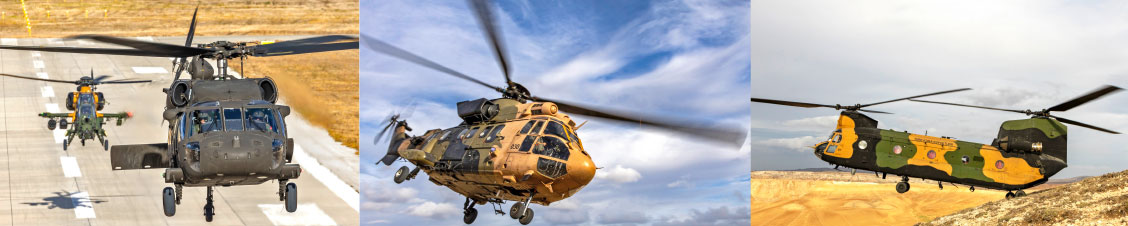
The introduction of the AH-1W in 1990, the AH-1P in 1992, and the T129 ATAK Attack Helicopters in 2014 played a critical role in enhancing the effectiveness of army aviation support for Anti-Terrorist Operations (ATO). The inclusion of the B-200 aircraft in 1991 and the B-350 aircraft in 2018 improved domestic and international flight efficiency for army aviation, and also contributed to ATO with reconnaissance and surveillance missions as Manned Reconnaissance Aircraft. Additionally, the addition of the S-70 Sikorsky in 1993, the AS-532 Cougar Utility Helicopter in 1995, the CH-47 Chinook Cargo Helicopter in 2016, and the T-70 Utility Helicopter in 2022 further expanded the operational capacity of army aviation. Moreover, the introduction of the T-182T aircraft in 2009 and the AW119 Training Helicopter in 2023 provide future army aviators with training using more modern aircraft.
The Army Aviation Units participated in the Cyprus Peace Operation, which began on July 20, 1974, and gained recognition for their success in the air offensive operations conducted in the Kırnı and Gönyeli regions. Throughout all phases of the operation, they carried out their assigned flight missions with great success until its completion. As the importance and development of army aviation continued to grow, the Army Aviation Branch was established in 1986.
Furthermore, significant experience has been gained through providing army aviation support for Anti-Terrorist Operations (ATO) in the Eastern and Southeastern Anatolia Regions. Additionally, the Army Aviation Command has made notable contributions to recent operations such as Operation Claw in northern Iraq and cross-border operations in Syria.
In 1997, the Army Aviation School underwent restructuring and was elevated to the status of a Division, becoming the Army Aviation School and Training Center Command, accompanied by changes in its staff.
Subsequently, on August 15, 2003, the Army Aviation School and Training Center Command was reorganized and renamed the Army Aviation Command, becoming affiliated with the Land Forces Command.
In 2014, the Army Aviation School Command was established, followed by the establishment of the UAS Brigade Command in 2018, both of which were affiliated with the Army Aviation Command.
Since 1957, the Army Aviation School Command has been conducting its training activities at Güvercinlik Airport, and in 2018, it was relocated to Isparta Kılıç Airport.
In 2020, the 1st Army Aviation Regiment Command, previously stationed at Ankara Güvercinlik Airport, was relocated to Isparta Kılıç Airport, while the UAS Brigade Command, formerly based in Batman, was transferred to Ankara Güvercinlik Airport.
Defence Turkey: What are the latest technological advancements in rotary-wing aircraft? Furthermore, what modernization projects is the Turkish Army Aviation currently undertaking in line with global military developments?
Brigadier General Zeynel Abidin ERGİNBAŞ: Our main ongoing modernization projects are as follows:
The ATAK Helicopter Project was initiated with a contract signed in 2007. The first helicopter was delivered in 2014, and deliveries are still ongoing.
MWS/FİS (ÖZIŞIK Systems) Contract was signed in 2002.
HEHSİS (Helicopter Electronic Warfare System) Project continues with the contract awarded in 2005
The supply contract for the T-70 Utility Helicopter was signed in 2014, and the first helicopter entered the inventory in 2022, with deliveries still ongoing.
Defence Turkey: The future warfare will take place in a multi-dimensional environment, in terms of time, space, and various means, where technological innovations will play a critical role. Within this context, army aviation emerges as a critical force multiplier. What lies ahead for army aviation in this multi-dimensional operational environment of the future, and how is it preparing itself for the future combat environment in terms of personnel training and aircraft inventory?
Brigadier General Zeynel Abidin ERGİNBAŞ: The battlefield of the future will undoubtedly see significant technological advancements. However, the human element on the battlefield will always remain paramount. In this regard, pilots undergo training that aligns with technological advancements. Training programs conducted in a joint operational environment, alongside aircraft mission simulators, empower personnel to seamlessly adapt to various operational scenarios.
In light of technological advancements, the continuous modernization of air vehicles to meet the future combat needs of the Land Forces is underway.
Additionally, joint training and exercises with other Force Commands for operations in a hybrid environment are ongoing. The Army Aviation Command undertakes significant missions in reconnaissance, surveillance, and close-in air support with UAVs/UCAVs in all defense operations within and beyond the borders. Furthermore, in search and rescue missions during natural disasters, all our aircraft, including UAVs, benefit from the experience gained in training and exercises.
Defence Turkey: Thank you for sparing the time for this interview