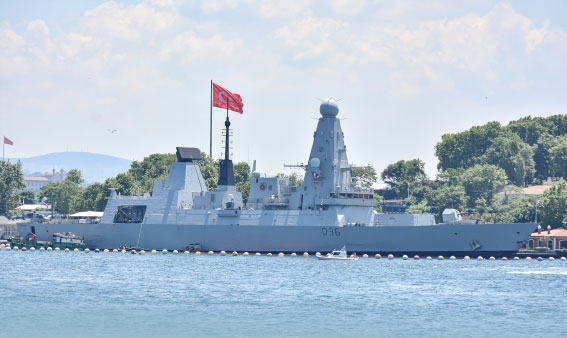
HMS Defender (D36) Hosted DIT’s UK Industry Day Event in Istanbul
Following a 5-day port visit for vital replenishment conducted prior to entering the Black Sea, the HMS Defender departed Sarayburnu Port on June 14th and sailed through the Bosporus with the Dutch frigate HNLMS Evertsen to conduct maritime operations in the Black Sea demonstrating interoperability with their allies in the region.
Following their Black Sea visit (Expected to last 20 days and accompanied by HNLMS Evertsen the HMS Defender [D36] Destroyer departed Black Sea and transited Bosphorus towards Mediterranean on July 2, 2021), the HMS Defender and the HNLMS Evertsen will re-join the rest of the Carrier Strike Group before they head through the Suez Canal. Travelling over 26,000 nautical miles (further than the distance around the world at the equator) the UK led CSG21 will visit more than 40 countries over the next 7 months from the Mediterranean to the Indo Pacific; including Singapore, the Republic of Korea, Japan and India. The CSG21 is made up of the aircraft carrier HMS Queen Elizabeth, Type 45/Daring Class destroyers HMS Diamond and HMS Defender, Type 23 frigates HMS Kent and HMS Richmond, and Astute Class submarine, RFA Fort Victoria, RFA Tidespring, U.S.S. The Sullivans of the US Navy and HNLMS Evertsen of the Royal Netherlands Navy.
While in Istanbul from June 9 - 14, 2021, the HMS Defender hosted a reception for representatives of the Turkish Government, the Armed Forces and the Defense & Aerospace Sector on the evening of June 9th during which Bridge and Operations Room teams demonstrated the Type 45 Destroyer’s response to a small boat threat and air defense capability and her Royal Marines Boarding team demonstrated their close quarter battle skills. The HMS Defender’s chefs also displayed their expertise with delicious canapés inspired by classic British dishes. A dinner with prestigious guests including the Governor of Istanbul was also held onboard. All events were carefully planned to ensure they were ‘COVID-secure’.
Within the scope of her port visit to Istanbul, the RN’s cutting-edge air defense destroyer HMS Defender also hosted a UK Industry Day event on the afternoon of Thursday 10th, June 2021. Organized by the Department for International Trade (DIT) of the UK Government, this event provided an ideal opportunity to discuss trends and to work together to foster further economic growth both in the UK and Turkey, from the seas to space. Possible areas of cooperation between the UK and Turkey were defined in areas of Technology, Advanced Manufacturing, Clean Growth, Defense and Security Sectors. In this context an exhibition was held on the flight deck and hanger of the HMS Defender with the participation of Airbus Defense & Space (ADS), BAE Systems, Caterpillar Defense UK (CAT UK), FNSS (A JV Company owned 51% by Nurol Holding and 49% by BAE Systems), Inmarsat, Leonardo UK, Rolls Royce, Shell, Thales UK and Vodafone. The aforementioned companies are taking part in Turkey’s on-going major aerospace programs including TF-X, HURJET, A330 MRTT, Liaison & General-Purpose Aircraft, A400M, T129 ATAK, Training Helicopter, ALTAY MBT, Various Armored Wheeled Vehicle Programs and Military and Commercial Satellite Programs.
High-ranking representatives from the Turkish Naval Forces (Commander of the Istanbul Naval Shipyard Rear Admiral [Lower Half/LH] Recep Erdinç YETKİN and Turkish Naval Forces Naval Technical Commander Rear Admiral (LH) İbrahim Rıza ADANIR), Presidency for Defense Industries (Vice President Serdar DEMİREL, Head of Naval Platforms Department Alper KÖSE and Head of Fixed Wing Platforms Department Abdurrahman Şeref CAN) and Defense & Aerospace Sector attended the event to which Defense Turkey Magazine was also invited. Turkish Space Agency President Serdar Hüseyin YILDIRIM was also among the attendees of the event.
Providing a short keynote speech at the event, the Commanding Officer of the HMS Defender, Commander Vince OWEN said: “It is a great privilege to have the opportunity to represent Global Britain in Istanbul. Turkey is an important partner and NATO ally. I am proud to have been able to showcase the best of Britton whilst alongside in Istanbul. I am very grateful to Turkey for extending such a warm welcome to us whilst respecting COVID-19 restrictions. We were built in 2009, 152 meters long and 8,000 tons. I’ve got 240 men and women on board, we’re into our first month of the 7 ½ month deployment that will see us go to the Black Sea next and then after that coming back through Suez and out to the Indo Pacific region and to get back to the UK by Christmas. And the main role of this ship is an air defense destroyer. You’ll see as you come in the radar. We got the big ball at almost 40 meters above the sea level (this greatly increases the ship’s radar horizon and therefore warning of sea-skimming threats), cutting edge phased array radar, you can see out at range up to 2,000 contacts at one time linked in with our Sea Viper System and really capable highly critical air defense platform to deliver that capability. I think that’s all I have to say… If any of my crew can help, please ask. I’ll hand you over to Jane now for a few words and then afterwards there’s food, drinks and refreshments available. Thank you for coming on board.”
Featuring gallium arsenide (GaAs) semiconductors, multiple low power modules and air cooling the all-seeing eye SAMPSON Multi-Function Radar (MFR) is integral to the air defense capabilities of the RN’s Type 45 Destroyers. The distinctive SAMPSON antenna is mounted in a single carbon-fiber composite frame, which holds two hexagonal back-to-back planar arrays. The two arrays have a 120º field of view but by rotating them and using steerable beams, complete 360º coverage is maintained at all times. Two semi-circular radomes cover the arrays to complete the big ball shape, which is about 4.8 meters in diameter. Operating in the S-Band between 2 – 4GHz, SAMPSON MFR’s antenna is rotated at 30rpm. Having a maximum detection range of at least 250nm and track about 2,000 separate targets simultaneously SAMPSON can guide up to 16 Sea Viper missiles in flight.
Taking the chair after Commander OWEN, Jane GRADY, Deputy Trade Commissioner for Eastern Europe and Central Asia at Department for International Trade (DIT) stressed that they place great importance on Turkey and their cooperation with the Turkish Defense & Aerospace Industry. “I am acting as Her Majesty’s Trade Commissioner for our region. Turkey is a critical market for the UK in terms of our trade investment relationships, but it goes way beyond that as many of you know. And from Istanbul we oversee our region, which consists of 14 markets into Central Asia including Russia as well. Turkey is of course the jewel really; I think in that region in terms of potential for developing relationships and not least of course in the defense sector. So, it’s a real privilege that you are here with us today both on the warship and also to meet some of our outstanding companies that are exhibiting today, and it is an opportunity I hope for people to meet and discuss and potentially build partnerships for the future, because that’s what global Britton is about. We’re about reaching out more than ever before to our friends and allies, building those critical partnerships not least in the trade and investment sphere and of course, the Free Trade Agreement (Turkey and the UK Tuesday signed a historic Free Trade Agreement on December 29, 2020 and it took effect on January 1, 2021) that was put into place at the back of last year to protect £18 Billion of trade between our countries and that was a key priority for the UK as we formally departed from the EU. And of course, we now look forward to developing that even further with a further and more comprehensive free trade agreement in sight with negotiations due to start on that at the end of 2022. So, there’s a lot to look forward to I think in the relationship. But again, back to those companies that are with us today: So we have Rolls-Royce, Caterpillar, FNSS, Airbus, Leonardo, Thales, Shell, Vodafone, Inmarsat and BAE Systems, and they’re all in hall today in the hangar so please do reach out to them. These companies operate in a diverse range of innovative technology sectors, which I think speaks to the UKs steps of know-how in terms of innovation and partnership. So, we cover sectors here today such as energy, defense obviously, aerospace and space, engineering and communications. It’s quite a wide array there and just looking at those companies gives you a taste of the UK’s ambition in terms of international partnership. So just take some of those companies, they’ve already got fantastic international partnerships. If we look at Shell in terms of the Netherlands, Thales in terms of France and of course Leonardo and Italy and of course Turkey with FNSS. So today is very much about partnership and building that out even further. And indeed, for my department, the Department of International Trade (DIT), technology is at the heart of what we are trying to do in terms of our global partnership ambition. So, I think today is a great event to do that, and so without further ado, I’d just like to say a great thanks again, huge thanks for hosting us Commander, and crew, last night we had a fantastic reception it was wonderful and today is our Industry Day. So, thank you very much again and colleagues, friends please do make the most of the next couple of hours, and I hope to say hello to many of you. Thank you.”
Notes on Exhibiting Companies
Airbus Defense & Space (ADS) presented its A330 MRTT and A400M airlifter programs at its stand. You can read detailed articles on the TurAF A330 MRTT and A400 Retrofit Programs in the 108th issue of Defense Turkey Magazine. ADS is also one of the bidders of the Liaison & General-Purpose Aircraft (GPA) Program with the C295 aircraft and the Turkish Land Forces’ Training Helicopter Program (covers the direct procurement of 15 [+15 optional] single engine helicopters) with its H125 Helicopter. The SSB launched a tender in 2016 to procure a total of 9 Liaison and General-Purpose Aircraft (GMU/GPA), 6 for the Turkish Land Forces and 3 for the Turkish Police. The Request for Proposal (RFP) document prepared as part of the Project was published by the SSB on June 21, 2016. In 2019 Gendarmerie General Command’s General Purpose Aircraft requirement also included in the GPA project. According to Gendarmerie General Command’s 2019 Activity Report the GPAs would be utilized to ensure the dispatch of large operation units together with their equipment and materials in a short time between long distances without being affected by meteorological conditions and the project cost would be financed through the national budget. However, the number of GPA to be procured for the Gendarmerie General Command has not yet been publicized, even the 2019 and 2020 Activity Reports did not contain any information on how many GPAs will be procured to meet the Gendarmerie General Command’s requirement. According to our sources, the Liaison and General-Purpose Aircraft (GPA) Project is not active as of June 2021 due to budget constraints and has been shelved for a while until the budget problem is resolved. Meanwhile Turkish Police (Aviation Department) is said to have a plan to lease a number of C295 medium transport aircraft from its own budget to airlift its equipment, personnel and ammunition in a faster and secure manner in one go. Currently, they use civil aircraft to carry out this need and personnel, equipment and ammunition are transferred separately due to safety precautions, and consequently this extends the transfer time and increases the costs. According to our sources, to meet the Turkish Police Aviation Department’s urgent transport aircraft requirement, the procurement model was preferred in the Manned Airborne Intelligence, Surveillance, and Reconnaissance (MAISR) Aircraft Program of the Turkish Land Forces Command. To meet their urgent requirement, the SSB had leased five second-hand Manned Airborne ISR Aircraft based on the Beechcraft King Air 350ER for two years under a US$70 Million contract (20,000 flight hours in total/4,000 hours per plane). The cost of a two-year comprehensive logistics support package to keep all aircraft and systems ready for duty 24/7, including the Ground Data Terminal, Remote Display Terminal, and Image Distribution and Storage System was also included in the US$70 million deal. Soon after the 20,000-flight hour leasing/service procurement period of the King Air 350ER MAISR Aircraft expired, a follow on 36-month or 25,000 Flight Hour Service Agreement was signed for five aircraft under the US$80 Million contract, and at the end of the leasing period the MAISR Aircraft were donated to the Turkish Land Forces.
Turkey’s next generation National Combat Aircraft (abbreviated as MMU in Turkish), also known as TF-X is being developed by Prime Contractor Turkish Aerospace (TUSAS) with technological assistance from BAE Systems. 100 BAE Systems engineers are currently working under the TF-X Program and the company also provides critical subsystems for both TF-X and HURJET aircraft.
Caterpillar Defense supplies diesel engines and engine subsystems to Turkish armored vehicle manufacturers, for example its diesel engines powers FNSS’ PARS and Harimau (Black Tiger) Medium Tank being delivered to the Indonesian Army. During the IDEF ‘19 Fair, a Memorandum of Understanding (MoU) was signed between the Turkish MoND and Caterpillar Defense UK (CAT UK) on the development of a new powertrain composed of a 12 cylinder (V12) 1,200hp diesel engine coupled with an Allison X1100-5A3 Transmission for use on FIRTINA-II Self-Propelled (S/P) Howitzers. The officials of the company informed me at that time that the engineers of the 1st ABFM would also take part in the development process of the new engine that would be based on an existing Caterpillar Defense UK engine’s core and since the engine that was planned to be ready for use in 2022 would not contain any components or sub-systems subject to ITAR restrictions, no restrictions would be experienced in its exports (ITAR-Free). However according to CAT UK officials with whom I met during the UK Industry Day event, following the MoU, the formal contract was not signed with CAT UK, Turkey rather has selected another company from an undisclosed country (I guess this unnamed country is Ukraine) which offered better proposals in terms of budgets. Development work on the new engine is expected to be completed in 2021 and it is planned to be tested on the FIRTINA-II S/P Howitzer in 2022.
Rolls-Royce provides LHTEC CTS800-4A turboshaft engines for T129A/B Phase I/II ATAK Helicopters and for T625 GÖKBEY Turkish light Utility Helicopters via its joint venture with Honeywell. In addition, the company has also shown interest in the Turkish TF-X Program, but according to our sources Turkey will soon sign a contract with Ivchenko Progress from Ukraine for cooperation in the development of 35,000lb class turbofan engines to power TF-X aircraft. Rolls Royce also wants to supply MT30 marine gas turbines under the TF-2000 Air Defense Destroyer Project. Part of Rolls-Royce Power Systems MTU on the other hand supplies 4000 Series MTU 20V4000M93L diesel engines both for ISTIF Class Frigate TCG Istanbul and PN MILGEM Corvettes.
As a global key player in Aerospace, Defense and Security based in Italy, Leonardo also has a business in the UK. With its origins in Basildon since 1952 (under the Marconi name) Leonardo UK (formerly Selex ES) designs, develops and manufactures products for national security and military uses as well as complex civil infrastructure management. Leonardo is one of the bidders of Liaison & General-Purpose Aircraft (GPA) Program with the C-27J aircraft and the Turkish Land Forces’ Training Helicopter Program (covers the direct procurement of 15 [+15 optional] single engine helicopters) with its TH-119/AW119 Helicopter. However according to our sources, due to budget constraints both the GPA Program and Training Helicopter Program, which is expected to cost around US$50 to US$70 Million, have been shelved for a while until the budget problem is resolved. Leonardo has undertaken an active role as a subcontractor in the TF-X and HURJET Programs and serves as the Prime-Subcontractor in the T129 ATAK Program and as the Prime Contractor in the MELTEM-III Program (6 P-235 MPA and 3 C-72 Maritime Utility Aircraft).
HMS Defender (D36) Destroyer
Launched in December 2009 the HMS Defender (D36) is the 5th of the Royal Navy’s 6 Type 45 Daring Class Air Defense Warfare Destroyers, which often is regarded as one of the most advanced warships in the world. Though her primary role is to provide the Fleet with air defense using the ferocious Sea Viper (ASTER 30 Block I) anti-air missile system, she is a truly versatile platform. The ship has a 48-cell Sylver A50 VLS, for a mix of up to 48 ASTER 15 missiles (range 1.7–30 km) and ASTER 30 Block I missiles (range 3–120 km). According to open sources during an ‘intensive attack’, a single Type 45 could simultaneously track, engage, and destroy more targets than 5 Type 42s, its predecessor could.
However, since their introduction into service Type 45/Daring Class Destroyers have experienced ongoing problems with the reliability and resilience of their all-electric power and propulsion system (in time this turned into Achilles heel of this class) dubbed the Integrated Electric Propulsion (IEP) System operating through twin shafts and comprising a pair of Rolls-Royce 21MW-rated WR-21 marine gas turbines and a pair of Wärtsilä 12V200 diesel generator sets rated at 2MW each. Problems with the intercooler-recuperator fitted to the Type 45’s WR-21 gas turbine engines have caused complete propulsion failures. However, removing the entire WR-21 marine gas turbines would be an enormous task and the PIP is instead focused on the removal and replacement of two Wärtsilä 12V200 diesel generator sets with three more powerful MTU Series 4000 diesel generator sets. The Type 45/Daring Class Destroyers will then change their standard operating procedure to cruise on its diesels and only use the GTs for higher speeds. Launched under a contract awarded on March 21, 2018 by the UK MoD to BAE Systems, BMT Defense Services and Cammell Laird Shipyard, the Type 45 Power Improvement Project (PIP) is designed to rectify these problems and put an end to the reliability issues which continue to limit the availability and dependability of the Type 45 Destroyers. The PIP implementation work would take around 12 months and is scheduled to be incorporated into the planned maintenance for the ships. The HMS Dauntless is the first Type 45 Destroyer that will undergo PIP upgrade at Cammell Laird shipyard to cure the propulsion problems that have plagued this class. The HMS Defender has not yet received the major Propulsion Improvement Package (PIP), which is scheduled to begin in 2023. In the meantime, the HMS Defender and the other Type 45/Daring Class Destroyers that have not yet received PIP upgrades are still able to be deployed globally using various temporary fixes and operating restrictions.
In reply to our questions on the PIP Project, Commanding Officer of the HMS Defender Commander Vince OWEN, who took Command of the HMS Defender in May 2020, underlined that the HMS Defender would receive the PIP upgrade during her planned lengthy dry-docking and refit period in 2023. And following the PIP, the ship will also receive an AIP upgrade to update its onboard equipment. Within the scope of this software-based AIP upgrade phase under a 10-year schedule, Type 45 Destroyers will receive around 30 software upgrades to update outdated onboard hardware. Commander OWEN stressed that, even though there was particular problem with the propulsion system, the HMS Defender has a very high readiness figure, now being consistently above 80% and that she will spend 7.5 months at sea in 2021. According to Commander OWEN following her refit the HMS Defender was able to reach 33.8 knots at full load during sea trials.
Following her 18-month major refit in Portsmouth conducted by BAE Systems the HMS Defender was accepted back into the RN Fleet during the first half of 2018. During the refit period the HMS Defender was integrated with the Shaman Communications Electronic Support Measures (CESM) System that was designed to gather signals intelligence (SIGINT). The AS-4692 VHF/UHF tapered slotted array direction finding/acquisition array of the Shaman System is fitted on the upper part of the pole mast and the AS-4293A VHF/UHF omnidirectional acquisition arrays are fitted half-way up the foremast and on the hangar roof. Shaman is based on the US Navy’s AN/SSQ-130(V) Ship Signal Exploitation Equipment (SSEE) Increment F cryptologic exploitation system. 7 sets have been purchased from the United States at a cost of around $90M and will eventually equip all 6 Type 45s, plus a set for shore-based training. The Shaman CESM allows the passive interception of adversaries’ transmissions across a broad part of the electromagnetic spectrum. The system can analyze, geo-locate and in some cases may be able to decode encrypted communications. Fitted with the Shaman CESM the HMS Defender can loiter off a coastline and will be able to record signals from mobile phones and military and government radio communications. At sea, intercepts may provide critical detail and forewarning about the actions of adversary’s naval units. It can also monitor the communications of allied countries