International Anatolian Phoenix
International Anatolian Phoenix - 2024 Exercise was held between 12 May - 23 May 2025, with the participation of Turkey, the USA, Germany, Azerbaijan, Italy, Qatar, Poland, Romania, Slovakia and Saudi Arabia, hosted by the Anadolu Kartalı Eğitim Merkezi (Anatolian Eagle Training Center Command /AETC) at the 3. Ana Jet Üs Komutanlığı (3rd Main Jet Base Command), Konya.
The AETC is a high-level training center, providing realistic combat training opportunities to TurAF Squadrons and friendly countries in a high threat environment, more sophisticated than the unit level training on aspects such as the size of the airspace, tactical ranges, threat emitters and number of participants.
Since 2009, the Anatolian Phoenix Exercises have been conducted in two periods per year at the 3rd Main Jet Base Command / Konya, with the aim of training the “Personnel Rescue Task Force” elements in a realistic operational environment and increasing the level of experience required by the current and future battlefield. Since 2012, they have been conducted in a national and international manner.
ANATOLIAN PHOENIX 2025
In previous years, the exercise was hosted by AETC and carried out by the 135th Personnel Rescue and Forward Air Controller Squadron Command. Last year, the Squadron Command was rised to the Group Command level and new Squadrons were established under this Group Command. The main purpose of this is to ensure that the Squadron's duties are very comprehensive. By dividing these duties among sub-squadrons, each squadron is intended to specialize in its own field.
The 136th Close Air Support (CAS) and Training Squadron, one of them, was responsible for the execution of the exercise this year. The newly established 137th AKIP (Arama Kurtarma Ihtisaslı Personel - Search and Rescue Specialized Personnel) Squadron supported the 136th Squadron.
The distinguished observer (DV) and press day of the exercise was held on May 22. The activity started with a briefing by Major Alper Okyay from the 136th CAS and Training Squadron at the 3rd Main Jet Base. Around forty local and foreign press members attended the briefing.
The main objectives of the exercise are;
The International Anatolian Phoenix 2025 aims to test and develop the command control process as part of the Personnel Recovery (PR) Operation, improve the interoperability of the PR Task Force elements (Helicopters, JTAC, PR, and CSAR teams) with the Air Force elements (Fighter jets, Airborne Early Warning & Control (AEW&C) Aircraft, Transport Aircraft, and UAVs), develop the “Survival and Escape and Evasion” methods and increase the training level of the pilots. The exercise also aims to reveal the needs of Personnel Recovery Operations (such as doctrine, organization, training, material, leadership, personnel, and infrastructure), test new methods, weapons, and equipment by conducting Joint and/or Combined Personnel Recovery (PR), Close Air Support (CAS), Dynamic Targeting (DT), and Time-Sensitive Targeting (TST) missions in the exercise scenarios and improve/identify the level of interoperability and areas of cooperation with other countries.
For this purpose, the types of tasks we perform in our scenarios are,
Close Air Support (CAS)
Time Sensitive Targeting (TST)
Combat Search and Rescue (CSAR)
Ground Assisted Air Interdiction (GAAI)
Air Assault
High Altitude Low Opening (HALO) Jump
Convoy/Point Defense
Small Unit Tactics
Evacuation
Infiltration / Exfiltration
High EW Environment Missions
During the execution phase of the exercise, Convoy Protection, Close Air Support, Casualty Evacuation, Parachute Jump and Combat Search and Rescue (CSAR) missions were performed at the Konya Firing Range.
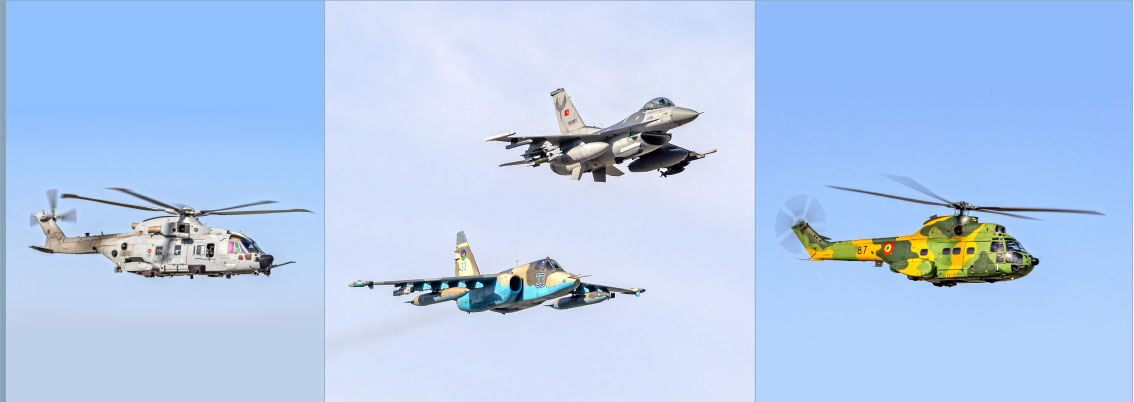
While Air Forces Command participated in this year's event with 12x F-16C/D, 1x Hürkuş, 1x E-7T, 2x CN-235M-100, 1x ANKA-S UAV, 1x Akinci UAV, 2x AS-532AL, 2x T-70 CSAR & JTAC Teams,
Land Forces Command with 1x T-70, 2x T129B ATAK helicopters and CSAR Team,
Turkish Naval Forces Command CSAR & JTAC Teams,
Special Forces Command with 1x S-70 Helicopter and CSAR Team,
Gendarmerie General Command is participating with 1x S-70 Helicopter and CSAR Team,
Coast Guard Command is participating with 1x AB-412 helicopter and CSAR Team.
More than 3,000 participants from 10 countries, 621 of whom are foreigner, are participating in the exercise this year;
United States of America with 2x UH-60M helicopters and CSAR & JTAC Teams,
Germany with Survival, Evasion, Resistance, and Escape (SERE) Team,
Azerbaijan with 2x SU-25 and CSAR & JTAC Teams,
Italy with 2x HH-101A helicopters and CSAR Team,
Qatar with 2x AW-139, 2x NH-90 and 2x AH-64E helicopters, 1x C-17A, 1x C-130J-30 transport aircraft, 2x TB-2 UAV and CSAR & JTAC Teams,
Poland with JTAC Team,
Romania with 2x IAR-330 helicopters and CSAR & JTAC Teams,
Slovakia with JTAC & SERE Teams,
Saudi Arabia with 2x AS-532AL helicopters and CSAR & JTAC Teams.
Konya firing range also hosts EHTES (Elektronik Harp Test Sahası - Electronic Warfare Test Range). Thus, the tasks required in the International Anatolian Phoenix exercise can be carried out under the pressure of intense electronic warfare and simulated enemy air defense elements. The systems found in EHTES as representative enemy air defense elements are as follows; ZSU-23-4, SA-3, SA-6, SA-8, SA-11, SA-12, Skyguard and MTS (Multiband Threat Simulator) for Pop-up threats. KORAL (Ground Based Stand-Off Jammer System) is used as an Electronic Warfare System. Thanks to this system produced by Aselsan, the radars of enemy aircraft and air defense systems can be jammed.
The daily routine of the exercise is as follows. Air Tasking Order (ATO) is published (Minimum 6 hours before mission). Planning is done accordingly. Before the mission, a main briefing is held with the participation of each element. Following this briefing, teams and air elements make their own briefings. A debriefing is held after the execution of the daily mission and new plans are made to develop the next mission according to the experience gained.
In the example CSAR Joint Task Force Scenario, COSPAS-SARSAT satellites, AWACS and UAVs provide the data needed. Aircraft are used for CAS/RESCAP/RMC/RESCORT missions to secure the CSAR Package. Tanker aircraft are used to support these aircraft with air refueling support. Sniper teams and Attack Helicopters are on the ground to eliminate imminent threats to Survivors, as well as to protect Rescue and Medevac Helo Packages. All of this traffic is managed and controlled by a ground unit called the RCC (Rescue Co-ordination Centre).
Major Alper OKYAY listed the training areas used in the exercise as follows;
West Area is mostly mountainous and mid elevated about 5-7000 feet’s. This area use Infil/Exfil Missions and suitable for Parachute Jumping. Also we have Beyşehir Lake for simulating Air-Sea Rescue operations in West area.
East Area is mostly flat and approximately has 4000 feet’s of altitude where we simulate desert missions. The Electronic Warfare Training Area and Firing Range are in this area.
And also there is Seydi Area which is on the South. The area gives opportunity to fly over in a really steep mountainous area with long and deep walleys with a height of more than 8000 feet. Suitable for conducting High Altitude CSAR/CAS Missions. All areas are within approximately 70 nautical miles from Base.
According to the exercise leading scenario there are two fictional countries: red, blue. Red Country currently has three operational air bases. In the midst of the ongoing conflict with Blue Country, Red Country has launched numerous air and missile attacks targeting civilian infrastructure, drawing widespread condemnation from the international community. In response, neighboring states and allied countries have imposed a comprehensive, multi-domain sanctions package on Red Country.
The blue country and its allies decide to intervene in the red country. DV Day recreates one day of this intervention.
Before the F-16 package arrives in the region, the ground-based KORKUT SOJ (Stand Off Jammer) system performs electronic jamming to suppress enemy air defense systems. During this time, Lightning decoys come to the region and fly as fake targets. Taking advantage of the weakness of the suppressed air defense system, the attack package attacks its targets. According to the scenario, F-16s hit targets marked by Special Forces and JTAC. The F-16s successfully destroyed the targets with 500-pound LGB-12 and Mk-82 general purpose bombs. The JTAC in the area marks another enemy air defense system with a laser and Hürkuş attacks this target with the MAM-L. Later, two AH-101A helicopters from the Italian Air Force were dispatched to rescue the wounded soldier during the assault. While the helicopters were taking off, Qatari AH-64E helicopters arrived in the area due to fire from enemy forces. Apache helicopters destroy enemy elements with 30mm cannons and 2.75-inch rocket fire.
While the helicopters were flying away from the area under cover fire, an attack is made on the enemy convoy detected in the area. As part of this mission Qatari AW139 and NH90 helicopters drop personnel. To evacuate friendly elements in the area, Qatari helicopters are reinforced by two Saudi AS532AL and two Romanian IAR-330 helicopters.
A CSAR team with T-70 belonging to the Turkish Air Force lands in the area to rescue personnel who has fallen into enemy hands. At the end of the exercise, Qatari C-17A and C-130J-30 aircraft will be airdrop to supply friendly elements in the region.
The exercise provides training for CSAR and JTAC elements from different forces and countries in a realistic environment and increases their capacity to work together. Thanks to both the diversity of participating platforms and EHTES, they have the opportunity to work and train under air defense and electronic jamming threats suitable for a real war environment. In this respect, the International Anatolian Phoenix takes its place as one of the most important exercises in the world