Leonardo Kicks Off the Project for the First Space Cloud System for Defense
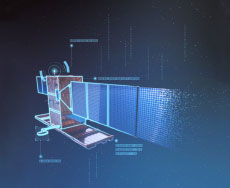
Supercomputers, artificial intelligence, and cloud are aboard a constellation of cyber secure satellites orbiting the Earth this is the objective of the "Military Space Cloud Architecture" (MILSCA) study project assigned to Leonardo by the Italian Ministry of Defense (through the contractual agency Teledife), as part of the National Military Research Plan (PNRM). For the first time in Europe, similar to what happens with the terrestrial cloud, the project intends to define a space architecture capable of providing government and national Armed Forces with high-performance computing and storage capacity directly in space.
The system, designed with integrated cyber security models, will guarantee greater speed and flexibility in the processing and sharing of information. The Space Cloud, which will be tested by creating a digital twin of the architecture, will be able to store over 100 Terabytes of data generated on Earth and in space on board each constellation satellite. It can perform processing with a power exceeding 250 TFLOPS (250 thousand billion operations per second) at single precision, adopting advanced algorithms that use artificial intelligence, machine learning techniques, and extensive data analysis. They can also communicate and exchange data autonomously with other satellites.
A cyber-secure supercomputer and archive system in space will guarantee users access to strategic data such as communication, earth observation, and navigation data anywhere, even in the most remote places, and at any time. Furthermore, a Space Cloud system significantly reduces data processing times, which is processed directly in orbit, providing real-time information and thus facilitating multi-domain and multi-nation operations. The transmission networks will be left free for other connections thanks to the only transfer of information of interest to Earth. In addition, storing data in orbit will also represent a useful back-up of the Earth centers, which are most exposed to natural disasters.