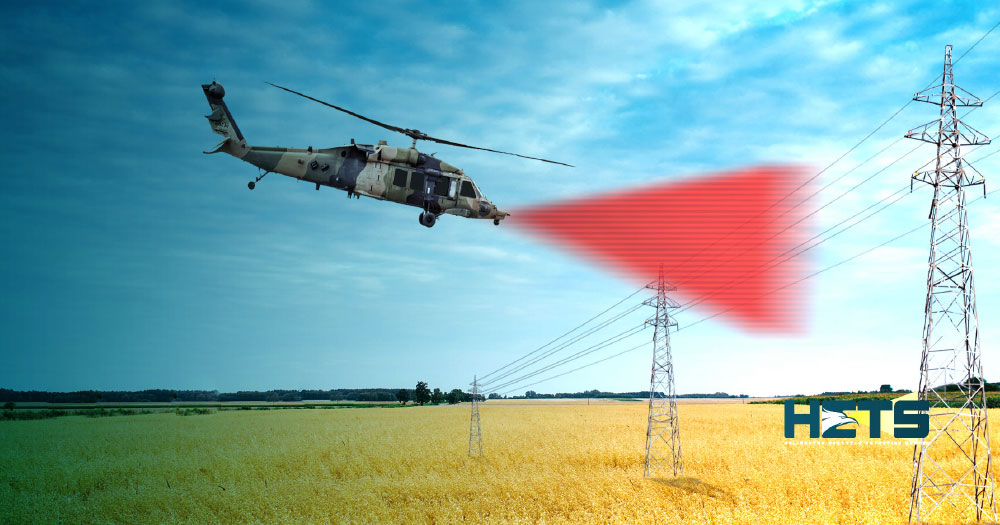
Meteksan Defence to Unveil Laser-Based Helicopter Obstacle Detection System at IDEF 2021
At IDEF 2021, Meteksan Defence will display its proven solutions already used by the Turkish Armed Forces and will introduce the Laser-Based Helicopter Obstacle Detection System for the first time. At this year’s event, visitors will have the chance to see the company's latest and updated products at the Meteksan Defence booth during the IDEF 2021 Fair.
Established in 2006 to combine and coordinate the projects and activities of high technology companies operating within the body of Bilkent Holding for the defense industry under a single roof, Meteksan Defence develops high-tech, national, independent, and indigenous products and subsystems for the Turkish Armed Forces and other security forces in line with the vision of the Presidency of Defense Industries.
Operating in 6 main fields, including radar systems, perimeter surveillance systems, laser & electro-optical systems, communication systems, underwater acoustics systems, and platform simulators, Meteksan Defence participates in many critical projects such as the development of anti-tank and air defense missile systems. Radar systems, perimeter surveillance radars, altimeters, tactical and strategic missile systems data links, sonar systems, underwater early warning and communication systems, and training simulators for helicopters and UAVs are the leading domestic and national products developed by Meteksan Defence.
Helicopter platforms are widely used in adverse weather and low altitude/high-speed conditions for mission success. Therefore, every year around the world, many helicopter accidents occur due to collisions with obstacles. In order to prevent accidents, it is very important to detect obstacles during flight and to provide warnings on time. Within the scope of the contract signed in 2019 between the Presidency of Defense Industries and Meteksan Defence, an active laser-based Helicopter Obstacle Detection System (HETS) was decided to be developed and integrated into helicopter platforms. Meteksan Defence has completed the development stage of the product, and HETS will be exhibited for the first time at the Meteksan Defence booth during the IDEF 2021 Fair.
HETS was developed with a fiber laser that has a wavelength of 1550 nm. It has the capability of detecting human-made structures such as buildings, towers, poles, power lines, and natural obstacles such as trees, forests, and hills and provides audible/visual warnings to pilots. Supporting different interfaces for easy integration into different helicopter platforms, the system differs from its foreign competitors with its low power consumption and lighter weight.
HETS can detect horizontal and vertical obstacles, including 5mm power lines, by scanning twice a second in its 30*40 degrees field of view and has an instrumental range of 1,500 m. It warns the pilot against obstacles at appropriate times with LIDAR technology, high precision signal processing, and user-friendly visual creation capability. Also, HETS can produce synthetic sound and tones in addition to a visual warning. The system supports MIL-STD-1553, RS-422, and ARINC-429 interfaces for use in integrated structures as well as producing video for MFDs.
Studies have been carried out demonstrating the successful university-industry collaboration model implemented between Bilkent University Ultrafast Optics & Lasers Laboratory (UFOLAB). High beam quality fiber laser sources, high-power laser transmitter structures, and precision laser/electro-optic detection techniques, and also developing superior performance fiber laser sources and detection techniques for Light Detection and Ranging (LIDAR) and directed laser applications are among these collaborative studies.
KAPAN Counter Drone System Provides Complete Protection Against Mini/Micro UAV Threats
The KAPAN Counter Drone System, developed by Meteksan Defence, will be exhibited at IDEF 2021 with its new subsystems and command control software. Radar Systems stand out as the most effective solution for detecting drones that have emerged as an up-to-date and asymmetric threat in critical facility and border security applications. Moving from this point, Meteksan Defence developed the KAPAN Counter Drone System using its own resources and launched it in 2018. At IDEF 2021, the KAPAN Drone Defense System will be on the scene demonstrating its new subsystems and command control software that raise its performance to a much higher level.
The Retinar FAR-AD Drone Detection Radar, which is included in the KAPAN Counter Drone System, is a result of the detailed studies of Meteksan Defence and the challenging field tests performed with the user. This version of Retinar has a new antenna customized for precise detection of mini/micro-UAVs, high-performance hardware, and special algorithms supported by artificial intelligence technologies. Thanks to its new structure, Retinar FAR-AD, which can detect air targets from a longer range and scan a wider area at a glance, makes KAPAN a more advanced counter-drone system. Apart from the Retinar FAR-AD Drone Detection Radar, the camera system for the classification and tracking of the drones detected and the jammer system for the neutralization of the drones are also included in KAPAN.
Besides all of these subsystems, the KAPAN Counter Drone System will be exhibited with the newly developed Command Control Software for the first time at IDEF 2021. KAPAN Command Control Software, which collects information from all sensors and produces a common aerial picture, is shown as one of the most innovative command control software developed in the world with its artificial intelligence-supported algorithms, 3-dimensional interface, open, scalable, and modular architecture.
MILSAR SAR/MTI Radar Enables UAV Platforms to Operate even Over-the-Cloud
As a long-endurance intelligence, surveillance, and reconnaissance system in the sky, Unmanned Aerial Vehicles (UAVs) will have an unblinded eye during adverse weather conditions where electro-optical sensors fall short. Significantly small in its size, weight and power consumption, even for the tactical UAVs, Meteksan Defence's MILSAR SAR/MTI Radar will be on stage in IDEF'21.
MILSAR is a synthetic aperture (SAR) and moving target indicator (MTI) radar system. Radars having these two capabilities are indispensable sensors of ISR platforms as they could produce high-resolution imagery of stationary targets and position, speed, and direction information of moving targets where EO sensors are ineffective in adverse weathers. The MTI feature comes up when the movements of vehicles on the ground, navigating warships' positions and routes at sea, or enemy aircraft flying in the air, are important and are to be monitored.
One of the top features of MILSAR is the easy integration and installation to a wide spectrum of UAVs from a tactical level (such as Bayraktar TB2 and ANKA of Turkish Armed Forces) to a strategic level (such as AKINCI and AKSUNGUR). Thanks to its cutting-edge technologies, and innovative architectural advantages, MILSAR has competitive SWaP characteristics. MILSAR was qualified on a MALE-class UAV in 2021 and is expected to be operational on Turkish UAV platforms with its weight of less than 30kg, high-resolution imaging capability from stand-off ranges, and easy-to-integrate feature.
Meteksan Defense Strengthens Submarine Platforms with Sonar Systems It Developed
Meteksan Defence was selected by the Presidency of Defense Industries as "Turkey's Underwater Center of Excellence," and harmoniously transfers its know-how and skills in ship sonars to submarines.
Systems developed by Meteksan Defence for submarine platforms include hydrophones, side-scan sonar arrays, intercept passive sonars, intercept detection and ranging sonars, digital underwater acoustic modems, hardware and software for sonar systems pre-electronics, signal processing and beamforming, and sonar operator interface software. While these domestically and nationally developed systems are being used for the modernization activities of existing submarines in the Turkish Naval Forces inventory, they are also of great importance for Turkey's MİLDEN National Submarine Project, where national design activities are ongoing.
The MSH-01 Hydrophone was completely developed by Meteksan Defence with its own resources and it is being used as sensors of passive sonar cylindrical hydrophone array (CHA), passive ranging sonar hydrophone array groups, wet-end side own noise analyses (ONA) systems, and cavitation indication (CI) systems of AY/PREVEZE class submarine ships. MSH-01 can be used in the said sonar systems of Type 209 Mod 1000 to Type 209 Mod 1400 class submarines, which are in service both in the Turkish Navy and worldwide Navies. Meteksan Defence also produces sensors, which are mounted along starboard and port sides of the submarine hull and form the wet-end side of the flank array sonar. The MSH-11 sensor is also intended to be used in flank array sonar systems of Type 209 Mod 1400 class submarines, which are in service both in the Turkish Navy and worldwide Navies.
As the Contractor of the Sonar Sub Systems of TÜBİTAK BİLGEM in the MUREN PREVEZE National Production Integrated Underwater Combat Management System Development Project, Meteksan Defence is assigned as responsible for the development of pre-electronic equipment that amplifies and converts the analogue signals coming from sensors to digital, as well as the signal processing and beamforming hardware and software of these digital signals. In addition, the sonar developed by Meteksan Defense within the scope of the Intercept Detection and Ranging Sonar (IDRS) Project will be integrated into our PREVEZE Class submarines within the scope of the Project





