``PN CONSIDERS TURKISH NAVAL COMPANIES AT PAR WITH ANY COMPANY WITHIN THE EUROPEAN DEFENSE INDUSTRY``

Defence Turkey: Sir, first of all thank you for sparing your time for our readers. Can we start our interview with a brief introduction of DCNS-P of the Pakistan Navy? How would you explain your job and official duties? How would you sum up your role?
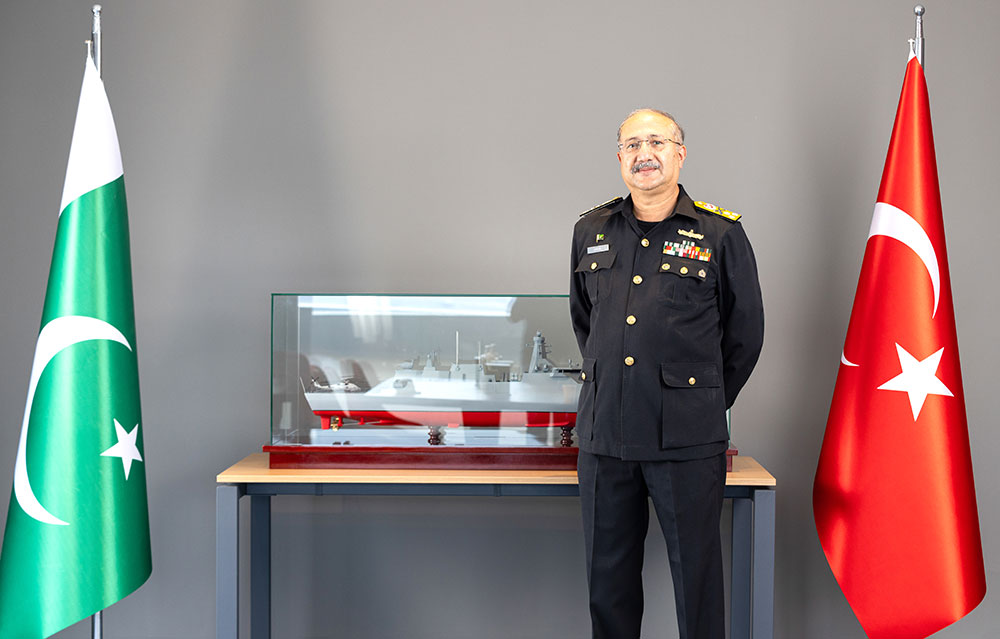
VADM Imran AHMED: As Deputy Chief of the Naval Staff (Projects) I am responsible for the implementation and monitoring of major Pakistan Navy (PN) Projects related to the construction of Ships, Submarines, Aircraft and other naval platforms (Floating Docks, Marine Assault Boats (MABs) etc.) Furthermore, modernization of weapons, sensors and integration onboard PN Platforms including indigenous development of equipment systems (ESM, Command & Control and Missiles etc.) is also under the Projects Domain.
The Projects Branch is focused on seeing that assigned Projects are completed within contractual timelines, without cost overruns and in accordance with desired quality standards and contracted technical specifications.
Defence Turkey: How did COVID-19 affect DCNS-P operations in 2021?
VADM Imran AHMED: At the onset of COVID-19, the Projects Branch was undertaking three major Projects in China, Turkey and Romania. With restrictions of Novel Corona Virus our operations were severely affected. However, with adequate use of available means and resources the situation was handled amicably. Special seats on PIA and Chinese Airlines were arranged for Officers and men travelling to and from China. Overall, despite the ravages of COVID-19, Alhamdulillah, milestones of all major projects were achieved with some delays.
Defence Turkey: Would you please tell us about the Pakistan Navy's core role and responsibility in national defense in the overall regional defense architecture?
VADM Imran AHMED: The Pakistan Navy’s role and responsibility is to Protect Maritime Interests of Pakistan, to deter aggression at and from sea, to provide disaster relief, to participate in development of coastal communities and to contribute to international efforts in maintaining good order at sea.

Defence Turkey: How is the Pakistan Navy developing its capacity to tackle current and future challenges in the Indian Ocean Region (lOR)?
VADM Imran AHMED: While focusing on all elements of maritime power, the Pakistan Navy is undertaking unprecedented modernization of surface, subsurface and air platforms. The modernization of the Fleet with new inductions will not only increase the numerical strength of the PN but will also provide advanced technologies to enhance the PN’s capacity and reach to tackle current and future challenges. The induction of state-of-the-art Type 054A Frigates and Submarines from China, MILGEM Class Corvettes from Turkey, OPVs from Romania and acquisition of Long Range Maritime Patrol Aircraft (MPAs) are some of the major indicators of the PN’s focus on capacity development.
Defence Turkey: Could you brief us on the growing naval ship building industry in Pakistan and the inland industrial support provided to the Pakistan Navy (PN)?
VADM Imran AHMED: Joint Ventures with Turkey and China for construction of Surface and Subsurface platforms have significantly enhanced Pakistan Naval Shipbuilding capacity. With every new platform built in Pakistan an indigenous Kit of Material component is being enhanced. Particularly in terms of Weapons and Sensors, we are getting full support from our public and private R&D Institutes, which now have a major share of warfare equipment onboard PN platforms.
Defence Turkey: Could you please describe the major procurement and modernization programs of the PN and the envisaged time frame of realization?
VADM Imran AHMED: The PN in pursuit of CNS (Chief of the Naval Staff) vision is striving to be a combat ready multidimensional force that contributes effectively to credible deterrence, national security and maritime economy while safeguarding Pakistan's maritime interests and radiating influence in the region with a global outlook. To achieve the desired end state, the PN developmental strategy has been crafted accordingly, that basically hinges upon construction and acquisition of modern and potent surface combatants, enhancement in subsurface capability and to acquire contemporary advancements in the Air domain as well. Mindful of the country's rightful destiny, the PN is building and acquiring Type 054A/P Frigates, 4 x MILGEM Class Corvettes, 4 x OPVs, Medium Altitude Long Endurance (MALE) Class CH-4 attack drones, Jet LRMPAs, a modern helicopter Fleet, Attack Submarines, acquisition of new Shallow Water Attack Submarines (S/Ms), while giving focused attention to the existing fleet. To further add on, the latest weapons & sensors are also being acquired to meet contemporary maritime challenges. In the next 3-4 year timeframe the outlook of the PN in terms of quantity and capability both will enhance manifolds, Insha Allah.

Defence Turkey: Under the contracts signed in 2017 and on June 1, 2018, Pakistan is procuring a total of 4 Type 054A/P Frigates (TUGHRIL Class) from China and the lead ship named PNS Tughril (261) was commissioned into PN service at a ceremony held at Hudong-Zhonghua Shipyard in Shanghai, China on November 8, 2021. Equipped with state-of- the-art combat management and an electronic warfare system along with modern self-defense capabilities the Type 054A/P Frigates are the largest and most advanced warships China has ever exported. What do the TUGHRIL Class Frigates bring to your Navy? Do you have any plans to procure further ships in this class?
VADM Imran AHMED: First of all, I would like to proudly admit that with the addition of PNS Tughril into the PN Fleet, the Pakistan Navy has achieved a quantum leap in offensive capability. The TUGHRIL Class ships are a Pakistan-specific, upgraded variant, state of the art major surface combatant warships and the most modern Frigates in the contemporary world. The ship is equipped with modern surface, subsurface and anti-air weapons, long range missiles, an improved radar system, electronic warfare, air and surface surveillance, acoustic sensors and other combat management systems. This class of ships will surely strengthen the PN's deterrence in the region and enhance maritime defense capabilities significantly. As already explained, 4 x ships of this class will be available to the PN shortly and the PN may opt for more depending upon the decision of leadership and as per the needs of the PN.
Defence Turkey: What can you tell us about the agenda of your visit to Istanbul and your meetings in Turkey? What are the targets of your official visit to Turkey?
VADM Imran AHMED: The main agenda of our current visit to Turkey is to review the progress of PN-MILGEM Corvettes being constructed by Turkey for the Pakistan Navy. I am happy to note that so far the project is progressing very well and both ASFAT and INSY (Istanbul Naval Shipyard) are doing their best for timely delivery of the ships.
Defence Turkey: Turkey enjoys deep-rooted brotherly and strategic relations with Pakistan. Since its independence, Pakistan has been enjoying very friendly and warm bilateral relations with Turkey in all fields especially defense. Military cooperation between these two brotherly countries, which started soon after Pakistan's independence, has been flourishing ever since, resulting in closer cooperation and understanding between the Armed Forces of the two countries. How do you evaluate the current state of Pakistan-Turkey cooperation in the Naval field? What is your forecast for the future?
VADM Imran AHMED: Pakistan regards Turkey as a dear brother and a close friend. Our two countries have stood resolutely by each other, in all moments of trial and tribulation. Our bilateral relations go far beyond the contemporary diplomatic relations but are greatly imbued with commonality of heritage, culture, religious and mutual interests. Geographically both Turkey and Pakistan are located at a very important and critical international crossroad and thus continue to remain in focus of great powers interest and intent to shape the environment that suit their strategic objectives. Apart from major Projects of the PN Fleet Tanker, MILGEM and Agosta-90B MLU Pakistan-Turkey cooperation in the naval field encompasses a wide spectrum of machinery equipment and weapons & sensors. The hallmark of this cooperation is the MILGEM Project, which is a testimony to the enhanced naval cooperation between our two brotherly countries.
Defence Turkey: Within the scope of the PN-MILGEM Project, which was launched under a Government-to-Government contract awarded in July 2018, the Pakistan Navy will procure 4 x Corvettes based on the design of ADA Class Corvettes of the Turkish Naval Forces (TNF), 2 of which are being constructed at KS&EW in Pakistan and Istanbul Naval Shipyard in Turkey, concurrently. Customized according to needs of the Pakistan Navy, with its stealth features, PN- MILGEM (named BABUR Class) will be the most technologically advanced surface platform of the Pakistan Navy Fleet. The Steel cutting of the first PN-MILGEM Class Corvette, which would be named PNS BABUR upon commissioning, was performed in January 2020 and the ship was launched at Istanbul Naval Shipyard (INSY) on August 15, 2021. Can we hear your personal assessment on BABUR Class Corvettes?
VADM Imran AHMED: Firstly, PN-MILGEM is not the first war ship collaboration program between the Pakistan Navy and Turkey. The Pakistan Navy has inducted 2 Onuk MRTP 33 Fast Attack Boats and recently a Fleet Tanker, which was build at KS&EW in collaboration with STM. With regards to PN-MILGEM, with the induction of a modern, well equipped and state of the art BABUR Class Corvettes in the PN Fleet, Pakistan will acquire the best capability to respond to future challenges and maintain peace & stability and the balance of power in the Indian Ocean Region. It would support the Pakistan Navy's initiative of securing the seas for international shipping by patrolling distant waters through Regional Maritime Security Patrol (RMSP). With their advanced sensors and weapons, BABUR Class Corvettes, when integrated as part of Pakistan Navy Task Groups, will be able to support a full spectrum of maritime operations and will enhance our ability to detect and respond to current and future maritime threats. Moreover 2 out of 4 x PN-MILGEMs are being built in Pakistan, it would also provide a significant boost to the local warship building capability.
Defence Turkey: What can you tell us about the Pakistan Navy's expectations from the PN-MILGEM Project? How many PN personnel are taking part in the PN-MILGEM Project?
VADM Imran AHMED: In recent decades Turkish Defense Industries have made tremendous progress. Turkish military products are globally recognized for their quality and performance. The PN -MILGEM Project is a testimony of the Pakistan Navy's trust in the ever-growing Turkish Naval Shipbuilding industry. Our expectation of PN-MILGEM goes much beyond the 4 warships being built. The project also includes Transfer of Technology, upgrade of Karachi Shipyard and designing a purpose-built JINNAH Class Frigate (JCF) for the Pakistan Navy. This essentially means that the PN-MILGEM Project not just include the personnel who are involved in the construction process, but that it has a host of other offsets that are part of the project in various categories.
Defence Turkey: Since the Pakistan Navy's PN-MILGEM/BABUR Class Corvettes have been customized to meet the Pakistan Navy's special requirements they will have some differences in terms of propulsion system and weaponry and the Pakistan Navy will procure some systems and subsystems under the Government Furnished Equipment (GFE) approach. Can you elaborate on the differences between ADA Class and BABUR Class Corvettes?
VADM Imran AHMED: Turkish Navy ADA Class Corvettes design has been used as a baseline for PN-MILGEM/BABUR Class Corvettes. However, the combat system outfit for BABUR Class corvettes have been customized according to their intended employment role and threat perspective. Consequently, PN-MILGEM has several differences in the weapons outfit, which has led to changed dimensions of the ship as well. PN-MILGEM is almost 9m longer, half a meter wider and 590 tons heavier than ADA Class. However, the propulsion suite is the same as ADA Class for a top speed of 26+ Knots. The major difference in combat systems is the addition of SAM VLS, indigenous SSM and torpedo system.
Defence Turkey: Instead of the RIM-116 RAM Short Range Air Defense Missile System the Pakistan Navy BABUR Class Corvettes were supposed to be equipped with the HHQ-16 Medium-Range Air Defense Missile System in a 16-Cell Vertical Launch System (VLS) to be located behind the main gun. However, in 2020 the Pakistan Navy changed its decision and decided to use MBDA's new generation Naval Based Air Defense (NBAD) System ALBATROS NG instead of the HHQ-16 on BABUR Class Corvettes. The renewed design of PN-MILGEM Corvettes, with a pair of six-cell (2x3) modules of the ALBATROS NG Maritime Launching System (MLS) was disclosed for the first time on April 30, 2021, during the PN MILGEM-3 Corvette's keel laying ceremony held at Istanbul Naval Shipyard in Tuzla, Istanbul. Can you elaborate on the main reasons behind this last-minute decision change?
VADM Imran AHMED: Let me correct the impression, it was not a last-minute decision, nor it should give any inkling of the PN swaying away from Chinese SAM systems. They are equally good and the PN has been and still is using Chinese combat systems as an integral part of PN weapon suites. It was a deliberate decision which the PN took keeping in view the desired balance of Eastern and Western weapon systems in the PN Fleet and in addition the integration requirement which the PN intends to have onboard PN-MILGEM Corvettes.
Defence Turkey: PN design teams, which took part in PN-MILGEM design efforts in Istanbul, Turkey together with the Turkish naval ship designers, have also started to design a new ship, which is called the JINNAH Class. The scale model of JINNAH Class was displayed for the first time during the IDEF '21 Fair in August 2021 at the ASFAT stand. Can you give us an update on the JINNAH Class Frigate (JCF) Project? What are the differences between BABUR and JINNAH Class in terms of propulsion system, weapons and sensor equipment? When is the first JCF expected to be inducted into PN service?
VADM Imran AHMED: As an offset of the PN-MILGEM Project, collaborative design of JINNAH Class Frigate (JCF) is being undertaken by PN and Turkish Naval ship designers. The first three phases of the project have been successfully completed, while the Functional Design Phase is in progress. The project will be completed by 2025. The JINNAH Class Frigates will have an increased length and displacement compared to the BABUR Class. The ship is being designed with CODAD propulsion combination and will be equipped with mostly indigenous weapons and sensors.
The JINNAH Class Project is being developed through indigenous efforts of Pakistan in collaboration with ASFAT, Turkey. In this regard, platforms design capability has been achieved through collaborative efforts of Pakistan and Turkey. To further refine capabilities of Pakistan in the shipbuilding industry as well as expertise in indigenously developed weapons and sensors, production of the JINNAH Class Frigate will contribute towards achieving self-reliance in construction of the first ever frigate size ship in Pakistan.
Defence Turkey: In June 2016 Turkish state-owned defense contractor Savunma Teknolojileri Mühendislik ve Ticaret A.Ş. (STM) won a contract for the Mid-Life Upgrade (MLU) of the three Agosta-90B Class (aka KHALID Class) diesel-electric attack submarines equipped with air-independent propulsion systems, currently in service with the Pakistan Navy. Can you share the current status of this program? What do the MLU of Khalid Class Submarines bring to the Pakistan Navy?
VADM Imran AHMED: The MLU Program is progressing smoothly. The 1st platform MLU has been successfully completed. Activities onboard the 2nd platform are at an advanced stage of completion. The 3rd platform activities are also on schedule. The MLU has enhanced the surveillance and war fighting capability of submarines with the latest sensors and sophisticated Combat Management System (CMS).
Defence Turkey: According to STM, the first submarine of the MLU project PNS/M (Pakistan Navy Submarine) Hamza (139) was handed over to the PN in late 2020 after the completion of Harbor Acceptance Tests (HAT) and the Sea Trials (Sea Acceptance Tests/SATs, including diving tests) that started in March 2020 in the Arabian Sea. Can you elaborate on the performance of PNS/M Hamza during 2021 after the MLU? Does the upgrade meet the Pakistan Navy's expectations?
VADM Imran AHMED: The performance of PNS/M HAMZA upon completion of sea trials is satisfactory. The crew is well trained, and the S/M is being utilized optimally as per operational dictates. The upgradation has met the PN's expectations in terms of enhanced surveillance capability and combat readiness.
Defence Turkey: In October 2018 Pakistan Navy commissioned an indigenously built 17,000-ton Fleet Replenishment Tanker named PNS Moawin (39) to its fleet during a ceremony held at Pakistan Navy Dockyard in Karachi. The Tanker, which was built in collaboration with Turkish defense engineering firm STM, is the largest naval vessel ever constructed by state-owned shipbuilder KS&EW. Can you elaborate on the performance of PNS Moawin during last three years? Is there any plan to construct a sister ship in the coming years?
VADM Imran AHMED: PNS Moawin has remained the backbone of the PN Fleet due her versatile roles including supply/support and medical assistance. The successful participation of PNS Moawin in all major exercises in and outside Pakistan despite challenging weather conditions reflects the operational readiness of the ship. Presently, the PN has been operating 2x Fleet Tankers and in the future the PN may opt to construct another Fleet tanker of PNS Moawin size.
Defence Turkey: How do you assess the exisiting capabilities of the Turkish Naval Sector companies in meeting the Pakistan Navy's modernization requirements?
VADM Imran AHMED: The PN considers that Turkish Naval Companies are at par with any company within the European defense industry. Accordingly, various Turkish companies have already been engaged by the PN for upgrade and modernization of Fleet units.
Defence Turkey: What is the possibility of joint naval industry programs with Turkey, On surface platforms? On airborne platforms, ASW and/or Maritime Patrol? On Weapons Systems?
VADM Imran AHMED: The Joint Naval Industry Program for the development of an airborne ASW/ Surveillance platform is a plausible proposition, however, as of now steps in this regard have not been initiated due the requirement of an elaborated aeronautical setup. Notwithstanding the aforesaid if the Turkish aeronautical setup has any such proposal to develop a joint ASW/Surveillance aircraft: the PN would certainly consider it and contribute with rich experience gained through operating multiple aerial platforms for the last 5 decades.
Defence Turkey: Can you brief us on some of the PN's future requirements?
VADM Imran AHMED: After the recent contracts of 10 x Major Surface Ships (4 x Type 054A/P, 4 x MILGEM Class and 4 x OPVs), 8 x Hangor Class Submarines and 3 x Jet A/C with LRMP (Long Range Maritime Patrol) conversions; the PN intends to strengthen the Fleet with state of the art, long range SSMs and ASMs. In addition, the PN is in the process of acquiring seamless coastal surveillance and defense systems.

Defence Turkey: How do you see the PN's future role in the region? What are the main perceived maritime security threats and challenges?
VADM Imran AHMED: In my assessment, the global environment is in a state of flux and is characterized by a growing competition of interests, having a deep impact on the maritime domain. In our immediate neighborhood, long drawn instability in Afghanistan simmers and continues to impinge upon regional security. The continued unlawful Indian occupation of Kashmir is resulting in grave human rights violations by Indian Armed Forces which is further exacerbated by the violent and extremist Hindutva Ideology. Nuclearization of the Indian Ocean through proliferation of nuclear submarines, equipped with long-range nuclear weapons by India, has also disturbed the strategic balance in the region. The ongoing conflicts in Yemen and Syria are also impacting regional maritime security. The access to shore-based missiles and remotely operated vehicles to the warring groups, is a particularly, serious threat to SLOCs transiting the Red Sea and the Gulf of Aden. Attacks on MVs in the Gulf of Oman, clearly demonstrate the seriousness of the prevailing threat. Ongoing conflicts in Pakistan's extended neighborhood have resulted in threats of maritime terrorism, piracy, drug trafficking, human and arms smuggling. In a nutshell, threats to our maritime security range from traditional to non-traditional, with an ominous mix of hybrid ones.
The PN is a flexible force that adapts to the changing environment. Owing to the magnitude and diversity of these threats and challenges, there is a growing realization that no nation can tackle them alone. Thus, collaborative maritime security has become an imperative for global peace and stability. Pakistan remains a forerunner in supporting collaborative maritime security initiatives in the region.
Defence Turkey: What is the way ahead for the Pakistan Navy?
VADM Imran AHMED: The PN is well cognizant of the challenges faced. However, without indulging into a numbers game, we are focusing on achieving and maintaining cutting edge capabilities to fulfill our national and international obligations. Moreover, our policy of collaborative maritime security, in the form of continued PN participation in CMF Ops, holding of the multinational Exercise AMAN and the linking of PN JMICC with a host of international organizations, has also resulted in economizing efforts to ensure regional maritime security. In a nutshell, for maintaining a balanced, potent and combat ready force, the PN continues to explore and engage international defense markets for new inductions and mid-life upgrades with due focus on indigenization to achieve cost effective solutions.
Defence Turkey: Vice Admiral Imran AHMED, would you like to add anything in the way of a closing message to our readers?
VADM Imran AHMED: Pakistan and Turkey enjoy brotherly and strategic relations. Pakistan has been enjoying very friendly and warm bilateral relations with Turkey in all fields especially defense. The religious, cultural and economic relations between both countries are expected to improve further. I wish the Turkish nation a prosperous future.
Defence Turkey: Dear Admiral, thank you for sparing your valuable time for our readers