QATARI EMIRI NAVAL FORCES Thriving Power in the Gulf Region
In 2012, The Qatari Emiri Naval Forces had 21 surface vessels in service. The total fully loaded displacement of these vessels at that time was 2,961 tons. When the current naval expansion program is finished the Qatari Emiri Naval Forces will have 61 surface vessels with a total fully loaded displacement of 29,216 tons.
These numbers show how impressive the expansion program is. The number of vessels will increase almost 3-fold. More remarkable is the 10-fold increase in the displacement. Qatar is not only acquiring new warships, but also larger more complex warships.
Building a navy is an expensive undertaking. Any country that sets out on one of the most ambitious naval expansion programs such as that of Qatar’s certainly must have deep pockets to finance the new warships and large pool of human resources to crew them. Luckily money is not an issue for Qatar.
There are three reasons for the naval expansion of the Qatari Emiri Naval Forces.
One of the major motivators of the Qatari naval expansion is the Emirati’s ongoing hassle with the fellow members of the Gulf Cooperation Council. These relations had a low tide in June 2017 when Saudi Arabia, the UAE, and Bahrain, joined by Egypt and Jordan, cut diplomatic relations with Qatar and imposed limits on the entry and transit of Qatari nationals and vessels in their territories, waters, and airspace. In 2019 realizing there are few benefits from continuing the blockade, Saudi Arabia and the UAE apparently began to look for a resolution, a move that was also supported by the US. While the inter GCC rift is healing slowly, the need to have a strong naval force is there as before.
Qatar has large oil and gas reserves. Oil and gas still account for over 90% of Qatar’s export earnings, and over half of government revenues. Proven oil reserves of about 25 billion barrels enable Qatar to continue its current levels of oil production for over 50 years. Its proven reserves of natural gas account for about 13% of the world’s total and it is the second largest exporter of natural gas in the world. And most of these gas and oil fields are located offshore. Qatar needs a strong naval presence inside its maritime borders in order to protect the critical energy infrastructure such as gas and oil platforms, their pipelines on the seabed and the large LNG facilities and oil refineries.
Furthermore, in November 2022 Qatar will host the World Cup. There will be thousands of football fans arriving from all over the world. The World Cup presents a good opportunity for sea borne terrorist attacks and to create terror and chaos in the country and in the region. Small patrol boats are needed to protect the stadiums and other entertainment facilities on shore and to intercept nonresponding or uninvited vessels.
Italy and Turkey have emerged as the main suppliers for Qatar. The mainstay of the rearmament of the Qatari Emiri Naval Forces is the massive order the Emirati placed with the Italian shipbuilding company Fincantieri for a total of seven vessels in June 2016.
The contract with a value of almost 4 billion euros, covers the construction of seven surface vessels, of which four corvettes of over 100 meters in length, one amphibious vessel (LPD - Landing Platform Dock), and two patrol vessels (OPV - Offshore Patrol Vessel), as well as support services in Qatar for an additional 10 years after the delivery of the vessels.
In July 2018 the steel cutting ceremony of the first corvette ordered from Fincantieri by the Qatari Ministry of Defense within the national naval acquisition program, took place at the Muggiano (La Spezia) yard, in the presence of the Deputy Prime Minister and Minister of State of Qatar for Defense Affairs, His Excellency Khalid bin Mohamed Al ATTIYAH and the Italian Minister of Defense, Elisabetta TRENTA.
The corvette was launched in February 2020 and started her sea trials in November the same year. The second corvette Damsah was launched on 13 February 2021. Al Khor the third ship was launched on 30 September 2021 and the last one Sumaysimah was launched on 29 March 2022.
The first two ships were delivered to the Qatar Emirati Naval forces on 28 October 2021 and 28 April 2022 respectively.
According to Fincantieri Al Zubarah Class Corvette, as result of the optimization of the vessel size, high performance, transport, and support capabilities, it can play different roles such as escort, support, relief, interdiction and patrol operations.
These ships are highly handy, have excellent nautical qualities, seaworthiness, and long range. They are able to operate in open sea missions and to manage protracted helo operations. The corvettes can accommodate a powerful Combat System, which makes their operational capabilities comparable to those of medium-size frigates.
The corvettes are 107 meters long, 14.70 meters wide, with a full displacement of 3,250 tons. The ships have 4 MAN 22/38D diesels on two shafts. The engines can propel these ships up to a maximum speed of 28 knots. The range at the economical speed of 15 knots is 300 nautical miles. The crew is 98 strong but there is additional berthing for 14 more.
Furthermore, the vessel will be capable of operating high-speed boats such as RHIB (Rigid Hull Inflatable Boat) through lateral cranes or a hauling ramp located at the far stern. The flight deck and hangar are sized to host one NH90 helicopter.
The corvettes have the 16 cell Sylver A50 vertical launcher system for Aster 30 Block 1 surface to air missiles for long range air defense. The Aster 30 Block missile has inertial guidance with a mid-course update and active terminal homing. The range is 120 kilometers at Mach 4.5. For short range air defense there is one Mk 49 21 cell Launcher for RIM-116C RAM Block II missiles.
The main offensive weapon of the Al Zubarah class corvette is the 8 Exocet MM40 Block 3 missiles on board. These missiles have 180-kilometer range at Mach 0.9 and carry a 165-kilogram warhead. Using inertial and GPS guidance in the mid-course and active radar in terminal homing the missile can fly skimming the sea.
For kinetic fires, on board are one Leonardo 76/62 mm Super Raid main gun and two Marlin RWS with 30mm guns.
The ships have Sylena Mk2 decoy launchers and the Morpheus torpedo defense system on board as physical countermeasures. For electronic countermeasures the ships have Virgilius electronic warfare and electronica jammers on board.
The main air search and fire control radar is the Kronos Grand 3D. The Grand 3D is a multifunctional radar based on advanced AESA technology which is used as main radar for the Principal Anti Air Missile System. The Kronos Grand 3D can perform extended self-defense, air and surface surveillance and simultaneous multiple target tracking, volumetric search and multiple missiles guidance profiles. The radar has a range over 300 kilometers and can provide active missile guidance up to 16 ASTER missiles simultaneously in saturation attacks. The fire control for the Super Raid gun is provided by the NA-30S Mk2 radar.
The corvettes have a Thesan mine avoidance sonar and a Black Snake torpedo detection sensor. The Al Zubarah corvettes do not carry any weapons such as torpedoes or sensor like sonars for anti-submarine warfare.
The second part of the contract with Fincantieri is the construction of two offshore patrol vessels. The first of the Musherib class was launched on 18 September 2020 and the second unit Sherouh was launched on 5 June 2021. Musherib was delivered to Qatar in January 2022.
The Musherib class are flexible ships, capable of performing several services, from surveillance to combat functions.
The OPV’s are 63 meters long and 9.2 meters wide. Their displacement is 725 tons fully loaded. The vessels have four diesel engines each on one shaft. The maximum speed is 30 knots, and the range is 1,500 nautical miles at a speed of 15 knots.
As the case with the Al Zubareh class corvettes the Musherib class vessels are fitted mainly with Italian sensors and if possible, with Italian made weapons. The main offensive weapons of the OPVs are the 8 Excocet MM40 Block 3 anti-ship missiles. For defense against air threats there are 8 vertical-launch MICA surface-to-air missiles with inertial guidance with course up to and active radar or IR homing variants up to 20 kilometers. For kinetic fires, on board are one Leonardo 76/62 mm Super Raid main gun and two Marlin RWS with a 30mm cannon.
The main air search and fire control radar is the Kronos Multi-functional radar. This is a smaller version of the Kronos Grand 3D, suitable for smaller vessels. The radar has a range over 300 kilometers and can provide active missile guidance for the MICA air defense missiles. The fire control for the Super Raid gun is provided by the NA-30S Mk2 radar.
Like the Al Zubareh corvettes the Musherib class OPV’s have Sylena Mk2 decoy launchers as physical countermeasures and Virgilius electronic warfare system for electronic counter on board.
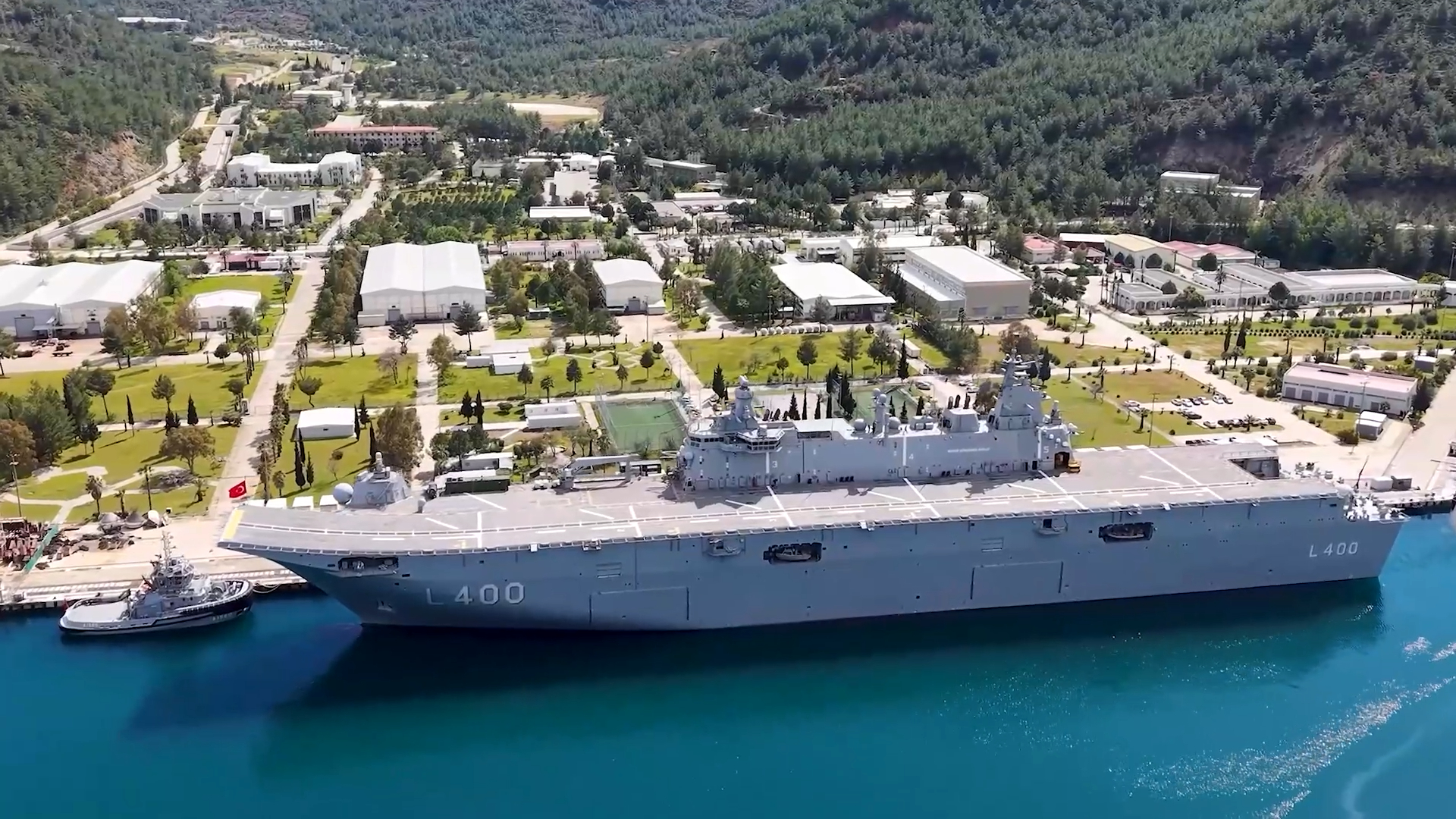
The final ship from the Fincantieri contract to be delivered is yet to be named and is a Landing Platform Dock type amphibious ship. This ship will be based on the LPD that the Italian company delivered to the Algerian Naval Forces in 2014.
The keel of the Qatari vessel was laid on 17 May 2022, at the Palermo shipyard. The ceremony was attended by Brig. Ahmad Al HAMMADI, Qatari Emiri Naval Forces Head of Project Control Office-Italy, and Marcello GIORDANO and Umberto ALOI, respectively, Fincantieri Palermo shipyard Director and Vice President Export Programs.
The LPD is designed to ensure extremely efficient land-air-marine connections. It will be highly flexible and capable of fulfilling different kinds of tasks, from humanitarian interventions to support the Armed Forces and land operations.
The ship will be about 143 meters long, 21.5 meters wide and with a fully loaded displacement of 8,800 tons it will be able to accommodate about 550 persons on board, equipped with two vehicle ramps and an internal floodable dock, capable of accommodating a ready-to-go LCM (Landing Craft Mechanized) that can also be stored on the garage deck, and can be deployed using a system of davits. Furthermore, the flight deck is sized for hosting an NH90 helicopter.
If the Algerian vessel can serve as a template, then the Qatari vessel will be equipped with the 8 cell Sylver A50 vertical launcher system for Aster 30 Block 1 surface to air missiles for long range air defense.
The Qatari LPD will be fitted with the Kronos Grand 3D main air search and fire control radar, and the NA-30S Mk2 radar for the Super Raid gun. While the details of the physical and electronic countermeasures systems, underwater sensors and other electronic systems have not been disclosed they will be the same systems fitted on board the Al Zubarah corvettes to create and maintain maximum interoperability and a standard user experience across all Italian made vessels.
In addition to the Italian order, the Qatari Emiri Naval Forces is acquiring two specialized training ships from Turkey’s Anadolu Shipyard to help to ease the training problem a result of this expansion program. This shipyard also won a contract for the construction of one LCT (Landing Craft Tank), two 40-meter LCM (Landing Craft Mechanized) and one 15.7-meter LCVP (Landing Craft Vehicle & Personnel) for Qatar to be used with the Italian LPD.
As Admiral Cunningham of the Royal Navy said “It takes 3 years to build a ship. It takes three centuries to build a tradition.” In order to create trained sailors to serve on the aforementioned corvettes, OPV’s and LPD Qatari Emirati Naval Forces need to train the next generation of sailors. Therefore, a contract was signed at the DIMDEX 2018 Maritime Defense Exhibition Between Qatar and the Anadolu Shipyard for the construction of two training ships. The first ship Al Doha was delivered to Qatar in 2021 and arrived on 15 December 2021. The second ship Al Shamal is was delivered to Qatar in February 2022.
These training ships each are 89.85 meters long and 12.9 meters wide, with a draught of 4 meters and a displacement of 1,950 tons. The steel hulled ships have an aluminum superstructure.
The two diesel engines each 3,600kW can move the ship at a maximum speed of up to 22 knots. The continuous speed is 18 knots. As the ships are constructed for training, they have two bridges. One is for navigation and the other is for training. The ships can accommodate 9 officers 24 petty officers, 36 ratings and 60 cadets and instructors.
Both are armed with one Leonardo Marlin small caliber naval gun system and two 12.7mm machine guns.
Anadolu Shipyard construction activities are not just for cadet training ships for Qatar. The shipyard also has a contract to build one LCT, two LCM’s and one LCVP type small amphibious vessel. The largest of these vessels, the landing craft tank for the Qatari Emiri Naval Forces, Fuwairit, was launched on 25 September 2021.
The LCT is 79.85 meters long and 11.7 meters wide. The forward draft is 1 meter while the aft draft is less than 2.5 meters. The displacement is 1,156 tons. The ship has a 400 square meter vehicle deck and can transport 260 soldiers or 3 medium battle tanks or up to 200 tons of cargo. The LCT has an economical speed of 16.5 knots and a maximum speed fully loaded at 18 knots. For self-defense the ship will be armed with two 30mm remote controlled weapon systems and two 12.7 RCWs.
Fuwairit can be used for a variety of missions such as personnel and vehicle transfer, logistics operations, and humanitarian assistance.
Another Turkish shipyard that has been supplying the Qatari Emirati Coast Guard with vessels of various types is Ares Shipyard.
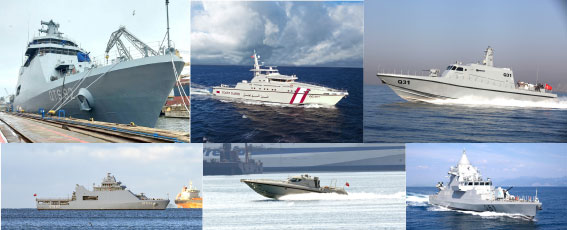
Ares Shipyard signed their first contract with the Qatari Emirate during DIMDEX 2014 for the acquirement of 2 Ares 150, 10 Ares 110 and 5 Ares 75 class patrol craft for the Qatari Emirati Coast Guard. In 2018 Qatar placed another order for 3 additional Ares 150 patrol craft and 6 Ares 80 SAT special forces craft.
Ares 150 is a 48-meter-long patrol craft armed with one Aselsan SMASH RWS with a 30mm Bushmaster II and one Aselsan STAMP RWS with a 12.7mm machine gun. The craft is made from composite materials. 3 MTU 12V 4000 M93L diesels offer a top speed of 37 knots. The Ares 150 patrol craft can carry, launch and recover two 7.5-meter interceptors from the aft deck. These craft are fitted with a navigation radar and Safran electro optic system.
Ares 110 is a 34-meter-long patrol craft armed with one Aselsan SMASH RWS with a 30mm Bushmaster II and one Aselsan STAMP RWS with a 12.7mm machine gun. The craft has a composite hull and superstructure materials. 3 MTU 12V 2000 M84 diesels deliver a top speed of 30 knots. Unlike its larger versio,n the Ares 110 can carry, launch and recover only one 7.5-meter interceptor. These craft have the same electronics as the Ares 150 fitted on board.
The Ares 75 is the smallest of the three types of patrol craft with a length of 23.9 meters. These vessels can carry one Aselsan STAMP RWS with a 12.7mm machine gun. A RHIB can be launched and recovered with a stern launching ramp.
MRTP34 Class Fast Intervention Boat of Qatari Emiri Naval Forces.@ Yonca-Onuk JV Shipyard
The third Turkish Shipyard delivering vessels for the Qatari Emiri Naval Forces is Yonca Onuk. The first deal for 3 MRTP 33 and 3 MRTP 16 class patrol craft was announced during DIMDEX 2012. Two years later during the next DIMDEX another deal for 10 MRTP 20 class patrol craft was signed. In 2018 a third contract was signed between the Qatari Emirati Naval Forces and Yonca Onuk shipyard for 4 MRTP 24/U type boats with 4 boats as options. This option was realized in 2022. When these boats, ordered in 2022, are commissioned, Yonca Onuk would have supplied 24 craft in total.
The MRTP 33s in Qatari service are 3.8 meters long and 6.94 meters wide, with a displacement of 126 tons fully loaded. The craft are armed with one Aselsan SMASH remote weapon station carrying one 30mm Bushmaster II gun. The Qatari boats are both longer and heavier than MRTP 33s in the Turkish Coast Guard.
The MRTP 20’s carry one Aselsan STAMP RWS with a 12.7mm machine gun. The vessels are 22.55 meters long and have a maximum speed of 60 knots.
The smallest of the Yonca Onuk boats, the MRTP 16s are 17.76 meters long and 4.2 meters wide. Their displacement is 26 tons. They have an incredible maximum speed of 65 knots.
All craft produced by Yonca Onuk are made of advanced composite material.
These new warships must be deployed in the most efficient way to be effective and to create deterrence. For this end to have a clear picture about the maritime domain is imperative. The Qatari Navy has signed a new contract with Italy’s Leonardo to develop a Naval Operation Center (NOC) for the military service, the first of its kind in the country.
The center will ensure navy forces monitor and control Qatar’s territorial water, Exclusive Economic Zone and adjacent waters. The center, which will control radars and sea-based tracking in real time, will include electronic warfare systems. Located inside the naval base in Umm Al Houl, a new naval base adjacent to the Hamad commercial port in development south of Doha, the center will enhance cooperation with other national agencies in charge of maritime security, according to a statement by Leonardo.
Another important aspect of the Qatari maritime expansion is the sustainability of the force. This means large and complex logistic support, maintenance and repair operations. Fincantieri established a subsidiary, Fincantieri Services Middle East in Doha (Qatar). According to Fincantieri, this new company will be engaged in a wide range of services for both the platform and the combat system and will be particularly focused on the life cycle management of the vessels. It will supply both integrated logistics support, typically developed during design and construction of the ships, including training activities, language courses, boarding and lodging, and in service support, dedicated to maintenance and developed after delivery and during operation of the vessel.
Having strong, layered naval forces is important for any nation such as Qatar, where the wealth of the nation is located offshore. Qatar has demonstrated that they understand the importance of building and maintaining a competent and fortified maritime force