Remote Weapon Station
FNSS and Aselsan has completed the first example of the Claw Remote Controlled Turret (RCT) which it has developed as a joint venture for the home and export markets.The ability to locate a weapon system almost entirely on top of a vehicle hull with virtually no intrusion to the hull can be a major advantage. These systems also enable the gunner to be located anywhere inside the hull providing additional flexibility. This approach led the way for the Remote Weapon Stations and later to Remote or Unmanned Turrets.
Remote or unmanned turrets are fairly new players in the arena of weapon systems as alternatives to conventional turrets and remote controlled weapon stations. They can be considered as a hybrid design combining the non-intrusion of remote weapon stations with armor protection and reachability of the conventional turrets.Development of the Claw RCT started in 2008 with the first example being completed in early 2011 and this was shown in public for the first time in May 2011. The project was internally funded by both companies.
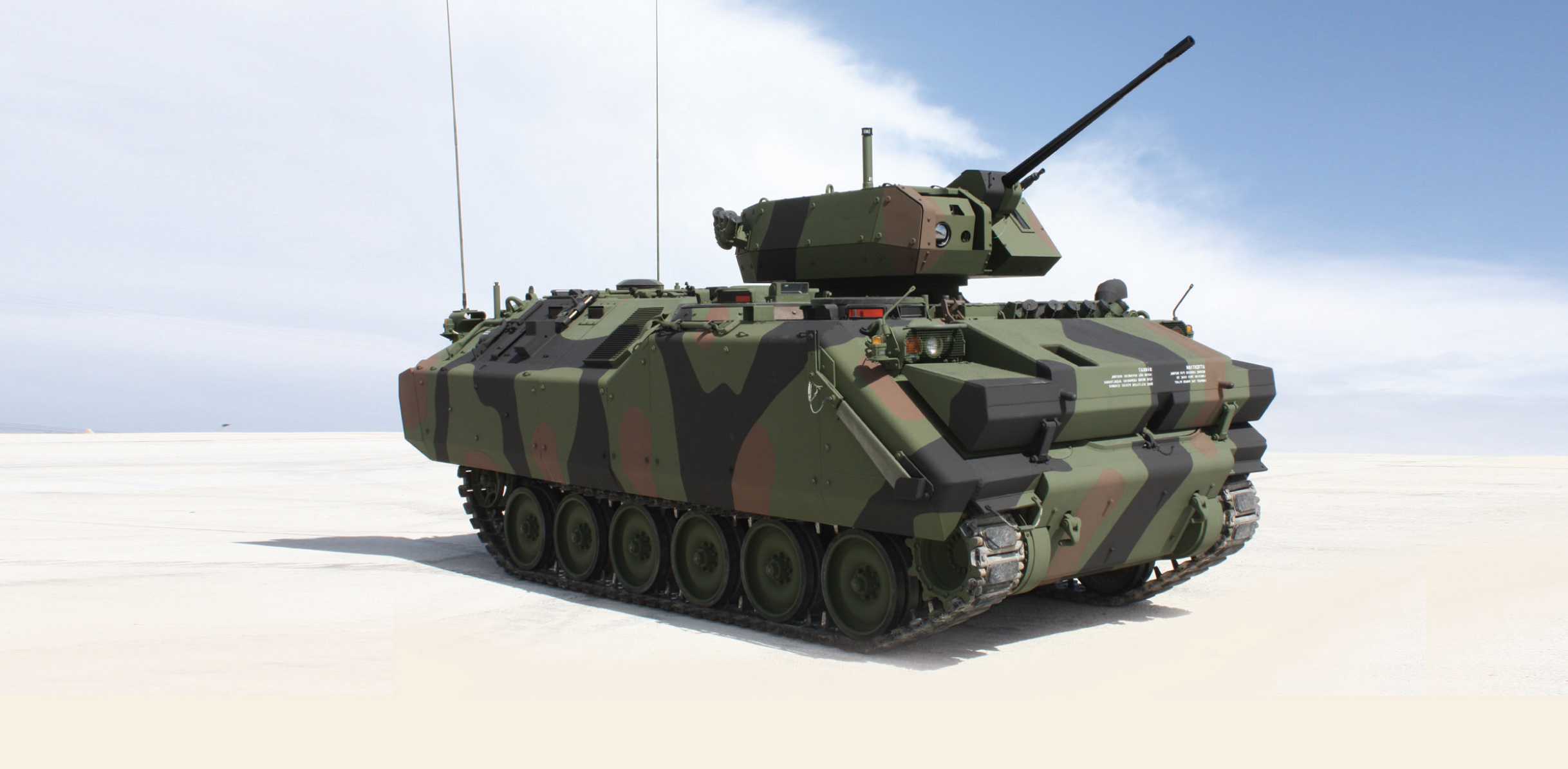
The Claw RCT is suitable for installation on a wide range of tracked and wheeled armoured fighting vehicles (AFV) as original equipment or to enhance the firepower of older platforms.The first example of the Claws RCT is armed with the Rheinmetall Italy 25 mm KBA dual feed automatic cannon which is provided with 210 rounds of ready use 25x137mm ammunition in two separate compartments for HE and AP. The empty cartridge cases and links are ejected outside of the turret for main and secondary armaments.
The 25 mm KBA cannon has a maximum cyclic rate of fire of 600 rounds/minute and the gunner can select single shot or burst modes of fire. A 7.62 mm MG3 machine gun (MG) is mounted co-axial with the 25 mm KBA cannon on the right side of the Claws RCT and this is provided with 400 rounds of ready use ammunition. The gun is electromechanically cocked from the user interface within the hull.A key feature of the Claw (or Pence in Turkey), is that ammunition for both of these weapons can be reloaded from within the platform under full armour protection.A bank of four 76 mm grenade launchers are mounted either side of the turret towards the rear, but these could be replaced by grenade launchers of other calibres according to customer requirements.
Turret traverse is all electric through a full 360 degrees with weapon elevation from -10 to +50 degrees with rates of more than 60 degrees per second.
Claw turret has an advanced fire control capability with the help of its onboard fire control computer and stabilized independent sight system. The Claw’s fire control software (FCSW) combines laser range, environmental readings, ammunition type, and turret control inputs to automatically elevate the gun for range and to automatically generate a kinematic lead solution if a target is moving. This functionality, very similar to that of Main Battle Tanks (MBTs), allows the gunner to center the reticule on a moving target, lase the target, and achieve a first-round-hit, without the need to fire sensing rounds and adjust aim.
The dual axis stabilized optronics package includes a 8-12 µm thermal imager with wide and narrow fields of view, day camera and laser range finder and provides the platform with the ability to engage targets under almost all weather conditions with a high first round hit probability. The gun is electronically slaved to the sight. An automatic target tracker is fitted as standard. The next version of the RCT will have an independent commander’s sight on the roof of the turret enabling hunter/killer capability. The weapons are laid onto the target by the gunner within the hull of the platform using a control console with a flat panel display and dual handed controller.
This display could also be used to provide images from cameras mounted around the vehicle as well as information from a battle management system, for example. The turret shell is of all welded aluminum armour protection with add-on steel armor providing ballistic protection to STANAG 4569 Level 2 as standard but this can be increased to Level 3 standard.The low weight of 1,700 kg of the baseline Claws RCT allows it to be fitted to a much wider range of platforms than conventional manned turrets fitted with a basket.The latter takes up considerable internal volume and reduces the number of troops that can be carried when the platform is being used in the armoured personnel carrier role, for example.The first example of the Claws RCT will soon enter the qualification phase including firing trials integrated onto the FNSS Pars 6x6 vehicle.While the prototype Claw RCT is armed with the 25 mm KBA cannon, a number of other weapons could be installed in this turret including the ATK 25 mm M242 and 30 mm MK44 cannons.