Roketsan Unveiled the New Generation Mini Cruise Missile Family "ÇAKIR"
Roketsan's New Generation Mini Cruise Missile ÇAKIR can be launched from fixed and rotary-wing aircraft, Unmanned Combat Aerial Vehicles (UCAVs), Armed Unmanned Surface Vehicles (AUSVs), tactical wheeled vehicles, and naval platforms, and offers operational versatility against land and surface targets. With a range of over 150 kilometers, ÇAKIR's targets include surface targets, land and surface targets close to shore, strategic land targets, field targets, and caves.
According to shared information in the presentation, the family of ÇAKIR cruise missiles are expected to be composed of ÇAKIR LIR, ÇAKIR AS, ÇAKIR SW, and ÇAKIR CR configurations.
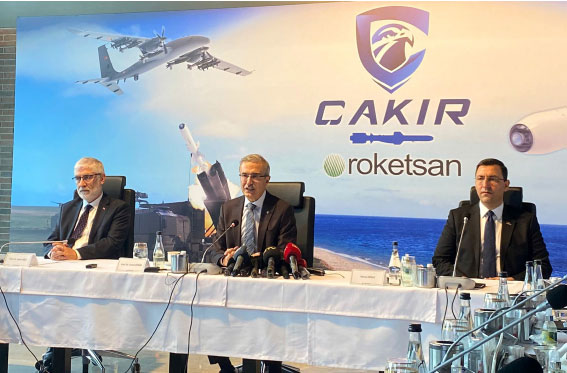
In his speech during the unveiling ceremony, Murat İKİNCİ gave information about the variants in the ÇAKIR Family. He stated that the ÇAKIR CR is a cruise missile against land targets and will have different versions with IR, RF, and Hybrid (IIR+RF) seekers. Another member of the ÇAKIR New Generation Mini Cruise Missile Family is the ÇAKIR AS anti-ship cruise missile developed for naval platforms. ÇAKIR AS will also be a part of the Coastal Defense System, where the ATMACA Cruise Missile will be the primary weapon system and will be used especially against small surface targets such as torpedo boats and AUSVs. The Coastal Defense System will incorporate a joint command control center/system and data link infrastructure, and ATMACA and ÇAKIR Cruise Missiles will be used together. Each ÇAKIR AS Launcher will be armed with 4 missiles. According to the information shared by Murat İKİNCİ, ÇAKIR LIR, the other member of the ÇAKIR Family, will carry an Electronic Warfare (EW) Payload to jam/deceive all EW platforms within the target area. While the missile is in the air, it will be able to simulate the radar signature of an F-16 or a user-specified aircraft to force the radar of enemy air defense systems to turn on. In this case, the ÇAKIR LIR will have a Signature Augmentation Subsystem (SAS) consisting of multiple active radar amplifiers covering different frequencies, which will show itself to the enemy air defense systems as Turkish Air Force (TurAF) aircraft with different RCS values (such as E-7T AEW&C, KC-135R Stratotanker, F-16 and F-4E 2020). In addition, RF Jammer equipment can also be installed to deceive the enemy air defense systems when necessary. However, for this type of SEAD mission, the ÇAKIR LIR will need to be capable of loitering over the target area, such as the ADM-160B/C and TALD/ITALD tactical air-launched decoys, and its flight time will need to be over 45 minutes depending on the altitude. Since the thrust of the KTJ1750 Turbojet Engine can be adjusted during flight with its low fuel consumption, the ÇAKIR LIR will be able to loiter in the air enough to perform this task with a low cruising speed. With these features, the ÇAKIR LIR will actually have a similar mission profile to TUSAŞ's Supersonic UAV GÖKSUNGUR (weight of 100kg, has a diameter of 80cm, and a length of 270cm). The last member of the ÇAKIR New Generation Mini Cruise Missile Family is the ÇAKIR SW Missile, which will have a modular structure and can perform swarm and saturation attacks, especially against targets with strong air defense.
Equipped with a domestic and national KTJ1750 Turbojet Engine developed by Kale R&D and the agility brought by its design, ÇAKIR easily performs tasks involving 3D waypoints defined during mission planning. With a unique warhead and hit point selection feature, the Cruise Missile offers a high destructive force against enemy targets. ÇAKIR owes the ability to engage targets with high precision under all weather conditions to its advanced mid-phase and terminal phase guidance systems. Network-based data-link facilitates Man-in-the-Loop capability for target update, attack/re-attack for the in-flight target of opportunity, and mission abort. The most prominent features of ÇAKIR are; its design, which allows the platform to carry multiple payloads up to four missiles, and its ability to perform swarm concept missions with inter-communicating missiles. The swarm concept, through which coordinated attack scenarios with multiple missiles are enabled, can be used to overcome hostile defense systems and ensures high effectivity against single or multiple targets. ÇAKIR offers high survivability thanks to its unique design with radar absorbing material utilized on the frame. ÇAKIR's ability for super sea-skimming and terrain masking in combination with radar-absorbing structure minimizes the detectability by enemy air-defense systems. Thanks to its Anti-jam GNSS and altimeter-supported inertial navigation system, ÇAKIR continues on its trajectory even in the event of intense electronic jamming.
Initiated with Roketsan's resources, the design studies of the indigenous and national ÇAKIR cruise missile are continuing, with the first tests are expected to be performed at the end of 2022 with the AKINCI UCAV and platform integration efforts for the other platforms (such as P-72 & P235 MPAs, SH-70 ASW/ASUW Helicopter, Fast Patrol Boat and AUSVs [ALBATROS & ULAQ]) are scheduled for 2023.
Within the scope of the unveiling ceremony of the ÇAKIR New Generation Mini Cruise Missile Family, a contract was signed between Roketsan and Kale R&D on the KTJ1750 Turbojet Engine Development. The signature ceremony which will take place with the participation of Turkish President of Defense Industries Prof. Dr. İsmail Demir, Roketsan Chairman of the Board Prof. Dr. Faruk Yiğit, Roketsan CEO Murat İKİNCİ and Kale Group Vice Chairman of the Board Osman OKYAY, covers the development and delivery of KTJ1750 Turbojet Engine to be used on the ÇAKIR New Generation Mini Cruise Missile prototypes.
The Qualification of Kale R&D KTJ1750 Turbojet Engine is Planned to be Completed Q4 of This Year
Cüneyt KENGER, General Manager of Kale R&D, shared on his LinkedIn account striking details about the technical features and development process of the KTJ1750 Turbojet Engine, which will power the ÇAKIR Mini Cruise Missile under development by Roketsan. Development of the KTJ1750 was started in 2021, and ground tests will begin soon with the first prototypes produced. The qualification process of the KTJ1750 is expected to be completed by the last quarter of 2022.
Kale R&D carries out KTJ Series Turbojet Engine development projects with different thrust levels for domestic (ATMACA/SOM Cruise Missiles, GEZGİN, ÇAKIR, and KUZGUN-TJ) and foreign customers by using its own resources with the knowledge and experience gained from KTJ3200.
Due to their small size and low weight, there is a misconception among the public that small turbojet engines are products that are easy to develop and produce. However, the production of a small turbojet engine for aircraft represents a more challenging engineering process than the production of large turbojet engines. Thanks to the experience and test infrastructures gained under the "Turbojet Engines Development Project," Kale R&D can now design and test turbojet engines such as the KTJ1750 in a shorter period of time.
KENGER said: "Kale R&D has been working on the development of turbojet engines since 2012 and has already developed the KTJ3200, which will power the SOM and ATMACA Cruise Missiles.
The serial production of the KTJ3200 has already started this year. The KTJ3200 has been a huge opportunity for our team to experience a whole engine development program from start to finish, comprising design, testing, manufacturing, and assembly activities, amongst others.
At Kale R&D, we also design and produce the control systems and engine accessories of our engines, mostly in-house. We own Turkey's single Altitude Test Facility specifically developed for testing jet engines that provides our engineers the chance to validate their designs under real flight conditions.
Seasoned propulsion engineers will know very well that building a prototype jet engine is one thing; however, making sure that the engine complies with all the harsh requirements is another thing that can only be accomplished with sophisticated test capabilities.
The capabilities that we have gained during the development of the KTJ3200 program give us the flexibility and agility that is required to support new programs such as ÇAKIR.
The development of the KTJ1750 engine started in 2021. Thanks to our established capabilities in all engineering disciplines providing us with high 'Technology Readiness Levels,' we have been able to complete the design very quickly.
The production of the first prototypes is almost completed, and the commencement of tests is imminent. Full qualification is planned to be achieved before Q4 this year."