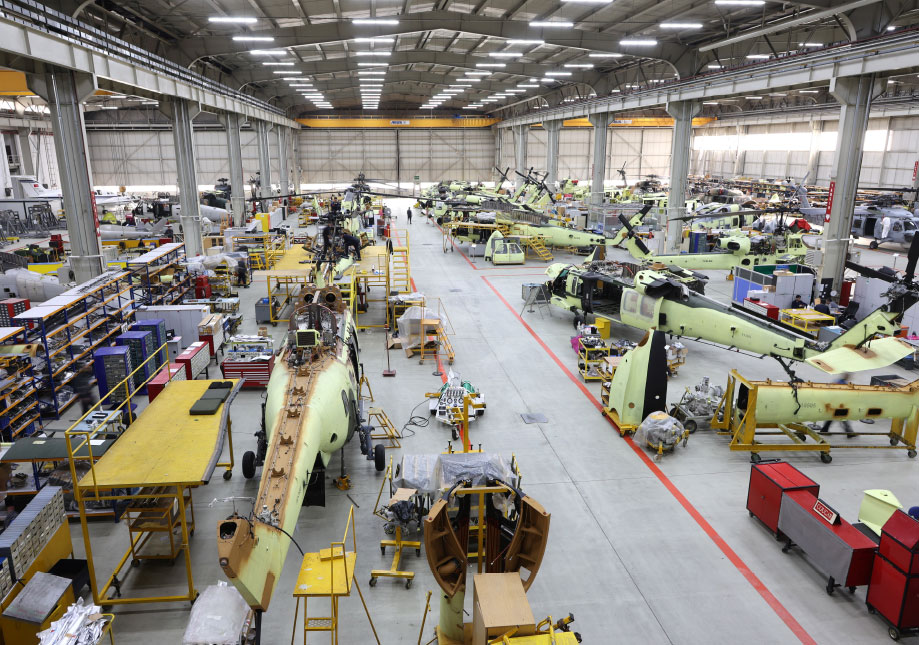
The Fortress of Turkish Army Aviation 5th Main Maintenance Factory Directorate

In recent years, helicopters have become indispensable tactical and logistical support vehicles in modern warfare, leading to an increase in their usage frequency and effectiveness. The tactical and logistical advantages of helicopters in warfare have prompted the development of new strategies, placing helicopters at the center of operations. In line with this understanding, Türkiye’s rapidly advancing Army Aviation has integrated the most modern systems of the era. Efforts to procure new-generation aircraft are also ongoing to meet the evolving needs.
For aircraft to be continuously and reliably operational without any problem, robust and uninterrupted logistical support is essential. In pursuit of this goal, the 5th Main Maintenance Factory Directorate (5th ABFM), operating under the General Directorate of Military Factories (AFGM) of the Ministry of National Defence, was established in 1948 to conduct replenishment and maintenance activities for aircraft. The factory successfully carries out maintenance, repairs, overhauls, modifications, and modernizations of both fixed-wing and rotary-wing aircraft. As of November 2023, a total of 1,100 personnel, including 800 Workers, Officers, and Engineers, were working in the 5th Main Maintenance Factory Directorate, which is the fortress of Turkish Army Aviation.
On November 16, 2023, we visited the facilities of the 5th Main Maintenance Factory Directorate (ABFM) with special permission from the Ministry of National Defence to gather firsthand information about maintenance, repair, overhaul, and modernization activities conducted on aircraft and helicopters, as well as aviation maintenance support provided to public and private institutions, quality management, laboratory, calibration, manufacturing activities, and the sentiments and thoughts of the personnel. Initially, we had a brief meeting with Brigadier General Kadir EĞRİBOYUN, the Director of the 5th Main Maintenance Factory, in his office. Subsequently, we conducted a factory tour and observed the ongoing maintenance, repair, overhauls, and modernization works on site. During the factory tour, we had the opportunity to gather information about the ongoing projects from the relevant department/workshop officials.
Defence Turkey: What can you tell us about the size of the indoor area and the main activities of the 5th Main Maintenance Factory Directorate?
Brig. Gen. Kadir EĞRİBOYUN: The 5th Main Maintenance Factory Directorate, operating under the General Directorate of Military Factories, is in Ankara/Güvercinlik. The premises have a total indoor area of 82,000 m2, which includes workshops, hangars, warehouses, and service facilities. The duties of the 5th Main Maintenance Factory Directorate are as follows:
Performing factory-level maintenance, repair, and overhaul of all aircraft and helicopters of the Turkish Land Forces Command, as well as helicopters of other security forces, public institutions, and organizations,
Conducting improvement and development studies related to aircraft and implementing necessary modifications and modernizations as deemed necessary,
Manufacturing spare parts required at the factory level,
Providing on-site maintenance and repair support to Army Aviation Units and other Military Branches and Organizations, when necessary,
Providing Technical Advisory services to Higher Commands and Lower Units regarding aircraft,
Carrying out the Technical Management Responsibility of Aircraft.
We conduct these activities with our experienced Officers, Non-Commissioned Officers, Civil Servants, and Workers who are specialized in their fields.
The 5th Main Maintenance Factory Directorate continuously improves its capabilities to fulfill its duties and increase its support to the Turkish Armed Forces (TAF). Our factory provides maintenance and repair services in accordance with international aviation standards not only for helicopters and aircraft in the inventory of the TAF but also for helicopters and aircraft of public institutions, organizations, and private companies through revolving funds. The 5th Main Maintenance Factory Directorate envisions itself as "One of the World's Leading Helicopter Maintenance Centers" and is the only center in the world that has signed an authorized maintenance and repair contract with Sikorsky Company.
Each aircraft supported is a symbol of our country's pride in the skies and dedication of the 5th Main Maintenance Factory Directorate personnel, reflecting the technological level achieved. Emphasizing our glory in celebrating the 100th anniversary of the founding of our Republic with our people, we would like to say the following: “Our factory, like all other Military Factories, is always ready and will be prepared to fulfill all tasks entrusted to it to elevate our national defence industry to higher levels by providing production, maintenance, and repair services at international quality standards to the Turkish Armed Forces, public institutions and organizations, as well as friendly and allied countries.”
“Tireless” Maintenance and Repair Warriors of Army Aviation
Turkish Armed Forces extensively use attack, reconnaissance, and training helicopters as well as utility helicopters for personnel and material transportation. Helicopters undergo overhaul due to factors such as the conditions they operate in, exposure to vibration, corrosion, reaching the end of their service life, or accidents. In this context, during our factory tour focusing on ongoing helicopter overhaul efforts at the 5th Main Maintenance Factory Directorate, our next stop was the Fuselage Group Leader, where the following information was provided regarding the activities conducted:
"Helicopters are overhauled every year based on fuselage condition assessments. During overhaul, all parts of the helicopters are completely disassembled, and the disassembled parts are sent to the relevant workshops for necessary inspection, repair, and refurbishment. Additionally, the paint of the helicopters is completely removed to conduct damage and crack inspections. After the necessary repairs are made on the fuselage, the helicopters are coated with primer. Following this process, assembly begins. Once the inspections, repairs, and refurbishments of the relevant parts are completed in the workshops, and the necessary parts are replaced due to wear, the helicopters are assembled and made ready for flight."
In the event of major damage resulting from accidents or crashes, the helicopters are repaired using fuselage repair jigs. The repair of the structural parts of the aircraft is also carried out in the Fuselage Repair Workshop. In this context, first, the helicopter fuselage and structural parts are thoroughly inspected, and then any identified damage, corrosion, and cracks are repaired according to the relevant documents and procedures. If necessary, these procedures can also be carried out on-site at units supported by the 5th Main Maintenance Factory Directorate.
At our next stop on the tour, we find ourselves at the Engine Accessory section. Here, one of the critical components of the helicopter, the engine, undergoes a meticulous process of disassembly, followed by individual inspections of all parts in the engine workshop. Subsequently, maintenance, repair, and overhaul work are carried out. The next stage involves transitioning to the testing process. The Engine Accessory Group Leader explains the activities conducted in this workshop as follows:
"In this workshop, maintenance, repair, and overhaul operations are conducted on both turbine and piston engines, as well as their sub-components, for both fixed-wing and rotary-wing aircraft, by trained and skilled personnel. When engines arrive here for overhaul or repair, they are completely disassembled and meticulously inspected down to the smallest detail. Parts that have reached the end of their service life are replaced, damaged materials and components are repaired, and subsequently, the assembled engines are prepared for testing. Helicopter engines completed on the assembly line are tested in computer-controlled engine test benches, where flight conditions are simulated to measure performance values. Engines that meet the required performance criteria are then sent to the fuselage assembly workshop or unit to be installed on helicopters."
Undoubtedly, the comprehensive and detailed work conducted here plays a crucial role in ensuring the smooth operation of the engines, which are the most vital components of both fixed-wing and rotary-wing aircraft.
Similar to engines, the transmission components, gearboxes, hydraulic systems, and associated bearings and seals, as well as blades and rotors, undergo measurement, evaluation, maintenance, and repair processes, along with comprehensive testing by experienced personnel in compliance with aviation standards. The Rotor Blade Section Chief describes the 5th Main Maintenance Factory Directorate's capabilities for maintenance, repair, and overhaul of tail rotor and main rotor and blades as follows:
"In this workshop, maintenance, repair, and overhaul operations for aircraft propellers, rotors and blades are conducted in accordance with relevant technical publications, work procedures, and international aviation standards. Propellers and blades that come to our workshop due to various damages are first inspected by our quality control personnel to determine the necessary repairs. The required repairs are then carried out according to the refurbishment manual for the respective part. Any damage that is not visible to the naked eye on the propellers or blades is thoroughly inspected using an X-ray machine. After the repair process, painting and static balancing are performed to ensure that the propellers or blades are ready for use."
Due to the potential consequences of even the smallest error in maintenance activities in aviation, which can lead to loss of human life and significant financial losses, each part undergoes a detailed inspection. Parts of the aircraft are cleaned using chemical and mechanical methods. Non-destructive testing methods are used to detect cracks that are not visible to the naked eye, and parts that are deemed suitable for use are prepared and returned to service.
The 5th Main Maintenance Factory Directorate also includes Fluid Analysis, Chemistry, and Metallography Laboratories. Fluid samples taken periodically from aircraft systems undergo various analyses in the Fluid Analysis Laboratory, enabling the detection of faults in the systems at an early stage. This helps prevent potential loss of life and property as wear and tear are identified without the need to dismantle aircraft parts. In the Chemistry Laboratory, tests are conducted to verify the suitability of adhesives and filler materials used in critical areas of aircraft. Meanwhile, in the Metallography Laboratory, metal parts undergo chemical composition, hardness, and tensile tests to determine if they meet the required specifications. Approximately 7,000 tools and equipment used during aircraft maintenance and repairs undergo calibration processes annually to ensure accuracy and address errors. These processes and other delicate maintenance are conducted in specially controlled environments with controlled dust, moisture, and temperature levels.
Maintenance, repair, overhaul, and improvement activities for advanced technology instruments, communication, navigation, electronic warfare, and fire control systems, collectively called "Avionics Systems," installed on aircraft are carried out by experienced and qualified personnel. Turkish engineers and workers carry out the design and production of many electronic test devices. The Avionics Group Leader at the 5th Main Maintenance Factory Directorate oversees the engineering tasks related to the design, development, preparation of technical documents, development of work procedures, and modernization activities for all electronic devices used on aircraft. Additionally, approximately 1,000 types of spare parts are manufactured annually using CNC (Computer Numerical Control) machines to meet the needs of the Turkish Armed Forces. Efforts are also underway to produce foreign-origin products within the country through the manufacturing capabilities of the facilities or collaborations with domestic companies. As a result of these efforts, foreign currency outflows have been significantly reduced while retaining value-added activities within the country by supporting local firms.
The 5th ABFM Manufacturing Study Department Chief, where 18,000 different parts are manufactured, provides important details about the quality understanding, quality policy, and ongoing quality assurance activities of the 5th Main Maintenance Factory Directorate:
"Our Directorate studies materials that can be manufactured in our Directorate and prepares technical drawings and information packages. We also examine imported materials to assess their manufacturability within the country and prepare technical information packages to manufacture those materials domestically. As the first military factory in Türkiye where serial assembly of helicopters (UH-1H) is carried out, 5th Main Maintenance Factory Directorate is one of the world's leading helicopter maintenance centers. The activities carried out at the 5th Main Maintenance Factory Directorate are implemented within the Total Quality Management understanding with the participation of all employees. In this context, various training sessions on various topics are provided to all personnel, both from within and outside the institution. Every suggestion to improve product and service quality, efficiency, personnel, and customer satisfaction is evaluated and carefully implemented. The 5th Main Maintenance Factory Directorate defined its Quality Policy as meeting the needs of the institution and organization it serves, particularly the Turkish Armed Forces, in a timely, most economical manner, in compliance with international aviation standards, without compromising on quality, occupational health and safety, and environmental management requirements in all areas of service provided, and to continuously improve and develop production and design activities. Our Factory Directorate holds AQAP-2110/2310 NATO Industrial Quality Management/Quality Assurance System Documents as well as the SHY-145 Civil Aviation Approved Aircraft Maintenance Organization Certificate for civil aviation-related activities."
Flying is the final destination for helicopters, which undergo meticulous maintenance, repair, overhaul, and modernization processes for all parts. The test flight begins with a full performance ground run. Experienced test pilots conduct ground and flight tests along with subsystem tests to complete the final checks of the helicopters.
The Quality Management Director, who is also a helicopter test pilot, summarizes the final activities before the airworthy steel wings take off from the nest as follows:
"In our unit, the airworthiness of aircraft and engine performance is tested for flight suitability. For this purpose, starting from the initial ground run, all systems undergo checks and adjustments, followed by flight checks. Our goal is to ensure that aircraft are delivered to their units without any issues once the process is completed. After all procedures are completed, the helicopter, painted in camouflage suitable for its mission in the paint workshop, is now ready for duty."
Besides making significant contributions to aircraft, the 5th Main Maintenance Factory Directorate constantly renews its efforts to fulfill its given tasks in the best possible manner. In this context, the Factory Directorate has produced and nationalized Aerial Firefighting Kits in a short time. These kits, which are also exported through ASFAT, play a vital role in preserving the significant wealth of the homeland, which is forests and nature. So where are these systems manufactured and how many produced so far?
Manufacturing Department Chief of 5th Main Maintenance Factory Directorate summarizes our question regarding the fire extinguishing kits that have been produced and delivered in the last three years as follows:
"Firefighting kits that were procured from abroad in previous years have been domestically and nationally produced by the 5th Main Maintenance Factory Directorate using local and national capabilities as of 2021. The 5th Main Maintenance Factory Directorate has produced and delivered, 27 kits with 2.5-ton capacity, 8 kits with 7.5-ton capacityfor use in helicopters in the inventories of the Ministry of National Defence, Ministry of Interior, and Ministry of Agriculture and Forestry."
The firefighting kits produced using domestic and national capabilities have made significant contributions to extinguishing huge forest fires in our country since their production. It's crucial to emphasize that they have been effectively used in extinguishing fires, making them one of the most critical components of our fixed and rotary platforms for preserving wildlife and natural habitats.
In this context, for more detailed questions, we will direct our inquiries to Procurement & Logistic Department at ASFAT, Atilla SERT, regarding the manufacturing process of Firefighting Kits at the 5th Main Maintenance Factory Directorate their capacities, advantages of domestic production, and ongoing efforts.
Defence Turkey: How did the production of Fire Extinguishing Kits by ASFAT - 5th Main Maintenance Factory Directorate start?
Atilla SERT: In recent years, meteorological data have shown unprecedented heat, strong winds, and climate change, makingit inevitable and necessary for the Green Homeland Defence to be carried out effectively through Aerial Firefighting. ASFAT, with its field of activity being HOMELAND DEFENCE, continues to increase its FORCE MULTIPLIER role by enhancing the capabilities of our Military Factories and Shipyards for effective utilization. As it is known, we experienced the largest forest fires in the history of the Republic in 2021, having to combat more than 200 forest fires during the July-August period and losing 140,000 hectares of our forests. ASFAT, together with the engineers and workers of the 5th Main Maintenance Factory Directorate, has produced Firefighting Kits for the first time in our country to effectively combat wildfires from the air. Fortunately, our burned forest area has decreased to one-tenth of the 2021 level in the periods of 2022 and 2023.
Defence Turkey: What can you tell us about the Fire Extinguishing Kits and ongoing work?
Atilla SERT: Our Green Homeland Defence initiative, which began with the production of Firefighting Kits with 2.5 Ton and 7.5 Ton capacity, continues under the direction of the 5th Main Maintenance Factory Directorate with the production of Powerpacks, Foam Regulators, Marine Rescue Equipment, Helicopter Belly Tanks Integration, Maintenance Repair, and Excellence Center establishment. The capacities of the Kits can be easily changed according to demand. Most of our country's firefighting kit inventory consists of ASFAT-5th Main Maintenance Factory Directorate kits. NATO Stock Numbers have been obtained for the 5th Main Maintenance Factory Directorate Firefighting Kits, which are produced at a quality level above similar ones and a cost well below world prices. The Fire Extinguishing Kits were also exported abroad. Considering the firefighting organizations, federations, and fairs worldwide, along with their unique ecosystems and technological advancements, it is clear that there is much more to be done in our country for Aerial Firefighting against Forest Fires. ASFAT and General Directorate of Military Factories (AFGM) will remain at the forefront of the Green Homeland Defence.
The 5th Main Maintenance Factory Directorate has earned a significant place within the TSK (Turkish Armed Forces) through its accumulated experience, continuously enhanced capabilities, qualified personnel, and modernization efforts to keep pace with rapidly evolving aviation technology. It also contributes greatly to the country's economy, similar to other Military Factories. In addition to the maintenance, repair, overhaul, modernization, and even production of crucial equipment such as firefighting kits, this facility restores helicopters that have become unusable due to accidents, crashes, or other reasons, through comprehensive efforts, returning them to inventory. Thanks to the capabilities gained through the dedicated efforts of the 5th Main Maintenance Factory Directorate many operations that were previously carried out abroad for years are now conducted within the factory premises. Consequently, the cost of these operations has been significantly reduced, and the downtime for repairs shortened, enabling the maintenance of high operational rates for aircraft.
The technical evaluation of the 5th Main Maintenance Factory Directorate is summarized by the Technical and Project Management Director of the 5th Main Maintenance Factory Directorate.
"The 5th Main Maintenance Factory Directorate is responsible for the technical management of rotary-wing aircraft in the inventory of the Turkish Armed Forces (TAF) and fixed-wing aircraft in the inventory of the Turkish Land Forces Command (TLFC). Since 1948, our Factory Directorate has been providing solutions for maintenance, repair, and modernization activities with its technical staff in structural, engine, and avionics areas for the depot-level maintenance of the aircraft in our inventory and contributes technically to the modernization projects of the Turkish Armed Forces concerning all aircraft under its responsibility. The 5th Main Maintenance Factory Directorate envisions itself as 'One of the World's Leading Helicopter Maintenance Centers.'
As part of our efforts to become a center of excellence in our field, we are meticulously working on projects that will establish the triangle of university-defence industry-Turkish Armed Forces, which will tremendously contribute to the advancement of our defence industry. All our activities are carried out in compliance with international standards, following AQAP-2110 (NATO quality assurance requirements for design, development, and production), AQAP-2310 (NATO quality management system requirements for aerospace, and defence contractors), TS-45001 Occupational Health and Safety System, and the SHY-145 certificate for providing maintenance and repair services to civil aviation.
To ensure that aircraft keep pace with rapidly advancing technology and can be used more efficiently and for longer periods, we continuously improve the capabilities and resources of our country through refurbishment, modification, and modernization activities implemented as a result of the joint efforts of Turkish engineers, workers, and technicians. Especially in recent years, with the significant support provided under the umbrella of the Ministry of National Defence, a major leap has been initiated in terms of facilities, equipment, training, and personnel.
With the support we have received in recent years to catch up with technology, we have established our 3D Design Office, Destructive Testing, Virtual Reality Office, and restructured our workshops according to modern engineering technologies. Thanks to these facilities, problems related to all rotary-wing and fixed-wing aircraft can be solved within our factory using modern engineering technologies. In addition, in the 3D Design Office, reverse engineering activities of all kinds are carried out, and rapid prototyping is done using additive manufacturing methods. Our factory's destructive/non-destructive testing capabilities enable the technical specifications of existing or manufactured system materials to be defined. With the corporate memory we have created in our Virtual Reality Office, both machine learning and technical development efforts of the personnel are conducted professionally.
Through Strategic Cooperation Agreements (SCA) that we signed with domestic companies under the umbrella of the General Directorate of Military Factories, our dependency rate on foreign-origin components is greatly reduced thanks to the indigenous and national systems developed by Turkish engineers in structural, engine, powerpack, and avionics fields. This prevents the country's resources from going abroad. Protocols signed with universities and vocational high schools also contribute to the infrastructure of qualified engineers and technicians who will work in Türkiye’s aviation sector."





