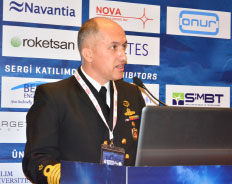
TNFC Design Project Office and the TF-2000 Air-Defense Warfare Destroyer
First of all, before explaining the TF-2000 Air-Defense Warfare Destroyer, I would like to briefly introduce the Design Project Office Directorate. Equipped with design and construction know-how, as a result of the 65-year training policy of the Turkish Naval Forces Command and with this confidence, the Design Project Office Directorate was established as the MİLGEM Project Office on March 12, 2004, with a humble staff of 45 people who believed that they could design the first national warship of the Republic of Turkey and the Turkish Navy. All its staff consists of Turkish Naval Forces Command (TNFC) personnel, including Engineer Officers, NCOs, and civil servants.
The Design Project Office operates in all disciplines required for designing a warship, such as shipbuilding, machinery, and electrical & electronics, and in this context, it can also perform detailed design activities along with form design, structural design, resistance and propulsion calculations, stability and maritime calculations, and platform and combat systems design. In addition, it also performs survivability analyses that require advanced engineering.
I would like to briefly explain the projects that the Design Project Office has previously accomplished. With the MİLGEM Project, which was initiated in May 2004, the design and integration of a complex surface combatant with today's technology standards and high combat capability were carried out for the first time in Turkey by the Naval Forces Command Design Project Office Directorate with the support of the domestic industry, using national resources. With this project, we nationalized the technologies used in many critical systems, gained knowledge and experience in this field, and we began to actually produce these technologies in our country. Under this Project, TCG Heybeliada, TCG Büyükada, TCG Burgazada, and TCG Kınalıada Corvettes were delivered to our Navy and are currently performing their duties.
The MİLGEM Project is one of the rare projects that was completed within the specified timeframe, performance, and budget among its counterparts, and the project has been described as a great success by international authorities. Initiated in February 2014 by the Design Project Office with the directive of the Naval Forces Command, the design activities of the I-Class Frigate Project, which requires knowledge and has gone through advanced engineering stages, were carried out by our Directorate. The construction of the first ship was started at the Istanbul Naval Shipyard in 2017, and the vessel was launched on January 23, 2021. The outfitting activities are currently continuing at a rapid pace at the Istanbul Naval Shipyard.
A national air-Defense Warfare Destroyer was needed to meet the country's defense, gradually starting from the seas and to meet the need for a surface platform with superior anti-air and offensive capabilities. In this context, with the directive of the Naval Forces Command, the design activities of the TF-2000 Air-Defense Warfare Destroyer Project started on January 14, 2019, by the Design Project Office, and the work is continuing.
The TF-2000 Air-Defense Warfare ADW) Destroyer will be able to operate effectively on all seas around the globe to increase the deterrence of the Turkish Naval Forces and establish a defined air picture to perform Area Air-Defense missions. Together with its Task Force elements, the TF-2000 ADW Destroyer will also be able to conduct long-range Air-Defense Warfare, Anti-Submarine Warfare, and Surface Warfare, and perform Offshore Engagement (Land Attack) to defend a geographical area against all kinds of threats and will have the capabilities to perform other wartime operations effectively.
Here, the general characteristics of the ship as of the current design are shown on the slide: full length 166m, displacement 8,500 tons. Since the maximum speed is defined as 28+ knots in the Project Definition Document, the current design follows accordingly. Of course, the most critical stage of the design process is selecting the Main Propulsion System. After defining the basic design principles, the selection and layout of the Main Propulsion System configuration, one of the most critical stages of the ship design cycle, was carried out. After reviewing all alternative Main Propulsion System configurations, it was decided to use Combined Diesel Or Gas (CODOG) configuration and a split-funnel layout as the Main Propulsion System as a result of the evaluations made in terms of both design and future sustainability based on the current resistance values and project definition document requirements. In this context, the envisaged CODOG configuration is planned to use two gas turbines to provide high power density for high-speed needs, two diesel engines for economical use at low speeds (cruising speed), and two controllable-pitch propeller systems to provide optimum thrust at different speeds stages.
Currently, only the power requirements of diesel engines or gas turbines have been determined under the TF-2000 ADW Destroyer design study. As the Detail Design Phase and the Contract have not been signed yet, it is not possible to procure the Main Propulsion System right now. The engine and gas turbine brand and model will be determined following the contract signature. Therefore, the current design prepared by the Naval Forces Command Design Project Office is an alternative design. In other words, the Main Propulsion System is progressing without being dependent on any brand, model, or company.
As can be seen on this slide, only the main gun is not a national product in the TF-2000 Air-Defense Warfare Destroyer. Other than that, all systems, devices, sensors, and weapons will be nationally designed and produced, and used on the TF-2000. In the following slides, I would like to briefly explain the Weapon Systems and Sensors that will be on the ship. The TF-2000 Air-Defense Warfare Destroyer will primarily serve to detect low, medium, high altitude, and short, medium, and long-range guided missiles by using the sea as a shield and destroy them before they approach the mainland. The TF-2000 will also incorporate high-capability combat systems, most of which will be developed nationally to bolster the country's air defense from the open seas and perform operational roles such as Area Air Defense.
While I am talking about the Weapon Systems and Sensors on the ship one by one, I would like to explain their current situation. As you know, the ATMACA Guided Missile has proven itself with the latest live firing from the TCG Kınalıada Corvette and is ready for use on all our ships and the TF-2000. It is planned to use a total of 16 ATMACA Missiles (8 on the starboard and 8 on the port side) on the TF-2000. In order to meet the need for a vertical launching system for the integration of Air Defense Guided Missiles, one of the most significant capabilities and elements of Air Defense, the MIDLAS Project is currently carried out by ROKETSAN for the I-Class. It is expected that the Vertical Launching System to be produced by ROKETSAN will also be used in the TF-2000. The ship will have 8 modules in total, 4 modules at the front and 4 modules in the middle (each module has 8 cells, there will be a total of 2x32 cell Vertical Launching System on the ship).
The 127mm Naval Gun is selected as the Main Battery in the Project Definition Document. It could be 5/62 caliber or 5/64 caliber. It hasn't been decided yet. As the Countermeasure System, the National Decoy Launching System, which has been produced since the GENESIS Project and integrated into all our ships, will be used in TF-2000 Destroys. The system's placement on the TF-2000 was determined according to the ship's radar cross-section (RCS).
The Multi-Functional Phased Array Radar (ÇAFRAD) is the core of the TF-2000. If I remember correctly, as part of the Phase-I Project, ÇAFRAD successfully illuminated the target during the ESSM Guided Missile firing test carried out from TCG Göksu on December 11, 2018, and completed the prototype process by scoring a direct hit on the target. Afterward, ÇAFRAD's arrangement on the TF-2000, its size, configuration, and placement on island structures were tested with analyses and trials conducted in previous years and took its current form. The ÇAFRAD System consists of a fixed Long-Range Radar (UMR), fixed Illumination Radar (AYR), fixed Multi-Function Radar (ÇFR), and a non-rotating IFF antenna on the mainmast.
Currently, the GÖKDENİZ Close-In Weapon System (CIWS) is planned to be used as the Close Air Defense System on the front and aft of the ship. Apart from that there are a total of four 25 mm Remote Controlled Stabilized Naval Gun Systems (STOP), two on the front and two aft of the ship. As underwater systems and weapons, it is planned to use a hull-mounted sonar system, torpedo tube system, torpedo countermeasure system, and the stern-mounted Low Frequency Towed Active Sonar System (DÜFAS) on the TF-2000. Along with the TF-2000, there are some developments and steps to be taken in the electronic warfare dimension. Several of these were also planned for this ship. Again, all electronic warfare (EW) and electronic support (ES), and electronic attack (EA) antennas will be located in the integrated mast designed by us. Directional Infrared Counter Measures (DIRCM) Systems and other electro-optical systems and laser warning systems will be installed throughout the ship. In addition, the communication and navigation systems will be located on the main and aft masts with distributed architecture.
As the Combat Management System (CMS), the nationally and locally developed GENESIS ADVENT Combat Management System of the Turkish Naval Forces Command (TNFC) will be used in the TF-2000 Air Defense Warfare Destroyer. The integrated GENESIS ADVENT Combat Management System enables the user to make correct and rapid decisions by responding to the needs required by the network-centric operational approach. The GENESIS ADVENT Combat Management System will be able to collect and evaluate data coming from the weapons and sensors on board the ship and provide command support for assigning weapons, and both transfer and receive target information to/from other platforms via the integrated link system.
In accordance with the current Project Definition Document, the hangar of the TF-2000 Air Defense Warfare Destroyer is designed for two Medium-lift Utility Helicopters with a maximum take-off weight of 15 tons. In addition, there is an additional platform, hangar, ammunition stowage, and a JP-5 refueling facility for two fixed or rotary-wing Ship-Based Unmanned Aerial Vehicles to land and take off day and night for reconnaissance and attack operations. The ship will have the capability to operate 3 RIHBs (Rigid Hulled Inflatable Boat), one in the stern, one on the starboard, and one on the port side. The helicopter platform on board the ship will have Level-1 certification, which allows operations to be carried out day and night in inertial meteorological conditions, and Class-2 certification, which provides service for the aircraft deployment area. The armed or unarmed UAVs to be deployed on the ship will be used for different purposes such as carrying/transporting cargo, audio/data communication relays, electronic warfare, establishing a defined sea picture, and reporting contact/target information. The ship-based UAVs will have systems and equipment that allows landing and take-off at up to sea state 4 and can be controlled by the Ground Control Station on the ship. There will be a total of 3 high-speed RHIB Boats, each with a carrying capacity of 16 people, for special operations and personnel transport purposes.
The TF-2000 Air Defense Warfare Destroyer will feature a Flexible Mission Bay that will allow the ship to carry different payloads/containers that the vessel will need, depending on the mission requirements. The Flexible Mission Bay will have enough internal space to take ten 20 ft containers or 4 RHIB Boats (12m), or one Medium-lift Utility Helicopter with a maximum take-off weight of 15 tons. The mission bay will also feature winch frames, and side hatches with a lifting capacity of 15 tons to carry the Containers and RHIBs in 3D space and lower them into the water from the starboard and port sides of the ship. Depending on the operational needs, unmanned surface (USV) or underwater vehicles (UUV) can also be carried in the mission bay.
The TF-2000 was made using the analysis method developed specifically for national warships, and it is planned to use domestically produced high-yield shipbuilding steel as the main construction material of the hull and superstructures. The TF-2000 Air Defense Warfare Destroyer will have sensors and protection systems that will allow it to operate in Chemical, Biological, Radiological, and Nuclear (CBRN) environments. In this context, there will be collective protection zones with positive airflow higher than atmospheric pressure on the ship. Within the scope of the survivability design approach in line with the current technologies, the TF-2000 Air Defense Warfare Destroyer is designed to have a reduced Radar Cross-Section (RCS), underwater acoustic sound level, and magnetic and infrared signatures. In order to achieve this goal, a signature management approach was applied from the first stage of the ship's design. The TF-2000 Air Defense Warfare Destroyer is designed to withstand the current underwater and surface threats, increase the ship's offensive power, and have high survivability. The basic structural construction design for high survivability is verified by global and local finite element survivability analyses for each threat type. The ship structure is designed with a survivability design approach to withstand the current underwater and surface weapon threats and have high survivability with increased durability. On this slide, you can see the structural damage caused by an internal explosion inside the ship. The most suitable compartment and construction structure was chosen by repeating all these types of analyses throughout the entire ship for all compartments, and the ship design was completed by taking all necessary precautions. Likewise, necessary analyses were made, and all precautions were taken to minimize the shock and pressure effect on the ship from a non-contact distant underwater explosion





