TST Will Be One of the World`s Largest Wind Tunnels in Terms of Test Section and Wind Speed!
Defence Turkey: Can we start our interview with a brief overview of the importance of the Wind Tunnel in the design and development process of an aircraft? Can you provide some information about the tests performed in the Wind Tunnel and the average duration of these tests?
Turkish Aerospace: Wind tunnel tests, along with Computational Fluid Dynamics (CFD) and flight tests, have an essential place in the aircraft design process. According to NASA, these three disciplines form a pillar for the data source that needs to be created to evaluate the aircraft. Computational fluid dynamics uses computer-based numerical algorithms to simulate computer models of aircraft in different flight conditions. However, in some cases, certain simulations such as flow separation and high angle of attack may not bring reliable results depending on the speed and flight conditions. It also requires substantial computing resources to get the results. In a wind tunnel, on the other hand, a scaled model of the real aircraft is held stationary inside the tunnel, and the air is moved instead. The limiting factors of the wind tunnel are the air velocity and the model dimensions related to the test section. Depending on these two factors, the importance of the Reynolds number increases. In general, as the weather conditions change, it can be difficult to repeat the tests under the same conditions. Different types of tests are possible in the wind tunnel, such as database tests, air intake tests, and alternative configurations (such as wing, nose, tail). Depending on the purpose, test activities are completed between 1 week to 3 months.
Defence Turkey: What can you tell us about the technical specifications of Turkey's biggest and Europe's second-largest Large Subsonic Wind Tunnel (TST) still under construction at the Turkish Aerospace facilities and the capabilities it will bring to the Turkish aviation industry?
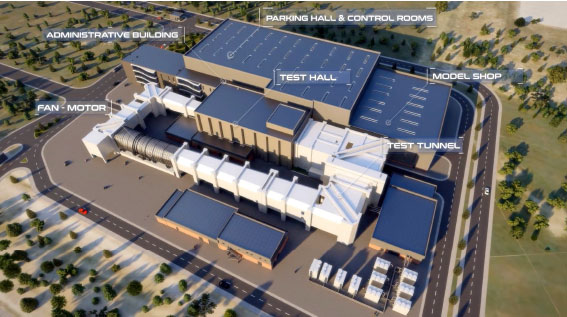
Turkish Aerospace: The construction of the Turkish Aerospace Large Subsonic Wind Tunnel, which we call TST for short, continues at our facilities. The TST will take its place among the largest wind tunnels in the world in terms of the test section and wind speed. With its test section of 6.4m x 4.8m and an expected wind speed of 130 m/s, the TST provides testing opportunities like the wind tunnels in Germany, China, Russia, and the USA with similar dimensions and velocities. In addition, we expect to reach a wind speed of 180 m/s in the small test section (4.9m x 3.7m). This corresponds to more than half the speed of sound. Our wind tunnel will be unique in this area. However, the dimensions of the test sections are not the only characteristics of the TST. It also features aero-acoustic capability. This will ensure that the noise generated by the airflow in the wind tunnel is minimized, and aero-acoustic tests will be possible. At the same time, the TST will be equipped with the most modern measurement and data collection systems as well as model animation systems. Therefore, we expect the TST to be one of the most capable wind tunnels in the world.
Defence Turkey: What measurement methods will be used in the large Subsonic Wind Tunnel, which is planned to be commissioned at Turkish Aerospace facilities by 2023?
Turkish Aerospace: In large and small test sections, force/momentum measurements and pressure distributions of all types of aircraft (Airplane, Helicopter, UAV) will be measured using the most modern model support systems to create an aerodynamic database. Flow Visualization tests will also be performed to evaluate aerodynamic phenomena.
Defence Turkey: What are the more prominent features of the TST compared to the Ankara Wind Tunnel (ART) and the equivalent wind tunnels in the world?
Turkish Aerospace: In addition to the Ankara Wind Tunnel (ART), the RÜZGEM Wind Tunnel at METU in Ankara also conducted its first tests last year. All three of these tunnels are closed-circuit horizontal loop subsonic tunnels. However, the biggest difference between the TST and the other two wind tunnels is the dimensions of the test section flow area and air velocity. The test section of ART (construction started in 1947) is 3.05m x 2.44m, generating a wind speed of 90 m/s. RÜZGEM, on the other hand, has a test section of 2.5m x 2.5m and reaches 100 m/s wind speed. We expect to get 180 m/s in the small test section of the TST (4.9m x 3.7m) and 180 m/s in the large test section (6.4m x 4.8m). The DNW LLF in Germany, CARDC LSWT in China, TSAGI T104 in Russia, and Boeing SWT in the USA are wind tunnels with similar dimensions to the TST.
Defence Turkey: Previously, it was claimed that two small fans had to be combined to generate airflow since the large fan required for the Large Subsonic Wind Tunnel Facility could not be bought from Germany and Japan. Were there any embargo-related problems during the installation process of the facility??
Turkish Aerospace: We did not face any embargo-related problems with the fan or other subsystems. Air circulation in the wind tunnel is provided by a single 14.5 MW water-cooled 12-blade fan, with a shroud diameter of 10.5m and a hub diameter of 5.6m. So, two small fans are not used. The manufacturer of the fan is a Scotland-based company that specializes in this field and has campuses in many parts of the world.
Defence Turkey: How many test sections will the Large Subsonic Wind Tunnel Facility have, and what type of tests will be performed for fixed and rotary-wing aircraft, and at what airspeeds (such as Static Wind Tunnel Test, Air Intake Test, Low-Speed Wind Tunnel Test)? Previously, it was stated that landing and take-off tests for aircraft could also be carried out with the integrated moving ground belt system at the facility.
Turkish Aerospace: Static wind tunnel tests, air intake tests, and moving ground belt system tests are planned to be performed at the facility. Currently, these tests are also carried out abroad. Integrating these systems into the TST will provide additional capabilities.
Defence Turkey: It has been announced that the Large Subsonic Wind Tunnel Facility, designed by the Canadian engineering company AIOLOS Engineering Corporation, will also have aero-acoustic testing capability. What can you tell our readers about this?
Turkish Aerospace: While performing aero-acoustic tests, for example, to identify the specific sound sources of UAV systems, first of all, the noise generated by the airflow in the wind tunnel should be minimized. Canadian AIOLOS Engineering Corporation paid attention to these issues and added acoustic remedial measures inside the tunnel during the design process.
Defence Turkey: Will the TST Facility also serve foreign customers when it becomes operational? Were there any institutions from abroad that also showed interest? How should we evaluate this facility in terms of Turkey considering international projects?
Turkish Aerospace: Our Company management attaches great importance to this issue. The TST facility will also provide opportunities to other institutions.
Defence Turkey: Turkish Aerospace had previously signed an agreement with the independent Aircraft Research Association (ARA) based in England for the Wind Tunnel Testing Risk Reduction Phase on July 19, 2018. What can you tell us about the activities carried out under this agreement?
Turkish Aerospace: Aerodynamic tests of our various aircraft were carried out in ARA’s wind tunnel facility. These tests have made significant contributions to our design activities.
Defence Turkey: The training and qualifications of the engineers who will work at this facility are also another important factor considering the quality of the services to be provided by the Large Subsonic Wind Tunnel Facility (TST). What can you tell us about the education level and experience of the personnel who will work here? Can you tell our readers about the qualifications of your workers compared to equivalent wind tunnels in the world?
Turkish Aerospace: We have prepared or are preparing training programs for our personnel with AIOLOS Corporation as well as with a third company. These are generally on-the-job training programs. In addition, we continue testing activities of indigenous programs within the company. We attach great importance to this issue in terms of gaining experience.
Defence Turkey: A supersonic wind tunnel is also needed to develop an aircraft like the MMU/TF-X. As far as we know, such tests are currently carried out using the infrastructure at BAE Systems facilities. TÜBİTAK SAGE will commission Turkey's first Supersonic Wind Tunnel in the coming years. Do you think the mentioned Supersonic Wind Tunnel will have sufficient capacity for Turkish Aerospace’s projects, or will you establish a separate supersonic wind tunnel for aircraft development?
Turkish Aerospace: We closely follow the valuable work of TÜBİTAK SAGE. Undoubtedly, this infrastructure will provide significant benefits to our country and Turkish Aerospace.
Defence Turkey: As we conclude our interview, is there anything you would like to add or a message to our readers?
Turkish Aerospace: I want to emphasize that we are also constructing a model workshop as part of the wind tunnel facility. The model workshop, which has an area of 2,700 m2, will be equipped with 5-axis CNC milling machines and quality measurement tools in various sizes and characteristics. It will also have three different model integration chambers and a separate calibration lab. In this way, we will be offering turnkey solutions, including model design/production/instrumentation and testing activities for domestic and international customers