“Growing Together is Our Goal Because Our Company is a Trustable Company with so Long Experience”
Leonardo Training Academy, Sesto Calende
The main factors behind Leonardo Helicopters’ rapid rise in the commercial and military markets since 2004 are its ability to offer original products containing the latest technologies that can meet market expectations and R&D investments in new technologies. Always on the technological frontier, Leonardo Helicopters Division invests in research, design and development, around 11% of its revenues each year. Thanks to this, instead of being a company that only develops and sells helicopters, Leonardo Helicopters is now a company that can offer its customers solutions tailored to their needs (over 1,000 certified kits have been developed to adapt the AW139 helicopter model to the customer's mission requirements, as an example), and designs and produces the transmission and avionics systems used in the helicopters it produces, as well as new rotary wing technologies. It is a global rotary wing manufacturer that can provide the necessary training and after-sales support services to the flight crew and maintenance personnel who will use the helicopters. The rapid increase in helicopter sales since 2004 has also been positively reflected in the number of flight crew and maintenance personnel trained.
Within the scope of the Leonardo Helicopters’ 2-day Press Tour event, on the morning of first day, we visited the Leonardo Training Academy (Alessandro Marchetti Training Academy) located in Sesto Calende and received information from Paolo PETROSSO, at the time VP of Simulation and Training Services at Leonardo Helicopters, regarding the Customer Support and Training Services provided by the company. He underlined that the Customer Support and Training is the service arm of the Leonardo Helicopters Division. Most of the activities related to Simulation and Training Services, including the support activities, at Leonardo Helicopters are performed at the Leonardo Training Academy campus, which operates 24/7. “We also make the design and development of all the digital services which is an essential part of our strategy going forward. Also, the service support engineering so everything that has to do with repair etc. it’s made here and that we have all the management of customer support and training,” PETROSSO said.
The team across the board between Italy, UK, US, Poland and all Leonardo Helicopters’ subsidiaries and network around the globe is comprising nearly 2,000 people. They are looking after the customer needs when the helicopters leave the factory. This is basically out of nearly 13,000 people working for the Helicopter Division of Leonardo. Leonardo is in total has around 51,000 employees. 13,000 of this for helicopters and 2,000 of them are for helicopter services. Leonardo Helicopters is a global player partnering with customers all over the world. More than just an Original Equipment Manufacturer (OEM), the Leonardo Helicopters is a business and total capability provider delivering the highest quality of Customer Service and Training solutions. Leonardo Helicopters’ customer base consists of over 1,500 customers in around 150 countries and they fly more or less 4,500 helicopters. According to PETROSSO, more than 50% of their customers have between 1 and 3 helicopters. “We also have customers that may have 100 helicopters. But the 50% is a relatively small fleet and this has a lot to do with the complexity of our business as in any support business. But obviously you must help, support and make the customers fly their helicopter regardless of the fleet size. So, we aim to make the customer that flies 1 helicopter to feel that they are the only customer that we have, like the customer that flies 100 helicopters,” he added.
Leonardo Helicopters’ integrated support and training network enhances customers intimacy. Division’s global network delivers direct access to it’s support and training services everywhere at 24/7 basis. “Because, it’s not ideal for the customer to travel the globe for the service. We want to be as close as we can to the customers so they can have rich services that are of a very very high standard,” PETROSSO said. Leonardo Helicopters’ partnerships are key to provide network opportunities, creating, maintaining and growing business together with it’s customers. Considering the fact that customers’ needs are quite diverse. Leonardo Helicopters operates or serves more than 100 facilities of which 82 are service station and the rest is their networks or either places where they have a factory or have an assembly line. But some of the Division’s subsidiaries around the globe are only support subsidiary. Meanwhile, support and training services are also profitable business for the Leonardo Helicopters Division. According to PETROSSO, the revenue of Customer Support and Training Services is almost 40% of the revenue of the entire Leonardo Helicopters Division. “The impact on the division results quite remarkable, of course, the more they fly the more these will increase. The numbers are to tell you how important it's for us to stay with the customer and serve the customer. This is key also of our strategy going forward. One of the service stations is the Kaan Air in İstanbul for civil market,” PETROSSO said.
Regarding the breakdown of the over 100 facilities around the globe that Leonardo Helicopters operates or serves PETROSSO shared following information: We have 3 24/7 Support Centers. The 24/7 Support Center is basically a pool of professionals so you have support engineers, you have logistic people. They basically stay on shift every day, every hour. These are the front line of the front line. These are the people that answer the phone if a helicopter is on the ground no matter if it’s a Saturday, Sunday, Friday night and there is a helicopter that needs parts, or they need the support consulting about technical methods. So, these people can answer on the spot. They can locate a spare part anywhere in the globe and activated the shipment to the customer no matter where they are. Maybe you know it's in Istanbul, it’s in Ankara and we can ship the part from Australia if the part is not available in the area. Nonetheless they have the picture of everything. To give you an idea of the complexity these people that work at 24/7 on answering the phone and they get on average 1,000 requests each month, it's quite a lot. As you can imagine, none of these requests, it's an easy one. Because it’s you can compare it to the first aid or emergency on a hospital. These are not scheduled appointment. These are really emergency calling someone that has the helicopter on the ground for an event that is unscheduled, and they need to fly. The average of time they take to close the request is 12 hours, which means between the time they get the phone call or email and the time they dispatch parts or repair scheme or support instruction, its less than half of a day. We have 13 Logistics Centers, which is where the spare parts are located. They are quite globally placed around the world. We also have 10 Repair Centers. What we mean by the Repair Centers? These are the centers that make repairs on ‘Golden Items’ such as transmission, blades, hubs. Really high-value, high-technology components that needs specific equipment, machinery and stuff to be repaired. As we said, we have more than 90 Service Centers the majority of those are third parties with Leonardo authorization. We have 11 Blade Repair Centers which are specialized on blade. In this case, we're talking about carbon fiber or any way composite material blades. So even the repair, it’s a quite relatively specialized maintenance. We have also 5 Training Academies (in Sesto Calende, Yeovil, Philadelphia, Swidnik and Kuala Lumpur) and 8 Authorized Training Centers. This is how we break down our services.”
At Sesto Calende campus there is also a floor for service engineering, where more than 100 people are looking at engineering services including technical publication software services, modification services and the fleet data. All managed by the team that is located here. It seems easy but the reality is that there is over 4,500 Leonardo helicopters take-off almost every day.
In all the things that are related to technology, training is one of the is one of the core elements that you need to have because you can have the best helicopter in the world, but if you don't have trained the crew to maximize the use of the helicopter, the investment is useless. On crew training and training simulators Leonardo’s specialists, shared following information with Defence Turkey: “Obviously with new helicopter we provide a training which is generally defined as Type Conversion (Type Rating). So, we get the pilot that is flying Bell or Sikorsky and then they buy a new Leonardo product, so we convert pilots, technicians and other professionals on the newly helicopter. But also in the recent year, we specialize a lot in operational training, which means not only we train the people on the new model, but also, we assisted the customer in making the aircraft operational when it gets sold. This is the example of police, SAR, EMS, etc. we have some of our instructors some of our training equipment which is specialized on these things. Because today we see that more and more the helicopters are acquired by customers that do not have that capability already. So, there are countries that say I want to acquire a Search & Rescue (SAR) helicopter, but they have no history of search and rescue with helicopters. So, they may be on the coast, but they never save people over the sea with the helicopter, or they never execute search and rescue people over the mountains. May be this is due to the fact that their previous helicopters did not have the capacity to do that. This is a challenge because when you are in front of your customer that have the budget to buy the hardware but do not have the capability now the challenge is not only building the helicopter, designing the helicopter, but you have to take the customer people and train them to become a rescue swimmer, to fly over the sea at night, to fly over the mountains. Sometimes they may also have medical crew that have never been in a helicopter before. So, we specialize in all those kinds of training, so we can train the customer while we produce the helicopter. When the helicopter is ready and then they move everything in country and we also in many cases we go in country and stay there for the depending on the mission, it can be a month, it can be three years and progressively we have them to reach the level that they have in mind and then we walk away. So, it's where we really achieve our mission. Because as Leonardo Helicopters Division we want to provide to our customer “Capabilities,” not only “Products.” So, we achieve our result when the customers are capable to use the machine for a purpose.”
When asked about whether they have the capability to perform joint operations in synthetic environment with existing simulators at the Leonardo Training Academy, Leonardo’s team said yes and disclosed that have already delivered this capability to an Italian customer. “We basically built completely a training center for Italy’s Guardia di Finanza in which you have 2x helicopters, 1x aircraft, 1x ship commander-control station. They’re all connected together so they see each other, they talk each other. They can be tasked at different times. So, we were able to connect all the training asset and depending obviously on the aircraft you can also connect the real-life aircraft together with the training center. When you connect these things, you have to cope with the security against cyberattack most of the time.”
When asked about whether they use radio link or data-link connection “Flying assets are typically data-link asset on the ground are typically physical connection. We do not use at least on tactical the military connectivity. You always want wire connection, so you don’t need to rely on neither military nor civil the network. You don't want wireless connection on the tactical assets at the moment. That's our challenge, it's coping with this multi-classified environment because this gives the flexibility to the customer. You never know what asset you will rely on.”
TUSAŞ has gained blade production capability under the T129 ATAK Program with Leonardo Helicopter’s license. Leonardo Helicopters has also taken active role in establishing a T129 ATAK Transmission Test Stand (inducted into the service in June 2022) at the 5th Main Maintenance Factory Directorate (MMFD). We learned that the 5th MMFD has been in discussion with Leonardo Helicopters for a while to gain repair and overhaul capability of the main rotor and tail rotor blades of the AW119Kx New Generation Advance Training Helicopters of the Turkish Army Aviation School. The 5th MMFD, Türkiye's Center of Excellence for Rotary Wing Aircraft, is also responsible for the maintenance, repair, and overhaul of the main rotor and tail rotor blades of helicopters in the inventory of the Turkish Armed Forces, such as S-70, SH-70, AS-532, UH-1H, AB-212, AH-1W, and AH-1P. The blades used in T-70 and T625 Helicopters are produced by Turkish Aerospace (TUSAŞ), and the Factory Directorate aims to acquire maintenance and repair capabilities for the main rotor and tail rotor blades of these helicopters in the future. Negotiations with the manufacturers were ongoing for AW119Kx and CH-47F Chinook Helicopters. Depending on the helicopter type, the procurement cost for a new production main rotor blade can reach $250,000. Leonardo Helicopters Division has also been cooperating with TUSAŞ for a while in development of the Navalized version (featuring improved fuselage, engines and blades against the corrosive effects of the marine environment such as intense humidity and saltwater) of the T129 ATAK Helicopter. And we learned that this joint development effort is expected to be completed in the next few years. The Turkish Navy Naval Air Command previously interested in the Navalized version of the T129 and declared its intention to procure up to 16 Navalized ATAK Helicopters (including both T129 ATAK-I and T929 ATAK-II) by the end of 2026, but since the product was not ready, it transferred the veteran AH-1W Super Cobra Helicopters (their fuselage and other sub-assembly elements are all made of corrosion-resistant material) in the Turkish Land Forces inventory as an interim solution. So, as soon as After gaining this capability, with Leonardo Helicopters contributions, TUSAŞ will be able to produce Navalized versions of both T129B and T929 Helicopters.
After getting briefings we toured the Leonardo Training Academy in Sesto Calende. During our tour we were informed by Paolo PETROSSO about the training simulators (new Virtual and Extended Reality Simulator [VxR] with motion system and representing AW119Kx IFR variant and MITHOS [Modular Interactive Trainer for Helicopter Operators]) used at the Academy. Leonardo Helicopters exhibited its new Virtual and Extended Reality (VxR) Flight Simulator for the first time with its motion system during Heli-Expo 2024 in February 2024. Featuring a miniaturized motion system, a cockpit, and instructor console the VxR Flight Simulator is representing AW119Kx Helicopter and has a total weight of just 300kg. After disassembly, the AW119Kx IFR variant VxR Flight Simulator, with a total weight of approximately 1,5 tons, can be easily transported to another location in two separate wooden crates. PETROSSO shared following information on the AW119Kx IFR variant VxR Flight Simulator and the flight training program being implemented on it, “Basically, what we have is the cockpit, the flight instruments, pedestal, flight controls, and seat etc. It’s all 100% real. Everything is wired. He has the tactile but the VR goggles representing the reality. So, when the pilot touches something, he is touching something real, but what he sees is virtual. You can see here what they see.
That is what the pilot is seeing and as you can see and that’s exactly streaming what’s on the VR goggles. You can see that the instructor in this case can see all the parameters and then our engineering assistant who is the guy that is developing the simulators, they can zoom into the flight controls. The pilots don’t have the traditional limit of the visual system because VR goggles allow for 360-degree visibility. You can see that; this is not your typically simulator. Like one of those you have a screen, and the screen is the limit. The pilot has a copilot which is a virtual avatar in this case. It is just amazing.
What we are doing for example, the pilot under training is another instructor. He is one of the most senior personnel we have in terms experience in training people. In one of the classrooms, we have very junior guy, a middle guy, a foreign trainee, and a very experienced pilot. He is the most senior by experience not by age. After each training we debrief every time, we do it along with an aviation psychologist, so that we can see how different people with different experience are reacting together. They're doing quite well. I have to say because they're flying a real training mission like they were training on the real aircraft. So, our pilot here is going to be in the simulator for two hours and then he debriefs another two hours. This takes five days. Then what we're going to do next week, the same classroom, they will go on the real helicopter, and we'll evaluate their performance.”
Providing world-class training services and solutions is one of Leonardo Helicopters primary missions. This is why Leonardo Helicopters’ Training Academies are continuously investing in Operational Training, offering a dedicated and wide range of ground and practical courses for the entire helicopter crew, aiming at enhancing both safety and mission effectiveness. Following this path, the new Modular Interactive Trainer for Helicopter OperatorS - the MITHOS training device - has been developed to offer students realistic, effective, full immersive, and eco-friendly operational training for winching/hoist operations during rescue and offshore/wind farm support missions. The system has also been extensively presented to international Search & Rescue (SAR) operators during Leonardo’s first SAR Helicopter Conference in Malta in April 2022.
Leveraging on the latest state-of-the-art augmented reality with a real helicopter cabin (based on a 1:1 scale), MITHOS employs augmented reality including use of a visor helmet and smart-touch gloves to accurately reproduce both the cabin environment and the external setting. It gives hoist operators, rescuers and medics the ability to fine-tune interventions and rehearse different operating scenarios. Students can train on all types of rescue scenarios and in all weather conditions in both normal and abnormal situations, including emergency procedures. The cabin mock-up offers initial basic hoist operations, allowing training on reeling IN and OUT operations with the hoist cable as well as cabin ingress/egress procedures. Search & Rescue, Initial Hoist Operator and HEC progression, HEMS, Tactical operations, Offshore wind turbine, are just examples of the wide range of courses and training missions available to satisfy the requirements of any type of operational training task. MITHOS can also simulate highly demanding scenarios such as confined area operations. It provides clear benefits in terms of safety and also training efficiency – thanks to MITHOS the live flying hours have been reduced by around 40% and this figure could increase further in future.
Officially inaugurated in July 2006 the Leonardo Training Academy at Sesto Calende, represents the company's flagship for services and technologies dedicated to training and technical assistance for the global fleet, made up of over 4,500 helicopters in service in around 150 countries. In 18 years, the Leonardo Training Academy has seen its staff grow (both internal and external) from around 60 to the current around 800 people. The number of students (including pilots, maintenance technicians and cabin crew from all continents) belonging to Leonardo Helicopters’ operators and trained in Sesto Calende in 2006 was 600, rising rapidly over time and reaching an average of 10,000 per year in the last six years. In deed a total of over 12,400 students trained at Leonardo Helicopters’ 5 Training Academies (in Sesto Calende, Yeovil, Philadelphia, Swidnik and Kuala Lumpur) and 10,000 of them get their training the Leonardo Training Academy in Sesto Calende). According to PETROSSO at Leonardo Helicopters’ 5 Training Academies, within the scope of the training of over 12,400 students training over 40,200 hours of simulator training and over 5,100 hours of live training have been performed and over 2,600 students were trained in streaming. At the Leonardo Training Academy in Sesto Calende, flight simulators are used 20 hours per day.
The Sesto Calende site represented an operational model that gave rise to a dense network of Training Academies and Training Centers in multiple geographical areas, developing increasingly sophisticated simulation and virtual reality environments.
The Leonardo Training Academy is considered a worldwide center of excellence for training, supporting all training needs of Leonardo Helicopters’ customers. In fact, the Leonardo Training Academy offers the highest range of services, from basic VFR (Visual Flight Rules) and IFR (Instrument Flight Rules) training, to the highest level of qualification required by the complexity of modern helicopters used in both military and civil environments. Leonardo Training Academy at Sesto Calende, uses the latest training technologies to improve safety, enhance pilot capabilities and to reduce cost of ownership.
The Leonardo Training Academy boasts:
21 classrooms for multimedia training
1 AW109 Flight Training Device (FTD) Level 3, 1 AW169 FTD and 1 AW189 Flight Training Device (FTD) qualified by an EASA /ENAC joint team to FTD Level 2 as per CS-FSTD(H) and features a high performance visual system with 150 degree by 60 degree field-of-view 12 foot dome display system.
2 AW139 Full Flight Simulator (FFS) Level D, 1 AW189 FFS Level D (Oil & Gas configuration), 1 AW169 FFS Level D and 1 FFS Level D for the AW109 Helicopter series (AW109E, AW109S, AW109N and AW109 LUH)
1 AW119Kx IFR variant Virtual and Extended Reality (VxR) Flight Simulator with motion system and MITHOS (Modular Interactive Trainer for Helicopter Operators)
Maintenance Training Simulators, covering the entire Leonardo Helicopters products
Several training devices such as Distance Learning, Computer Based Training, Virtual Interactive Procedural Training and Virtual Maintenance Trainer.
The Leonardo Training Academy is an Authorized Training Organization (ATO) approved by the Italian Authority in accordance with PART-FCL, which offers Theoretical Knowledge and Flying Training for ab-initio and experienced students. Located within the Training Academy is Rotorsim, established in 2003 as a joint venture between Leonardo Helicopters (formerly AgustaWestland) and CAE, to provide synthetic training solutions for AW109 Power and AW139 Helicopter operators. Since then, Rotorsim has expanded to include AW109 LUH (Light Utility Helicopter), AW109N (Nexus), AW189, AW169 and NH90 training. The Rotorsim training centre in Sesto Calende, Italy is located within the Leonardo Training Academy campus. At the core of the facility there are full-mission and full-flight simulators, certified by the world civil aviation regulatory authorities such as the FAA in the USA and EASA in Europe at the highest current international FFS standard (Level D) (one hour of simulator training equals one hour helicopter flight). Some of Rotorsim’s simulators feature CAE’s roll-on/roll-off (RO/RO) concept. This allows different cockpit modules to be hosted in the same mothership depending on the training needs.
Final Assembly and Flight Lines of Leonardo Helicopters in Vergiate
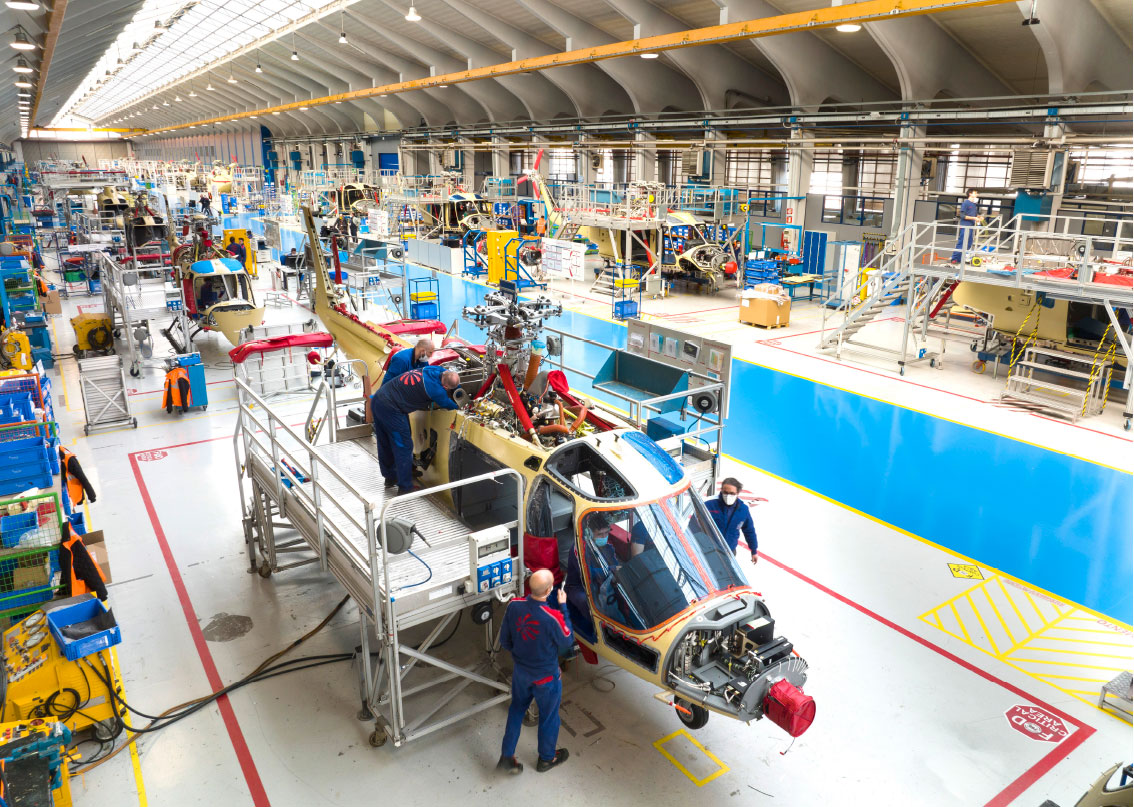
In the afternoon of the first day of the Leonardo Helicopters’ 2-day Press Tour event we toured the Final Assembly and Flight Lines of Leonardo Helicopters in Vergiate. During the Final Assembly Line tour we were able to see the industrial process that Leonardo helicopters have to produce its helicopters. The most important think that needs to be underlined is that Leonardo Helicopters produce customized helicopters, so all the helicopters in the Final Assembly Line are different, have a specific (customer unique) configurations. Leonardo Helicopter’s main plant in Vergiate, Italy, is the company’s primary production and flight test facility. At Vergiate, the AW109 GrandNew, AW109 Trekker, AW119Kx, AW139, AW149, AW169 and AW189 all come together and make their first flights.
In Vergiate, the assembly normally takes three months. But, when we move to the Flight Line the story is completely different because the customization comes out. Of course, there are all sorts of different customization and of course the more configuration you have, the more time you need to complete the helicopters. It really depends on what is the requirements of the customer and it can go to from a standard time of three weeks in the Flight line up to, months depending really on what is the requirement of the customer.
Leonardo utilizes digital manufacturing technologies at Final Assembly line in Vergiate. Due to confidentiality, we weren't allowed to take photographs at the facility, where tests are conducted for the production, assembly, and acceptance of military and civilian helicopters. We also saw the last batch of three AW119Kx Next Generation Advance Training Helicopters of the Turkish Army Aviation School Command at the Final Assembly (one helicopter) and Flight Line (two helicopters). Deliveries of these three AW119Kx Helicopters were completed in April 2024 and have been inducted into the Turkish Army Aviation School service in May 2024.
Another important thing that need to know about Leonardo Helicopters’ process is that the key parts of the helicopter, such as cables, pipes, hydraulics, blades, transmission and the structure, are mostly produced in their center of excellence in Italy. For example, the blades are built in Anagni, transmission is produced in Cascina Costa and the structure is produced by PZL-Świdnik – Leonardo’s subsidiary, and in Brindisi. The rest is a bought off the shelf. For example, the engine is P&W, GE or Safran, hardware/display avionics can be Rockwell-Collins or Honeywell while avionics software is developed by Leonardo itself. Most of the parts are bought, but the key parts of the helicopter are all produced by Leonardo Helicopters’ Center of Excellence. By this way, they keep the technology in a specific area, and manage the technology in specific all the time.
The Final Assembly Line (FAL) in Vergiate is planned over 6 stations for each model: larger aircraft stay for 7 to 10 working days in each position and then move on, while the smallest ones (AW109 family and AW119Kx) stay only 6 days each. Workers have a pre‐assembled construction kit with all the tools and instrumentation to fix in the helicopter on a certain day so they will not make any mistakes. All the instrumentation, as well the engines, are pre‐checked to be fixed without any issues or lost time.
Leonardo Helicopters produce helicopters, even if they are very different one from another, always within the same time. Thus, helicopters are kept in Final Assembly Line for a certain number of days and in different stations. For example, AW139 stays in the Final Assembly line for 48 days total and the helicopters are produced in 6 different stations of 8 days each (6x8=48). The AW139 has more or less 20.000 parts. So, 20.000 parts are being assembled at the Final Assembly Line. The AW189 is normally overall built in 60 days, 6 stations with 10 days each (6x10=60) so it’s a bit more than AW139. The AW169 stays 9 days in 6 stations (6x9=54) because it’s still a young product. They do better in AW139, even if it's bigger than the AW169 because they know it better. AW169 is still under industrialization improvement process. As of February 2024, Leonardo Helicopters Division has delivered approximately 1,200 AW139 helicopters to around 290 commercial and military users worldwide and the fleet accumulated over 4 million flight hours. Over 320 AW169s are on order today, with around 170 units delivered from the Vergiate Final Assembly Line to operators in over 30 countries. The global AW169 fleet has logged in excess of 170,000 flight hours in all kind of operations and conditions.
The global rotary-wing aircraft manufacturer Leonardo Helicopters delivered a total of 149 helicopters in 2022, and 185 helicopters in 2023, represents an increase of 36 units (a 24% increase) in the number of helicopters. Next year will be even more and the orders are going up. According to information we get during tour the total capacity of the Final Assembly Line is 130 helicopters per year. Half of it is AW139 and the others are more or less 15 AW189, 30-35 AW169 and the rest is AW101, 109 Family and 119Kx. In 2023 118 helicopters were delivered from Vergiate Final Assembly Line and in 2024 this figure will be increased to 131. During FAL tour we see that there were two lines of AW139 and they were working in two shifts of eight hours each and on Saturday mornings to do some extra hours.
Cascina Costa
On the second day of our visit, we first toured the facilities in Cascina Costa, which also serves as the headquarters of Leonardo Helicopters. Here, we learned about the Digital Simulation Laboratory (kind of a System Integration Laboratory) and the AW609 Tiltrotor Digital Development Simulator, which form the core of Leonardo Helicopters' Digital Twin design capability. These facilities were established approximately 2 years ago. Additionally, we received information from officials about the AW609 Tiltrotor Aircraft Program, which is currently undergoing flight testing as part of its civil certification process. Launch customer Bristow Group’s first AW609 was assembled in AW609 Final Assembly Line in Philadelphia, USA. More recently, Leonardo also announced the intention to open an Italian assembly line in Grottaglie.
Digital Simulation Laboratory is composed of two simulators, one is specifically used for the flight control system development and the other one is for the fly model development. Leonardo Helicopters use it for many purposes. Leonardo Helicopters started developing it five years ago. Digital Simulation Laboratory has more or less 12 computers and each computer could run almost 3 to 7 processors. Since it is a training-based simulation environment it is first used for pilot training and then it’s performance was customized, upgraded and enhanced in order to support the engineering development. Providing information about the Laboratory, the Leonardo official explained what he meant by 'engineering development' with the following words: “For example, for the flight control system, we develop a function, a new feature, or an update of our current function, and during the process of the development and testing of this function, we can make it testable for engineers. So, after they develop it, they can try it on the simulator and also, we can ask the pilots to fly the function before going in real flight.
One of the main features of the Digital Simulation Laboratory is the representativeness of the avionic systems. The same software that is flying in the real helicopters is also run at the simulators. Thus, concerning the functional representativeness, a high level of representativeness (almost 99%) is assured. So, the simulators’ functional behavior is the same as the helicopter.
In developing some functions like the automatic landing Leonardo Helicopters can save almost 20% of the flights because they can ask the pilots to come Digital Simulation Laboratory and fly before going into real helicopter. So, they can receive feedback earlier than in a normal way. Thanks to Digital Simulation laboratory they can also save time during engineering development. Because for example an engineer while developing a new function can come to Digital Simulation Laboratory and test it. Not wait for the real flight. The other main thing is that having a simulator for the engineering development means that they don't have a dependency on the real helicopters. There are too many constrains on real helicopters such as weather (if its rainy or it is too cold or too hot they cannot do the test that they want), maintenance, if the pilot is available or so on and so forth.
Since it is a virtual development environment, Leonardo Helicopters engineers reproduce 5-7 types of different helicopter such as 139, 189, 169, 609 etc. on the two simulators in the Digital Simulation Laboratory. According to the Leonardo Helicopters representative who gave us information about the Laboratory, in two-three minutes they can switch from AW169 to AW189. This means also that they can have a high level of synergy between models. “For example, if a component is not still available on the market for the 169 but the 189 has something similar in the simulation environment, I can use it for the 169. So, at least I can start the development. I can try all the configuration in terms of mass, CG, or payload of the helicopter and environment as well. I can set up clouds, low visibility, etc. We did it for example, for the automatic landing with the pilots so we can reproduce the low visibility conditions. So, we can receive very useful feedback from them in terms of what they expect from the helicopter during the automatic landing in the low visibility conditions. We try it here. It is safer. We did a lot more flights than in real life because its less expensive, cheaper. For example, in normal way to develop a function, we do 10 real flights. However, in simulation I can do 100 and its even cheaper than doing 10 so I can have more feedback in a better way, that's the main point,” he said.
Disruptive Technology in Air Transportation: The AW609 Tiltrotor
The AW609 Tiltrotor is built on the technological know-how obtained under the experimental tiltrotor XV-15 Program of Bell/Boeing Partnership, which was formed in 1996 to develop a civil tiltrotor aircraft. Boeing left the XV-15 Program in March 1998 and Agusta (now Leonardo Helicopters) joined the Program as a partner in September 1998. Following Agusta's involvement in the Program, the development of the aircraft named BA609 and carried out by Bell/Agusta Aerospace Company (BAAC), a Bell-Agusta Joint Venture company. During the 2011 Paris Air Show, in June 2011 AgustaWestland stated that it will assume full ownership of the Program, and in November 2011, all ownership of BA609 Tiltrotor Program was acquired by AgustaWestland. After purchasing the rights from its partner Bell, BAAC was closed and development responsibility was transferred to AgustaWestland Tilt-Rotor Company (AWTRC) in Arlington, Texas and the name of the aircraft was changed to AW609.
Combining the VTOL (vertical take-off and landing) capability of a helicopter with the speed and range of a conventional fixed-wing aircraft a tiltrotor is an aircraft that generates lift and propulsion by way of one or more powered rotors mounted on rotating shafts or nacelles located at the wingtips.
The AW609 is powered by two modified Pratt & Whitney Canada PT6C-67A Turboshaft Engines, each drives a three-bladed powered rotor and generates 1.940shp for normal operation and 2.492shp for 30 seconds under one-engine-inoperative (OEI) conditions. In the event of a single engine failure, either engine can provide power to both powered rotors (proprotors) via a drive shaft. The AW609 is also able to carry out a successful and safe autorotational landing from cruising altitude. The 9- to 12-seat AW609 Tiltrotor is able to take-off and land vertically like a helicopter but achieving higher speeds, altitude and range than a conventional rotary-wing aircraft. The all-weather tiltrotor AW609 is designed to fly at 270 kts and 25.000 ft. With an 18.000 lb maximum takeoff weight (MTOW), 6.000 lb+ useful load, and 750 nm range, the fly-by-wire AW609 is poised to change the face of civil aviation by giving operators a - huge speed and range advantage over a conventional helicopter. The AW609 can take off vertically at 16.800 lb weight. At the 18.000lb MTOW, a running takeoff would be necessary with nacelles tilted at approximately 75 degree. In the full helicopter mode (nacelles vertical), the AW609 can hover out of ground effect (HOGE) at 6.000 ft and in ground effect (HIGE) at 10.000 ft, both under ISA conditions. The AW609’s advanced Night-Vision Goggle (NVG) compatible Collins Aerospace’s Pro Line Fusion System avionics (first utilized on AC4), with three 14-inches touchscreen displays, enable greater situational awareness, while the fully digital, triple redundant fly-by-wire flight control system reduces pilot workload. The Pro Line Fusion System is also compatible with TCAS II, ADS-B, and the Rockwell Collins Multi-Scan Threat Detection Weather Radar, offered as a customer option.
Though the AW609 features the basic architecture of the V-22, unlike it, the AW609 is optimized for passenger safety and comfort and featured a cabin that soundproofed and pressurized to the aircraft’s 25,000 ft ceiling. Further, in the unlikely event both of the tiltrotor’s PT6C-67A engines were to fail, the AW609 can perform autorotational landings, since its proprotors generate much lower disk loading than those of the V-22, and, thus, the aircraft behaves more like a helicopter. In a 2009 test of a dual engine failure, an AW609 prototype’s pilots were able to carry out a successful and safe autorotational landing from cruising altitude. The AW609 can switch from helicopter mode to airplane mode within 8 seconds in an emergency situation, and in approximately 30 seconds in normal flight, depending on the flight speed, altitude and the load it carries. Even if one of the AW609’s engines stops during flight, thanks to the drive shaft located between the two engines, as in the CH-47 Chinook Helicopter, the power of the working engine is transferred to the disabled engine, ensuring that the propeller continues to rotate, thus providing a safe flight for the AW609.
Within the scope of AW609 Tiltrotor Program, the world’s first multirole tiltrotor program designed to be civil certified, Leonardo Helicopters manufactured 4 AW609 prototypes for the flight and certification tests. The first prototype (Aircraft 1, N609TR, designated AC1), which made its first flight on March 6, 2003 at the Helicopter Flight Test Center at Arlington Municipal Airport, Texas, and is used for ground testing in Italy, which includes endurance tests of the AW609’s rotor and drive system. The AW609’s drive system and five gearboxes have completed 30-minute run-dry testing successfully. The second prototype (Aircraft 2, N609AG) had been used for the development of new installations. It crashed and burst into flames during a maximum dive-speed test on October 30, 2015, over northern Italy, killing test pilots Herb MORAN and Pietro VENANZI. Following the comprehensive investigation of the accident the National Agency for the Safety of Flight of Italy determined that the test aircraft, during trials dictated by the FAA certification process, achieved a maximum airspeed of 306 knots (AW609’s Vne [never exceed speed] is 283 knots) before uncontrollable oscillations (similar to Dutch roll) forced the proprotors to deform and strike the leading edges of the wings, severing fuel and hydraulic lines and culminating in an inflight breakup. The third prototype (Aircraft 3, N609PA) is conducting engine-handling performance and load-level surveys in Philadelphia, US. It was utilized during icing and high altitude-high temperature certification tests in Michigan. The AW609 is said to be designed for flight into known icing conditions and meets the highest FAA requirements for both fixed-wing aircraft and helicopters including single-engine operation and autorotation. The fourth prototype (Aircraft 4, N609PH), built in Philadelphia in production configuration, made its first flight on December 23, 2019. As the last prototype and equipped with production avionics, the AC4 is used for mechanical-systems and avionics testing in Italy and conducts customer demonstrations. The AC4 is equipped with a new landing gear and a newly configured and widened cabin door. After discussions with EMS and SAR operators, the company enlarged the entry door on the starboard side to 35 inches and modified it from a side-opening configuration to a vertical clamshell door with an electric hoist mounted to the upper section, if required for the SAR role. The increased width allows a stretcher to be brought into the cabin using a winch and then rotated lengthwise. The winch is planned to be capable of lifting a 600-pound load. To provide more headroom in the cabin, the company lowered the floor. All of the prototypes are currently involved in the last stages of testing activities ahead of (Federal Aviation Administration) FAA certification. During our visit to Leonardo Helicopters’ Cascina Costa facility on January 30, 2024 we had the opportunity to see the AW609 prototypes AC1 (N609TR) and AC4 N609PH in the hangar. At the time of our visit, the N609PH prototype was being prepared for flight testing.
Within the scope of AW609 Tiltrotor Program, the first production AW609 (Aircraft 5, N609LH), made its maiden flight on October 13, 2022 at Leonardo Helicopter’s final assembly line in Philadelphia, US. Retained by Leonardo the AC5 was initially conducted ground-based certification trials, including indirect effects of lightning strikes and high-intensity radiated fields testing. Then it joined the ongoing flight-test certification program in Philadelphia. Both AC4 and AC5 are equipped with production avionics and are being used for demonstrators in their prospective markets. The final assembly of the second production AW609 (Aircraft 6, N609LE), the first customer aircraft (for Bristow Group), was also completed in 2022 at the Philadelphia facility and it was registered on August 4, 2022. As of January 2024, the production configuration has been frozen, with the second production aircraft due to join the test program during 2024. The AW609 Tiltrotor will enter into service with AC6, which is the second production configuration aircraft.
In 2015, AgustaWestland reported that one of the AW609 prototypes flown 721 miles (626 nm) from Yeovil in the UK to Milan, Italy in 2 hours and 18 minutes. In November 2021, Leonardo Helicopters flew AC4 (N609PH), the last prototype, but fully production representative, 2.550 nm from its facility in Cascina Costa, Italy, to the Dubai Airshow, UAE. It was the AW609’s first appearance in the region. On May 11, 2022 the global leader in vertical lift solutions and launch customer for the AW609 Tiltrotor in the United States, Bristow Group, participated in a sixty-minute demonstration flight in Philadelphia marking an important milestone as Leonardo and Bristow collaborate to introduce the AW609 aircraft into service. In March 2022 the AW609 user base was further expanded with the addition of an undisclosed long-established European operator of Leonardo Helicopters’ who will aim to introduce 4 AW609 Tiltrotor to carry out a range of passenger transport missions supporting its point-to-point operations worldwide. The AW609 Medical Equipped Cabin (EMS interior) mock-up was displayed for the first time at Association of Air Medical Services, which took place in Tampa, Florida, from October 24 - 26, 2022. The AW609 Medical Equipped Cabin can board up to 5 medical crew members and one patient on a stretcher. In October 2022, AC3 (N609PA) made the AW609’s National Business Aviation Association (NBAA) debut in Orlando, Florida, with a full-scale VIP/Corporate cabin mock-up on exhibit. In VIP/Corporate configuration the AW609s will be fitted for between 5 to 7 passengers, with options for Wi-Fi, a forward lavatory with a hard door, and a small galley. The lavatory seat will not be certified for take-off and landing. On February 22, 2023 pilots from the Federal Aviation Administration (FAA) flew the AW609 Tiltrotor for the first time. Performed in AW609 AC4, the production representative development aircraft, the flight was a pre-TIA (Type Inspection Authorization) activity. With the completion of this flight successfully the AW609 Tiltrotor Program moved forward to the final stage of the FAA certification process. During March 16-17, 2023 pilots from the European Union Aviation Safety Agency (EASA) flew for the first time the AW609. The flights took place in Cascina Costa, Italy were part of the first round of EASA’s familiarization activities for the AW609 Certification Program. In mid 2023, the FAA released the certification basis, another major step towards the type certificate.
As of July 2024, the AW609 Tiltrotor Program test fleet has accumulated over 1.900 flight hours in the US and Italy. The AW609 Tiltrotor entered the final stage of certification testing activities in February 2023 (with the flight of FAA pilots) and Leonardo Helicopters is hoping to complete all activities required for certification of its long-awaited AW609 Tiltrotor by early 2025.
According to Leonardo Helicopters the AW609 has a slightly higher procurement cost than a conventional helicopter in the same weight class, however, its operating cost will be lower than a helicopter in the same weight class, and it will also consume less fuel compared to a conventional helicopter in the flight to the same distance. The AW609 has strong interest around the world in all five mission sets: VIP, Corporate, Offshore, EMS, and SAR. Once certified, the AW609 Tiltrotor will be the first tiltrotor to enter commercial service. The aircraft can take off and land vertically, and carry up to 9 people in a pressurized cabin at twice the speed and range of a typical helicopter. Thanks to its rotorcraft-like versatility and airplane-like performance the AW609 will revolutionize air transport. In airplane mode the AW609 is extremely quite, even at low altitude, people on the ground do not realize it is coming until they see it.
Leonardo & Bell Signed an MoU to Bring Tiltrotor Technology into the European Market
During Heli-Expo 2024 on February 28, 2024 Bell Textron Inc., a Textron Inc. company, and Leonardo S.p.A., have signed a Memorandum of Understanding (MoU) to evaluate cooperation opportunities in the tiltrotor technology domain. Sharing a multi-decade history of industrial cooperation on both traditional helicopters as well as tiltrotor technology collaboration Leonardo and Bell have teamed to explore cooperation in a bid to bring tiltrotor helicopter technology into the European market. “The cooperative effort will begin in earnest with the NATO Next Generation Rotorcraft Capability (NGRC) Concept Study #5, where Leonardo will take the lead on a tiltrotor architecture proposal with Bell in support,” they said.
NATO’s NGRC Project aims to develop replacement solutions to fill capabilities of medium multi-role helicopters currently operated by Allies that will reach the end of their life in 2035 to 2040. Under that program, rotorcraft OEMs are being challenged to lever- age recent advances in technology, production methods, and operational concepts in developing these new aircraft.
“This cooperative effort between Bell and Leonardo reflects our shared vision that next generation rotorcraft will be influenced by the speed, range and maneuverability only tiltrotor technology can deliver,” said Lisa ATHERTON, Bell President and CEO. “We are proud to deepen our relationship with Leonardo as we continue to explore emerging vertical lift programs in Europe and the United States.”
Gian Piero CUTILLO, Managing Director of Leonardo Helicopters, said “We’re thrilled to evaluate new joint efforts for the next generation of rotorcraft technologies, based on our solid and shared view of the unique advantages of tiltrotors. Leonardo has always firmly endorsed tiltrotor technologies to meet evolving rotorcraft requirements, even more so as new needs emerge in the market.”
In February 2024, the U.S. Army has announced the cancellation of the Future Attack and Reconnaissance Aircraft (FARA) Program, which covers the procurement of a high-speed aircraft that would fill the armed scout role left vacant by the retired OH-58D Kiowa Warrior. Despite the dramatic upheaval impacting FARA, its sister Future Long Range Assault Aircraft (FLRAA) Program is continuing as planned, with the Bell V-280 Valor is set to inducted into service in 2030. Bell’s US Army’s FLRAA Program win in December 2022 with the V-280 Valor tiltrotor provides validation for Leonardo’s investment in the civilian AW609. Bell was initially awarded the FLRAA contract in December 2022, selected over the Sikorsky-Boeing Defiant X. However, the Sikorsky-Boeing team subsequently protested to overturn the decision, but this was denied by the U.S. Government Accountability Office in April 2023, giving Bell the green light to push on with the Program. The choice of the Bell V280 Valor for the U.S. Army’s Future Long-Range Assault Aircraft (FLRAA) Program is a clear evidence that there is a growing acceptance of the operational advantages offered by tiltrotor technology. Indeed, Leonardo sees also growing interest for the AW609 also in the government market, including the Italian one.
AW609 Successfully Completes Its First Ship Trial Campaign
The AW609 tiltrotor program set another major industry capability milestone after its first successful ship trial, which was recently conducted with the support of the Italian Navy. During April 3-12, 2024, the AW609 AC4 aircraft, fully representative of the final production configuration, performed demonstration trials relocating from Leonardo’s facility based in Cascina Costa (Samarate) to Maristaer Grottaglie Naval Base. The tiltrotor, with test pilots and flight test engineers from Leonardo (supported by Italian Navy personnel for the embarked operations), took off from the base inbound from the Italian aircraft carrier (ITS CAVOUR – Italian Navy Fleet Flagship), 20 nm offshore, showing its effective approach, stable deck landing, and touchdown capabilities.
During the demonstration, the AW609 provided a unique opportunity to further strengthen the awareness of the outstanding advantages of Leonardo’s tiltrotor in a dedicated maritime environment. This testifies how the world’s first tiltrotor set to achieve a civil certification meets demanding operational and safety standards. Therefore, it is ideally positioned to meet a range of government and public service needs, in Italy and globally.
The demonstration trials are the latest step taken under the activities carried out by a joint working group established in 2022 including Leonardo, the Italian Navy, the Italian Army, and Guardia di Finanza (Italy’s Customs Police).
Following the first ship trials campaign, Leonardo will start a detailed evaluation and analysis of the collected data. These would allow possible follow-on trials to better refine approaches as well as drive further platform enhancements to operate in the naval/embarked environment