From TEMPEST to Global Combat Air Program
On July 16, 2018, United Kingdom (UK) Ministry of Defense announced its Combat Air Strategy. The document outlines the framework, strategy and necessary steps to be taken by the UK for air dominance in the coming decades. Among the key elements of the strategy are the improvement of the Typhoon fighter, development of the Future Combat Air System (FCAS) Technology Initiative, establishment of new international partnership programs to meet future requirements and challenges. The strategy document focused on the air component, describing it as "...an aircraft, manned or unmanned, whose prime function is to conduct air-to-air and/or air-to-surface combat operations in a hostile and/or contested environment, whilst having the ability to concurrently conduct surveillance, reconnaissance, electronic warfare and command and control tasks."
On the same day of the announcement of the Combat Air Strategy, at the Farnborough Air Show, the Tempest program was unveiled by the BAE Systems.
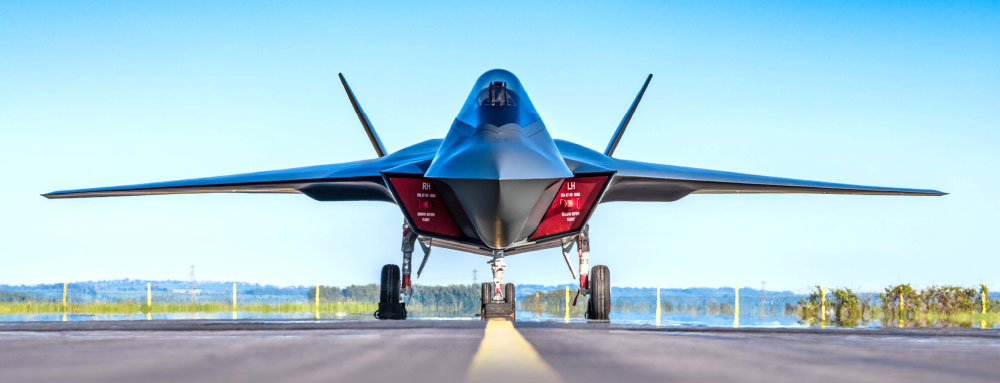
The Tempest was introduced as a "sixth generation fighter" incorporating several novel technologies and concepts such as deep learning Artificial Intelligence (AI) assisted control, ability to fly fully uncrewed, ability to control swarming drones and swarming precision guided weapon systems, a fully Virtual Reality (VR) cockpit embedded into the pilot's helmet, and capability to use hypersonic weapon systems.
The project was introduced as being run by the Team Tempest, led by BAE Systems as the main contractor and integrator, with other companies such as Rolls-Royce responsible for the engine and power systems, MBDA responsible for the weapon systems, Leonardo developing avionics and sensors.
International Cooperation
In July 2019, the UK and Sweden signed a memorandum of understanding (MoU) for cooperation on the development of a sixth generation combat aircraft. Despite the MoU, Sweden did not become a formal member of the Team Tempest, instead it participated in the efforts in devising the Combat Air Strategy.
The first nation to be formally involved in the Tempest project is Italy. The government of Italy announced its intention in becoming a member of the Team Tempest in 2019. A Statement of Intent (SoI) document was signed between the companies of the two countries in September that year. UK Defense Secretary Ben WALLACE announced in July 2020 that General Electric UK, GKN, Collins Aerospace, Martin Baker, QinetiQ, Bombardier (later to become Spirit Aerosystems) and Thales UK joined the Team Tempest, together with a number of small and medium sized companies and academic institutions. More than 600 companies and institutions across the UK are engaged in the Tempest programme.
On December 21, 2020, a trilateral MoU was signed by the UK, Italy and Sweden, named Future Combat Air System Cooperation (FCASC), to define the general principles for cooperation on an equal basis. This was followed by the start of the Concept and Assessment phase of the project on July 29, 2021, with BAE Systems being awarded a £250 million contract. In August of that year, Italy announced its plans to invest in €2 billion to the project by 2035, with the first instalment of €20 million being allocated for 2021. In the July 2022 Italian defense budget, the development of the fighter was accelerated with Italy now budgeting a spend of €220 million in 2022 and €345 million in 2023, with a forecast total investment of €3.8 billion by 2036.
In December 2021, the UK and Japan announced joint development of an engine testbed, followed by an announcement in February 2022 on the development of a next generation fighter aircraft radar demonstrator named JAGUAR (Japan And Great Britain Universal Advanced RF sensor), to be developed by Leonardo UK and Mitsubishi Electric.
Japan's involvement evolved into the merging of the Tempest and Japan's own F-X projects into an umbrella program, designated as the Global Combat Air Program (GCAP) at the end of 2022.
Global Combat Air Program
On December 9, 2022, the governments of Japan, the UK and Italy announced that they would cooperate on the development and production of a sixth-generation combat aircraft, merging the Tempest and the F-X projects. The GCAP is envisaged as an equal partnership between the member nations. In the UK, BAE Systems will act as the prime contractor and be responsible for the airframe, Rolls-Royce the engines, Leonardo's UK division the electronics, and MBDA UK the weapons. In Japan, Mitsubishi Heavy Industries will act as prime contractor, with IHI Corporation handling the engines, and Mitsubishi Electric handling the electronics. In Italy, Leonardo will be prime contractor, with Avio Aero working on the engines, and MBDA will also work on missile development.
Tempest Design Characteristics
The Tempest incorporates a modular, flexible design, being able to be adopted to various mission profiles as well as technological requirements and developments. The aircraft has two engines with delta wings and angular vertical stabilizers and no horizontal tail surfaces. Among the state-of-the-art technological features of the aircraft are deep learning AI assisted avionics and mission systems, a virtual cockpit, capability to operate directed energy weapons, fully automated, AI-assisted ground handling and maintenance operations and ability to share real-time data of large volumes with all other friendly ground, air, sea and space assets.
During the Farnborough Air Show in 2022, Rolls-Royce revealed the Orpheus engine project. The company stated that the Orpheus, a twin-spool design, was developed in under two years, with two experimental engines being manufactured and successfully tested. Rolls-Royce utilized innovative engineering techniques, such as the use of Additive Layer Manufacturing (ALM). The Orpheus is expected to become the core of the engine component of the Tempest.
Leonardo is working on an integrated sensing and non-kinetic effects (ISANKE) and integrated communications system (ICS) for Tempest. The company formed a partnership with Mitsubishi Electric to work on the development of JAGUAR sensor technology, which is expected to be used in the development of ISANKE and ICS for the Tempest programme. ISANKE will provide a sensor network across the airframe. It is expected to unlock the potential of sixth generation sensors by shifting from distinct equipment to integrated systems. ICS will enable the connection of the ISANKE system into the wider system-of-systems within the FCAS.
Program Future
The maiden flight of the Tempest aircraft is planned to take place in mid 2020s, with an anticipated service entry in mid 2030s. The Royal Air Force (RAF) describes the Tempest as "the next generation combat aircraft, operating at the cutting edge of technological innovation and securing the UK's position as a global leader in combat air". According to RAF, the Tempest will replace the Typhoon from 2035, operating together with the F-35 Lightning II.
It should be noted that the three GCAP partners are also operators of the F-35 Lightning II. This means that these nations will form their air forces around the duo of F-35 and GCAP in 2030s. The F-35 is the backbone of the US-led Atlantic combat air alliance, whereby the GCAP will be the tip of the spear of a US-assisted, UK-led alliance