Revolutionizing Design and Collaboration for Aerospace and Defense with Immersive Engineering
Today’s aerospace and defense (A&D) companies must function in a highly complex environment with stringent regulatory requirements and industry standards, specific customer and product specifications, and pressures to improve production schedules and cost efficiencies. Driven by technological advancements and the relentless pursuit of innovation, the A&D industry is experiencing rapid evolution. According to Deloitte Insights 2024 aerospace and defense outlook report, A&D leading companies are embracing digital transformation to optimize product development, enhance operational performance, and seize business growth opportunities despite supply chain, costs and workforce challenges.
To remain competitive and efficient, many A&D companies recognize the need to modernize their processes and tools, in pursuit of their digital transformation journey by integrating cutting-edge digital technologies. One of the most promising developments is immersive engineering, which is gaining traction for its ability to deliver highly advanced interactive solutions for engineering. To accelerate the digital transformation journey, A&D companies are seeking solutions that can help them foster even more collaborative environments where engineers from different disciplines around the world can work closer than before. But what exactly is immersive engineering, and how can it revolutionize the A&D industry?
Immersive engineering leverages technologies such as virtual reality (VR), augmented reality (AR), and advanced simulations to create engaging and realistic environments where engineers can visualize, manipulate and test their designs in unprecedented ways. By transforming abstract concepts into tangible experiences, immersive engineering allows for more intuitive and collaborative problem-solving. Engineers can immerse themselves in virtual prototypes, explore complex systems from multiple perspectives and simulate real-world scenarios with high fidelity. For A&D companies, this advancement delivers on the anticipated promise of 3D and VR that can facilitate better collaboration among companies in realistic, scalable environments. Immersive engineering not only enhances the precision and creativity of the design process, but also continues to reduce the time and cost of these methods.
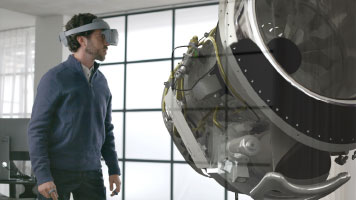
Historically, A&D engineers have invested countless time and efforts into designing intricate aircraft systems, laboring over every detail without truly grasping the sheer scale of their creations, until they see them built. All of this changed the moment they put on a VR headset. Suddenly, engineers are finding themselves standing next to a life-size wing, experiencing their designs in a shared virtual reality space as if they were physically present. This is not just a technical breakthrough; it is a groundbreaking moment for engineers that promises a new profound new understanding of their work. This immersive experience enables closer interactions within the design team, driving innovation faster than ever before. Engineers can now collaborate in a more hands-on manner, visualizing the final product with greater clarity and confidence.
Working in a shared virtual environment saves countless hours and reduces the need for physical prototypes, minimizing guesswork and costs. This technology provides peace of mind, knowing that when the physical prototype is finally crafted, it will align perfectly with the design intentions. By adopting immersive engineering technology, engineers are seeing their designs finally come to life in VR, which is incredibly rewarding, offering insights and perspectives that were previously unimaginable. This advancement in technology provides a transformative experience that deepens the connection to the engineering team’s work and propels innovation.
Immersive engineering capabilities allow teams to interact with the highest fidelity digital twins, capturing the product, its in-service function and behaviors, manufacturing process and production lifecycle. Multidisciplinary optimization (MDO) technologies combined with immersive engineering capabilities are helping engineers solve real-world problems faster, achieve design for sustainably, and develop products with greater efficiency to turn new ideas into industry-changing innovations.
Immersive engineering provides a wealth of possibilities
Companies that adopt immersive engineering can realize numerous possibilities for the A&D industry, including more dynamic collaboration across geographically dispersed teams, accelerated development cycles and enhanced training and simulation for complex systems. Engineers can engage with design models in ways that were previously impossible to improve the quality of final products with digitalization technologies for immersive engineering.
The Siemens Xcelerator portfolio provides a suite of advanced software and hardware integrations that create a 3D immersive environment connected to physics-based design tools. Siemens offerings enable engineers to leverage virtual environments for more efficient and effective project execution, including solutions like the industry-leading NX™ software, specifically Siemens NX Immersive Designer.
Part of Siemens NX Immersive Designer includes Sony’s spatial content creation system combined with Siemens Xcelerator software portfolio. This includes the XR head-mounted display with high-quality 4K OLED Microdisplays and controllers for intuitive interaction with 3D objects. The new solution provides high-quality, realistic renderings so designers and engineers can create and explore design concepts in a borderless immersive workspace to innovate in the industrial metaverse.
“At Sony, we are passionate about empowering creators with cutting-edge technologies, and in the field of spatial content creation, we have thrived in innovating the way they work by utilizing our proprietary motion and display technologies,” says Yoshinori Matsumoto, Executive Deputy President and Officer in charge of Technology and Incubation for Sony Corporation.
Natilus: immersive collaboration success with Siemens
Natilus, a California-based aviation and aerospace component manufacturing company, designs tailor-made autonomous cargo aircraft to transport goods more sustainably and cost-effectively, reducing the cost of airfreight by 50 percent through smarter design and materials. As the world’s first autonomous air freight transport provider, Natlius implemented Siemens Xcelerator software tools to help design large yet sustainable aircraft. “Natilus today is very engineering heavy. We have 15 engineers on staff, and all of them use NX," says Aleksey Matyshev, CEO of Natilus.
A key challenge for Natilus is showing customers the exact breadth and depth of the products they are building. Although Natilus engineers can see individual pieces in the hangar to develop a partial idea of the design, putting it all together using an immersive engineering environment helps customers understand the entire design at scale. Siemens immersive engineering capabilities are portable and functional, enabling Natilus to travel to customers and prospects so they can experience virtually generated aircraft designs firsthand. “This type of technology is part of our story to help make those sales and keep conversations with customers really energetic,” says Matyshev.
Natilus has realized success with Siemens Xcelerator software tools and immersive engineering and announced advanced purchase commitments exceeding $6 billion for over 440 aircraft. To view the Natilus team and its use of Siemens immersive engineering, watch the YouTube video: Siemens and Natilus | An Immersive Engineering case study (youtube.com).
The future of immersive engineering for the A&D industry
A&D companies can achieve a transformative and promising future for aerospace engineering with the convergence of AI, VR and advanced simulation technologies. Drawing inspiration from the immersive experiences of the 3D gaming world, these cutting-edge solutions will revolutionize how engineers design, test and refine aerospace systems. These same compelling, interactive experiences that captivate gamers are now accessible for engineers and provide unprecedented levels of detail, accuracy and engagement with physics-based design tools.
Immersive engineering now offers a promising prospect for renewing interest in aerospace and defense (A&D) careers among STEM students. Today's students who have grown up with VR and immersive gaming platforms can transfer their passions and skills seamlessly into the field of aerospace engineering. This new wave of immersive engineering technology will be a key game-changer to address the workforce gap, attracting a new generation of talent to drive the industry forward. The promise of immersive engineering is not just in its ability to enhance current capabilities but in its potential to inspire and cultivate the next generation of aerospace engineers. By leveraging immersive engineering, the A&D industry will be better positioned to navigate the complexities of digital transformation, achieve higher levels of optimization, and bring innovative products to market more quickly and efficiently .
Siemens Todd TUTHILL – Headshot & Bio
Todd Tuthill is the Vice President for Aerospace and Defense Strategy and Marketing at Siemens Digital Industries Software. Todd’s engineering background is in systems design with functional engineering and program leadership roles and a strong vision for digital transformation. His 30+ aerospace leadership career spans McDonnell Douglas/Boeing, Moog, Raytheon, and Siemens. His experience encompasses all aspects of A&D programs, including design, model-based systems engineering, software engineering, lean product development, supplier/partner management and program management. In his role at Siemens, he is a passionate advocate for the advancement of digital transformation across the A&D industry.